Book Review and Thank You Letter: Frostbike by Tom Babin

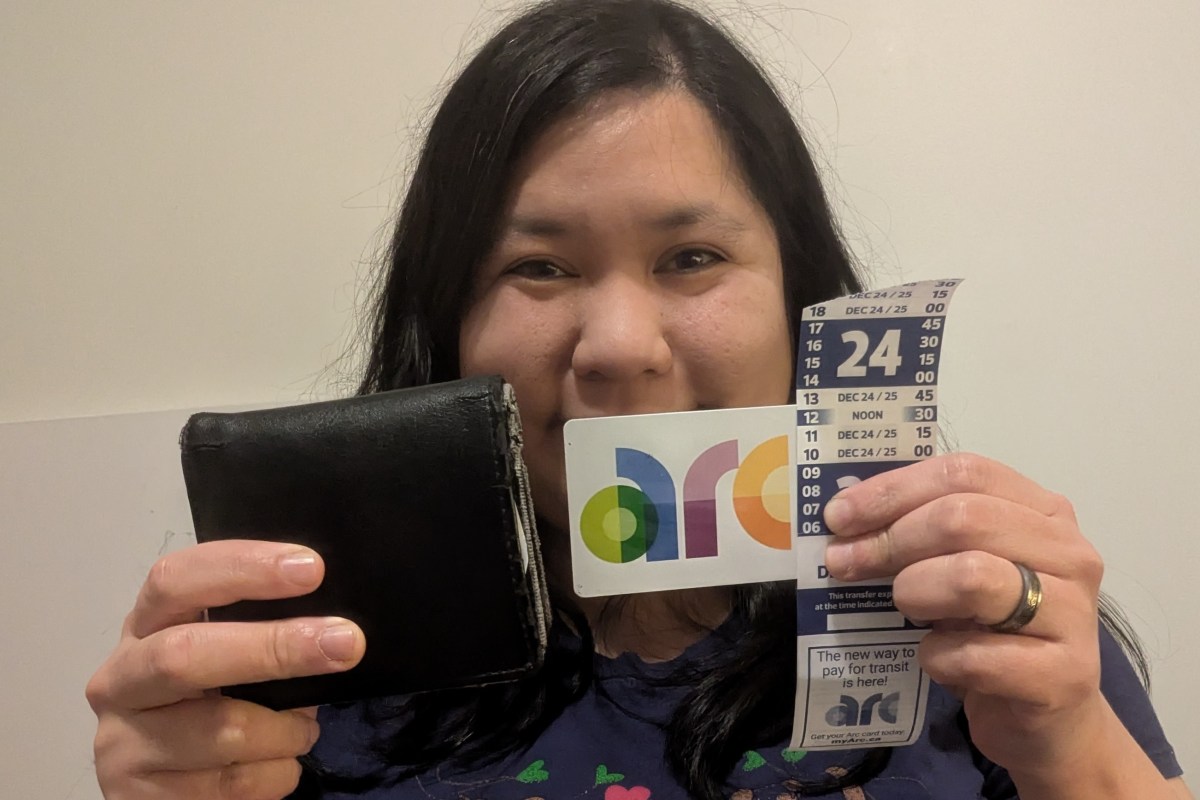
Giselle holding the book Frostbike. Her husband's bike is behind her.

By: Giselle General

A few weekends ago, I visited someone near my home to talk about different neighbourhood things and the upcoming election. That late morning visit was lovely and veered into a conversation about winter cycling, something my husband just started to do in 2024 when the snow hit. As a result, she enthusiastically offered to lend this book that I immensely enjoyed. So to this neighbour, who also gave me a sample pack of roibos tea from a local tea shop, this is a Thank You letter and review of the book Frostbike, the Joy, Pain and Numbness of Winter Cycling, by Tom Babin.


April 19, 2025

Hi neighbour,

That winter morning was frosty, but my hands felt better right away from how you welcomed me to your home, with a cup of tea. The great conversations about my post the day before about someone wanting to organize an English-learning initiative for newcomers in the neighbourhood was even lovelier. As we chatted about different matters, the inevitable half-complaints about winter came up. Then I shared that my husband tried biking to work once a week since the summer, with this season being his first time winter biking.

I was so delighted that you were delighted to hear about this, and shared all your experiences biking from your neighbourhood all the way to the core of downtown. I appreciated your observations on your experiences as a cyclist and how the service roads, sidewalks, shared-use paths and the dedicated bike lanes affect your ride. That you were looking forward to the warmer weather since you are quite faster on the bike then driving at times. So, when you enthusiastically offered to lend me the book Frostbike for my husband to read, I happily took in home.

The thing is, my husband is a digital book reader these days. He’s quite happy with the app from our local library and been reading books regularly. So I ended up being the one who read the book. The fact that the author in Canadian, and Albertan at that, was a particular draw to me. This is not someone who lives overseas – this is someone with relatable and relevant experience, who lives only a 4-hour drive away.

I liked the way the table of contents was outlined, and how the information and stories started growing in scope. Starting from his personal journey of biking, building and acquiring bikes to help him get cycling in winter. Then the second part is about his assessments of locations, both local and abroad and their winter cycling infrastructure. Then the final part went even broader, the collective thoughts, sentiments and culture not just about cycling, but about winter in general.

Perhaps because I haven’t had a lot of exposure to writing based in Calgary – whether it is fiction, non-fiction, or journalistic, the book gave me the very first deep explanation of the chinooks. It went in detail how that weather phenomenon affects people who live there – from huge migraines from temperature and air pressure changes, to the drastic change from ice and snowbanks to deep watery cold puddles on roads and sidewalks in just a matter of hours. I mean, I’m not a fan of being splashed by cars when I’m on the sidewalk, I can only imagine it being worse down there.

The author’s experiences with biking in the winter reflected what my husband shared to me these past few months. That compact snow is ideal. Ice is more manageable that some would assume. Studded tires make a huge difference. Soft snow and slush is the worst, even more when they are combined with bits of mud, sand and gravel. Putting salt can be described as “the devil you know”, very useful for traction, but damaging in many other ways. Biking at -20 or -30 weather is more doable than anticipated. That car drivers being impatient and hostile is one of the worst things about cycling. And yes, the way infrastructure is laid out plays a very big role in how pleasant or save the bike ride could be. I’m so grateful though that my husband got actual studded tires right away. I definitely would not let him get away with the author’s first attempt at using flat screws on a conventional bike wheel. I do a lot of DIY stuff, but that’s too far. As I always say to my husband – safety first!

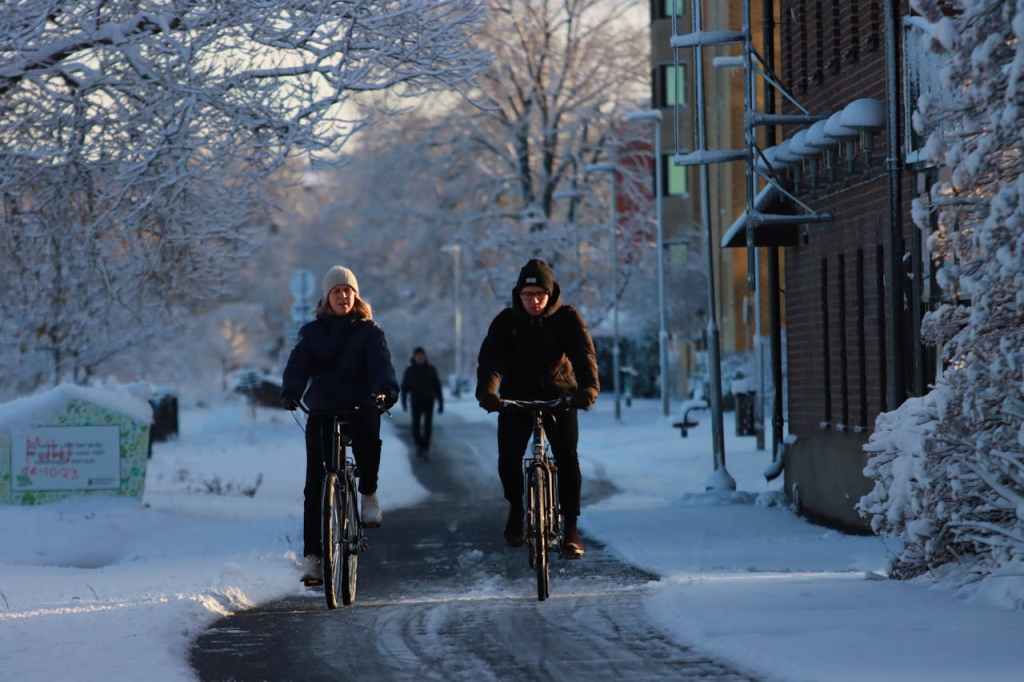
Two people biking on a bike path in winter. Everything, except for the actual bike path, is covered in snow.

The section that talked about the different cities in Europe that have enviable cycling infrastructure was fascinating to read. I empathize with the author’s struggle with not finding the perfect ‘silver bullet’ solution that can be easily copied over to North America, especially in cities that are much bigger compared to the smaller Scandinavian cities. A common pattern is those European cities is the practical normalization of biking all year long, which makes the seasonal switch to winter biking more manageable. The cities described made me realize the truth of the advocacy statement I’ve heard so many times here in Edmonton: build it and they will come.

As someone who doesn’t cycle, the chapters of the last section resonated with me the most. The author started to probe deeply on how pop culture and casual interpersonal interactions over the decades talk about winter so negatively. This I completely agree, and I find a bit frustrating. The pity that people cast towards me when I said “I walked less than half an hour to get here” is so intense. Music, media, TV, movies and songs definitely portray winter as harsh, relentless and something to escape from.

He argues that our negative impressions of winter are holding people back from something positive (or even practical) like winter cycling. I’d say that it is also holding people back from doing even just short walks in the winter! As an immigrant, I have had enough stories and warnings about how awful winter is, so this definitely tracks.

Edmonton had an initiative now for a few years called Winter City Edmonton, to encourage people to seek out interesting and exciting activities to do during winter, such as the winter festivals. And this year, the encouragement also had a different direction, to get people to do more of the typical fun activities but with a winter twist, such as going to a restaurant with a winter patio. I think that the next step should be encouraging doing everyday transportation while being prepared for winter, not wanting to escape it as quickly as possible. With heated cars (that even have heated seats and heated steering wheels), well-insulated buildings, and high-tech cozy winter wear might have contributed to people rejecting the notion of winter altogether, rather than having a practical mindset of it being a regular part of the day. This is what is needed to encourage people to have infrastructure to make walking and cycling manageable all year long. To quote the book when talking about cycling in those European countries “I found a similar practicality: winter didn’t seem to be the enemy, it just was.

I really enjoyed this opportunity to learn from a long-time winter cycling enthusiast what my husband went through, and what the passionate folks in the city are talking about. I know in a few years I would consider getting a bike again, but for now, I feel more informed in understanding where people are coming from, as far as the other transportation methods that don’t involve the car.

So thank you! I hope your biking this year, now that the snow is gone and I think we are past the second “false spring” is going well so far. Maybe my husband will see you on the trails or roads, and perhaps I also will in the future. I bet that if the Coffee Fridays YegBike community has a book club section, they would talk about this book. It’s safe to say, they probably already had.

Who To Call for Help? You Don’t Know?! – Captive Transit User Series Part 17

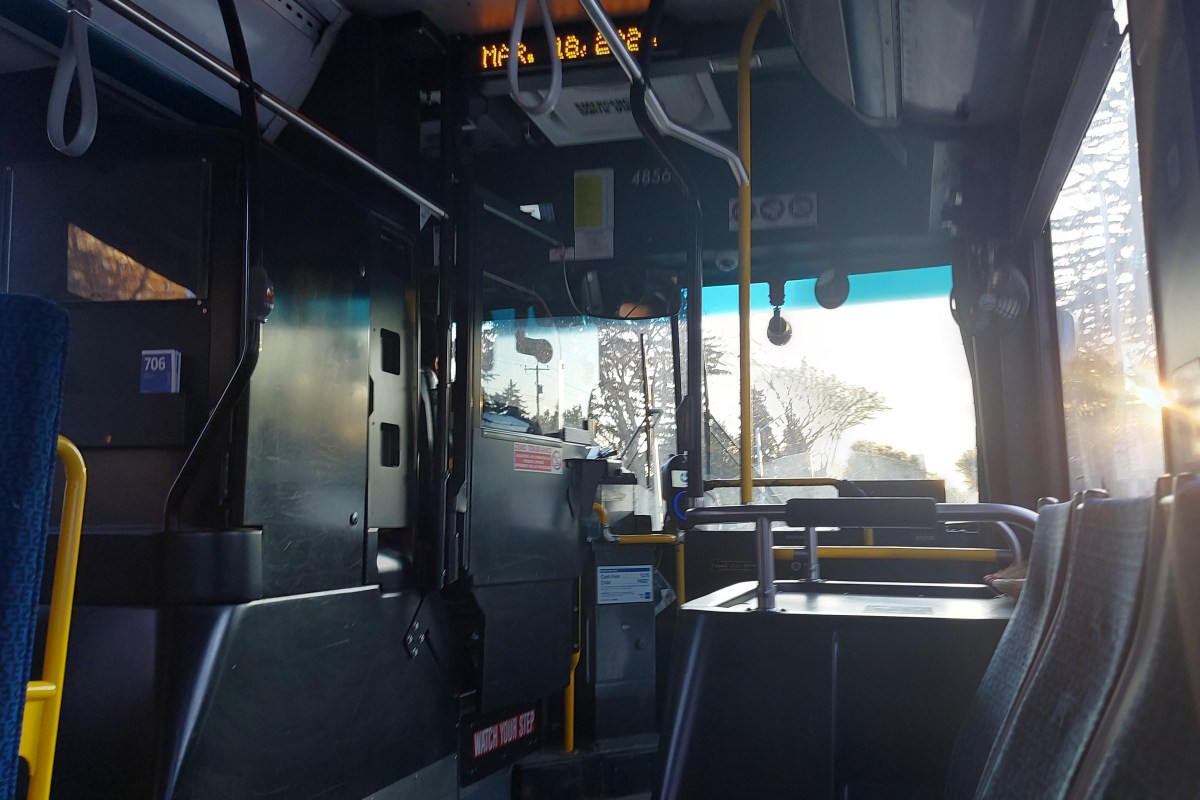
The inside of the regular sized Edmonton transit bus. The front area near the driver's compartment has no information or printed signage about the Transit Watch contact line.

By: Giselle General

This is part of an ongoing series of posts discussion issues I personally encounter while taking public transit in Edmonton. Links to other posts will be added on an ongoing basis:

What is a Captive Transit User? I learned about the term for the first time from the City of Edmontonโ€™s website. The easy definition is: someone who takes public transit because itโ€™s the best (or only available) option for them to travel around. The part about feeling โ€˜captiveโ€™ comes from the restriction that sometimes comes up, perhaps because one is too poor to own and maintain a vehicle, one does not know how to drive, or for medical reasons, cannot operate a vehicle. In many ways, I relate to this a lot. Though Iโ€™m pretty fortunate to afford the occasional taxi ride, and with my husband having a car.


In my first few years in Canada, I had to learn how to keep track of all the different phone numbers, watch lines and apps for reporting different issues. In fact, because I knew that this can be confusing for other people, I’ve written a resource articles on this subject a few times for multicultural media outlets in the city. It can be hard to tell right away what constitutes an emergency. When someone is in the middle of an unsafe situation, regardless of whether someone’s bleeding or not, everything seems urgent.

Frankly this is why I have major concerns that the information to ask for help when taking transit can be hand to find. If my personal feedback can be summarized in one word, that would be consistency.

Consistency on where the information can be found, both on the buses and LRT vehicles, would be handy. When I used to take the LRT more frequently, I eventually trained my eyes on where the emergency buttons and alarm strings to ask for help are located. I’m too short to reach the alarm strings – but that’s a different subject altogether. Also, on a 25- minute trip which is typical for my travels, there had been the rare occasion when the same automated robot voice that announce the next LRT stop would also talk about Transit Watch, the phone number where people can call or text if they feel unsafe.

But unfortunately, for those who take the buses, this information is definitely hard to find. On top of the fact that Transit Watch is actual full 10-digit phone number instead of the 3-digit ones like 911 or 311, so it’s not something that people will instinctively remember and dial. I mean, even I don’t know the full number in my mind, but I had saved it as a contact on my phone. In my experience, upon entering a bus, 75% of the time I don’t see any posters about Transit Watch at all. When it does, the posters are in different parts of the overhead compartment for the posters.

In my typical 30- 45 minute bus trip, I don’t hear a single robot-voice announcement about Transit Watch as well. Back in 2023, Edmonton Transit Service had a marketing campaign encouraging people to take one of six potential actions when they see harassment while taking public transit. These posters were in many of the buses but not as much these days. Although I was relived to see it a dozen times so far this year.

Inside an Edmonton transit bus, with a poster about Transit Watch 780-442-4900.

In transit stations, not all of them have a PA system to blast audio announcements. In the places that do, one of which is the South Campus LRT station, I have heard a few robot-voice announcements for different topics, including bus delays, scheduling changes, and even encouraging participation on Stuff A Bus. I have heard a handful of times about Transit Watch. But how about other locations? Sure, it is a temporary station, but I think it’s important to have more visible signs and reminders at West Edmonton Mall transit station for example. It truly would be nice to have a consistent approach in every transit station.

I have taken bus trips with the smaller community buses as well, and I don’t recall seeing a poster about Transit Watch. It’s been a few months since I have taken an On-Demand buses which are much smaller, and I know there’s no space there for paid advertisement or even a small bulletin board. Perhaps a decal or sticker somewhere prominent can be strategically placed somewhere. Or maybe even a QR code that’s quite popular these days.

The inside of the smaller-sized Edmonton Transit bus, the shuttle bus along Jasper Place Transit Centre. There is no poster for the Transit Watch number because there's no good space to put one.

Consistency builds trust. I think if there’s more consistency in communicating that 1 – harassment is not okay , 2 – reporting unsafe situations when taking transit is truly worth the effort, 3 – the contact number is repeated often enough while people are taking transit that they might eventually memorize it, and 4 – that the person who reported can see the resolution, perhaps people could be more understanding about unpleasant situations about taking transit. I agree with what the City officials had said that majority of public transit trips happen successfully, on time and no issues. But for the times when it does, people need to trust the system for reporting and the response to it. This starts with knowing when and how to report.

Support Canadian With Your Patronage and Pocketbook: Repost from Alberta Filipino Journal

Giselle holding a computer table showing the page "Made in Canada: by Canadians, for Canadians"

By: Giselle General

I am a columnist for two newspapers in Alberta that serve the Filipino community. I feel particularly proud of this one because of the timely topic and integrating ideas beyond making shopping decisions. This was published in February 2025. You can get a free copy of the paper, published monthly, from many Filipino-owned businesses in Edmonton. You can also view everything digitally at www.albertafilipinojournal.com/.


Community Resource Article โ€“ Support Canadian with your Patronage and Pocketbook

Many of us have heard about impending tariffs by the United States. Because of this, thereโ€™s a boost to โ€˜Buy Canadianโ€™ more than ever. You might be wondering how you can take part, especially if you have a tighter budget, or have gotten use to the popular options.

Supporting Canadian businesses comes in many forms. It can be as hyper-local as using products and services made in our city, prioritizing art or events made by fellow Canadians anywhere in the country or not spending money at all. Below is a list of ideas you can consider, to have more Canadian in your everyday activities and purchases.

Media and Entertainment

  • CBC Gem: You can create a free login on your computer or Smart TV and watch news, shows and movies produced in Canada through our public broadcaster.
  • TELUS STORYHIVE: This special program funds content made by locals in Alberta and BC, such as short-form documentaries on community topics, podcasts and vod-casts, mini-series, and more. My documentary about Filipinos in Edmonton is funded through this and thereโ€™s lots of great shows to watch. Itโ€™s on Telus Optic TV and YouTube.
  • Accessible Media Inc. Canada: It is a dedicated channel created about, and by, Canadians with disabilities. Thereโ€™s so much inspirational and well-produced content to watch.  You can create a free login on your computer or Smart TV or watch on YouTube.
  • CKUA Radio Station: This radio station, with a webpage and app, is based in Alberta and showcases music from all over the world, a great way to break way from Hollywood-produced music.
  • Filipino-Canadian content: There are many kababayans countrywide that produce content and itโ€™s time to them to our lists. Whether it is the Whatโ€™s the Tsismis podcast, the many vloggers on YouTube, documentaries Paglalayag, Canadian Adobo and Kalinga,  or books such as Magdaragat, Reuniting with Strangers, Tonyโ€™s Wheels, and more.

Consumer Goods

  • Made in Canada directories: Webpages can identify products made in Canada, which can help with your shopping. Some of these are: madeinca.ca as well as madeincanadadirectory.ca.
  • Bulk Barn: This is a great store where you buy items by weight, such as flour, rice, spices, pasta, candies, and more. If can save more money than buying in small packages, and itโ€™s Canadian.
  • Farmers Markets and Pop-Up Markets: There are indoor farmers markets and pop-up markets hosting local businesses. They even give a chance for ones that have closed to come back in a different way. For example, Intent Coffee, a cafรฉ by Filipinos in Edmonton, has returned as a pop-up cafรฉ.
  • Cultural Stores: If you continue to support these stores, whether the products made by a kababayan locally, imported from the Philippines, an Indigenous creator, or a multicultural market by fellow immigrants in Canada, that certainly counts as a way to support.
  • โ€œBuy Nothingโ€ Neighourbood Groups: Instead of buying an item right away, perhaps a neighbour is giving it away for free. Connect with your neighbourhoodโ€™s Buy Nothing Facebook page and see if you can get the item you need. Itโ€™s a great way to save money, help the environment, and connect with neighbours.
  • Business Districts in the city: Whether it is Whyte Ave, Stony Plain Road, Downtown, or the ones by your neighbourhood block, visiting and patronizing independent businesses there is a very valuable way to support Canadian locally.  

Attractions, Events and Activities

  • Tourism Webpages for Cities and Towns: Our province has Travel Alberta, a great resource to discover places to visit in our beautiful province, or even how to have a successful business in the Canadian tourism sector. Many local areas have similar resources to help you spend your tourism dollars here, such as Visit Jasper, Explore Edmonton, Tourism Calgary, Visit Drumheller, and more.
  • Getting at the Neighbourhood Level: At times, thereโ€™s no need to travel far and use companies to have fun and have meaningful experiences. I highly recommend checking the events in your local neighbourhood such as your neighbourhood community league, the nearby seniors centre, and schools.
  • Exploring Local Recreation Destinations: Consider trying a festival in the city you havenโ€™t considered before. If you havenโ€™t visited the local zoo, museum, library with unique architecture and free drop-in programs, or the local skating rink, here is your chance to prioritize them.

It is very important to think long-term, sustainable, and manageable. If you are unable to do all of these or might need to change, thatโ€™s completely okay and valid. If you learn about other options outside this list that works better for you, do them. I heard the saying โ€œvote with your walletโ€ and I believe it also works with international trade. Letโ€™s support Canadian with our choices and wallet even more moving forward!

The Transit Advocacy Group Is Here! The Captive Transit User Series Part 16

By: Giselle General

This is part of an ongoing series of posts discussion issues I personally encounter while taking public transit in Edmonton. Links to other posts will be added on an ongoing basis:

What is a Captive Transit User? I learned about the term for the first time from the City of Edmontonโ€™s website. The easy definition is: someone who takes public transit because itโ€™s the best (or only available) option for them to travel around. The part about feeling โ€˜captiveโ€™ comes from the restriction that sometimes comes up, perhaps because one is too poor to own and maintain a vehicle, one does not know how to drive, or for medical reasons, cannot operate a vehicle. In many ways, I relate to this a lot. Though Iโ€™m pretty fortunate to afford the occasional taxi ride, and with my husband having a car.


The name Edmonton Transit Riders (ETR) sounded very much like the city group where I volunteered for six years, the Edmonton Transit Service Advisory Board (ETSAB). But they are different and once I heard about ETR, I’m very happy that they exist.

Over many years I have observed different ways that people use their voice to advocate for improvements in our public transit system. There are people like me that use our personal social media platform sharing our own individual experiences and opinions. There are people who create anonymized accounts with a group name to build an impression it is part of a collective of thoughts who care about a common goal. There are people who join established organizations or groups to share their time, energy and insights in a formalized way within the city government’s system – I’m talking about ETSAB here. And there’s ETR, the external organization who wanted to combine the power of being a formalized group willing to mobilize in a wide range of ways to make public transit better.

A selfie of Giselle and Danielle Witte, board chair of ETR, in front of the under-construction Meadowlark LRT Station.

Sometime in the fall, Danielle Witte, the board Chair of ETR contacted me for a meeting to learn more about what I mentioned above, how current groups have been giving feedback to improve public transit. I offered a unique kind of meeting – a walking meeting where we discussed his questions and I gave him a tour of the West Edmonton LRT construction sites from future West Edmonton Mall to the future Meadowlark Station. I told him how excited I was for the group, and that ETR, ETSAB and the actual public transit city employees for ETS have a lot of positive opportunities to work with each other.

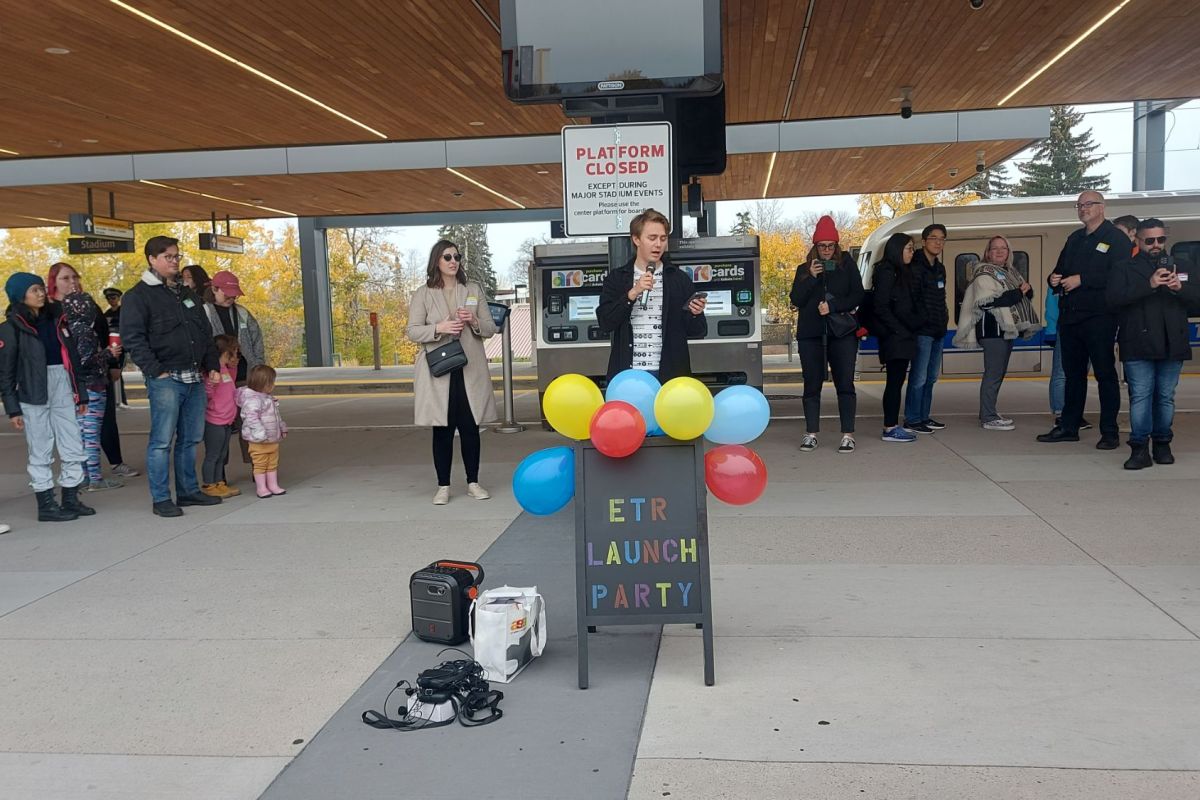
On October 20, the group hosted a official launch party which included an announcement with speeches, and then a private tour of the Blatchford LRT station that is not yet open to the public where the attendees can connect and chat with each other. It was nice to see the current board chair of ETSAB, actual representatives from ETS, city politicians, and other people enthusiastic about transit.

Giselle taking a selfie in front of the Edmonton LRT Blatchford station, during a private tour as part of the Edmonton Transit Riders launch.

Interestingly enough, I remembered a discussion about the Blatchford station during an ETSAB meeting, and see the station still not being used was a reminder that our recommendations to city staff sometimes get implemented. It does make an impact.

In some ways, the word hype feels superficial, but with what ETR is doing, I think building hype about public transit is not only just a good thing, it is an excellent thing that is very much needed. There’s a lingering disdain from everyday people about public transit, combined with an undercurrent of classism and car culture. I’ve said countless times, people complain about hiccups on public transit too quickly and harshly but if those experiences are tied to their driving experience, people are more forgiving.

When I was chatting with the ETR volunteers and board of directors, I was amazed that they were planning to go to Ottawa for a conference about transit. There’s a lot of flexibility they have that made me wish I had something similar when I was with ETSAB. Then again, ETSAB is a part of the city and funded by taxpayer money, so I understand the limitations that where in place. It is nice though that ETSAB board members get a chance to attend the Canadian Urban Transit Association fall conference every year.

Front view of the Blatchford LRT station. Crowds of people are by the platforms observing the space.

One thing I really appreciate is that both organizations seem to have a relationship with the staff of the city’s transit system. Everyone seem to have a well-known common ground of sharing the desire to actually make public transit better.

In future years I eagerly look forward to seeing more of what ETR does. I subscribed to their e-newsletter and social media accounts and they are a lot more public with their advocacy which is fantastic. They had several media interviews, organized an automated e-petition to speak about the low-income transit programs, and had plans to advocate to the provincial and federal orders of government. It’s quite remarkable. Once the actual transit department launches their merchandise line I bet that the ETR supporters would be the first in line to buy or market these items ala influencer style – yes that includes me.

Looking back at the LRT launch for the Valley Line East last November 2023, it is nice to join along a group of fellow transit nerds. If I am lucky enough to be the next city councillor of my area of the city on the west end, I’ll be thrilled to organize the official launch or tour of the LRT along with them! The warm drinks, train-themed cake and ceremonial scissors would be on me – unless someone beats me to it which is very possible!

Being the Human Transit Navigator: The Captive Transit User Series Part 15

By: Giselle General

This is part of an ongoing series of posts discussion issues I personally encounter while taking public transit in Edmonton. Links to other posts will be added on an ongoing basis:

What is a Captive Transit User? I learned about the term for the first time from the City of Edmontonโ€™s website. The easy definition is: someone who takes public transit because itโ€™s the best (or only available) option for them to travel around. The part about feeling โ€˜captiveโ€™ comes from the restriction that sometimes comes up, perhaps because one is too poor to own and maintain a vehicle, one does not know how to drive, or for medical reasons, cannot operate a vehicle. In many ways, I relate to this a lot. Though Iโ€™m pretty fortunate to afford the occasional taxi ride, and with my husband having a car.


People unfamiliar with a transit system, whether it is because they are new to an city, a neighbourhood, or just so happened to not use transit for a specific event, benefit from the help of a fellow human who seemed to know their way around. A few times this summer, it was nice to be that fellow human, even as a stranger, to be that source of help and companionship to someone. Here’s a few stories when I by myself, or with my husband, did this to people in the city.

Edmonton Folk Festival

This summer was the first time that my husband and I went to Edmonton Folk Festival. Because we had little time between having dinner at the bar near his work by the Manchester Square, we took an rideshare to the festival location. But we decided to take the relatively-recently-opened Valley Line LRT to her back.

While walking through the green space to get to the station, someone called out to us. They seemed confused and asked where the LRT station is. My husband and I pointed to the direction that we are headed. In the spot where we were standing, it seemed easy to miss the LRT station, as the glass pyramids of the Muttart Conservatory is right close by. The people seemed relived to know that the LRT station was indeed close by, which is a great reason why the festival organizers heavily promoted transit as a way to get to and from the festival.

This is the first year that the festival is going on with the LRT access. I bet that in future years, it would be a no-brainer for most people to get to the festival through transit, either to get to the bottom or top of the hill.

New worker going to downtown

On a Thursday morning in August, I was waiting to get on my usual bus to get to downtown. A man was talking passionately over the phone, in a language I cannot understand. He hung up, browsed his phone for a few minutes and then he approached me, speaking in limited English. Asked which buses go to downtown by 109 Street, and whether the bus is arriving since it’s been late for 5 minutes. I can imagine how a late bus for a route you’ve never used before would make anyone anxious. So I told him “yes that’s the number 2, it will come soon, and we can take it together!”

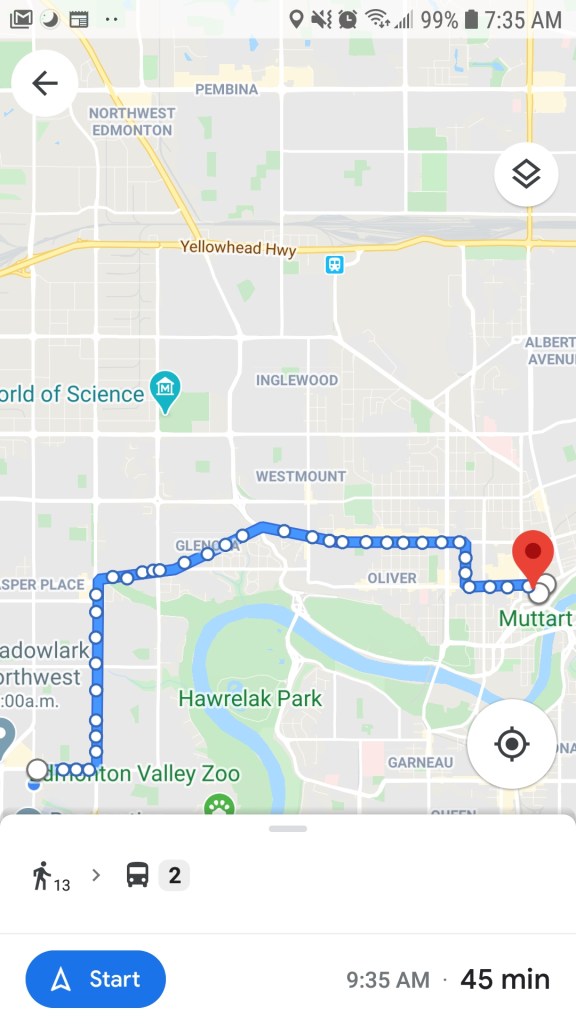
The bus arrived and we hop on together. He was restlessly looking at the window to check where we are going. I placed the address of his destination on my Google maps app, and showed him the blue moving dot that symbolizes the bus. We were sitting close to the front, so I also point to him the digital screen that was showing the intersection of the upcoming bus stops. I told him, “once we are close to downtown, the screen and the audio annoucement will say.. 121 Street – Jasper Avenue, 116 Street – Jasper Avenue, 112 Street – Jasper Avenue… and then that’s when you pull the stop alert and get off. Then when you get off, you just need to walk 2 blocks that way, and you’ll be in your destination!” I finished my instructions while pointing towards the south.

He shared to me that it was his first day at his job. He shyly told me that his English is “not very good” but he will be starting classed at Norquest college very soon. I said that Norquest is very close to where he was getting off for work, so he can take the same bus and just wait for a few stops further into downtown. I shared that I am an immigrant too, only that I’ve been here for 17 years. He sounded amazed upon hearing that.

As his stop approached, I got him to pull the string for the stop request. As he left the bus, I said good bye and waved at him through the glass, while making sure I press the button again as I was getting off at the next stop. I sent a silent prayer, wishing him a good day at work as I headed out to start mine.

Lady navigating west end construction zone

One morning, I was on the bus heading to work and after a few stops, a woman wearing business clothes came in. There were several vacant seats at the front, but she didn’t sit right away. Clutching her phone tightly, she talked to the driver asking if the bus would be passing by 139 Street and 102 Avenue. He said yes, and continued to drive. She continued standing at the front craning her neck, seemingly wanting to have the same line of sight as the driver.

Only a few stops later, she asked the driver again how close we are getting to her destination. We were still on 87 Avenue, about 15 minutes away. I do know though that she is getting off on a very busy construction zone and might miss where the bus stop is.

I waited for catch her eye, I smiled and said, yes the bus is heading that way. I pointed at the digital sign above her head and said “as you can see, and you will hear, the upcoming bus stops will show on the sign. So you will hear when the next step is 139 Street and 102 Avenue and press the button then.” As we waited along the very congested 142 Street, the bus finally got a chance to turn on 102 Avenue. The bus arrived at the intersections and the got off one of the temporary-looking bus stops.

Honestly, I’m quite relived that smartphones are around. It helps communicating bus routes and travel times better. One can argue that if someone has a phone and data, people can just look at the directions and go where they need to go. But I think that the additional element of human help can provide that extra level of reassurance. Many times, I’ve seen passengers come up to the bus, show their phone to the driver and confirm, and happily enter the bus once they get the okay from the driver. But in a pinch, whether in a random location around the city, a busy transit station, or a bus stop, I enjoy pitching in when needed. It’s a fleeting moment of kindness, lasting a few minutes at most, but can help with those unfamiliar with our transit system get the hang of it.

The Construction Neighbours: The Captive Transit User Series Part 14

By: Giselle General

This is part of an ongoing series of posts discussion issues I personally encounter while taking public transit in Edmonton. Links to other posts will be added on an ongoing basis:

What is a Captive Transit User? I learned about the term for the first time from the City of Edmontonโ€™s website. The easy definition is: someone who takes public transit because itโ€™s the best (or only available) option for them to travel around. The part about feeling โ€˜captiveโ€™ comes from the restriction that sometimes comes up, perhaps because one is too poor to own and maintain a vehicle, one does not know how to drive, or for medical reasons, cannot operate a vehicle. In many ways, I relate to this a lot. Though Iโ€™m pretty fortunate to afford the occasional taxi ride, and with my husband having a car.


When people choose a place to live, they consider many important things in choosing the neigbhourhood. We knew when we picked the neighbourhood we live in now that since the LRT will literally pass through the main road nearby, that we will be inundated with the impacts of the construction for many years until the line officially opens. But what is something that many residents complain about, became something that piqued my curiosity over the years.

I’m basically like a “Marites”, the nosy neighbour looking into the latest “tea” of what is happening next door, but for an LRT construction. This transit nerd is delighted with integrating such a Filipino reference, hehe. Every time I leave my home to commute to work, itโ€™s neat to see the changes.

Between my husband and me, our no-cost-but-super-fun date idea has been to go for a half-hour work along the construction site, observe the different holes and poles, the cranes and trucks, the cement and the metal pieces, and the people around the site. I bet my husband is truly enjoying being married to a transit nerd – no need to go far or spend a lot of money for romantic quality time, haha!

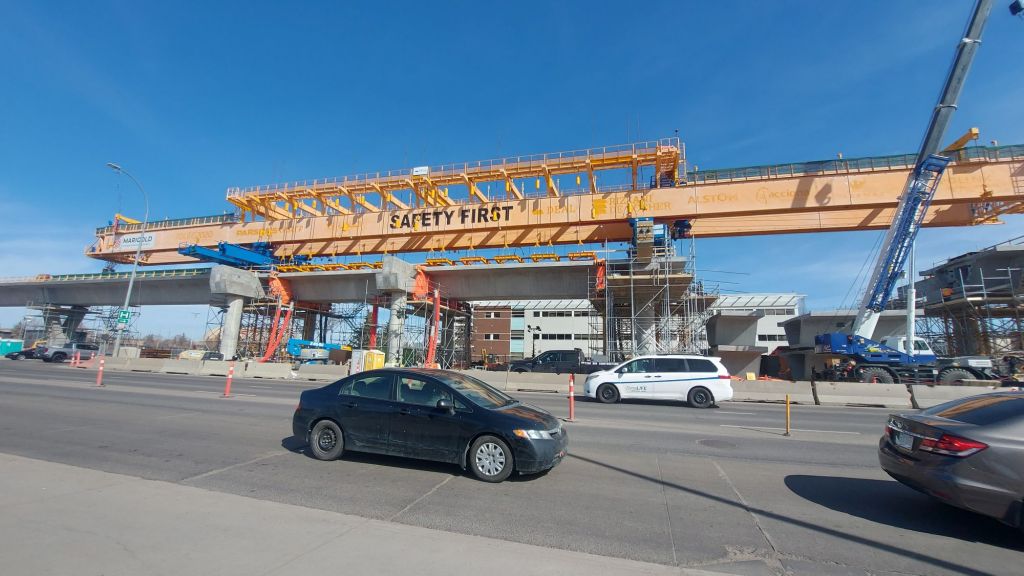
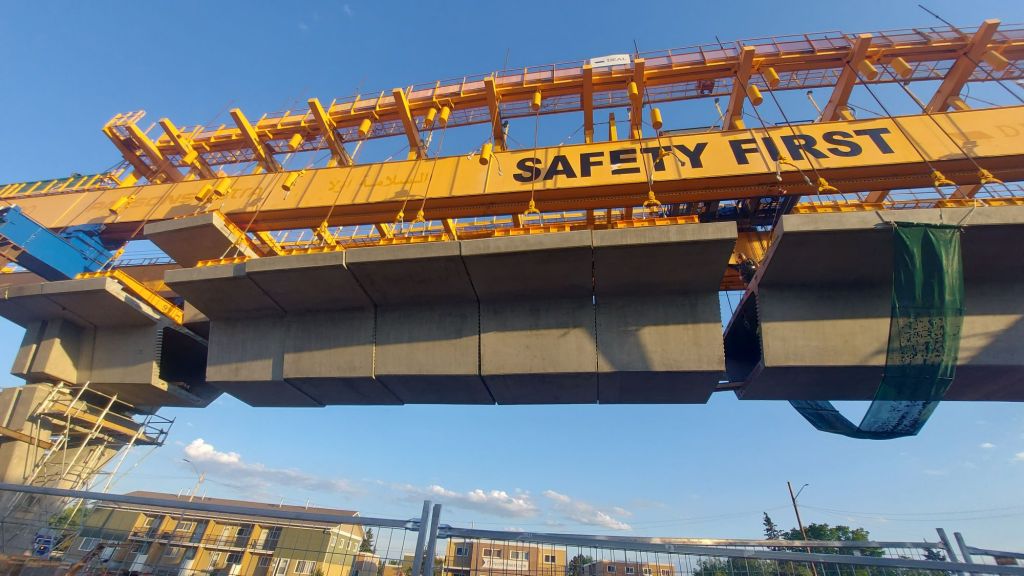
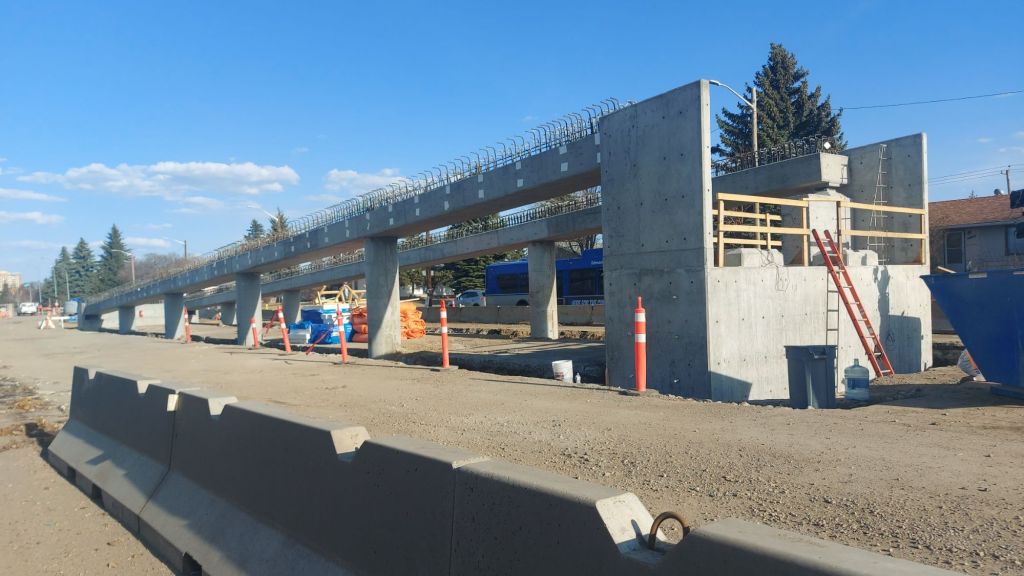
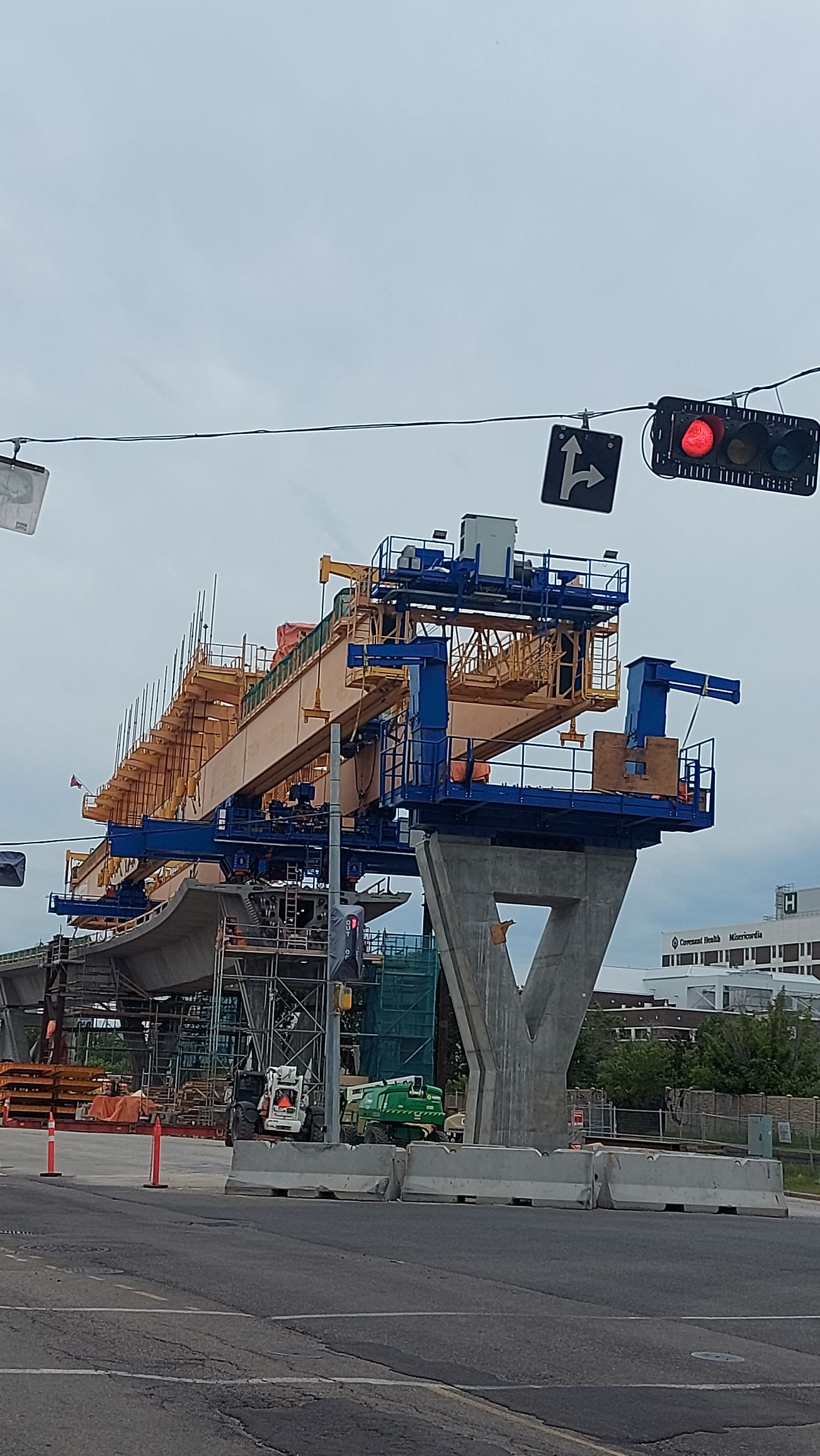
As the cliche goes, a photo says a thousand words. So here is a photo dump of the photos of the LRT construction progress because because itโ€™s fun and nerdy

The construction zone for the West Edmonton LRT along 87 Ave.  It is winder and there's block of ice and snow along the road and construction site.
The construction zone for the West Edmonton LRT along 87 Ave. The two traffic lanes are backed up, and four pillars are almost finished construction.
The construction zone for the West Edmonton LRT along 87 Ave. The specialized above-ground crane is lifting platforms for the above-ground Misericordia station.
The construction zone for the West Edmonton LRT along 87 Ave.  The view is from underneath the specialize crane. 6 platforms were lifted and still have gaps in between each other.
The construction zone for the West Edmonton LRT along 87 Ave. The ramp to take the tracks to street level is partially done, with lots of metal rebar sticking out.
The construction zone for the West Edmonton LRT along 87 Ave. The specialized crane is approaching the traffic light on 165 Street.
The construction zone for the West Edmonton LRT along 87 Ave. A crane is parked in the middle of the site.

Frankly at this point, for very short trips, it is much better to walk โ€“ to the mall, the library, the pharmacy. But as long as the locations are literally long the main road, I can also be lazy and take the bus in one direction.

I heard many times that the construction impact north of my neighbourhood, along Stony Plain Road, is much worse for the businesses there. In fact, the City launched a campaign called “Rally for the Road” to encourage people to continue to patronize the businesses along the road, where construction makes it difficult and unappealing to park to get to these businesses. I know of a business owned by a fellow Filipino that sells Filipiniana inspired attire. I hope to visit the business someday when it is easier to travel to get there, either by car of perhaps, the newly opened LRT line!

The construction zone for the West Edmonton LRT along 87 Ave and by the business plaza on 159 Street. A sign by the fence says "Businesses Are Open During Construction"

In the middle of May, during the Annual General Meeting for our community league, we also held a town hall where staff from the city and the LRT construction company co-presented and answered questions from the neighbourhood. I really appreciated them doing this. The maps and slideshows were informative in giving both the big picture progress of the whole project, timelines for summer 2024 and what to anticipate as far as changes in access to lanes and intersections. We were given the reassurance that any concerns can be shared to them anytime, and that they have what sounds like daily meetings with the staff at the hospital to ensure access is not blocked unintentionally.

On top of that, our community league president seems to have established a good relationship with relevant staff. He managed to make a few phone calls to sort out the traffic lights nearby to help traffic flow better.

The construction zone for the West Edmonton LRT along 87 Ave and 165 Street, the intersection that will be closed for two weeks as the specialized crane finished lifting platforms for the track.

And just a few weeks after this neighbourhood meeting, my husband and I can see the large crane off our second-floor bedroom window.

We were told that our section will be finished by fall this year, then the section off the other side of 178 Street will be worked on. I will definitely miss the unique crane when it moves. And I hope that the residents who live in that area, that have been affected by construction for just as long as we are, have a manageable experience for the next few years.

A Month of Cool Transit Milestones: The Captive Transit User Series Part 13

Giselle posing beside a table with a sheet cake. The design on the cake says "Train, Choo! Choo!"

By: Giselle General

This is part of an ongoing series of posts discussion issues I personally encounter while taking public transit in Edmonton. Links to other posts will be added on an ongoing basis:

What is a Captive Transit User? I learned about the term for the first time from the City of Edmontonโ€™s website. The easy definition is: someone who takes public transit because itโ€™s the best (or only available) option for them to travel around. The part about feeling โ€˜captiveโ€™ comes from the restriction that sometimes comes up, perhaps because one is too poor to own and maintain a vehicle, one does not know how to drive, or for medical reasons, cannot operate a vehicle. In many ways, I relate to this a lot. Though Iโ€™m pretty fortunate to afford the occasional taxi ride, and with my husband having a car.


November 2023 was such an incredible month for all things transit in Edmonton. On a typical day, it is understandable that many everyday people, the media, and those politically engaged have many frustrations about our transit system and are quite vocal about it. But November was a bit special as there were precious opportunities of celebration and showcase.

Valley Line Southeast LRT Line Opening

On November 5, the long-awaited LRT line from downtown to Southeast Edmonton finally opened. While there wasn’t an official event organized by the city, it felt really festive right at 5 AM throughout the LRT stations along the line. This is thanks to enough people in the city who organized, shared enthusiasm and as a result, filled up the LRT vehicles during their first trip from downtown to Mill Woods and back. I described those wee hours of dawn as ‘festive in a nerdy way.’ There was cake, coffee, an opportunity for everyone to take turns to cut a ribbon with large ceremonial scissors, and run into other people in the city who are keen on municipal politics, love trains or active transportation, or both.

I am super grateful to my husband (who is not a big politics or transit nerd like me) who convinced me to go to this ‘opportunity of a lifetime’ event and offered to come along with me, since there are no buses available at 4 AM from our place to downtown.

Here are some of the media articles that captured the enthusiasm of the opening day. It was pretty fun trying to spot my husband and I in the photos and video snippets.

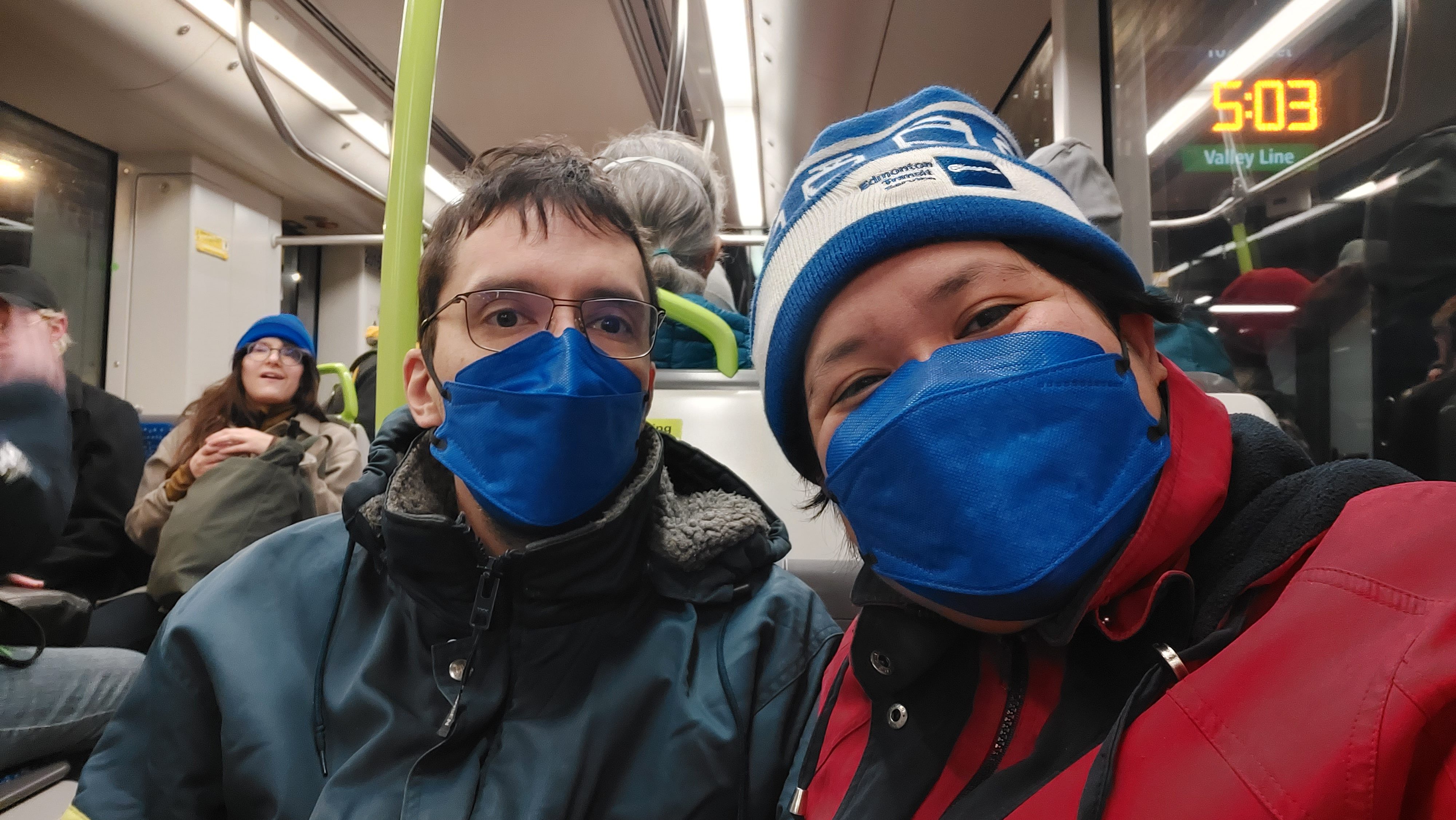
At 5:03 AM, after the passengers did a countdown, the LRT departed from the 102 Street station on the way to Mill Woods. My husband and I were lucky to find seats.

Edmonton Hosted the annual Canadian Urban Transit Association Conference

In mid-November, Edmonton hosted several transit-related conferences, the Youth Transit Summit and the regular Canadian Urban Transit Association convention. The CUTA conference happens twice a year, a smaller spring convention and the main fall convention, in various locations across Canada. Back in 2018, during my first year as a board member of the city’s transit advisory board, I was able to attend the CUTA conference in Toronto. So it was very exciting to have my home city host it. I got sick in the middle of that week, but the fact that multiple members of our board were able to attend was wonderful.

The fact that the new LRT line opened just in time for the conference, so that it can be showcased to all the conference participants who signed up for technical tours, was a bonus. The technical tour I was able join, the recently re-opened Stadium Station, was informative and enjoyable. The best part for me is that not only was the tour focused on the station itself, but the changes in the residential areas nearby. The new cluster of tall residential towers is the first time I’ve witnessed a real-life example of TOR (Transit Oriented Development).

Edmonton Transit Service staff shared information and answered questions of the crowd during the technical tour of the station. One surprising fact I learned is that the undergound station is still functioning and was renovated into a service room.

Thinking back to my last vacation in Manila, Philippines, I chose to rent a condo that was walking distance to an LRT station and a mall. It made travel very convenient as it was an effective way to beat the horrible road traffic during the holiday season. My current home here in Edmonton will have the same convenient access as well. My husband and I walk to the mall and business plazas nearby. We are walking distance from a hospital, gas station, convenience store and a car wash. When the LRT finally gets opened in a few years, it would make getting around even more flexible. I’m curious to see what will happen now to the areas within blocks off every transit station.

Showcasing the Transit System to a City Councillor

Then in late November, I did something for the first time, something I have casually offered on social media to the politicians of the city but no one took it up until that day. On Sunday November 26, I spent the morning with one of our city councillors and their staffer on multiple ETS transit trips across the city, experiencing various methods including the bus, LRT, replacement service, on-demand bus, and walking to a destination as opposed to taking a bus. I admit I was nervous, worried that I may sound irritating with too many complaints and concerns I was pointing out all throughout the trips. But they were both receptive and the blog that was published afterwards is insightful.

I showed Councillor Cartmell the various ways temporary bus stops are designed. I pointed to him that this one along 102 Avenue and 133 Street has good platforms for the front and back doors.

Transit, safety in public spaces, homelessness, and ‘value for taxpayer money’ arguments take up a lot of discussions on city politics lately. I’m curious to see what additional decisions that are made politically and the changes that city administration would make to work on these issues.

The Evolution of Audio Announcements- The Captive Transit User Series Part 7

By: Giselle General

This is part of an ongoing series of posts discussion issues I personally encounter while taking public transit in Edmonton. Links to other posts will be added on an ongoing basis:

What is a Captive Transit User? I learned about the term for the first time from the City of Edmontonโ€™s website. The easy definition is: someone who takes public transit because itโ€™s the best (or only available) option for them to travel around. The part about feeling โ€˜captiveโ€™ comes from the restriction that sometimes comes up, perhaps because one is too poor to own and maintain a vehicle, one does not know how to drive, or for medical reasons, cannot operate a vehicle. In many ways, I relate to this a lot. Though Iโ€™m pretty fortunate to afford the occasional taxi ride, and with my husband having a car.

“A hundred and eleven street, a hundred and second Avenue…A hundred and twelve street, a hundred and second Avenue… A hundred and thirteen street, a hundred and second Avenue.”

These lady robot announcements weren’t always a part of one’s commute taking the bus here in Edmonton. The first time I started hearing them, I think it’s about 2012 or so, I can’t help but giggle while taking the bus because the voice just sounds monotonous and a bit silly. My brother (who was new to Edmonton at the time) and I would poke fun at the robot voice sometimes. But the more I hear these announcements, the more I appreciate its benefit when taking transit in Edmonton.

When I first came to Edmonton in 2008, I used a print map of ETS to get around. I have both the city-wide map to help me understand the different routes available, and the the route-specific maps as well. I needed to be familiar with the route number 4, 106, 150, 111, 112, 100, 119, 136 and the LRT so I can to go school, work, hang out with friends and do other activities. I still had a flip phone during those early years and Google Maps is not as good as it is now.

A public transit bus rapidly passing through.

I tried very hard to make sure I get off the right bus stop, but in the winter, when it is dark and the windows are frosted it can be tough to look out by the window and keep track. If you end up missing your stop by a few blocks, walking a few extra minutes late at night and in the winter is not something I – or anyone – look forward to.

I also realized that the audio announcements help people with disabilities! I remember reading a quote from a news article from a person who is blind, who said that the automated announcements of the next bus stops are really useful. I bet that for people who are also new to Edmonton, it’s handy as well.

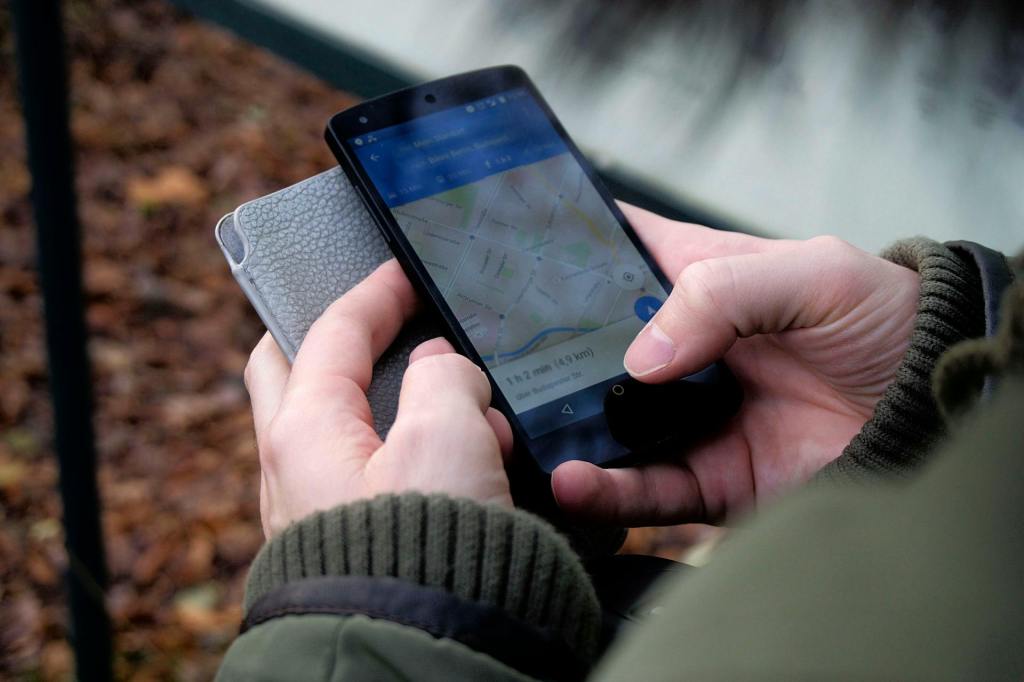
Screenshot of Google Maps showing walking and bus directions in Edmonton.

When I visited New York City last year, a city where sure, there are numbers in the street names, but the system is so different, hearing the audio announcements of the upcoming bus stops, while looking at the app on my phone, helped me navigate around really easily.

But then, we all know that technology is not perfect. When I lived on the further west side of the city, taking the 136 bus, one of the words that is in several street names kept on being mispronounced. For some reason, ‘Potter” became “Potters” and the word next to it loses the letter S at the end. So, Potter Greens Drive sounded like Potters Green Drive. The city’s app for reporting different city issues also wasn’t perfect – there wasn’t an option to report operating issues specific to buses at the time. But I did my best to report it anyways. I really hope it’s been fixed.

At least twice a week, there seems to be technical issues with the LRT announcements when it is supposed to indicate the next station. Either the next station announced is a few stations off, or the announcements were in reverse order. Luckily, now there is an option in the City’s app to report issues about transit vehicle operations.

Selfie of woman outside in winter, wearing a knitted winter hat and most of her face covered in a light blue scarf

LRT stations have additional types of announcements as well which is handy. Particularly right now during the pandemic, there are audio reminders that masks are mandatory. Back in early 2020, both the above-ground and underground LRT stations started to give passengers a heads up that bus transit fares are increasing in the near future.

Overall, audio announcements has been a handy feature for all users of our transit system. I hope that it continues to have the proper resources to maintain and update its functionality so that it works most – if not – all of the time.

Edmonton Experience Story: Coliseum Open House Before Closing

By: Giselle General

On December 17, 2017, my partner (now husband) and I decided to take the one last opportunity to tour the Coliseum before it was officially closed down. This is a summary of the tour, including some observations of the area and new things I have learned.

My partner is a born-and-raised Edmontonian, while I moved here when I went to university. That being said, I had a chance to go to the Coliseum a few times. First, for an Oilers game with my partner, then for a few concerts, and also another time for an Oil Kings game, during one of the nights when there was a Teddy Bear Toss.

We went there by taking public transit, which was lovely because it gave my partner greater flexibility. Also from our memory, parking in Northlands is expensive. As the years went by, traveling around by transit is a part of our date that we enjoy, since the buses and LRT vehicles are almost empty and we cozy up in our seat.

A "Points of Interest" map of the Edmonton Coliseum.

When we went to the Farewell Weekend tour, it was pretty quiet. I wonder if it is because it was the last day, or because it was pretty chilly.

The map was a useful guide to particular points of interest, and upon visiting those places, there were signs that explained the function of the area and some interesting historical or sports-related facts. Many places that are not publicly available is available for viewing this time around, such as the locker rooms and bathrooms for the athletes, the media room, fancy suites on the top floor, with a lobby that looked like a hotel.

We both forgot about the open skating opportunity, so instead, we went to the frown row, Corey sat in the penalty box, and asked me to take a photo of him pretending to be upset for being sent to the box. We spent a some time watching people skate around, while enjoying the soda and nachos we bought from the only concession stall that was open.

The skating rink of the Edmonton Coliseum, veiwpoint from the bleachers.

Afterwards, we decided to take the LRT to go to downtown instead of going home right away. At Churchill station we saw a woman painting a mural on the concourse of the LRT station. It was incredible, with patterns of what seemed to be a woman, lots of red birds, and a village and various scenery of a community. I started from a distance when he nudged me to say hello to the artist and chat about the mural. I felt shy at first but my husband reassured me that the artist might actually appreciate the chat. And he was right. I told the artist that she outline seems really interesting, that the elements she’s painted so far look incredible, and inquired her on what the painting is about. She told me that it is part of an initiative called Paint The Rails, which now had resulted to several paintings across different city’s LRT stations.

As we were already in downtown, we decided to stop by the Farmer’s Market and we arrived just in time to see the different shops close down. It’s nice to see the different types of businesses that were there, and we took some photos in front of the nice decoration that were set up in the interior of the City Hall building.

Afterwards we decided to visit the funicular for the first time, which is just a few block away by the Hotel MacDonald. We thought it was really neat and the lookout point at the bottom was great! I remember that one of the benefits of the funicular is for people with mobility aids to have a chance to see our beautiful river valley more closely. Using it ourselves made us realize and appreciate that goal.

After that we decided to head on home. As the Coliseum was accessible by transit and our detour in downtown Edmonton was also accessible by transit, we continued to use transit to head home. It was a lovely weekend date in the winter that we continued to cherish.

“I Think I’ll Walk Instead”: The Captive Transit User Series Part 5

Woman wearing an orange fabric mask with plastic windown showing her smile, and wearing a straw floppy hat.

By: Giselle General

This is part of an ongoing series of posts discussion issues I personally encounter while taking public transit in Edmonton. Links to other posts will be added on an ongoing basis:

What is a Captive Transit User? I learned about the term for the first time from the City of Edmontonโ€™s website. The easy definition is: someone who takes public transit because itโ€™s the best (or only available) option for them to travel around. The part about feeling โ€˜captiveโ€™ comes from the restriction that sometimes comes up, perhaps because one is too poor to own and maintain a vehicle, one does not know how to drive, or for medical reasons, cannot operate a vehicle. In many ways, I relate to this a lot. Though Iโ€™m pretty fortunate to afford the occasional taxi ride, and with my husband having a car.

Time is money, and time is finite. At the same time, health is wealth. These are the different ideas I wrestle with whenever I think about how to travel to a location, as someone who cannot drive.

My family doctor’s clinic is located in a place that is accessible by public transit. At the same time, I’m aware of how long it takes to go there by walking. I’m very apprehensive about taking the bus right now because at this point in time, wearing masks is not mandatory, it is simply ‘highly recommended‘. I think, it is part of human nature, that if we can get away with NOT doing something, even if it is a small inconvenience, many of us tend not to do it. So what I did is walk the 45 minutes to get there and back. As the posters say, travel only when it’s essential. Might as well follow the advice.

Edmonton Transit Service Poster: COVID19 Update: Travel only if it's essentaial.

I’ve gotten so far as evaluating whether I’ll be capable or brave enough to consider biking to downtown. As I’m short and have a mediocre health levels, I always add 20% to the travel time that Google Maps recommend. If riding a bike takes 35 minutes, then for me it will be close to an hour, which is not bad. Is it worth the switch? But I think about my coworker who cycled to work who got hit by a car last December and was really badly hurt. That scares the daylights out of me. I don’t think I want another permanent dent on my skull. Falling of a mountain cliff and fracturing my skull once in my life is enough, thank you very much.

I heard perspectives that there will be frequent transit users that the system will lose due to COVID19. Unless the policy changes, I am one of them. Through my volunteering with the citizen-based volunteer government advisory board, the Edmonton Transit Service Advisory Board, I expressed my thoughts as clearly as I can. The chair of our board sent an official message to the councilors about the matter. While the outcome is not what we hoped for, there is some comfort in knowing that we made deliberate effort working with the government system in place.

White LRT vehicle on an outdoor train station platform.

In addition to the health-related aspect of wearing a mask, there is a safety component that I need to be more conscious about. As a woman, an Asian woman who visibly looks like one, I am aware of the additional hostility that Asian people are subjected to due to the pandemic. Comments such as “you bring coronavirus in Canada!” or “you’re a dumb sheep for wearing that mask”, can be hurtful, and potentially dangerous if the person saying them is being physically aggressive. That is the reality of sexism, racism and just overall xenophobia. One can argue that it is internalized victim-blaming, but there is merit in doing some preventative measures to stay safe. If I get hurt or killed by a racist, sexist person, I won’t get to continue my goals of living a positive life for myself and the people around me.

So this is where I am. Until mask wearing is more normalized, I will likely steer away from taking transit as much as I can. I might even take an Uber more frequently, given their firm policy of ‘No Mask. No Ride’. It will be interesting to see how transit policy changes in preparation for the upcoming school year.