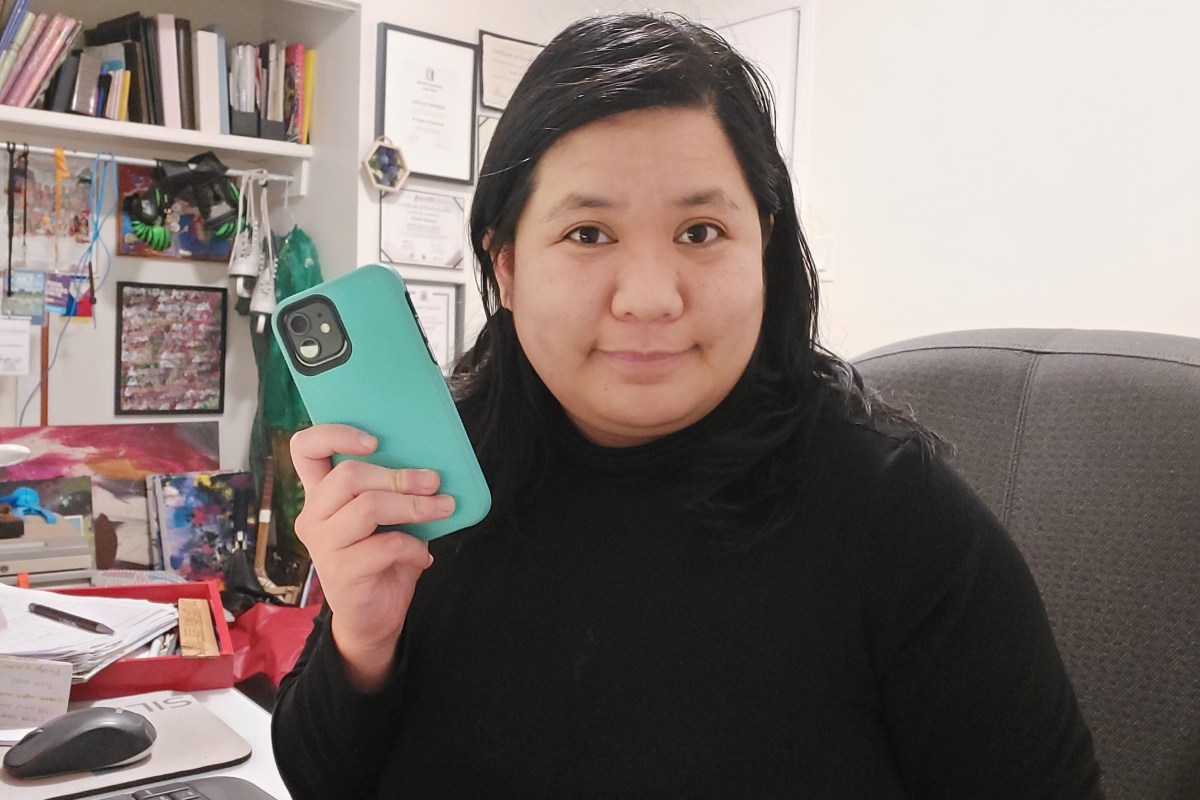
Memoir Writing Reflections #10: I Got a Contract

By: Giselle General

Most of this year has been preoccupied by my second attempt running for city council, where I lost again.

Now that it’s over, I can re-focus again on my other endeavours that have been in the works for several years now. I made a social media post when I signed the dotted line last June, but I can embrace and fully recognize and celebrate it again – I got an author contract!

Earlier this spring I received an offer from NeWest Press, a nonprofit local publisher based here in my hometown of Edmonton. I really love the fact that it is local. I also really love that I am not the first Filipina-Canadian author they worked with. I highly recommend buying or borrowing The Cine Star Salon by Leah Ranada. I figured, if NeWest helped make her book into its final form, then I’ll be in great hands.

I’m equal parts baffled, humbled and excited that I got a contract quickly by comparison, only a year after I have completed the all the professional editing and beta reader services for the manuscript. I’ve heard so many stories of past and present struggles from writers about taking a very long time, as in years, to get a publisher. From feeling frustrated waiting for a long time, many decide to self-publish or make changes to the manuscript over and over to submit again.

It’s such a fascinating and intimidating experience reading the author contract that I searched for lawyers and contract reviewers to help me understand all it entails. There are some straightforward stipulations such as being on time with giving feedback on the manuscript, the advance payment, how many will be produced and what happens when copies are sold. And there are some long-term items should the book gain traction, such as movie rights, international distribution and translation.

Part of what makes this book writing process likely a bit unusual compared to many writers, is that I technically already got compensation. Thanks to the grants I applied for during the writing and editing process, I feel like I already earned some income from my writing efforts. And I will be the first to recognize how fortunate that is. I still remember the e-newsletter from the Edmonton Arts Council emphasizing that roughly 20% of applicants get approved. I bet that percentage is even smaller with the Canada Council for the Arts with the applicants all across the country. Both organizations gave funding for this book. I will never take that for granted.

As a result, I don’t feel pressured to sell a certain number of books to earn back my time and effort to break even or make a profit. Everything else is gravy. But of course, I’d like to have as many book sales as possible. The fact that contracts now have standard clauses for movie rights and international distribution can make anyone dream big!

The most remarkable part of this, is that it truly feels like a full-circle moment. The assigned editor for this final stage is the one who helped me get started in the first place. Wendy McGrath, my author mentor with the Writers Guild of Alberta program called the Horizon Writers Circle back in 2022. The one who said to me with fierce determination when I first talked about the idea of the memoir, “yes, in six month we will finish a first manuscript together!” The one who insisted that I start applying for grants so I can get professional editing services and pay them properly. The one who also edited a separate written work for a local anthology. The one who already have read and edited several chapters of the first draft. Most definitely, the perfect person to help take it to the finish line.

I like my rules and timelines so pretty soon, I will be fully working on the final round of editing for the manuscript before it officially goes on print. I had two additional manuscript review services I used a while back, but I didn’t incorporate their recommendations when I submitted the manuscript to a few publishers. This final review will be the perfect time to read the feedback to see if the delivery of the story can be more effective in some way.

Some major changes that need to be done are changing the names of the characters to protect people’s identity and decisions on how to deal with copyrighted content such as songs and poems. It felt right in my heart to add actual sections and quote them in the chapters when I was first writing. But in its final form, I feel more open to removing it altogether. It can be quite expensive to request for authorization and rights.

I’ve casually talked to people in the city the past few weeks about the book, as a way to deflect the conversation after I receive the standard sympathetic comments for losing at the election again. I met a person from another local bookstore I haven’t heard of, who said their shop is willing to host an event and a local reading session. My massage therapist told me that I should inform them when the book is out as they have a shelf by the reception area to sell locally made products. I’ve already been to a few book launch and author reading events and plan to attend more in the next while.

Even before all the book-related activities, I do have another launch coming up soon, the premiere of the documentary project Building Pinoy. Any lessons about promoting a creative project, dealing with reactions, will definitely be something that I’m sure I can apply for the book.

There’s an actual finish line that I can foresee. A year and a half will fly by quick.
Recovering Political Candidate: Steep Cost and Sacrifices

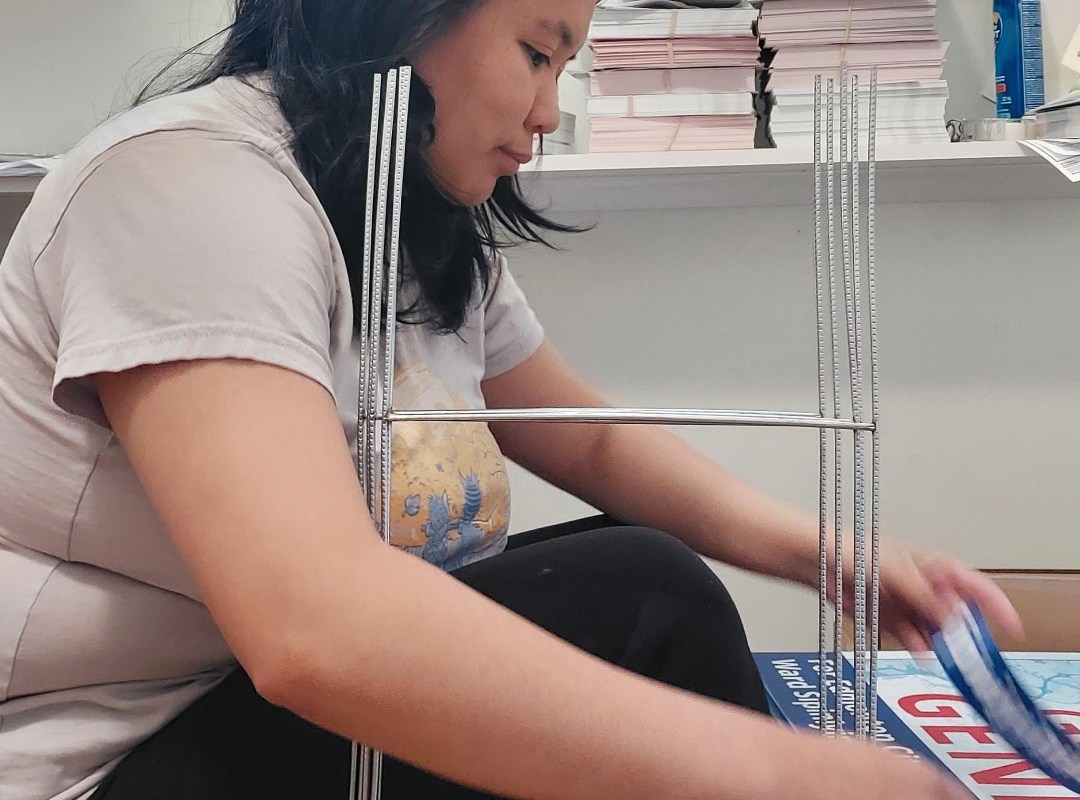
Giselle assembling lawn signs for the 2021 election campaign.

By: Giselle General

I suppose it’s kind of strange that I’m continuing the name of these series as “Recovering Political Candidate” given that I am running again. There’s already two posts I made as part of this series:

Then again, it feels like while I’m embarking on one, I’m still recovering from the previous one, unpacking all the things I’ve experienced and observed. Time gives perspective as they say, and going through the same experience again, I suppose this time for me, with four years of maturity, sheds things in a different light.

When people think about running for office, they often imagine debates, door-knocking, and campaign signs. But what most donโ€™t seeโ€”and what few openly talk aboutโ€”are the financial, professional, and emotional costs of stepping into the political arena. For those of us who come from working-class, immigrant, or marginalized communities, these costs arenโ€™t just inconvenient. Theyโ€™re systemic barriers.

As someone who immigrated to Canada as a child and became the first in my family to graduate from a Canadian university, Iโ€™ve experienced the unspoken challenges of trying to โ€œbreak inโ€ to political spaces while navigating real-life survival. I didnโ€™t grow up around people who ran for office. My relatives didnโ€™t work white-collar jobs or attend Chamber of Commerce lunches. Like many others, I was figuring it out as I wentโ€”sometimes fumbling, sometimes scraping by, always learning.

When I ran for City Council in 2021, I had to keep working full-time in the spring and summer with two months off full-time campaigning.

A time-tracking table. Each half-hour  for every day of the week is represented by one cell on the table. Times are color-coded as follows: Sleep, Personal Care, Meals, Chores, Commute to Work. Work. Family/ Friends social time. About 30 hours is not color-coded, representing the maximum hours that can be spent theoretically, on the election campaign.
I wondered what the true difference between a candidate who is campaigning full time compared to someone who is doing it after work. And it’s all the green blocks here, about extra 30 – 40 hours every week. That’s why I can’t help but wonder, even I’m technically adding more, would three months of full-time campaigning be enough?

I banked my vacation days and carefully budgeted unpaid leave. Not because I had the luxury to, but because I couldnโ€™t afford to stop earning income. I later learned that many candidates take months off entirely, living off savings or family support. I didn’t have that option then.

In this second run, Iโ€™ve come to see just how many โ€œnormsโ€ in local politics are built around people with financial privilege, professional networks, or flexible lifestyles. Here are just a few examples of the hidden costs:

Visibility Comes with a Price Tag

Being โ€œpresentโ€ at the right events such as fundraisers, business luncheons, galas, is often seen as a sign of seriousness. But tickets can cost $50 to $200 or more. Even free events often expect donations. Most happen during the workday, which means using time off or risking your job. And for women, racialized folks, and those with specific appearance pressures, just showing up polished and prepared costs time and money.

Running While Working Can Break You

Thereโ€™s a quiet expectation that serious candidates go on leave to campaign full-time. But unpaid leave means lost income, and not everyone can afford that. Some of us push through by working during the day and campaigning at night, leading to exhaustion, burnout, or even injury. This is a real and unsustainable cost.

In 2021, my husband and I decided that I will never compromise on my sleep (so no all-nighters) that he will not be deeply involved in the campaign so we have a semblance of a healthy home life, and that the financial cost of taking a bit more time off work is worth it. We are hoping it will help prevent permanent injuries or trauma.

Starting Up A Campaign Isn’t Free

Even a modest campaign needs branding, a website, photos, flyers, signs. Unless youโ€™re fundraising from day one or have wealthy donors ready to go, those expenses fall on you. There’s also pressure to appear “professional” which means a slick logo, high-quality materials, a polished online presence. That’s because anything less may be judged as unprepared or unserious.

While I’m re-using many supplies form 2021, I know if I don’t freshen up my style, it will be outdated and out of touch. There are many more cool apps and tools that help make things more efficient, and many are subscription based that can stack up if not kept in check.

Who You Know Matters – Much More Than Anticipated

Iโ€™ve spent years volunteering, organizing, and serving on boards, but Iโ€™ve also learned that social capital doesn’t always translate into campaign capital. Recognition and legitimacy are often reserved for those already plugged into elite circles or political dynasties. Meanwhile, working-class and immigrant leaders are often asked to โ€œproveโ€ themselves for yearsโ€”often invisiblyโ€”before being seen as viable.

As a simple example, through my community service I knew of about 5 executive directors or CEO-level people from nonprofits. If many of them decline to publicly endorse me because of repercussions at their job, the list runs out pretty quickly. While someone with deeper networks and connections, whether it is because they had parents who are still alive and able, or who were also are politically connected, had a profession that already has a certain prestige assigned to it, or had lived in the area for much longer, the odds are definitely in their favour.

Where Campaign Schools Fit In

One thing that has been incredibly valuable to me has been participating in campaign schoolsโ€”local and national programs designed to help women learn the basics of running for office. Iโ€™ve attended several, and I always leave feeling inspired and energized. They offer toolkits, checklists, and often a sense of solidarity thatโ€™s hard to find elsewhere. Being in a room full of women determined to lead and make a difference is powerful.

But for those just starting out, whatโ€™s offered in these programs is maybe 5% of whatโ€™s truly needed to launch a viable, well-resourced campaign. Turning that initial spark into a full campaign with traction, momentum, and infrastructure is a whole other challengeโ€”especially if you donโ€™t already have access to wealth, political connections, or campaign professionals.

Thatโ€™s why these programs must not just continueโ€”they need to grow. Campaign schools and women-in-politics initiatives should be more robust, more practical, and more deeply connected to the realities that many of us face: holding down full-time jobs, navigating care responsibilities, or entering spaces where people donโ€™t expect someone like you to lead. We need to move from inspiration to implementation, and that takes sustained, tangible support.

What now?

This isnโ€™t just my story. Itโ€™s a structural pattern. Politics in Canada, even at the local level, often functions as a gated space. Those gates arenโ€™t always locked, but they are weighed down by money, time, and access. And the reality is, people from communities like mine often pay the price just to stand in the same room.

But hereโ€™s what Iโ€™ve learned: knowing these barriers doesnโ€™t make me cynicalโ€”it makes me even more committed to change. Because if we want a city thatโ€™s truly inclusive, we need a political system that supports everyday people stepping into leadership.

That means:

  • Talking openly about the financial and emotional costs of candidacy.
  • Supporting candidates not just with votes, but with practical helpโ€”rides, printing, graphic design, donations, and more.
  • Reimagining what political legitimacy looks like, so itโ€™s not based on your job title, who you golf with, or shared tables at a fancy gala, but your service to your community.

Iโ€™m still learning, healing, and unlearning as I goโ€”just like many others. The journey of immigration, trauma, and over-responsibility doesnโ€™t disappear when you run for office. But neither does the strength and wisdom that comes from living through it.

So if youโ€™re thinking of running someday, or if youโ€™re supporting someone who is: know that itโ€™s okay to ask for help. To name the barriers. To build slowly and strategically, even if you donโ€™t have all the traditional tools.

The more of us who show up authentically, the more we change what โ€œleadershipโ€ looks like in this city.

I’m still willing to spill the tea!

And I’ve offered this before and I will emphasize it again. If you are interested in running for politics and wanted to know how it really looks like for someone who was described as marginalized, underdog, non-conventional candidate, who is an everyday worker and attempted to do this in 2021, I’m willing to tell it all. While scheduling might be trickier because I have to hustle even more to make up for what I’m lacking, I’m willing to share the numbers, the details of the years of planning, the financial and family decisions, the spreadsheets and timelines I aimed for, I reached and I missed. Talk to me, and I will share the real deal of my experiences. Not to scare people off, but to be more equipped.

Book Review and Thank You Letter: Frostbike by Tom Babin

Giselle holding the book Frostbike. Her husband's bike is behind her.

By: Giselle General

A few weekends ago, I visited someone near my home to talk about different neighbourhood things and the upcoming election. That late morning visit was lovely and veered into a conversation about winter cycling, something my husband just started to do in 2024 when the snow hit. As a result, she enthusiastically offered to lend this book that I immensely enjoyed. So to this neighbour, who also gave me a sample pack of roibos tea from a local tea shop, this is a Thank You letter and review of the book Frostbike, the Joy, Pain and Numbness of Winter Cycling, by Tom Babin.


April 19, 2025

Hi neighbour,

That winter morning was frosty, but my hands felt better right away from how you welcomed me to your home, with a cup of tea. The great conversations about my post the day before about someone wanting to organize an English-learning initiative for newcomers in the neighbourhood was even lovelier. As we chatted about different matters, the inevitable half-complaints about winter came up. Then I shared that my husband tried biking to work once a week since the summer, with this season being his first time winter biking.

I was so delighted that you were delighted to hear about this, and shared all your experiences biking from your neighbourhood all the way to the core of downtown. I appreciated your observations on your experiences as a cyclist and how the service roads, sidewalks, shared-use paths and the dedicated bike lanes affect your ride. That you were looking forward to the warmer weather since you are quite faster on the bike then driving at times. So, when you enthusiastically offered to lend me the book Frostbike for my husband to read, I happily took in home.

The thing is, my husband is a digital book reader these days. He’s quite happy with the app from our local library and been reading books regularly. So I ended up being the one who read the book. The fact that the author in Canadian, and Albertan at that, was a particular draw to me. This is not someone who lives overseas – this is someone with relatable and relevant experience, who lives only a 4-hour drive away.
I liked the way the table of contents was outlined, and how the information and stories started growing in scope. Starting from his personal journey of biking, building and acquiring bikes to help him get cycling in winter. Then the second part is about his assessments of locations, both local and abroad and their winter cycling infrastructure. Then the final part went even broader, the collective thoughts, sentiments and culture not just about cycling, but about winter in general.

Perhaps because I haven’t had a lot of exposure to writing based in Calgary – whether it is fiction, non-fiction, or journalistic, the book gave me the very first deep explanation of the chinooks. It went in detail how that weather phenomenon affects people who live there – from huge migraines from temperature and air pressure changes, to the drastic change from ice and snowbanks to deep watery cold puddles on roads and sidewalks in just a matter of hours. I mean, I’m not a fan of being splashed by cars when I’m on the sidewalk, I can only imagine it being worse down there.

The author’s experiences with biking in the winter reflected what my husband shared to me these past few months. That compact snow is ideal. Ice is more manageable that some would assume. Studded tires make a huge difference. Soft snow and slush is the worst, even more when they are combined with bits of mud, sand and gravel. Putting salt can be described as “the devil you know”, very useful for traction, but damaging in many other ways. Biking at -20 or -30 weather is more doable than anticipated. That car drivers being impatient and hostile is one of the worst things about cycling. And yes, the way infrastructure is laid out plays a very big role in how pleasant or save the bike ride could be. I’m so grateful though that my husband got actual studded tires right away. I definitely would not let him get away with the author’s first attempt at using flat screws on a conventional bike wheel. I do a lot of DIY stuff, but that’s too far. As I always say to my husband – safety first!

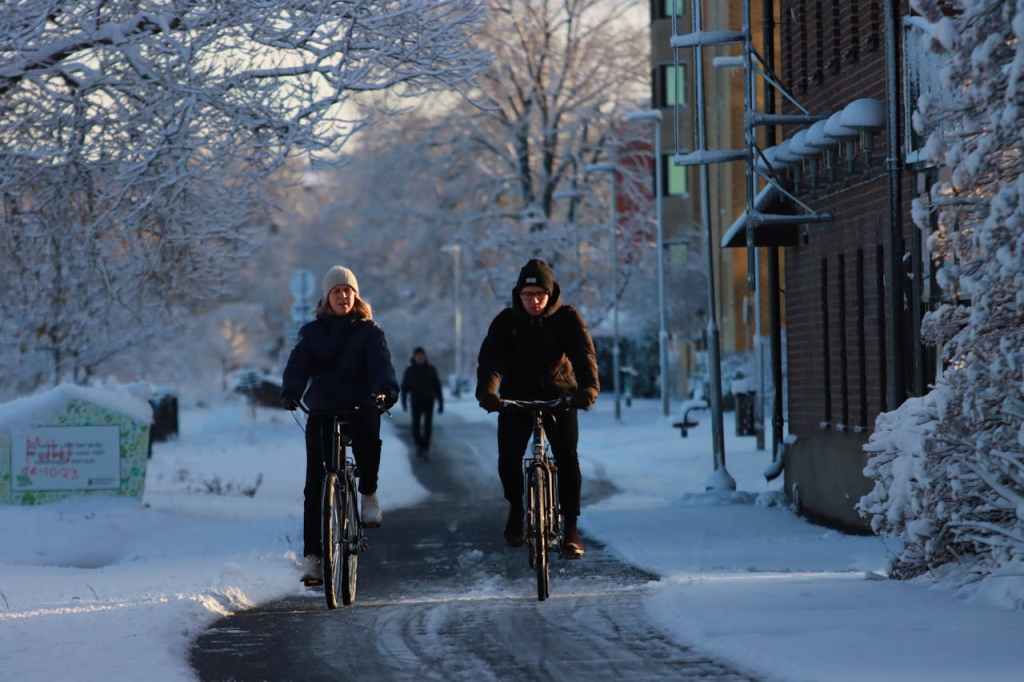
Two people biking on a bike path in winter. Everything, except for the actual bike path, is covered in snow.

The section that talked about the different cities in Europe that have enviable cycling infrastructure was fascinating to read. I empathize with the author’s struggle with not finding the perfect ‘silver bullet’ solution that can be easily copied over to North America, especially in cities that are much bigger compared to the smaller Scandinavian cities. A common pattern is those European cities is the practical normalization of biking all year long, which makes the seasonal switch to winter biking more manageable. The cities described made me realize the truth of the advocacy statement I’ve heard so many times here in Edmonton: build it and they will come.

As someone who doesn’t cycle, the chapters of the last section resonated with me the most. The author started to probe deeply on how pop culture and casual interpersonal interactions over the decades talk about winter so negatively. This I completely agree, and I find a bit frustrating. The pity that people cast towards me when I said “I walked less than half an hour to get here” is so intense. Music, media, TV, movies and songs definitely portray winter as harsh, relentless and something to escape from.

He argues that our negative impressions of winter are holding people back from something positive (or even practical) like winter cycling. I’d say that it is also holding people back from doing even just short walks in the winter! As an immigrant, I have had enough stories and warnings about how awful winter is, so this definitely tracks.

Edmonton had an initiative now for a few years called Winter City Edmonton, to encourage people to seek out interesting and exciting activities to do during winter, such as the winter festivals. And this year, the encouragement also had a different direction, to get people to do more of the typical fun activities but with a winter twist, such as going to a restaurant with a winter patio. I think that the next step should be encouraging doing everyday transportation while being prepared for winter, not wanting to escape it as quickly as possible. With heated cars (that even have heated seats and heated steering wheels), well-insulated buildings, and high-tech cozy winter wear might have contributed to people rejecting the notion of winter altogether, rather than having a practical mindset of it being a regular part of the day. This is what is needed to encourage people to have infrastructure to make walking and cycling manageable all year long. To quote the book when talking about cycling in those European countries “I found a similar practicality: winter didn’t seem to be the enemy, it just was.

I really enjoyed this opportunity to learn from a long-time winter cycling enthusiast what my husband went through, and what the passionate folks in the city are talking about. I know in a few years I would consider getting a bike again, but for now, I feel more informed in understanding where people are coming from, as far as the other transportation methods that don’t involve the car.

So thank you! I hope your biking this year, now that the snow is gone and I think we are past the second “false spring” is going well so far. Maybe my husband will see you on the trails or roads, and perhaps I also will in the future. I bet that if the Coffee Fridays YegBike community has a book club section, they would talk about this book. It’s safe to say, they probably already had.

Who To Call for Help? You Don’t Know?! – Captive Transit User Series Part 17

The inside of the regular sized Edmonton transit bus. The front area near the driver's compartment has no information or printed signage about the Transit Watch contact line.

By: Giselle General

This is part of an ongoing series of posts discussion issues I personally encounter while taking public transit in Edmonton. Links to other posts will be added on an ongoing basis:

What is a Captive Transit User? I learned about the term for the first time from the City of Edmontonโ€™s website. The easy definition is: someone who takes public transit because itโ€™s the best (or only available) option for them to travel around. The part about feeling โ€˜captiveโ€™ comes from the restriction that sometimes comes up, perhaps because one is too poor to own and maintain a vehicle, one does not know how to drive, or for medical reasons, cannot operate a vehicle. In many ways, I relate to this a lot. Though Iโ€™m pretty fortunate to afford the occasional taxi ride, and with my husband having a car.


In my first few years in Canada, I had to learn how to keep track of all the different phone numbers, watch lines and apps for reporting different issues. In fact, because I knew that this can be confusing for other people, I’ve written a resource articles on this subject a few times for multicultural media outlets in the city. It can be hard to tell right away what constitutes an emergency. When someone is in the middle of an unsafe situation, regardless of whether someone’s bleeding or not, everything seems urgent.

Frankly this is why I have major concerns that the information to ask for help when taking transit can be hand to find. If my personal feedback can be summarized in one word, that would be consistency.

Consistency on where the information can be found, both on the buses and LRT vehicles, would be handy. When I used to take the LRT more frequently, I eventually trained my eyes on where the emergency buttons and alarm strings to ask for help are located. I’m too short to reach the alarm strings – but that’s a different subject altogether. Also, on a 25- minute trip which is typical for my travels, there had been the rare occasion when the same automated robot voice that announce the next LRT stop would also talk about Transit Watch, the phone number where people can call or text if they feel unsafe.

But unfortunately, for those who take the buses, this information is definitely hard to find. On top of the fact that Transit Watch is actual full 10-digit phone number instead of the 3-digit ones like 911 or 311, so it’s not something that people will instinctively remember and dial. I mean, even I don’t know the full number in my mind, but I had saved it as a contact on my phone. In my experience, upon entering a bus, 75% of the time I don’t see any posters about Transit Watch at all. When it does, the posters are in different parts of the overhead compartment for the posters.

In my typical 30- 45 minute bus trip, I don’t hear a single robot-voice announcement about Transit Watch as well. Back in 2023, Edmonton Transit Service had a marketing campaign encouraging people to take one of six potential actions when they see harassment while taking public transit. These posters were in many of the buses but not as much these days. Although I was relived to see it a dozen times so far this year.

Inside an Edmonton transit bus, with a poster about Transit Watch 780-442-4900.

In transit stations, not all of them have a PA system to blast audio announcements. In the places that do, one of which is the South Campus LRT station, I have heard a few robot-voice announcements for different topics, including bus delays, scheduling changes, and even encouraging participation on Stuff A Bus. I have heard a handful of times about Transit Watch. But how about other locations? Sure, it is a temporary station, but I think it’s important to have more visible signs and reminders at West Edmonton Mall transit station for example. It truly would be nice to have a consistent approach in every transit station.

I have taken bus trips with the smaller community buses as well, and I don’t recall seeing a poster about Transit Watch. It’s been a few months since I have taken an On-Demand buses which are much smaller, and I know there’s no space there for paid advertisement or even a small bulletin board. Perhaps a decal or sticker somewhere prominent can be strategically placed somewhere. Or maybe even a QR code that’s quite popular these days.

The inside of the smaller-sized Edmonton Transit bus, the shuttle bus along Jasper Place Transit Centre. There is no poster for the Transit Watch number because there's no good space to put one.

Consistency builds trust. I think if there’s more consistency in communicating that 1 – harassment is not okay , 2 – reporting unsafe situations when taking transit is truly worth the effort, 3 – the contact number is repeated often enough while people are taking transit that they might eventually memorize it, and 4 – that the person who reported can see the resolution, perhaps people could be more understanding about unpleasant situations about taking transit. I agree with what the City officials had said that majority of public transit trips happen successfully, on time and no issues. But for the times when it does, people need to trust the system for reporting and the response to it. This starts with knowing when and how to report.

In Pictures: Indoor Garden Maintenance in Winter

By: Giselle General

On a previous post, I mentioned about our monthly routine to take care of all our indoor hydroponics gardening that we named “Plant Maintenance Day”, which we just completed today. I thought it would be cool to show a glimpse of the process to make sure that the plants are as healthy as they can be and that the equipment lasts as long as possible.

Newer models of the Aerogarden are much easier to clean, just like this oval shaped unit with no strangely shaped components inside the water basin. This basil plant looks overall healthy, although the slightly brown shade of the roots is a slight concern.
This Jalapeno plant is getting tall, and the clear roots is a sign that it’s healthy. We just harvested dozens of peppers a few weeks ago and there’s more that are developing. It is nice to see the roots while I washed the underside of the plant unit.
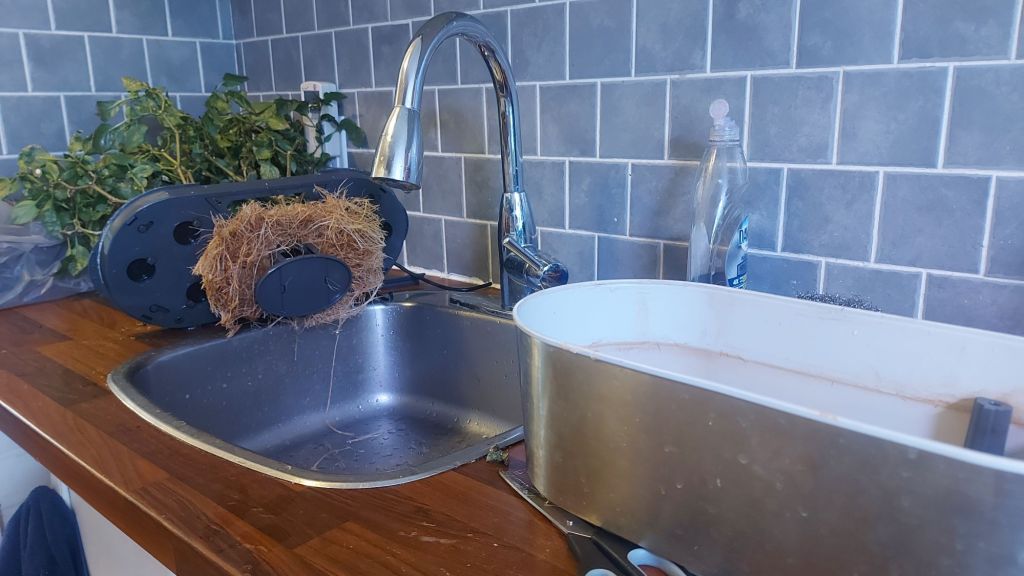
I’m so relieved that our sink has one of those faucets with a movable spout as it makes filling water in containers easier, including for the planters after washing them.
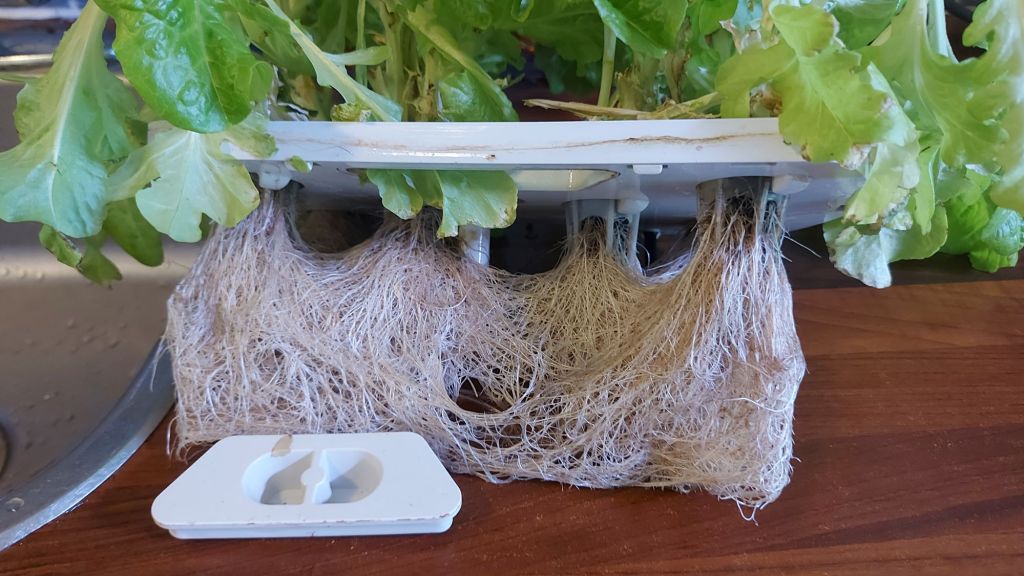
I guess there is strength in unity! This long Aerogarden unit where we planted all six pods with lettuce, had their roots intertwined with each other. I just needed to trim the bottom a little bit because if the roots fill in the container (which has happened before), the plant will start to get ill.
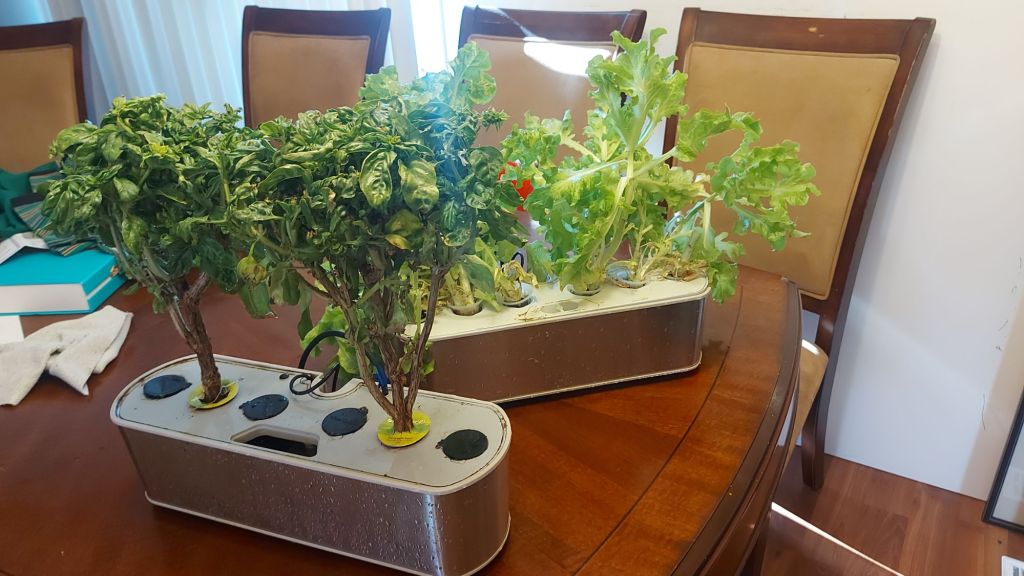
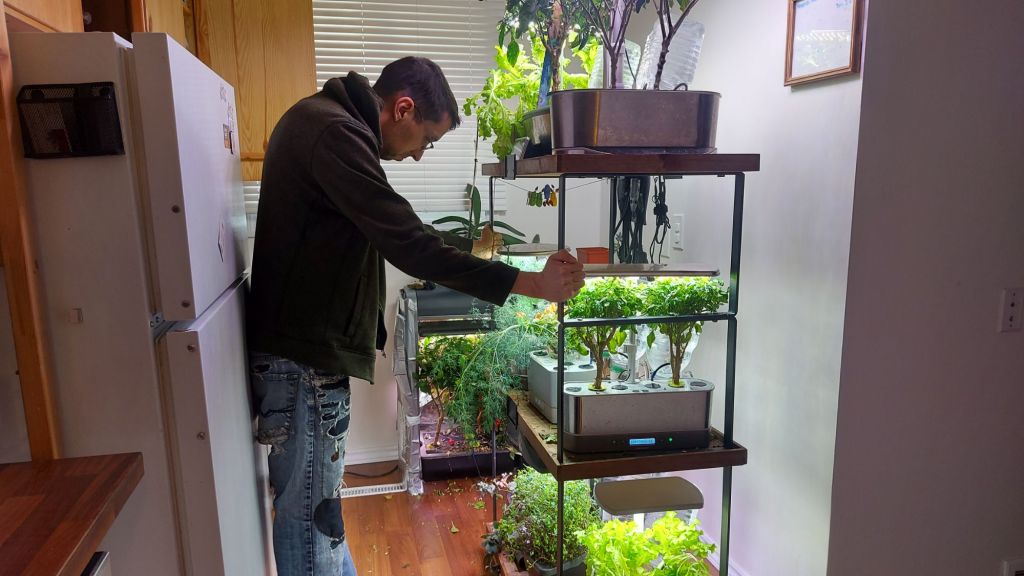
It’s a production line cleaning all the 12 Aerogarden units. After I finish cleaning them and re-filling with fresh water, I place them on the dining table, ready to be returned to our plant shelf.
These bright and white roots are a delight to see under the other Aerogarden unit we planted with lettuce. Two of the planters with lettuce is the perfect amount to make enough salads for the husband’s work lunches for the week.
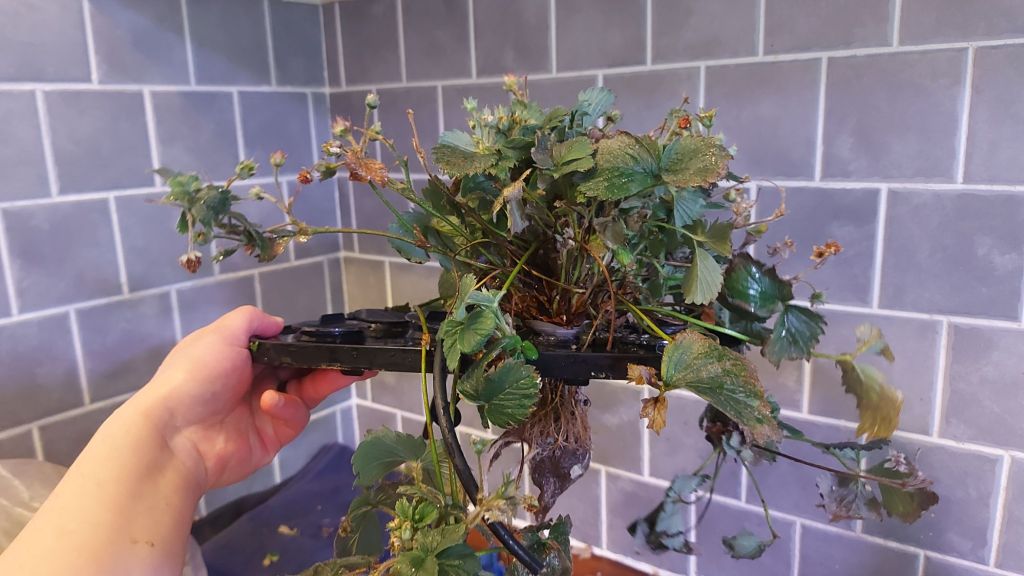
This strawberry plant is not looking well at all. It looks like strawberries are not a good fit for hydroponics gardening of this style. But we wanted to give this one more chance, so it goes the usual treatment of getting the roots washed as well as the whole planter.
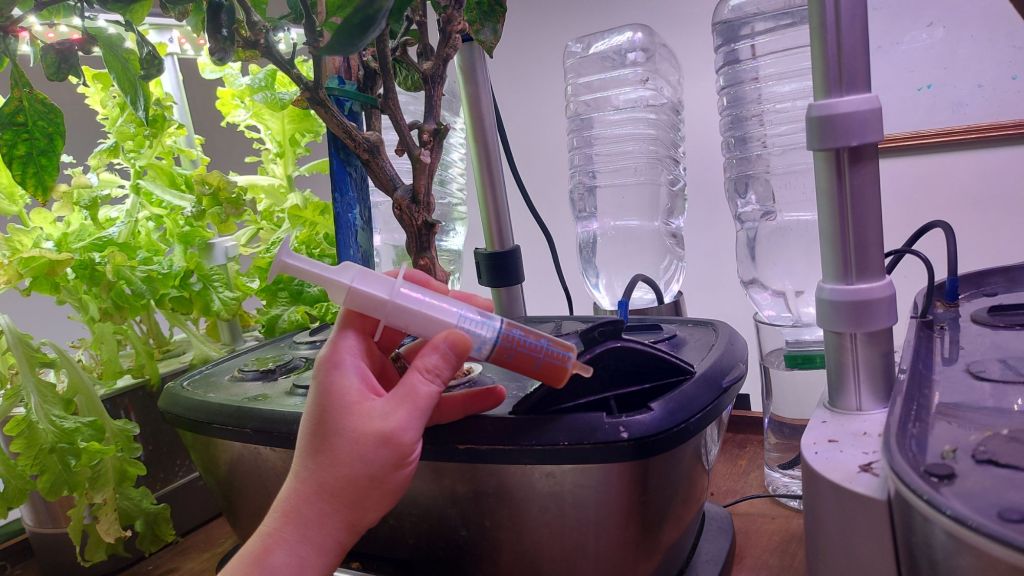
After each planter gets fresh water, they get a new dose of fertilizer as well. A syringe makes measuring and placing this liquid very easy.
This planter is the top shelf, so it’s about five and a half feet high and I had to reach with a step stool. While this is a good spot to put the fertilizer in, I just had to go with whatever hole I’m able to reach and see clearly.
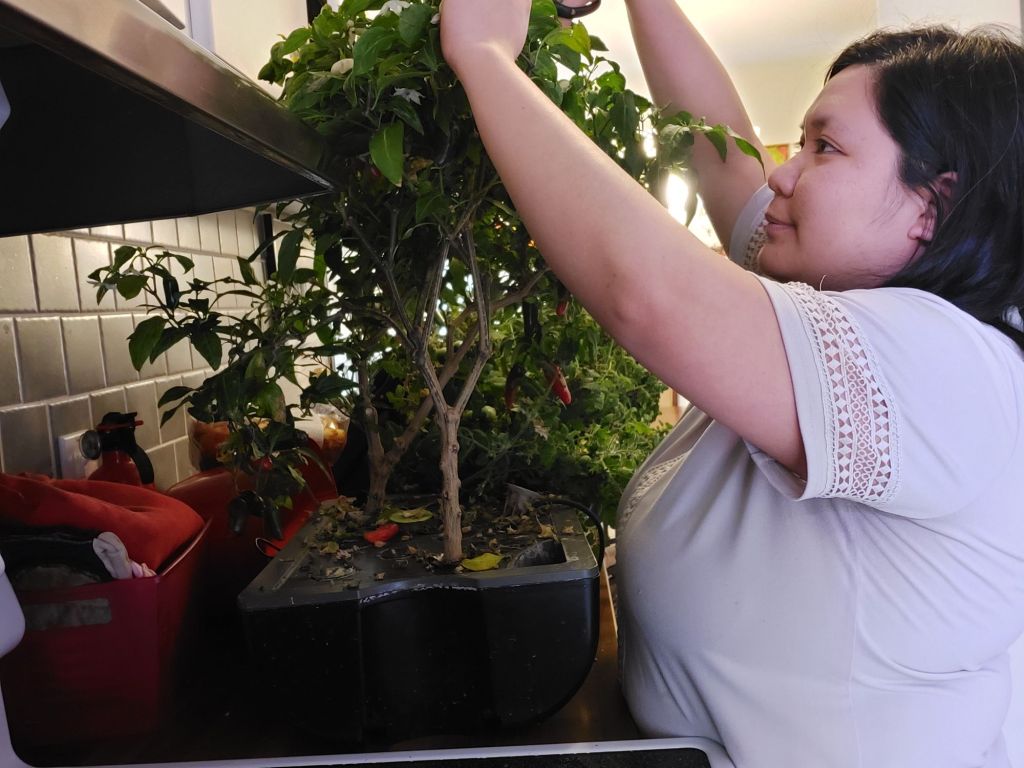
The height of all the plants need to be limited, otherwise they will hit the top panel with the lights and the bulbs get damaged. So this one got a very aggressive “haircut” from me today. Then I harvested all the peppers that were turning red.
And after cleaning off all the random plant leaves and dirt that have fallen off during the cleanup, the plants are happy for another month!

It’s remarkable how we have been doing this for almost three years now. While working side by side today, he asked me if I would consider outdoor gardening. I said not anytime soon, because I truly enjoy seeing the greenery all year long, as well as the delicious harvests that we get. As long as we have the energy to do the detailed cleanup once a month, adding water and fertilizer as needed, and harvest regularly before the fruits get overripe, we’ll keep this routine as is.

The Transit Advocacy Group Is Here! The Captive Transit User Series Part 16

By: Giselle General

This is part of an ongoing series of posts discussion issues I personally encounter while taking public transit in Edmonton. Links to other posts will be added on an ongoing basis:

What is a Captive Transit User? I learned about the term for the first time from the City of Edmontonโ€™s website. The easy definition is: someone who takes public transit because itโ€™s the best (or only available) option for them to travel around. The part about feeling โ€˜captiveโ€™ comes from the restriction that sometimes comes up, perhaps because one is too poor to own and maintain a vehicle, one does not know how to drive, or for medical reasons, cannot operate a vehicle. In many ways, I relate to this a lot. Though Iโ€™m pretty fortunate to afford the occasional taxi ride, and with my husband having a car.


The name Edmonton Transit Riders (ETR) sounded very much like the city group where I volunteered for six years, the Edmonton Transit Service Advisory Board (ETSAB). But they are different and once I heard about ETR, I’m very happy that they exist.

Over many years I have observed different ways that people use their voice to advocate for improvements in our public transit system. There are people like me that use our personal social media platform sharing our own individual experiences and opinions. There are people who create anonymized accounts with a group name to build an impression it is part of a collective of thoughts who care about a common goal. There are people who join established organizations or groups to share their time, energy and insights in a formalized way within the city government’s system – I’m talking about ETSAB here. And there’s ETR, the external organization who wanted to combine the power of being a formalized group willing to mobilize in a wide range of ways to make public transit better.

A selfie of Giselle and Danielle Witte, board chair of ETR, in front of the under-construction Meadowlark LRT Station.

Sometime in the fall, Danielle Witte, the board Chair of ETR contacted me for a meeting to learn more about what I mentioned above, how current groups have been giving feedback to improve public transit. I offered a unique kind of meeting – a walking meeting where we discussed his questions and I gave him a tour of the West Edmonton LRT construction sites from future West Edmonton Mall to the future Meadowlark Station. I told him how excited I was for the group, and that ETR, ETSAB and the actual public transit city employees for ETS have a lot of positive opportunities to work with each other.

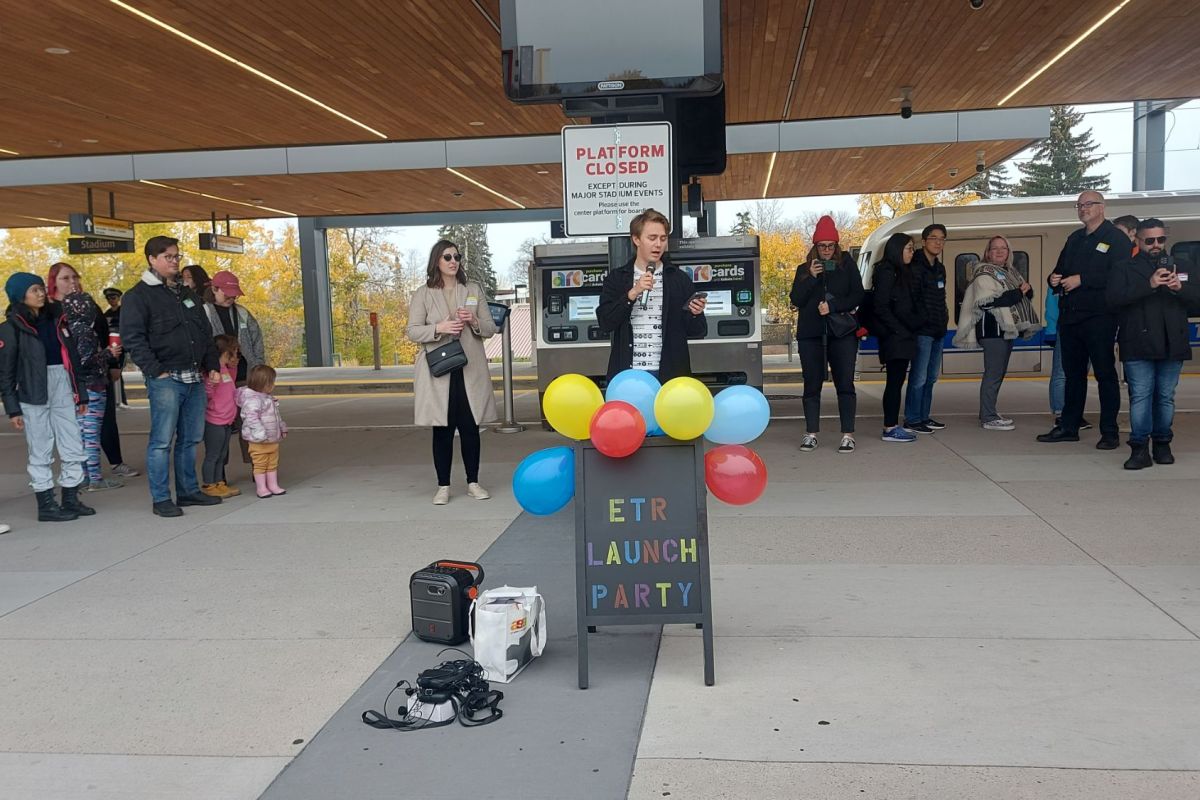
On October 20, the group hosted a official launch party which included an announcement with speeches, and then a private tour of the Blatchford LRT station that is not yet open to the public where the attendees can connect and chat with each other. It was nice to see the current board chair of ETSAB, actual representatives from ETS, city politicians, and other people enthusiastic about transit.

Giselle taking a selfie in front of the Edmonton LRT Blatchford station, during a private tour as part of the Edmonton Transit Riders launch.

Interestingly enough, I remembered a discussion about the Blatchford station during an ETSAB meeting, and see the station still not being used was a reminder that our recommendations to city staff sometimes get implemented. It does make an impact.

In some ways, the word hype feels superficial, but with what ETR is doing, I think building hype about public transit is not only just a good thing, it is an excellent thing that is very much needed. There’s a lingering disdain from everyday people about public transit, combined with an undercurrent of classism and car culture. I’ve said countless times, people complain about hiccups on public transit too quickly and harshly but if those experiences are tied to their driving experience, people are more forgiving.

When I was chatting with the ETR volunteers and board of directors, I was amazed that they were planning to go to Ottawa for a conference about transit. There’s a lot of flexibility they have that made me wish I had something similar when I was with ETSAB. Then again, ETSAB is a part of the city and funded by taxpayer money, so I understand the limitations that where in place. It is nice though that ETSAB board members get a chance to attend the Canadian Urban Transit Association fall conference every year.

Front view of the Blatchford LRT station. Crowds of people are by the platforms observing the space.

One thing I really appreciate is that both organizations seem to have a relationship with the staff of the city’s transit system. Everyone seem to have a well-known common ground of sharing the desire to actually make public transit better.

In future years I eagerly look forward to seeing more of what ETR does. I subscribed to their e-newsletter and social media accounts and they are a lot more public with their advocacy which is fantastic. They had several media interviews, organized an automated e-petition to speak about the low-income transit programs, and had plans to advocate to the provincial and federal orders of government. It’s quite remarkable. Once the actual transit department launches their merchandise line I bet that the ETR supporters would be the first in line to buy or market these items ala influencer style – yes that includes me.

Looking back at the LRT launch for the Valley Line East last November 2023, it is nice to join along a group of fellow transit nerds. If I am lucky enough to be the next city councillor of my area of the city on the west end, I’ll be thrilled to organize the official launch or tour of the LRT along with them! The warm drinks, train-themed cake and ceremonial scissors would be on me – unless someone beats me to it which is very possible!

Love Language Reflections: The Annual New Year Budget Deliberation Day

By: Giselle General

Most people plan elaborate parties, find a fun public event with fireworks and a festive way to count down to midnight, some even post a long heartfelt social media posts with photos taken throughout the year, others may claim that staying at home to have a restful night is the best way to spend the day. There’s a wide array of things people do to bring in the new year.

For my husband and I, we eagerly count down to our distinct personal occasion, that we tell people about it. Do we look forward to this day with the same enthusiasm as our anniversary? It’s possible!

It’s our annual Budget Deliberation Day! It’s when we wait until the last business day of the year for our online purchases to process, add all the information in our budgeting software, assess our expenses for the past 12 months and then set our budget for the upcoming year.

When a colleague asked my husband what activities we have planned for the holiday break, he mentioned about Budget Deliberation Day. His colleague claimed “if my spouse and I do that, we will get divorced!” I can see how that can be the case for many couples and families. It’s difficult to talk about money. Having what could look like a business meeting to talk about an integral part of our personal lives, can feel coldhearted and harsh. I suppose for my husband and I, that is the point of having a dedicated day and process for this, it eliminates stress and anxiousness because it is predictable, safe, calm and with a mindset of informing and supporting each other.

We did not do this right away after we moved in together. What I do know was when he bought his own home for the first time, he also got a budgeting software. Just as boyfriend-girlfriend at that time, whenever I come over to his place, he would eagerly show the charts and graphs of his income and expenses and the sub-categories for each. During this time I was living with my relatives still, who didn’t have a system about budgeting that they taught me. So I was winging it as a young adult in my 20’s, using spreadsheets and even the free version of the Mint budgeting app at the time.

When we moved in together I still used my own system, including the built-in budgeting interface that was part of my bank’s online banking. Year after year, the boyfriend – then turned common-law partner – continued to show me the software, gently encouraging me to finally give it a try. When my bank removed the budgeting section off their online banking, I figured it is time to do it. If we are going to build a life together long term, might as well have an easier way to discuss finances. After all, we are “team communicate!”

So what happens during budget deliberation day? Not a whole lot actually. Since throughout the year, we regularly add our budget information in the software, we already have a good sense of our income and expenses. It’s not like we have no clue what is happening and have sort through 12 months of information. We check the long term information such as net worth, investments, money we can easily access and withdraw. We check our income and expenses to see how much they match up with what we have anticipated at the beginning of the year.

One very important thing to note is this is not a time to shame each other, and ourselves, if we went over budget on certain categories. Since we are not in debt and have some money in our chequing account, we know that going over budget is not going to hurt us in the long run. It could be just a sign that for next year, we just need to increase the budget in that category.

Our categories are not identical either, and that is not the point for us anyways. For me, I wanted to clearly see how much I spend on groceries compared to eating out, so those are separate categories. For the husband, eating out is combined with the rest of his “fun personal” expenses category. For the longest time it was difficult for me to set boundaries about giving financial help to relatives overseas. Setting the budget for that category and assessing it every year helped me set boundaries so I can help wholeheartedly without being resentful, and without compromising my financial goals. Besides, if I get into financial trouble, no one from the motherland can help me.

We plug our computers onto the monitor and show each other the software page, the chats and the numbers. We might have to ask to raise a budget category. The whole thing takes about two hours tops. Today we finished right before lunch, and that’s with both of us sleeping in.

The software is not the fanciest one around but that never mattered to us. The colours are straightforward enough, and the charts in different formats (line, pie, bar, doughnut, custom) are fun to read. We have this in our computers, so not an app on our phone, which I think prevents us from obsessing about budgeting in a toxic way.

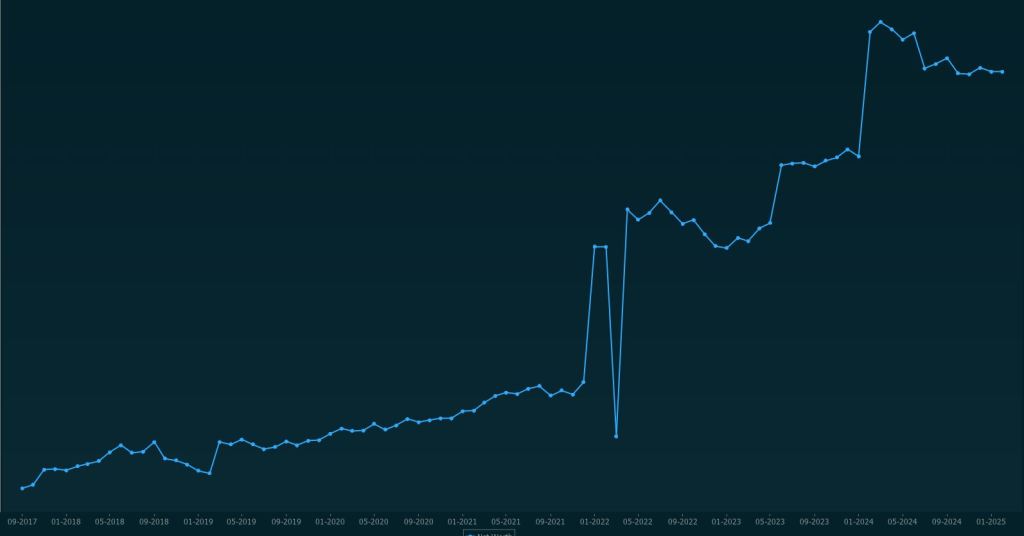
He’s used the budgeting software for 15 years now, and I have for seven. I think the most fascinating realization for me is how the numbers and charts tell a story. In his net worth chart, the largest dip in the line graph was when we traveled overseas for the first time. He had to spend a lot of money and also lost wages for three months. For me, the steepest decline in my line graph was when we downsized from a single family home to a town house and I used my savings to pay for a portion of the house. It’s so worth it though – because we were mortgage free afterwards!

Budget Deliberation Day is also an opportunity for us to talk about potential big expenses for the upcoming year. This helped us plan for a new roof, hot water tank and furnace. This helped us plan for our big adventures, whether it is travel, changing careers while ensuring we can pay our bills while finding a new job, running for politics, or aggressively increasing our retirement savings. I personally think that unexpected financial surprises, especially the type when the other person can claim “you could have talked to me about this sooner because you knew!” is what causes conflict between couples, not the actual numbers being shown in the budget.

It’s truly a solid way to start the year, secure and confident in my ability to be financially aware, appreciate my spouse for his diligence, and look forward to our future together.

Memoir Writing Reflections #9: The Paid Services are Done!

By: Giselle General

During the Writers Guild of Alberta 2024 conference where I spoke in a panel about memoir writing, I mentioned that a big driving force in my decisions is fairness in compensation. The moderator of the panel seemed to appreciate how much I emphasized paying people properly for their efforts. In an area where people are typically underpaid, if they are paid at all, I vehemently refuse to add to the exploitation of artists.

That was why I really appreciated the advice from my writing mentor Wendy, that I can – and should – apply for grants. It didn’t even occur to me that I can get money to cover expenses I needed, let alone have money to pay myself for the efforts beyond writing the book.

Based on my online search, I concluded that I needed a developmental editor, a line editor, and a copy editor. What they do are related to each other, but are also distinct. This resource (written for a Canadian audience from a Canadian webpage) can help provide clarity on the differences of each. I contacted several editors using both the directory I found online and also contacting a facilitator of a writing workshop that I enjoyed. After getting quotes and plugging in the numbers on the grant applications, I clicked submit. I had earlier success with a smaller grant, but these ones are different, with a complete budget breakdown for each expense. I agonized on how much to add in the subsistence category until I decided to allocate a partial subsistence since I won’t be doing this book project full time. I hoped that my explanation that I contacted three sources for a quote for each editor service was both believable and accurate. I told myself to wait patiently, doing as many self-edits as I can until the professionals take over – if I can can hire them, that is.

A woman browsing their laptop, with books and a coffee on their desk.

To my surprise, my grant applications got approved. The money I asked for is also a pretty decent size, about tens of thousands of dollars. I would have been content to be approved the money I needed to pay myself a partial subsistence (some kind of living allowance for doing this work). But I got exactly what I requested, to the penny. Right after the agreements were signed and the money got deposited, I contacted the first editor right away, worried that after three months that they have other projects and won’t have time to mine anymore.

Thankfully the developmental editor was available, a fellow Filipina-Canadian who is deeply involved in social justice, arts, and literary community in Ontario through an initiative called Living Hyphen, supporting the creative expression of hyphenated Canadians like her and me. When she gave her quote earlier she even offered to give a discounted rate in case finances are an issue, but I placed the full amount in the grant application and now that I got it, I’m ready to pay that full amount. We had to sort out timezone differences for the video calls and sent several emails back and forth to ensure the contract details worked for both of us. We agreed for her to have three months to do the review since she needed to read the whole manuscript to give the big-picture and structural advice that the developmental editor is supposed to do, while tolerating my countless grammatical mistakes.

When I received her very detailed report on what to consider before the next round of edits, I asked her a very vulnerable question: “You know how in our culture, we are supposed to obey the elders and authorities without question? I feel unsure about your report. Am I supposed to obey and follow them all? Am I supposed to do them and send back to you for approval?” I’ll always treasure her kind response to this. “Whatever you decide is up to you. You have the final choice to accept, reject any or all of the recommendations. It’s your story.” Definitely worth every dollar I was able to pay – thank you funding grants!

After a few more discussions where I realized she didn’t understand something major in the story, I knew I had a lot of work to do. While doing all these edits, I contacted the line editor next – the one who would take up the challenging tasks of editing the grammar, line by line. This person is not a Filipino – which I did on purpose because it is important for a native-English-speaker to understand the story and to flag Filipino references that are unclear to her. With how the scheduled ended up falling in place, she had to edit from mid-December until early January. I felt a bit guilty and emphasized that there’s no need to work through this over Christmas break. But she seemed okay with doing it. After all the hundreds of verbal tense edits she did on the almost 90,000-word manuscript, I gleefully e-transferred the payments.

A month after the line edits were completed, I contacted the person I chose as a copy editor, a fellow Filipino-Canadian in the local literary community in early 2024. This is my third professional editor so I kind of know the motions: preliminary meeting and discussion, contracts, payment details, sending a copy of the manuscript, and then waiting patiently. Through him, I saw the clear signs of a professional who cares about outcomes and not just getting paid. He booked a meeting with me to flag his concerns, believing that my manuscript is not ready for copy-editing just yet since there are certain parts of the story that he had trouble understanding. I told him my short-term goals which is to have a manuscript and templates of documents to contact agents and publishers.

So we had to change our scope to help achieve that – to do some line editing and copy editing of the sample chapters I will send, to do another set of line editing on the chapters with sensitive content, and to help me draft the content I will send for applications to get the book published. Think of it as a resume-writing service, but the applicant is me as a writer and the story of the memoir. All these cost a bit more, but with the grant funding I got, I was able to make some adjustments.

Once his edits were completed, the literary conference took place. The organizers did a fantastic job with the panel, as the first panelist had at least two memoirs published and bunch of other books, the second panelist had one memoir published, and there’s me who just finished the professional edits of the manuscript. Maybe I’ll reach the same achievement as the other two, but for the audience it was helpful to listen to writers at different stages.

A wall in Giselle's office with a sticky note with writing notes, a sheet with brand new jeweled stickers, and a sheet used as a tracker for editing book chapters.

Given the extra funding I got, the first consultant-based reading service I used was the Manuscript Reading Service of my province’s writing guild here Alberta. As I paid the fees and waited for the manuscript to be reviewed, I took my mind off anxiously waiting by doing other visual artistic projects, mostly upcycling. I particularly liked the pay structure, how reviewer gets most of the payment. The review I received was insightful.

After I went through another round of self-edits, it’s time to do the other professional service I never thought I’ll have the funds for – beta readers. Their role is to read the the manuscript and assess it as a โ€œregular readerโ€. I did this for a Canadian author a few months ago and it was a pretty cool experience. I admit, I had an โ€œimposter syndromeโ€ moment and wondered if my time and effort reviewing the document, and my insights condensed in a four-page report, were worth the fees given to me. It was a process to re-frame my mindset. Consultants of all sorts are paid for a reason, so I deserved that fee as well.

For my manuscript I ended up having three beta readers, a writer based in the US, then two people from my city, a non-Filipino person I know through my other community service work, and a Filipino person with a education in writing. I sent them the same set of questions about their experienced reading the book and their responses were quite different than I realized. It’s exactly the feedback I needed because my story has very Philippines-based context, that would be published in a country outside of my motherland (if I get lucky), with a diverse audience. Until now, I actually have a lot of decisions to make on whether their opinions will sway me enough to edit certain book chapters. Or perhaps I should wait until an agent or publisher reads the sample chapters and we can work through the rest of the edits together.

I joked a few times that dealing with grants is the worse combination of applying for jobs and doing your taxes, including the need to report what you did with the money at the end of the time period. For the first art funder I submitted my report and it was accepted, which meant that my recordkeeping was organized and they clearly understood where and how I spent their funding for this project. As this year comes to a close, I am preparing my final report to the second funder as well.

It’s still so humbling to think about the financial access I was able to tap into, and because of that, I was able to pay all these professional writing services the amount they asked for. No haggling, not undercutting. This whole experience for the past year and half drives my motivation even more to get this story to the finish line, to its final published form.

Back view of Giselle in her office desk using her computer.

Life in the (Slow) Swimming Lane: Conquering the Deep End of the Pool

By: Giselle General

In December 2023, so about a year ago, I decided to finally work on something that eluded me since I was a kid. The ability to actually finally stay afloat and tread on the deep end of the swimming pool. I figured that there’s no better place to do this than the place where I used a swimming facility for the first time over a decade ago, the YMCA on the west end.

I grew up in a mountain village in rural Philippines, where swimming pools are nonexistent. The hot spring resorts in the nearby mountains are not the optimal place to learn how to swim properly as they are designed for large groups that go there to socialize and splash around on waist (or chest) deep water. When I moved to the city, the school I attended didn’t have a pool despite it being a private school – only the more expensive ones had them.

When I moved to Canada at 16, I never heard any invitations to check the pool at my high school, so whether our school even had a swimming team or the related facilities will forever be a mystery to me.

Back in 2011 at age 20 out of my own initiative I finally went to the YMCA on the west end. I forked up the monthly fee despite being a part time student with seemingly endless expenses from my schooling, home expenses, my brother’s upcoming immigration to Canada and shopping for all the supplies he needed, and things that a young adult would like to get every now and then.

It was awkward at first. I observed other people who used the floating belt and how they swam on the pool within the confines of the plastic ropes. My hands, feet or shoulders kept hitting the plastic rope, I can hardly breathe, and I gasped loudly in relief once I reached the end of the lane. I tried to go twice a week in the summer before my shift at work started at 1 PM. But that summer flew by fast. As soon as my teen brother arrived in Canada that fall and I got admitted to to co-op placement program for my business degree in university, the swimming routine went adrift.

Fast forward to the next attempt at the pool in 2014, when I got an office job in downtown Edmonton. The downtown YMCA was only two blocks from my office and I managed to stick to my gym membership for about six months before I fell out of habit again. The workout rooms and the group exercise classes gave me a strange dilemma, and only after a few tries in the pool, I opted to do exercises that don’t require me to smell like chlorine even after taking a shower.

I haven’t thought of swimming again for many years until 2023. I noticed that my back and shoulders were hurting more often, and going for a massage once a month didn’t seem to be enough. I also found out that my new job then didn’t cover the cost of massage therapy. I needed a cheaper way to get the movement that my shoulders and back needed that stretching, dancing and pilates fail to help.

It occurred to me that my Saturday afternoons were free while the husband was away with the drinking and running group. I figured, might as well work on a fitness goal for myself too!

Since it’s been such a long time since I was last in a pool, I booked one private lesson to assess my skill level – or should I say, lack of skill. I just need to know whether I can be on the deep end while wearing a flotation belt without panicking or feeling ashamed. That was the best $45 and half-hour session I’ve spent for myself that year. The lifeguard instructor confirmed I can rotate my arms and flip my feet just fine and watched closely my awkward attempt to do the “egg-beater technique” to tread water on the deep end. “Now, all you need is practice”, he said. That I sure can do.

That became my routine. Saturday afternoons, as soon as the husband drives off, I got ready to take the bus to the YMCA. Two walls of the swimming room had clocks. I eyed on the clock’s hand rotating as I swam back and forth with the floater belt acting like an armour of courage. On my third visit, I waited until the open space with the deep end was free of the lane-swimmers, take off the floater belt and twirl my arms, legs and feet. When the water reached my chin, I’d grab onto the edge of the pool for a moment, and then let go for another try.

With more visits in the pool, I gained more seconds treading water on the deep end. 15 seconds, then 25, then 30, then 45, and then a full minute before needing to grab onto the pool’s edge. Then a minute, and then a minute an a half. The hands of the clock making a full rotation acted like my cheerleaders, beckoning me push just a little harder. The day came when I went onto the swimming lane with no floater belt, from the shallow to the deep end for a minute and swam back, and did that over and over for a half hour. By March, I finally reached the milestone of being a mildly-functional swimmer.

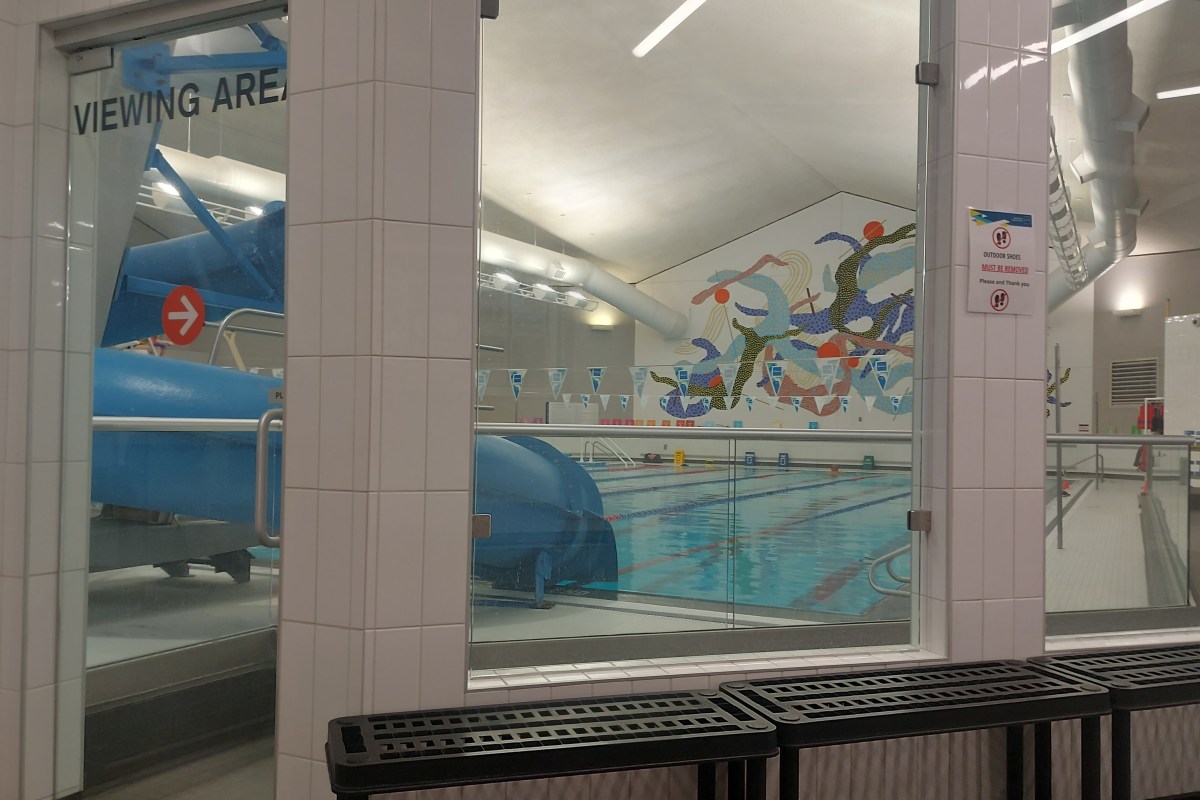
There was actually a swimming facility closer to my home. I eagerly watched the city’s webpage on recreational facilities for the pool’s re-opening. I got annoyed when the opening got delayed three times. I admit I was also losing motivation to take the 25 minute bus ride to the other pool and back. When the neighbourhood pool finally did open, it was exactly the next level of learning I needed. It’s only a fifteen-minute walk to my house and because of that I can shower at home afterwards. Literally no excuses this time.

The smell and feel of the poolwater was somehow different. A bit gentler and I loved it. The change rooms and locker spaces were much bigger too. When the entire pool is configured for lane swimming only, there are six lanes that has room for one swimmer going in both directions so it is effectively 12 lanes. On the days when I go and it is open swim time, the pool is divided into the shallow, middle and deep sections. It was another great way for me to hang out in the deep end for as long as I need to, as long as I get out of the way of those using the water slide, diving board, and rope.

Whenever I go to the pool, I make sure that I stay in the lanes clearly labelled as “slow”, so I stay out of the way from those who were zipping through the lanes at what looks like to be five times my speed. I still bump the plastic floating dividers sometimes. But at least I don’t panic and need to be pulled out by the lifeguards. As I watch other swimmers with the floating belt swimming on the lane next to me, I try to subtly beam positive vibes and prayers to them, hoping that they too will reach the milestone of feeling more skilled in the water.

Just like any habit that is supposed to be healthy, around late summer I started to fall out of habit again. This time around, my body tells me when I really needed it – no excuses. After only a half-hour swim, my shoulders and back feel much more relaxed and nimble. And at $8 per trip to the pool, it’s definitely much cheaper than massage therapy. It’s not just exercise – it’s therapy, it’s pain management. For the drop-in rate, I got a discount because of the family membership fee I purchased for the neighbourhood’s community league, which is surely a bonus.

Also since the summer I joined my husband a bit more regularly when he goes to our very unique running-and-drinking group. A 45-minute brisk walk is a good addition to my fitness routine, if I choose to ignore the snacks and alcohol that we consume at the end of route. And as always, for doing errands that are close by, I walk for up to 30 minutes one way instead of taking the bus or waiting for a car ride. The true definition of a 15 minute neighborhood that makes certain fitness activities more achievable for me.

My goal is to one day to be a more public space to test how I deal with the deep waters then. I’m thinking the WaterPark that is pretty close. Or if I get invited to a social event in someone’s backyard pool or a lake that works for me too. I’m just thrilled that I won’t need to piggyback off my husband like when we were at the hot springs in Iceland in 2018 or at the local WaterPark in 2019. To be able to carry my own weight, or at least, my body afloat in the deep end, is an empowering feeling I didn’t realized I needed until I achieved it.

Being the Human Transit Navigator: The Captive Transit User Series Part 15

By: Giselle General

This is part of an ongoing series of posts discussion issues I personally encounter while taking public transit in Edmonton. Links to other posts will be added on an ongoing basis:

What is a Captive Transit User? I learned about the term for the first time from the City of Edmontonโ€™s website. The easy definition is: someone who takes public transit because itโ€™s the best (or only available) option for them to travel around. The part about feeling โ€˜captiveโ€™ comes from the restriction that sometimes comes up, perhaps because one is too poor to own and maintain a vehicle, one does not know how to drive, or for medical reasons, cannot operate a vehicle. In many ways, I relate to this a lot. Though Iโ€™m pretty fortunate to afford the occasional taxi ride, and with my husband having a car.


People unfamiliar with a transit system, whether it is because they are new to an city, a neighbourhood, or just so happened to not use transit for a specific event, benefit from the help of a fellow human who seemed to know their way around. A few times this summer, it was nice to be that fellow human, even as a stranger, to be that source of help and companionship to someone. Here’s a few stories when I by myself, or with my husband, did this to people in the city.

Edmonton Folk Festival

This summer was the first time that my husband and I went to Edmonton Folk Festival. Because we had little time between having dinner at the bar near his work by the Manchester Square, we took an rideshare to the festival location. But we decided to take the relatively-recently-opened Valley Line LRT to her back.

While walking through the green space to get to the station, someone called out to us. They seemed confused and asked where the LRT station is. My husband and I pointed to the direction that we are headed. In the spot where we were standing, it seemed easy to miss the LRT station, as the glass pyramids of the Muttart Conservatory is right close by. The people seemed relived to know that the LRT station was indeed close by, which is a great reason why the festival organizers heavily promoted transit as a way to get to and from the festival.

This is the first year that the festival is going on with the LRT access. I bet that in future years, it would be a no-brainer for most people to get to the festival through transit, either to get to the bottom or top of the hill.

New worker going to downtown

On a Thursday morning in August, I was waiting to get on my usual bus to get to downtown. A man was talking passionately over the phone, in a language I cannot understand. He hung up, browsed his phone for a few minutes and then he approached me, speaking in limited English. Asked which buses go to downtown by 109 Street, and whether the bus is arriving since it’s been late for 5 minutes. I can imagine how a late bus for a route you’ve never used before would make anyone anxious. So I told him “yes that’s the number 2, it will come soon, and we can take it together!”

The bus arrived and we hop on together. He was restlessly looking at the window to check where we are going. I placed the address of his destination on my Google maps app, and showed him the blue moving dot that symbolizes the bus. We were sitting close to the front, so I also point to him the digital screen that was showing the intersection of the upcoming bus stops. I told him, “once we are close to downtown, the screen and the audio annoucement will say.. 121 Street – Jasper Avenue, 116 Street – Jasper Avenue, 112 Street – Jasper Avenue… and then that’s when you pull the stop alert and get off. Then when you get off, you just need to walk 2 blocks that way, and you’ll be in your destination!” I finished my instructions while pointing towards the south.

He shared to me that it was his first day at his job. He shyly told me that his English is “not very good” but he will be starting classed at Norquest college very soon. I said that Norquest is very close to where he was getting off for work, so he can take the same bus and just wait for a few stops further into downtown. I shared that I am an immigrant too, only that I’ve been here for 17 years. He sounded amazed upon hearing that.

As his stop approached, I got him to pull the string for the stop request. As he left the bus, I said good bye and waved at him through the glass, while making sure I press the button again as I was getting off at the next stop. I sent a silent prayer, wishing him a good day at work as I headed out to start mine.

Lady navigating west end construction zone

One morning, I was on the bus heading to work and after a few stops, a woman wearing business clothes came in. There were several vacant seats at the front, but she didn’t sit right away. Clutching her phone tightly, she talked to the driver asking if the bus would be passing by 139 Street and 102 Avenue. He said yes, and continued to drive. She continued standing at the front craning her neck, seemingly wanting to have the same line of sight as the driver.

Only a few stops later, she asked the driver again how close we are getting to her destination. We were still on 87 Avenue, about 15 minutes away. I do know though that she is getting off on a very busy construction zone and might miss where the bus stop is.

I waited for catch her eye, I smiled and said, yes the bus is heading that way. I pointed at the digital sign above her head and said “as you can see, and you will hear, the upcoming bus stops will show on the sign. So you will hear when the next step is 139 Street and 102 Avenue and press the button then.” As we waited along the very congested 142 Street, the bus finally got a chance to turn on 102 Avenue. The bus arrived at the intersections and the got off one of the temporary-looking bus stops.

Honestly, I’m quite relived that smartphones are around. It helps communicating bus routes and travel times better. One can argue that if someone has a phone and data, people can just look at the directions and go where they need to go. But I think that the additional element of human help can provide that extra level of reassurance. Many times, I’ve seen passengers come up to the bus, show their phone to the driver and confirm, and happily enter the bus once they get the okay from the driver. But in a pinch, whether in a random location around the city, a busy transit station, or a bus stop, I enjoy pitching in when needed. It’s a fleeting moment of kindness, lasting a few minutes at most, but can help with those unfamiliar with our transit system get the hang of it.