The Construction Neighbours: The Captive Transit User Series Part 14

By: Giselle General

This is part of an ongoing series of posts discussion issues I personally encounter while taking public transit in Edmonton. Links to other posts will be added on an ongoing basis:

What is a Captive Transit User? I learned about the term for the first time from the City of Edmonton’s website. The easy definition is: someone who takes public transit because it’s the best (or only available) option for them to travel around. The part about feeling ‘captive’ comes from the restriction that sometimes comes up, perhaps because one is too poor to own and maintain a vehicle, one does not know how to drive, or for medical reasons, cannot operate a vehicle. In many ways, I relate to this a lot. Though I’m pretty fortunate to afford the occasional taxi ride, and with my husband having a car.


When people choose a place to live, they consider many important things in choosing the neigbhourhood. We knew when we picked the neighbourhood we live in now that since the LRT will literally pass through the main road nearby, that we will be inundated with the impacts of the construction for many years until the line officially opens. But what is something that many residents complain about, became something that piqued my curiosity over the years.

I’m basically like a “Marites”, the nosy neighbour looking into the latest “tea” of what is happening next door, but for an LRT construction. This transit nerd is delighted with integrating such a Filipino reference, hehe. Every time I leave my home to commute to work, it’s neat to see the changes.

Between my husband and me, our no-cost-but-super-fun date idea has been to go for a half-hour work along the construction site, observe the different holes and poles, the cranes and trucks, the cement and the metal pieces, and the people around the site. I bet my husband is truly enjoying being married to a transit nerd – no need to go far or spend a lot of money for romantic quality time, haha!

As the cliche goes, a photo says a thousand words. So here is a photo dump of the photos of the LRT construction progress because because it’s fun and nerdy

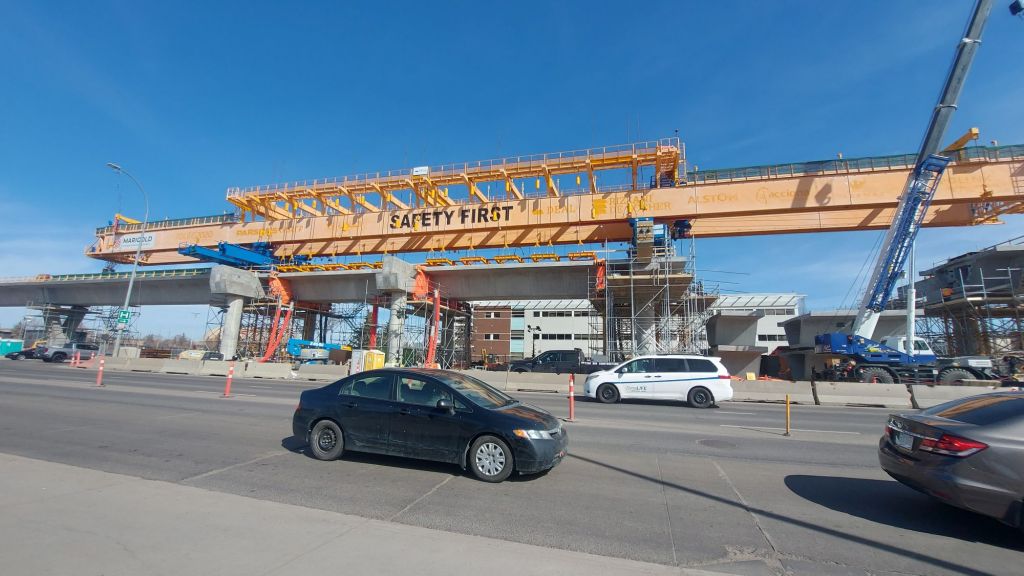
The construction zone for the West Edmonton LRT along 87 Ave.  It is winder and there's block of ice and snow along the road and construction site.
The construction zone for the West Edmonton LRT along 87 Ave. The two traffic lanes are backed up, and four pillars are almost finished construction.
The construction zone for the West Edmonton LRT along 87 Ave. The specialized above-ground crane is lifting platforms for the above-ground Misericordia station.
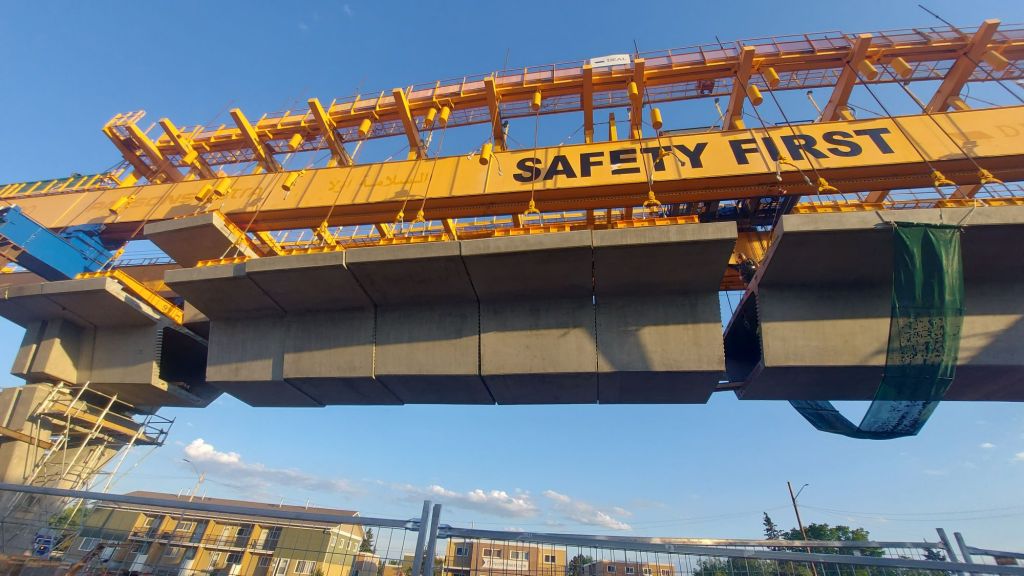
The construction zone for the West Edmonton LRT along 87 Ave.  The view is from underneath the specialize crane. 6 platforms were lifted and still have gaps in between each other.
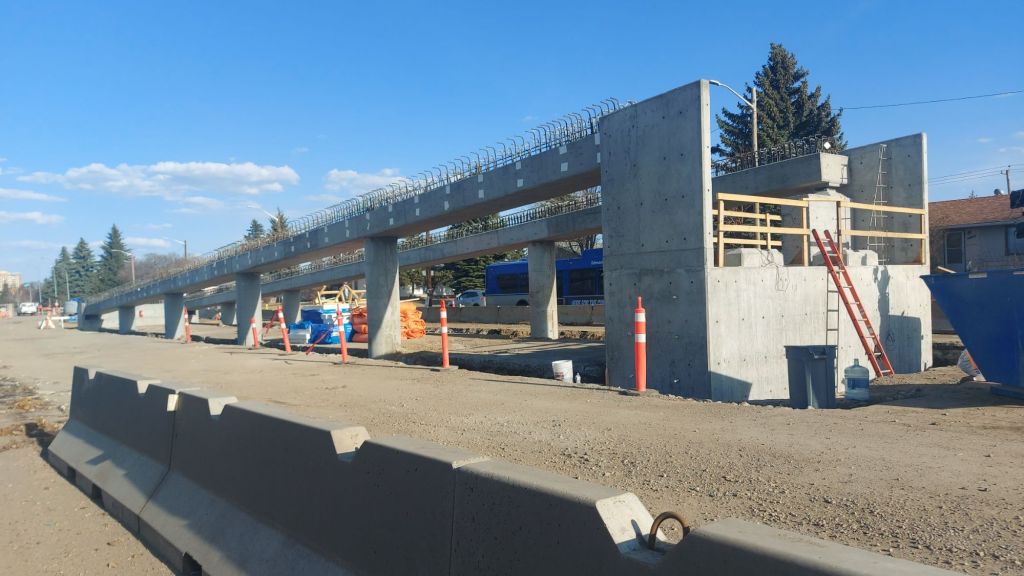
The construction zone for the West Edmonton LRT along 87 Ave. The ramp to take the tracks to street level is partially done, with lots of metal rebar sticking out.
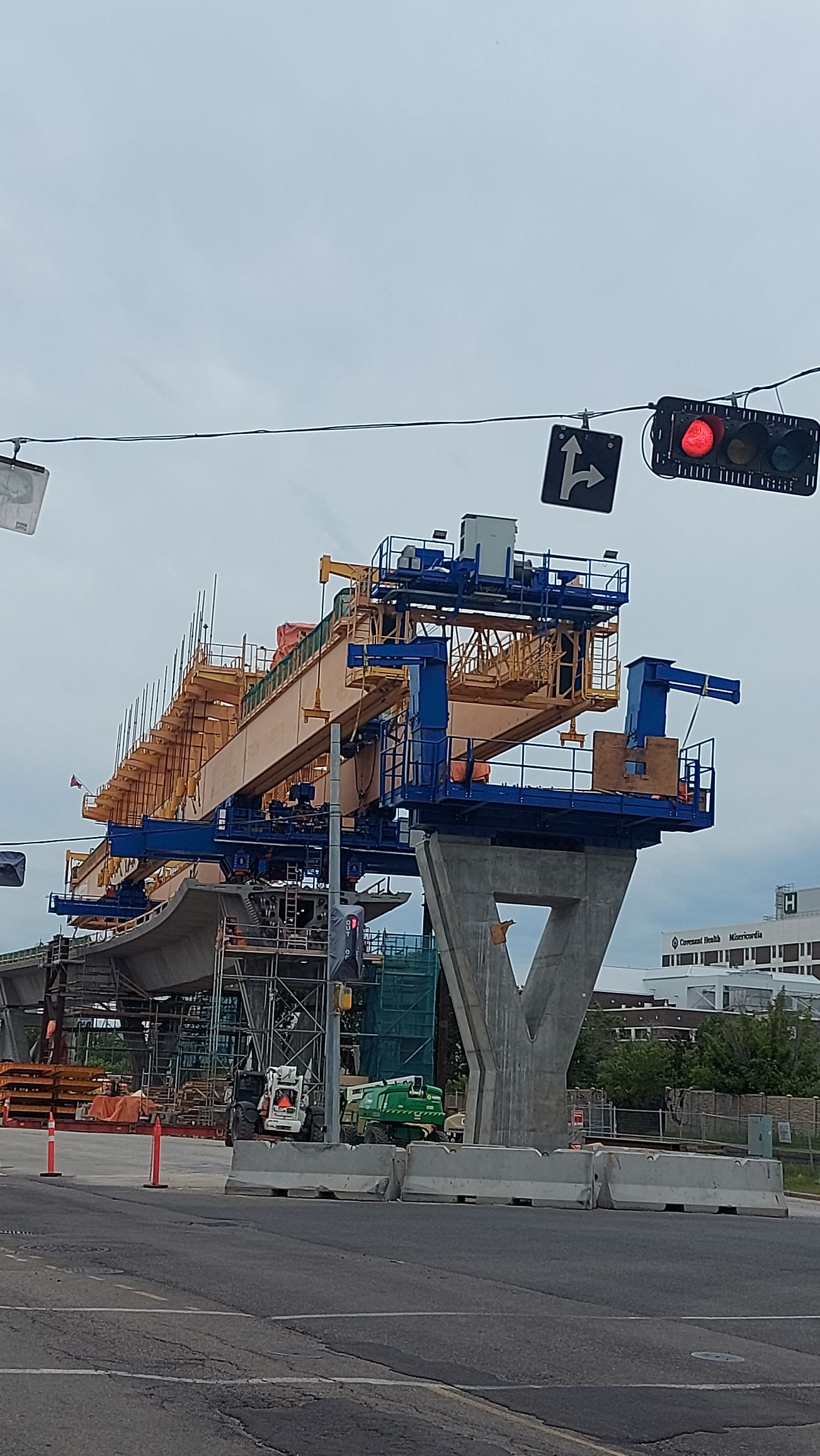
The construction zone for the West Edmonton LRT along 87 Ave. The specialized crane is approaching the traffic light on 165 Street.
The construction zone for the West Edmonton LRT along 87 Ave. A crane is parked in the middle of the site.

Frankly at this point, for very short trips, it is much better to walk – to the mall, the library, the pharmacy. But as long as the locations are literally long the main road, I can also be lazy and take the bus in one direction.

I heard many times that the construction impact north of my neighbourhood, along Stony Plain Road, is much worse for the businesses there. In fact, the City launched a campaign called “Rally for the Road” to encourage people to continue to patronize the businesses along the road, where construction makes it difficult and unappealing to park to get to these businesses. I know of a business owned by a fellow Filipino that sells Filipiniana inspired attire. I hope to visit the business someday when it is easier to travel to get there, either by car of perhaps, the newly opened LRT line!

The construction zone for the West Edmonton LRT along 87 Ave and by the business plaza on 159 Street. A sign by the fence says "Businesses Are Open During Construction"

In the middle of May, during the Annual General Meeting for our community league, we also held a town hall where staff from the city and the LRT construction company co-presented and answered questions from the neighbourhood. I really appreciated them doing this. The maps and slideshows were informative in giving both the big picture progress of the whole project, timelines for summer 2024 and what to anticipate as far as changes in access to lanes and intersections. We were given the reassurance that any concerns can be shared to them anytime, and that they have what sounds like daily meetings with the staff at the hospital to ensure access is not blocked unintentionally.

On top of that, our community league president seems to have established a good relationship with relevant staff. He managed to make a few phone calls to sort out the traffic lights nearby to help traffic flow better.

The construction zone for the West Edmonton LRT along 87 Ave and 165 Street, the intersection that will be closed for two weeks as the specialized crane finished lifting platforms for the track.

And just a few weeks after this neighbourhood meeting, my husband and I can see the large crane off our second-floor bedroom window.

We were told that our section will be finished by fall this year, then the section off the other side of 178 Street will be worked on. I will definitely miss the unique crane when it moves. And I hope that the residents who live in that area, that have been affected by construction for just as long as we are, have a manageable experience for the next few years.

Recovering Political Candidate: I spoke at a Campaign School

By: Giselle General

I thought that being an election campaign failure – as in not winning the seat I was running for – would render my efforts meaningless. So it is to my surprise that I have been requested to speak to my experiences as an election candidate. I suppose there is truth to the saying that it is through mistakes and failures that people can gain the most growth.

I personally had benefitted from election campaign schools in the past, the first being the eight-month long program by the City of Edmonton back in 2017. The very local context of that program was really helpful for me as someone who was just somehow considering the idea of bring politically active at a candidate level. The experiences shared by the guest speakers then, many of which actually won, made the experience real and human.

Equal Voice is a Canada-wide organization helping women who want to run for politics or support those who wanted to do so. The first workshop I attended was hosted by the Alberta chapter of the organization. If I recall correctly, the Alberta chapter is no longer functioning, but the national organization continues to be active.

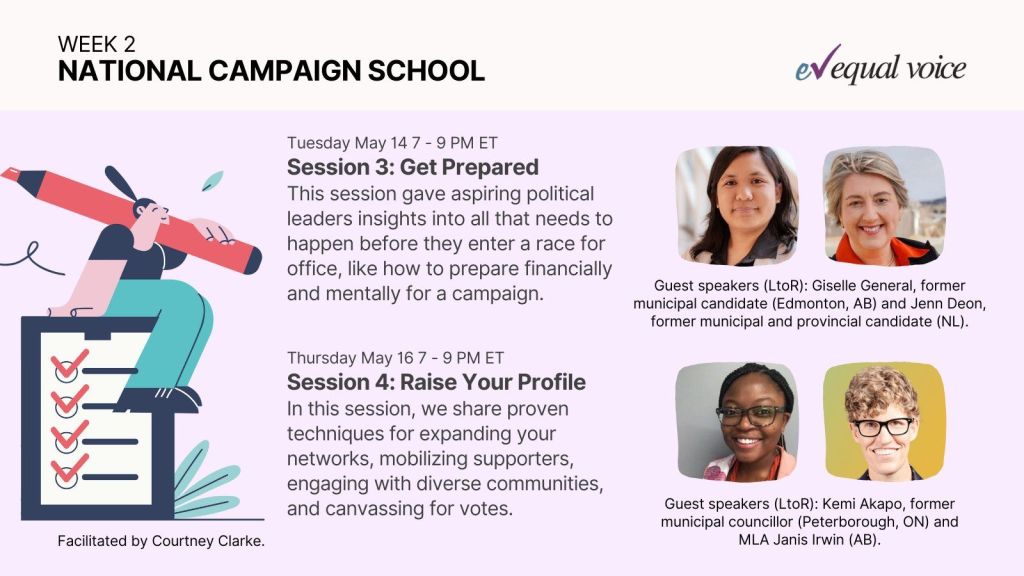
It looked like the other provincial chapters were super active as well. It was why I was so surprised when an organizer from the Newfoundland and Labrador chapter contacted me in October to speak to my experiences for their online election campaign school events. I was more than happy to share (maybe vent a little bit, haha) about what I did from 2018- 2021 to prepare for full-on election campaign mode leading to October 18, 2021.

Then in early April I heard from them again to speak on the same topic for their current campaign school. I guess I shared a few useful things last time, because the instructions I got were “just do the same things as last fall as you did great.” I’m really thrilled about the new options available now that online events are more frequent.

For those interested, here are my speaking notes, the longer version of what I shared .

  • INTRO: Even if you forget specific details, the main takeaways I’d like to share are:
    • Self awareness and using your strengths and skills as a foundation is very important.
    • Remembering there’s life after the election so consider your decisions accordingly.
    • All the things you do and life/ professional skills you have are all useful for the campaign.
    • Take inventory of your privileges and points of marginalization, being aware helps with planning and being compassionate to yourself. 
  • Conversations you had with your loved ones, your employer
    • Husband – Clearly defined role of my family members. For me, the campaign is NOT a family affair. There were some tradeoffs, but separating my campaign and family life from the get go was worth it for me. “I want to continue to be married after the election.”
    • Brother: I reassured my brother that it’s not as violent as the Philippines and (maybe) I won’t get murdered here. But if I do, my will, and life insurance, and organ donor card is up to date and they know what to do. 
    • Employer (Nonprofit Org): They knew I do a lot of community service and when I went to an election campaign school and all of my city volunteering, it’s just a matter of time. We discussed things such as what type of leave (banked vacation + some unpaid time off), how much (or little) should I publicize my employers name to protect their privacy (I didn’t use their name), and duration of time off (2 months until end of the election month – I returned November 1). 
  • What kinds of things were you doing to prepare for your campaign, in advance?
    • 2021 was my first time running so it wasn’t like I had a strict guideline or a playbook. Also, COVID-related restrictions truly influenced my decisions. I wanted to behave as compassionately and ethically as I could, so I likely wasn’t going out in public right away compared to many people. 
    • Personally, with the things I did, I never had a political objective in mind. I never thought of “oh I will do this so that when I run they will think of me at the election” because frankly even now it feels sleazy to me. My focus at the time was to continue the things I already do that has some kind of public component and sharing about what I do and what I believe in regularly on social media. On social media I did the 70 – 30 rule. 70% re-posting and amplifying content I resonate and believe in, 30% posts about what I’m interested in or doing that aligns with my values. If there’s an overlap with municipal politics, that’s a bonus.
    • I also found community service that had the overlap of 1 – things I like, 2- things I am good at 3 – some level of public profile and 4 – some connection to the city or municipal matters. Transit board, neighbourhood board, multicultural journalism, city-focused nonprofit boards. 
    • The rest are tasks that helped me in my personal life that have a positive spill-over effect for running for office (as outlined below).
  • How did you save money and for how long?
    • Saved money for 3 years (up to $17,000) so I have savings to pay the full amount candidates can pitch for the campaign, and cover my entire salary when I’m was away for 2 months.  I did this from 2019 – 2021, $500/ month and the pandemic also helped cut my expenses. I’m doing this again. I’m a DINK household who is NOT passionate about travel. 
  • How did you grow your network in advance of putting your name on the ballot, and prepare your network for this political journey you were taking?
    • For me, given I’m an introvert, yes social media helped a lot. I know many candidates are community leaders that seem to be in every community fundraiser, picnic, gala and public event. And that likely increased their visibility. But that’s not who I am. Also in 2020, opportunities are more limited and I wanted to be – and still am – COVID-cautious. 
    • I learn about people who have different beliefs by curating my social media feed (particularly Twitter and LinkedIn) strategically. I don’t argue or shame them, but I **do** read the hot takes and the comments. 
    • Also, through paying attention to the local media here, including actually paying subscription fees for a local media startup, I have deeper understanding and awareness of local political issues.
  • Any appointments to be made, or tips for endurance, mental health, physical health on the campaign trail? 
    • I went to therapy (to address personal issues which in my case is sexual abuse trauma) and had therapy on an ongoing basis throughout the campaign. Fortunate enough to find free ongoing mental health resources. Need to search and apply and wait. 
    • Not commit to any political parties at a federal or provincial level. 
    • Not be ashamed of my lone wolf/ introvert tendencies. I worked with it, not against it. It saved me stress and angst. 
    • Share personal observations on the campaign trail – I talked about human but mundane things such as safety, bathroom access, accessibility in apartments, (lack of)  wheelchair ramps on most houses, taking the bus to carry campaign supplies around, etc. 
    • While it sounded like an exaggeration, I made a “extreme worst case scenario” list of what will make me cancel the campaign or prevent me from running (ex. me dying. my husband dying, our house going on fire and losing our home. either of us becoming bankrupt, amputated, drastically disabled, etc.) 
    • I also made a list of my campaign goals, with a realistic and dark side because of my reality as woman who is an immigrant, who looks Asian/ Indigenous, who is COVID-cautious, who cannot drive and has bladder and mobility issues. 1 – not die, 2 – not be in financial ruin, 3 – run a campaign based on my principles, with a combination of inspiring and education, 4 – win. 
  • Highlights, lessons learned on the campaign trail? Things you’d do differently the second time you run?
    • If I run again, I will do many of the prep I did from home and personally that helped me in 2021. I had very clear expectations and boundaries with my husband and with myself. (See tips above).
    • But I will be more careful of what I say on social media 2 years before the campaign period. I made a social media post about running for election and as a consequence, one of the boards where I volunteer asked me to step down from an executive (Vice President) position from that board. While I wasn’t actively campaigning yet, the risk of conflict of interest, real and perceived, is too risky for them. I was actually afraid I’ll be asked to step down, and that would have been bad for me as I’m the only Filipino member of the board and I want to stay and make an impact there. I continued to be a ‘regular’ board member and became an executive again after the election. But the timing of when you official share your interest in running, even if you are not officially on campaign mode yet, can impact your current community involvement. 
    • Employer conversations will be different this time around as I am a public servant now (work for provincial government). I’ll need to be a lot more quiet about it and know my work benefits and rights early next year. 
    • Maybe, using a language, timing and setting that resonates with my values of a “non politically smarmy politician”, perhaps I will share in in-person conversations more often that I will be running. It looks like there were some awareness gained in 2021 and there were offers for people to support more directly in the future. 
    • I will continue to have strict accessibility standards. So many people are still so ableist and don’t know how to produce accessible digital communication. I did it all and I’m proud of it. I’ll do it the same way again and not compromise on this. 
    • Remind myself again that THERE IS LIFE AFTER THE ELECTION, if I win, then that begins my journey as an elected official. if I lose, I gotta do the clean up, reporting and back to my former job and family routine at some point. Have a long term view of decisions you make. 
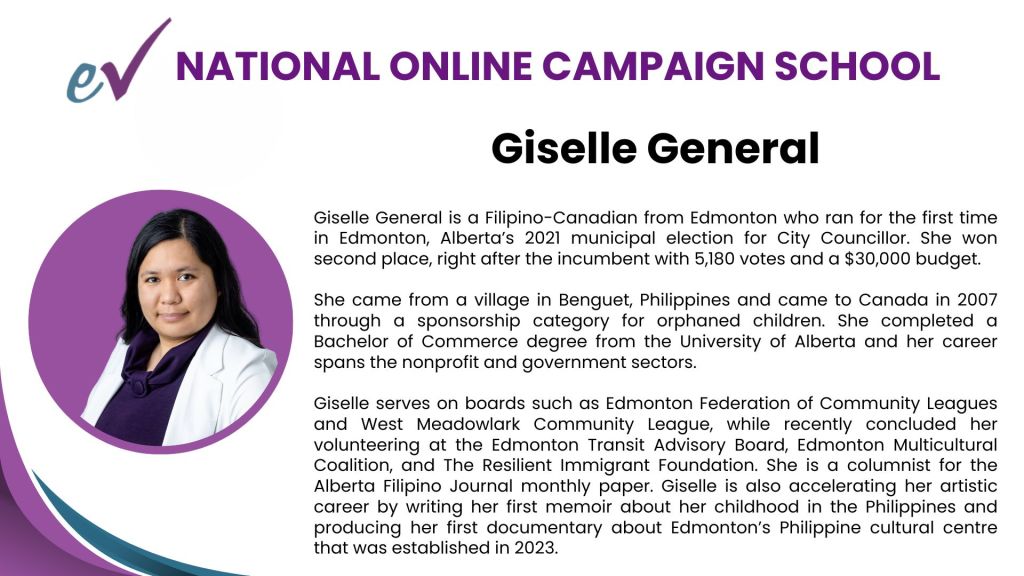
Between October 2023 and May 2024, some of my community positions have changed into former positions so I needed to make sure that my bio for the campaign school promotions was updated.

It seemed like the perspectives I shared were well-received based on the reactions in the smaller discussions and the follow-up email from the organizer. It was a great experience, especially for doing it the second time around, and if they invite me for a future talk or panel I certainly will do it again.

For those who wanted to run, it is a lot of work, and some of the things I did contradicted the other panelist’s experience. So take what works and make it your own.

Recovering Political Candidate: What I wish I Knew

By: Giselle General

Sometime in December 2023, I was contacted by a researcher who is working on a paper asking for the financial barriers faced by women running for public office. Did she ever find the right person willing to talk and vent about this very topic! I was connected to her through a national organization that aims to encourage women to run for public office.

I shared what I knew and gave so much more information that the questions she outlined in her 3-page questionnaire. I truly hoped I didn’t sound too grouchy when I explained all the potential barriers, both ones I experienced personally and broader patterns I’ve observed.

Despite the fact that my candidacy was coming up to three years ago, I remember many things that I wished were more clear during the campaign workshops and campaign toolkits that I accessed between 2017 – 2021.

So here is a short list of what I wish I knew.

  • About the “social etiquette” in Canada, Alberta, and Edmonton when it comes to door-knocking. I didn’t feel confident enough to reassure volunteers on how to handle different types of situations such as homes having no mailboxes, the “no soliciting” signs, entering gates and how long to wait at the doors.
  • How to handle conversations with one’s employer on handling things such as time off, salary and using vacation days and reputation management for the workplace. I think I handled it okay, but if I had more information I would have been less terrified.
  • The range of options on how to handle the election campaign with family members.
  • Exercise routines to help manage pain and soreness from walking, standing a long time, using mobility aids (like my walking cane) for a long time, hand care (from knocking on all the doors), and more.
  • Personal finance budgeting once the motivation to run is there. This includes saving for money for taking time off from work to do campaigning full time, money to initially fund election expenses, budgeting some extras that may be needed such as replacement shoes, therapy appointments, pens, umbrellas, or takeout food.
  • Options for campaign finances, as in ideas of what a low-budget, medium-budget, and a high-budget campaign can potentially look like, as it took me too long to decide whether I should get one digital billboard or one bus bench.
  • Tips and tricks to coordinate with landlords to connect with apartment residents, as this process also took a lot of time coordinating while being afraid I might be somehow breaking some election rule that I was never aware of.

I will likely talk about this more in future posts. In the meantime, I eagerly look forward to the research publication talking about this topic.

Everyday people that wanted to participate in the political discourse in this very important way should feel confident in their ability to do a decent job. They should not feel demoralized by obstacles that seem systemic in nature.

To conclude, here’s the copy of the post I wrote for the Alberta Filipino Journal back in 2021 during the beginning of the actual campaign.

General Point of View: Trailblazing and Smashing Ceilings – The Journey of a First-Time Elections Candidate

By: Giselle General, April 2021

This election candidacy is a journey five years in the making.  Here is a reflection on my experiences as of this date as someone running for the first time.

A main challenge is informing people on different topics. There are many issues that affect our daily lives, and it can be difficult to remember which level of government is responsible. On top of that, there are issues that are a shared responsibility between the municipal, provincial and federal government. So it is important for me, my campaign team, and other candidates to be informed and patient when discussing with others.

The electoral district boundaries not only changed in composition, but also the names have changed. They are changed from numbers to Indigenous names. I think the names are beautiful and meaningful, but many are frustrated and unwilling to learn. I can personally attest that all it takes is practice, just like learning Asian geography back in high school. After a few rounds of practice, I can confidently say without missing a beat that “I am running for city councillor for West Edmonton, the ward of sipiwiyiniwak!” Those in ward Dene and O-day’min will have an easier time, while those in ward Ipiihkoohkanipiaohtsi would need to practice a few more times.  

I found out that apartments and condo buildings are usually ignored by campaign teams. I found this shocking and unacceptable! Because most apartment buildings are rentals, this means that many people who are not homeowners and from lower economic background are not given the same opportunity by election candidates to share their thoughts about political matters. No wonder the voter turnout in municipal elections is only 30%. Like a spark that ignited in me, I felt a fierce sense of determination to go against the tide and find ways to connect with people living in higher-density places. I hope that landlords and building managers would cooperate with my campaign team so we can engage with residents effectively and safely.  

A harsh and true advice I received was “you need a lot of money”. And I don’t have a lot. I feel motivated to find creative ways to compensate for the shortage of money, and fun ways to raise money and support. From virtual dance-a-thons as a fundraiser, using social media for marketing instead of spending money on billboards, and asking volunteers to drop off brochures instead of paying Canada post thousands of dollars, the ideas seem to be endless. Necessity is the mother of invention as they say, and I’m excited to find innovative ways to connect with potential voters and supporters. I hope that I get hundreds of volunteers from all walks of life, and that even those who cannot vote yet, the newcomers and under 18 years old, feel inclined to join the campaign team as well.  

The election day is in October, and given how time feels like it’s slipping through our fingers, it will be here before we even realize it. All the spare time I have, between breakfast and starting work, between dinner and bedtime, between laundry and cooking on the weekends, are occupied by the seemingly endless tasks to gain more resources, to recruiting volunteers, to ensuring we consult with people with different perspective. Door-knocking officially starts in May and I’m eagerly looking at the calendar counting down the time.  

I am excited to be transformed by this experience. I suppose, turning 30 years old this year also highlights the significance of this adventure. I’d love to win of course, but it’s more that that. My hope is that I am just one of the many people from under-represented backgrounds, of the women, the young adults, the migrants and the Filipinos who would take the leap and throw their name in an election race. I hope that my experience can serve as inspiration and a resource guide in navigating an election candidacy that appropriately considers the complications that arise from our lived experiences. If I don’t end up being that trailblazer, I hope that someone else does not too long after I run.  

When Community Service and Self Care Goals Conflict

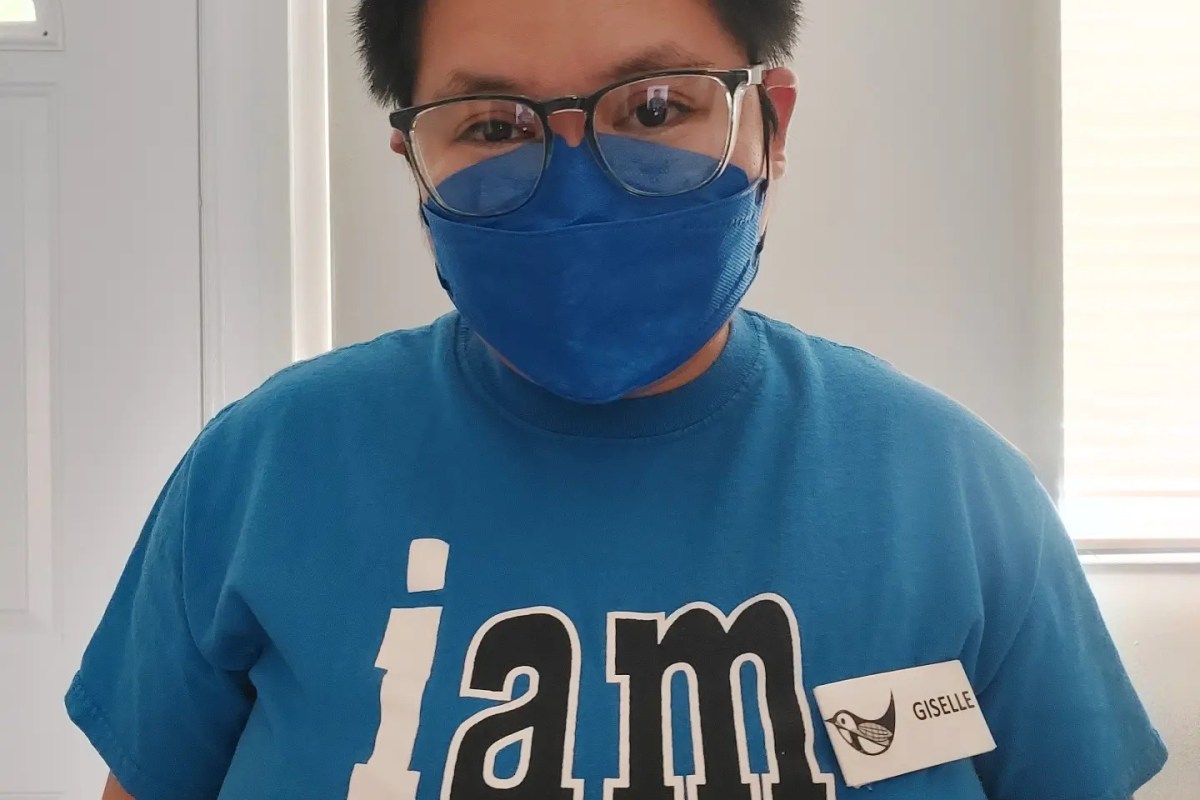
Giselle wearing a stylish safety glasses, KN95 mask and a volunteer Tshirt

By: Giselle General

Last fall, I had an an eye-opening moment as I went about doing my volunteer activities. During the third weekend of September 2023, I had two activities back-to-back, both outdoors. From morning until early afternoon, I was in my neighbourhood park helping with an annual gathering that includes serving lunch, having activities for kids and families to enjoy, and for residents to apply for their membership with our organization. Shortly after, I went to an Philippine arts event at an outdoor park in downtown Edmonton.

When the day began, I checked the air quality index and it is a 4. Not yet a concern which is great. But as we approached the lunch hour, my eyes started to feel irritated so I wore my glasses. It’s not the type that corrects your vision, but a cuter version of safety glasses I got a few years ago. Turns out, my eyes get irritated by the wildfire smoke, more easily that the average person.

It was 3 PM when I rushed to the arts event, where I kept my glasses but didn’t wear an N95 mask. That was my mistake. Although I must say that communicating and connecting with my fellow writers in our booth was so much more efficient without the mask. Also, since we were outdoors, I figured the COVID risk would be minimal.

Unfortunately on my bus ride home, as I sat on my seat resting my legs from walking and standing all day, that’s where it hit me. When taking transit I still wear a mask because I definitely don’t want to catch any of the respiratory viruses spreading around. As I sat patiently waiting for the bus to reach the west side of the city, I checked the air quality index app again. It went up to 8 – high risk! No wonder my eyes were irritated for the afternoon. As soon as I arrived home, I plopped on the couch while struggling to answer my husband’s question about what we plan to have for dinner. After dinner, my chest started to hurt, and I have to make an effort to breath in for the rest of the night.

I had plans to attend other neighbourhood events the next day, but when I looked out the window and saw the familiar orange haze in the sky I knew it’s a bust. The air quality index app showed a rating of 8 in the morning which went up to 10+ in the afternoon. I have to stay in.

This is just frustrating. I very much hate the fact that my own body seems to now get in the way of my volunteer activities. I also know that since COVID precautions are virtually nonexistent in public spaces, the burden on individuals to protect themselves is just more significant. The worst part is, event individual precautions are less effective especially if let’s say, you are one one of the 100+ people in an indoor hall during a community engagement event. While on one hand, I know that my assistance and contributions will be very helpful during the said event or activity, none of the organizers, fellow volunteers, or attendees would step in to help me if I get permanent harm from attending.

Perhaps that is part of the reason why that even more so the past few months, I make sure that majority of my volunteer activities can be done from home. Writing two informative articles for the monthly ethnic paper for the Filipino community in Edmonton continue to be rewarding. Over winter and until now, I started to do volunteer sewing tasks, upcycling old merchandise from my husband’s running group and turning them into personalized outfits. The documentary and book projects are also tasks that hopefully will make a positive impact in the future and can be done without risk of being exposed to smoke, fumes, viruses, hostile weather or all of the above.

There’s really no solid takeaway message I can pin down. During my election campaign a few years ago, I made decisions that I know prioritize my wellbeing and my life over potentially winning over votes. “My goal is to come home alive” and “if I’m sick, severely injured, or dead, then I won’t be able to help” are my personal constant reminders when I feel guilty about missing community events or volunteering opportunities.

In the new year, I tried to nudge more of my free time towards improving my personal health. Weekends offer what seems to be an unlimited opportunities to get involved and volunteer, whether it is events, workshops, rallies, and more. However, given that my husband goes out for a run with his running group in the afternoons (in the winter), I discovered that it is best to try a fitness related activity that I can try to stick to on a weekly basis. So for that past three months, that has been swimming for about 45 minutes at the local YMCA.

Giselle wearing a swimsuit getting ready for a swim.

This weekly swim routine has paid off really well in just a few weeks. It’s hugely help reduce my shoulder, neck, and back pain from doing office work full time. Swimming laps and treading water is definitely good cardio without aggressively hurting my joints. And slowly, as I gain confidence in learning how to tread in deep water, I also manage my fear while celebrating my incremental improvements.

This tradeoff has been worth it for now. My community service time and activities are sprinkled over week nights, lunch breaks and weekends, so I figured carving out a premium time for my self is the right call for now. I do dread the upcoming summer though with the greater likelihood of forest fires and smoke risk. Maybe volunteering for public and indoor activities is the approach moving forward.

A Month of Cool Transit Milestones: The Captive Transit User Series Part 13

Giselle posing beside a table with a sheet cake. The design on the cake says "Train, Choo! Choo!"

By: Giselle General

This is part of an ongoing series of posts discussion issues I personally encounter while taking public transit in Edmonton. Links to other posts will be added on an ongoing basis:

What is a Captive Transit User? I learned about the term for the first time from the City of Edmonton’s website. The easy definition is: someone who takes public transit because it’s the best (or only available) option for them to travel around. The part about feeling ‘captive’ comes from the restriction that sometimes comes up, perhaps because one is too poor to own and maintain a vehicle, one does not know how to drive, or for medical reasons, cannot operate a vehicle. In many ways, I relate to this a lot. Though I’m pretty fortunate to afford the occasional taxi ride, and with my husband having a car.


November 2023 was such an incredible month for all things transit in Edmonton. On a typical day, it is understandable that many everyday people, the media, and those politically engaged have many frustrations about our transit system and are quite vocal about it. But November was a bit special as there were precious opportunities of celebration and showcase.

Valley Line Southeast LRT Line Opening

On November 5, the long-awaited LRT line from downtown to Southeast Edmonton finally opened. While there wasn’t an official event organized by the city, it felt really festive right at 5 AM throughout the LRT stations along the line. This is thanks to enough people in the city who organized, shared enthusiasm and as a result, filled up the LRT vehicles during their first trip from downtown to Mill Woods and back. I described those wee hours of dawn as ‘festive in a nerdy way.’ There was cake, coffee, an opportunity for everyone to take turns to cut a ribbon with large ceremonial scissors, and run into other people in the city who are keen on municipal politics, love trains or active transportation, or both.

I am super grateful to my husband (who is not a big politics or transit nerd like me) who convinced me to go to this ‘opportunity of a lifetime’ event and offered to come along with me, since there are no buses available at 4 AM from our place to downtown.

Here are some of the media articles that captured the enthusiasm of the opening day. It was pretty fun trying to spot my husband and I in the photos and video snippets.

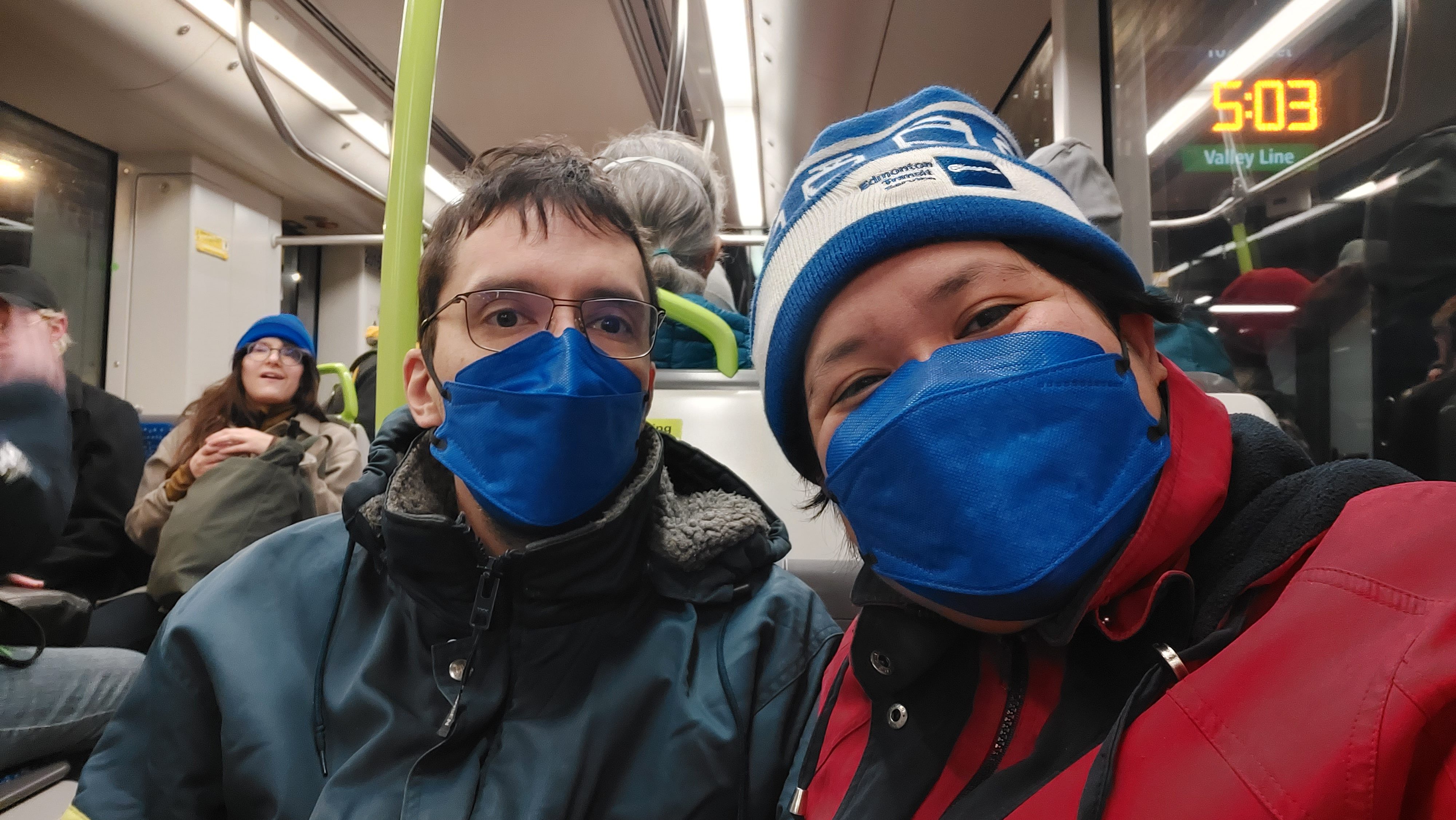
At 5:03 AM, after the passengers did a countdown, the LRT departed from the 102 Street station on the way to Mill Woods. My husband and I were lucky to find seats.

Edmonton Hosted the annual Canadian Urban Transit Association Conference

In mid-November, Edmonton hosted several transit-related conferences, the Youth Transit Summit and the regular Canadian Urban Transit Association convention. The CUTA conference happens twice a year, a smaller spring convention and the main fall convention, in various locations across Canada. Back in 2018, during my first year as a board member of the city’s transit advisory board, I was able to attend the CUTA conference in Toronto. So it was very exciting to have my home city host it. I got sick in the middle of that week, but the fact that multiple members of our board were able to attend was wonderful.

The fact that the new LRT line opened just in time for the conference, so that it can be showcased to all the conference participants who signed up for technical tours, was a bonus. The technical tour I was able join, the recently re-opened Stadium Station, was informative and enjoyable. The best part for me is that not only was the tour focused on the station itself, but the changes in the residential areas nearby. The new cluster of tall residential towers is the first time I’ve witnessed a real-life example of TOR (Transit Oriented Development).

Edmonton Transit Service staff shared information and answered questions of the crowd during the technical tour of the station. One surprising fact I learned is that the undergound station is still functioning and was renovated into a service room.

Thinking back to my last vacation in Manila, Philippines, I chose to rent a condo that was walking distance to an LRT station and a mall. It made travel very convenient as it was an effective way to beat the horrible road traffic during the holiday season. My current home here in Edmonton will have the same convenient access as well. My husband and I walk to the mall and business plazas nearby. We are walking distance from a hospital, gas station, convenience store and a car wash. When the LRT finally gets opened in a few years, it would make getting around even more flexible. I’m curious to see what will happen now to the areas within blocks off every transit station.

Showcasing the Transit System to a City Councillor

Then in late November, I did something for the first time, something I have casually offered on social media to the politicians of the city but no one took it up until that day. On Sunday November 26, I spent the morning with one of our city councillors and their staffer on multiple ETS transit trips across the city, experiencing various methods including the bus, LRT, replacement service, on-demand bus, and walking to a destination as opposed to taking a bus. I admit I was nervous, worried that I may sound irritating with too many complaints and concerns I was pointing out all throughout the trips. But they were both receptive and the blog that was published afterwards is insightful.

I showed Councillor Cartmell the various ways temporary bus stops are designed. I pointed to him that this one along 102 Avenue and 133 Street has good platforms for the front and back doors.

Transit, safety in public spaces, homelessness, and ‘value for taxpayer money’ arguments take up a lot of discussions on city politics lately. I’m curious to see what additional decisions that are made politically and the changes that city administration would make to work on these issues.

Report it on the App: The Captive Transit User Series Part 12

By: Giselle General

This is part of an ongoing series of posts discussion issues I personally encounter while taking public transit in Edmonton. Links to other posts will be added on an ongoing basis:

What is a Captive Transit User? I learned about the term for the first time from the City of Edmonton’s website. The easy definition is: someone who takes public transit because it’s the best (or only available) option for them to travel around. The part about feeling ‘captive’ comes from the restriction that sometimes comes up, perhaps because one is too poor to own and maintain a vehicle, one does not know how to drive, or for medical reasons, cannot operate a vehicle. In many ways, I relate to this a lot. Though I’m pretty fortunate to afford the occasional taxi ride, and with my husband having a car.


Whenever I take the bus or LRT, regardless of whether I’m alone or traveling with my husband, I try to pay attention to my environment. Sure, at some point I end up getting slightly bored and browse on my phone, but I don’t do that until a few minutes after getting on the bus. It’s also why I don’t wear headphones while taking transit.

Frankly speaking, the reason I feel inclined to stay alert is not related to safety. Sure, that is important, but thankfully I personally haven’t experiences direct and aggressive treatment on the bus which is a relief. I have a different motivation, that is to observe whether something is going wrong with the bus, train, bus stop or transit station that needs to be fixed. The moment I spot it, I report right away on the 311 app.

The City of Edmonton has an app called the 311 app, that enables people to report different things that the city can resolve. It includes a feature to take a photo (although it is not mandatory which is good), text boxes to add a summary of the issue, automated geo-location, and a check box to indicate whether the issue causes accessibility concerns.

As far as transit, the categories are:

Late Bus: For this section there are questions such as the location, bus stop and route number, and whether the delay is due to weather conditions. I personally don’t make a report when a bus is 15 minutes late and if the travel apps like Google or Transit had actually indicated it. It means that it is a real-time update. But if it is winter and the bus is 20 or more minutes later, then definitely I would report.

Transit Feedback: I am guessing that this category is for other types of feedback that are not related to buses being late, or not related to broken and dirty things in transit facilities. In the past, the third category is specifically related to vandalism and cleanliness, so I have used this category to report something that is simply not working, like a digital sign. I also haven’t used this option in a while.

Transit Maintenance: This is the option I use most often. What I typically report falls under two categories: items related to cleanliness or vandalism, and items related to functionality of electronic items in the bus. The vandalism I’ve reported vary, from scribbles on the seat in front of me written with pen or paint, broken wayfinding signage in downtown right beside a bus stop, a few bus shelters where the glass walls had completely shattered, and the one I know should be addressed quickly – colorful and sticky stains on the bus seats, especially the fabric ones.

As far as functionality of electronic items in the bus, there are two main ones. First is the ARC Card machines where people are supposed to tap on their way in or out. The sounds from the machine are quite distinct whenever it doesn’t function. When after 10 minutes on the bus, I can still hear the particular beep that indicates it’s not working, then I make a report. If the display screen is not working, I do the same. The most frequent report I do though is whenever the device that is supposed to announce the next stop is not working. as indicated in this post, I’ve learned to appreciate the value of hearing and also reading the information of the next stop, especially when it’s hard to see over the window. The best part about the app is whenever I report issues, there’s a check box that asks whether it is a disability issue. Whenever it does, I check if off every single time. I truly hope that the issue gets escalated.

It’s truly unfortunate that I cannot see whether the issue is fully resolved or not. The odds of me taking the same bus with dirty seats right after I made a report is unlikely. The only update is seeing the ticket being closed or “redirected to other business area.”. However, in our data-driven society, I know that every report gets added in the statistics. In fact, there are public databases available on all the 311 reports made to the city, for those who want to do analysis on a certain issue and want to use the number of complaints filed as supporting evidence.

If there’s one change I’d like to see on the app, is to know for sure whether the issue is fully resolved or not. A photo to show the issue is fixed or cleaned would be so nice. A once-sentence update that says the broken speaker or digital sign is fixed on a certain date would be so reassuring. Even a statement saying that the issue is considered and can be addressed by future policy gives an indication that it is a long-term problem. Maybe this can help prompt people to use these reporting methods more and trust them.
For now, I still use the app. It’s more productive that venting on social media.

The Unusual Birthday Gift I Gave Myself Last Year

By: Giselle General

Last year on my birthday at the end of May, I did something that I considered an unusual, but valuable, gift to myself. I officially handed my letter of resignation to the job I had for eight years.

Materially, my life is overall comfortable. Also I find shopping for items like clothes, cosmetics, gadgets pretty dreadful. Having to think of gift items for people to get me is the opposite of fun. Thinking of what to buy myself as a treat that need to be bought at a specific time of year is also pretty restrictive.

As my wages grew over the years, both from my employment and the honourariums for some of my volunteering and writing work, I try to be very mindful of lifestyle inflation. I didn’t want to fall into the trap of buying something just because I could. In the occasions where I do splurge, those purchases were made intentionally and with no guilt.

A big theme I’ve seen in how I approach my birthday is about giving myself something special of great non-tangible value. The trip I took in New York City in 2019 is my first overseas solo trip, granting myself the new experience of independence and rare unrestricted indulgence. The boudoir photoshoot I also booked a day before my birthday is to grant myself a new way of reclaiming my body and sense of self, a valuable thing for sexual abuse survivors like me. In 2020, I hired a freelance artist to recreate a piece of artwork I drew in 2013, granting myself a way to preserve precious memories and the enjoyment of collaborating with an artist. The drawing in particular was the memento I made from my first trip to the Philippines after immigrating, taking my Canadian (white) boyfriend in tow. In 2021, my self-gift was as simple as granting myself rest and family time as I started to ramp up my election campaign running for city councillor. Something truly in short supply and so precious for that period of time.

For my birthday last year, the plans to celebrate were straightforward and already confirmed. My brother worked night shift so meeting him separately worked better since typically dinner times happen when he is already on his way to work. The husband’s family will be coming over for a separate dinner in the home we just moved in to a few months prior. They planned to bring black forest cake. Perfect.

The only thing missing is the precious thing for me.

I talked to my husband about the idea throughout the month of May. This was not something taken lightly. The job search process over the past few months were not going so well, and I knew it is because I was not giving it the right energy and focus. Also, in the past, I was unemployed when I applied for that job I truly enjoyed for eight years. It seemed like I can only do one of these two things at a time: work full time or job hunt full time.

On top of this, I realized that I never had a full two-month summer break since before my parents died, which was the summer of 1999. Since 2000, my summer breaks consisted of working for most of it, either working in the store in the mining village in the Philippines, working in retail or placements during my university years, and then as a full-time working professional. As a child, since my birthday was the end of May, just right before the schoolyear begins in the Philippines, my birthday always marks the end of a notable period of time and the beginning of another.

I looked at my bank account repeatedly. I inspected the information in the budgeting software I used since 2017. If I were not to do anything extravagant or ridiculous, I can afford to pay my bills and save for retirement with no interruption, for quite some time.

This is the perfect timing for this reset.

When I woke up on my actual birthday which was a Tuesday, I was a bundle of nerves and certainty. I was working from home that day, in my home office where to my left was a wall of frames, including the employee recognition certificate I received for my years of service. The draft email was already in my inbox. And then I clicked send.

Just a few minutes after, I got a message through our internal chat software. It looked like it came as a surprise. Then emails and video calls took took place, with strategies and decisions to make the most of the one-month resignation notice.

Since we had a hybrid work arrangement still, my office was not as decorated as it was. Packing up any remaining personal items was easy. The last month of work flew by, as I eagerly waited for my last day of work, just right before Canada Day long weekend.

After the long weekend, my relaxed summer break began. Nothing changed in my evenings as I kept all my volunteer commitments. I also wanted to spend the same amount of time with my husband so I kept my sleeping schedule the same. But the time period that is labelled as the typical weekday work hours from 8 AM – 5 PM, were all free and flexible. It felt eerie but not as slow as I expected. Boring and lazy and unstructured was exactly what I’m looking for and what I got. It was quite remarkable.

In the middle and end of the month, when I paid my bills, rent or the automated deduction for my retirement savings got taken out of my bank account, I relished in the feeling that I didn’t have to work during that current week to pay for it. My past self (and of course my husband) helped make this comfortable period of time happen.

When September long weekend arrived as well as back to school for students, I knew this free time was up. It is time to be a responsible adult again and actively work towards finding my next job. I knew it will take months from applications, to interviews, to the offer and a starting date. As fall came and went, the pressure crept up a bit more. Thankfully my husband consistently and patiently put my panicked thoughts into perspective.

In some career-oriented articles, I’ve heard of people talking about the benefit of taking a break, sometimes they call it a sabbatical. The type of break for a working professional where they won’t have to worry about financials, but are able to not work full time to rest or try something different. I didn’t name it that way back in May 2022, but it looks like a two-month sabbatical and life reset is what I have gifted myself. One can argue that it was quite expensive, if not the most expensive gift I have given to myself. My living expenses were $3,500 a month and I didn’t find employment until six months later.

It was wonderful and definitely worth it though. Something that is hard to give or get for someone like me with extreme workaholic tendencies. The gift of rest, of reset, of leisure, of personal flexibility. I hope that I can do it again just a few more times during my prime career working decades.

Event Review: Writers Guild of Alberta “Origins” Conference

By: Giselle General

This past weekend, from June 2 – 4, 2023 I had the great fortune of attending the weekend-long annual conference organized by the Writers Guild of Alberta. They titled their conference this year “Origins: A Return to Networking, Publishing, Genre and Craft.” It’s a hybrid conference, with the in-person location at Fort Calgary and the keynotes and focus workshops available to attend online.

Frankly when I first heard of the conference through the e-newsletter from Writers Guild of Alberta, I was already checking my budget. I started a new job recently so my bank account is not draining anymore and I had full intention of finding a way to pay for it. Then, good news came. As I was a mentee of the Horizon Writers Circle this year, the conference was covered for free. There was even a travel allowance! This prompted a conversation among my fellow mentees to travel together from Edmonton to Calgary.

I agonized for a while on how to attend for two main reasons. I’m learning to be more kind to myself and be more conscious of my precious and limited energy for socializing. I haven’t attended a multi-day conference since November 2018 and I found it exhausting. If I wanted to focus on learning, I need to protect my capacity.

I’ve also felt reluctant to probe and ask questions related to COVID precautions and limiting viral transmission. I don’t feel comfortable attending large gatherings that can be a superspreader event. What’s the point of learning about improving my writing craft, if I die or get permanently debilitated by long COVID?

After some deliberation I decided to join the event virtually. As I read the details in the registration I felt hopeful that the virtual components were planned and executed seamlessly. As the conference day approached, I received the instructions on travel, accommodations, and online links. I was amazed by how the online component felt naturally included, and not something that was thrown together last minute. This gave the impression that the organizers have full intention for the event to be inclusive, compassionate, flexible, accommodating, which is what I believe the artistic and literary world is supposed to be.

How was Friday?

I rushed to finish dinner and run the dishwasher before plugging my headphones and connecting online. I then discovered that the opening keynote speaker is sick, and at the last minute, is joining online from their home in Edmonton. So technically speaking, I’m geographically closer to her. Her manner of describing how humans use language as a means to make change was just so awe-inspiring to me.

I knew that those who attended in-person had an opening networking event and a casual get-together after the keynote. As my online meeting linked closed, I happily went on to do chores to ensure my weekend is as cleared as possible.

How was Saturday?

Turns out, the morning keynote speaker had a travel-related hiccup and didn’t make it to Calgary. I’m super duper grateful to the power of the internet, giving him a way to do a virtual presentation. It was a compelling keynote that reminded me to continue learning about Canadian history that was not taught in my newcomer orientation and citizenship booklets, to find them in literature that is being produced these days. For Indigenous writers, it is a way to control the narrative of their lives and experiences withing the wider Canadian society and story. For recent immigrant and settlers like me, there’s many ways to learn and enrich our understanding of this place where we live.

It was my first time participating in a panel workshop with writing exercises for both attendees in-person and virtual. The last time I attended a writing workshop with writing prompts (as in, you get five minutes to write answering the question the facilitator gave) was at Pinoys on Parliament conference last year, but all of us are attending virtually so there’s lesser technical hiccups. This is also my first interactive workshop related to memoir.

“Do what’s right for you, for this project, at this time.” I appreciate the compassion, the permission, and flexibility when it comes to processes and decisions. The reminder of the fundamentals that are sometimes forgotten was very valuable. As always, there’s the “good problem” of having too many good choices of panels to attend. When I was choosing which to attend, I read all the details to my husband who does not do artistic of literary work. His perspective helped me narrow it down to the one that makes most practical sense. The fact that we can watch the recordings afterwards is also very reassuring.

I’ve organized events and conferences myself, so I have full appreciation of what happens behind the scenes. It was incredible to see the resources adjustments to mitigate the tech issues. Really incredible and appreciated.

How was Sunday?

Our keynote for Sunday joined us virtually from overseas, all the way from Greece. It was such a delightful and insightful Q and A about their approach across different projects and genres. There’s great comfort in hearing a successful writer acknowledging that certain processes related to writing are still difficult. For an outdoor hotel in Europe and only with one single internet interruption, I’m overjoyed that the setup of the conference allowed her to share her time with all of us.

As someone who belongs to many nonprofit boards, I appreciate the value of the seemingly boring but very important activity during an Annual General Meeting. I’d say it’s the most engaging one I’ve attended in a long time, particularly on the elections part. I’m glad that the Writers Guild of Alberta will have a full board of directors for the upcoming year, and that they are working on ensuring their committees are able to help with particular goals, such as membership engagement, diversity and inclusion, and youth supports.

The afternoon panel I would say is the most practical and helpful for me in my personal writer’s journey. The Q and A between publishers and agents addressed many questions from the in-person and virtual audience with tangible examples whenever they could, and saying frankly “I don’t know” and “it depends” at other times. My notebook is filled with notes on what I can work on in the next few months as I set up my schedule with editors and publishing one day.

Takeways

I’ve helped organized many events and conferences in the past, and have attended many events and conferences before COVID and in recent years. I am very aware of the additional time, coordination, cost, and sometimes, stress that comes from organizing events in a hybrid fashion. I’m immensely grateful that they did so. It meant that three of the major speakers were still able to share their wisdom despite unexpected cancellations or other plans that resulted in scheduling conflicts. It helped me focus on my primary objective for this conference, which is to learn and preserve my energy accordingly – and also preserve my limited vacation time and money. Alberta is a massive province and it’s difficult to expect rural Albertans writers to be able to travel all the way to a major city, or from one major city to another. It’s a truly tangible way to showcase the commitment to diversity and inclusion.

My two final takeways with my ongoing literary journey that I hope are action-oriented are these:

First, joining a literary-oriented organization and paying the nominal membership fee is very much worth it. Just starting with one is enough. In my case it was through the Writers Guild of Alberta. This one membership is what helped me pace myself in gradually expanding my literary community, where I eventually felt convinced that despite the seemingly grandiose image that come up with the word “guild”, that perhaps I belong here too.

Second, especially for people like me who don’t have a career in literature, to carve some time for a literary or artistic program or event. There’s no need to pressure one’s self to spend a lot of money or fill every single evening or weekend. A small local event once a month, one multiple-month flexible program per year, once conference in the spring and one in the fall. All these add up after a while.

This event has been such a gift. It’s a comment that came up in the comments during the virtual meetings. Simple and the most accurate way to describe it. Huge huge thank you to the organizers, sponsors, staff and volunteers for making it a success.

Construction Zone Bus Stops: The Captive Transit User Series Part 11

A street in Edmonton with a temporary bus stop made with cement barricade, wooden platform, and 2 x 4 for the fencing.

By: Giselle General

This is part of an ongoing series of posts discussion issues I personally encounter while taking public transit in Edmonton. Links to other posts will be added on an ongoing basis:

What is a Captive Transit User? I learned about the term for the first time from the City of Edmonton’s website. The easy definition is: someone who takes public transit because it’s the best (or only available) option for them to travel around. The part about feeling ‘captive’ comes from the restriction that sometimes comes up, perhaps because one is too poor to own and maintain a vehicle, one does not know how to drive, or for medical reasons, cannot operate a vehicle. In many ways, I relate to this a lot. Though I’m pretty fortunate to afford the occasional taxi ride, and with my husband having a car.


I jokingly refer to my current place of residence as the “West End Construction Pandemonium Zone.” Although that is true, I cannot monopolize the title. All the different areas along the LRT construction route, whether the east one from Mill Woods to Downtown or the west one, really fall under this category. When I tell exactly where I live, though, people agree and do the small cringe that shows sympathy.

Funny enough, my commute taking the bus to and from our neighbourhood is overally pretty smooth. The issues I encounter are not any more different than my previous homes or workplaces. The new experience for me over the past year is the slight changes in the bus stops. Whether the east bound or west bound ones, every few months or so, the bus stop gets moved a block or two away. This is so the construction company has full access to the stretch of road where they are doing underground or above ground work. 

As a result, I had to pay attention to my surroundings and check the navigation apps. and I had to calculate extra walking time, and it’s best not to be surprised. The worst feeling is having to run to go to the nearest bus stop and see the bus zip past you. Learned that the hard way a few times. 

I learned that for drivers, there’s a bit of a learning curve as well. Sometimes, their digital screen doesn’t immediately update and so they will not be allowed to stop and let passengers disembark. 

The temporary bus stops would have the usual sign used in regular bus stops, but that’s where the similarities end. Since the stops sometimes have to be positioned in the middle of the road or right beside a sidewalk, there were these wood structures with platform and railings set up. There are no seats or roofs either. Depending on the location the ramp for wheelchair users are set up different ways. I suppose, portability is a factor in these structures so they can be moved wherever they are needed.

Snow clearing was something I worried about since construction zones are left untouched. This winter has been very, very good, perhaps even safer than the sidewalk near the houses. I suppose sparing a bucket of gravel to deal with an icy patch is barely noticeable given the amount of construction materials they have to use. I hope that this continues for however many more winters to come.

Being sneaky with jaywalking (oops) is something many of us bus riders do, because taking the very very longer way to cross the street and catch the bus is a pain in the butt. I am careful and know my basic safety principles when crossing the street so fingers crossed I don’t get hit by a car. Besides,  as a result of the construction there are fewer lanes on this major road, basically cut in half. So crossing the street the jaywalking way is like crossing a residential street that feels like an unmarked crosswalk. Let me be clear I’m not actively endorsing this – do at your own risk.

And there are times when the bus stop comes a lot closer to my house and it’s really nice. This is the case for the west bound bus stop where I disembark on my way home.

It takes diligence and responsibility of not only the city, but the construction company to ensure that residents and users of the road have a manageable experience, especially for a project that will take years – maybe even close to a decade, to be completed. 

My husband and I also walk by the construction area (of course just by the periphery and we stay outside the barricades), and observe the process. We can’t help but trade jokes about the pillars being constructed, given what happened in the summer of 2022. I’d take photos of the construction areas and sent them to my family group chat. My brother-in-law teases me that I’m overly generous and optimistic about when the construction will be completed. Well, I’d love to take his son, my nephew, on a cool train ride before he enters first grade so I can gain some ‘cool auntie’ points. 

The only other thing I hope that temporary bus stops have is better shelter from the heat and cold. Given that many of the regular bus shelters and stops don’t have it, perhaps it is a pipe dream. But, it never hurts to dream, right? It would also help in the summer construction months, to shield my eyes from the dust cloud right after a bus pulls over.

Memoir Writing Reflections #3: A Mic and A Stage

By:Giselle General

The largest, most intimidating, and important activity of the six-month mentorship is showcasing a sample of the work produced during that time. Since I had a very specific goal, a first draft of the manuscript for the memoir, showing a sample of this is not going to be a problem.

Speaking in front of a crowd is also not an issue for me. I had my elementary school teachers in Philex Mines, Philippines, to thank for that. Also, since 2017, I have spoken in front of crowds about vulnerable aspects of my life because of all the opportunities during the Canada 150 celebrations. 

In February, I was frantically getting organized for a potential new job which started after Family Day long weekend. At that point, I felt that I finished the last wholesale revision of all the 48 book chapters. I was also preoccupied with another important task that I didn’t envision as a part of my writing journey – funding applications. Sure, I did it in September but I was a bit more relaxed and wasn’t taking it too seriously. But after I actually got funding and I realized the implications of having money to help with artistic projects, I took it a bit more seriously. Doing three comprehensive funding applications asking for a larger sum of money and offering a detailed budget was more administratively taxing than I realized. And another person had an artistic idea and wanted to apply together. So, there are a lot of numbers, deadlines, and persuasive language telling strangers why they should give money for our project. Clicking the Submit button and getting the automated notification that the application was submitted gave me a huge sigh of relief.

In mid-February, I had my final one-on-one meeting with my mentor author. A few weeks before, she shortlisted three chapters that she edited for me to read in front of an audience. I timed all of them and was so happy to find one chapter that fits exactly within the six-minute limit. She gave additional tips that I didn’t even consider, such as taking a couple of seconds to self-promote afterward, and giving an introduction with enough context since I am not reading Chapter 1. 

During the week before the event, I actually spent more time thinking of a meaningful way to show my gratitude to Wendy for all the help and mentorship she did over the past six months. I’m a terrible shopper and even a worse gift-giver since I tend to be anti-consumerist and simple. Then the perfect idea came. Since there is a nearby Filipino convenience store, I thought it would be great for her to experience my story in a deeper way. I purchased several products that I used to sell in the store that I managed as a child, placed them in a paper gift bag, and wrote a note. 

When I arrived, it was one of those instances where I was happy to be wrong. I thought that it would be a quiet, intimate setting with just us mentors and mentees, a dozen people around a slightly larger table sharing our literary work. Turns out, it’s a whole performance, with a mic in front of a stage and a dozen rows of chairs. My quick mental math estimated about 80 people. There were writers and artists I’ve seen in the past who attended. When I told this, my husband had the same assumption and was impressed that my fellow mentees managed to present a piece of our writing in front of a larger crowd. On top of that, it is a very distinguished crowd too, people of the actual literary and artistic community in Edmonton. It’s not just a random group of people from the general public. They have a deeper understanding and appreciation of the artist and writer experience. 

For the lineup of mentees, I was first, where I shared a chapter close to the end, right before I immigrated to Canada. People smiled, giggled, and shared a collective “oh!” and “aw” after I read some of the lines in the chapter. I felt they understood the rollercoaster of emotions that my younger self experienced in the stories and internal thoughts in the chapter. After my piece, I talked about the Edmonton Arts Council and the feature they did about my work, where I heavily mentioned the Horizon Writers Circle program.

Then my fellow mentees read their pieces. Essays, poems, prose, and story chapters that captivated and entertained the audience. After the formal event program concluded, so many people in the audience took the time to speak to us individually and congratulate us for being part of the program and for the work we have shared. The conversations went on for so long, the appetizers ran out by the time I finished chatting with people. 

As a treat, I went to a nearby sushi restaurant and indulged. Being alone at a restaurant table was also the perfect way to wind down after being in such a cozy and crowded room – classic introvert of me. 

It’s remarkable, partially unbelievable, that the six months flew by just like that. At this point, I need to wait patiently to get the funding application results so I can hire professional editors to polish the manuscript. I’m also purposefully not looking at any of the files. I figured that letting it sit for at least three months will give me a fresh perspective when I start my self-revisions again. 

For now, learning a completely different kind of writing is at the forefront. Political news release writing and speechwriting will give me new skills that I think will help me improve my skill set moving forward.