There’s no need for a rocket scientist to tell me, or anyone else, that people seem to be more divided than ever. There’s enough commentary around lamenting the increasing ‘us versus them’ mindset, amplified by social media, people speaking out against injustices they have suffered from for so long, and people feeling anxious about all social, economic, and political changes happening around them.
“This is a hill I’m willing to die on” is one of those euphemisms that I, as a English as Second Language speaker, try to wrap my mind around.
In a government advisory board I volunteer for, a long-time board member suggested the concept of ‘understanding, not agreement’.
I think this means, making an attempt to follow the thought process of someone’s argument or reasoning, without necessarily agreeing with this person’s position. It is something I haven’t heard before and it stuck with me ever since. I think that there is value to what he said, something I am discovering more and I expand the ways I volunteer in the community.
It gets tricky of course when the person’s perspective is inherently harmful or invalidating the suffering of others. I don’t have an answer right now on how to navigate this. I think that would be the necessary next stage as I try to get more involved in the community.
In one of my recent appointments with my therapist, we talked about getting backlash and criticisms and how to react to them. One piece of advice she gave was ‘find the nugget of truth’. I think there is something to that. Even if a racist person keeps on spewing out problematic commentary, if you dig just a little bit, there is something else beneath the hostility. It can be ignorance, it can be fear, it can be lack of belonging, or a little bit of each.
Someone who keeps on mentioning economic impact when it comes to policy decisions might not necessarily be a callous jerk who cares only about jobs. Perhaps their train of thought is that financial stability is a valuable foundation of a person’s wellbeing, and if that is not considered, it can be tough to convince people to do certain actions.
Someone who keeps on mentioning the number of people dying when it comes to policy decisions might not necessarily be a delusional person who thinks the government has unlimited money. Perhaps their train of thought is that every single life has value, and believes that if a person is dead because of government policy failing them, that is completely unacceptable.
Back in university, I remember reading an article about how conservative and liberal minded people can convince the other camp of their perspectives. The essence of the advice was to use the logic and mindset of the other party to frame the arguments towards the topic of discussion. For instance, it can be valuable to say that increased environmental protections through policy can help preserve and maintain the God-given nature, a precious resource and blessing that deserves care.
Given that COVID19 is still an issue, after almost two years, in an attempt to protect my mental health, to protect people around me from being subjected to my anger, and to keep my faith in humanity, I’m trying a bit harder to tell myself these days “understand what led a person to believe that way, even if in my own mind, it is completely nonsensical”. A book I read during a trip, Predictably Irrational: The Hidden Forces That Shape Our Decisions by Dan Ariely, also reminded me of the natural and human flaws of decision-making and belief.
As I browse through the different definitions of the word understand, I’m trying to learn how people behave and communicate, even if I am not convinced of their mentality.
to perceive the meaning of; grasp the idea of; comprehend
to perceive what is meant; grasp the information conveyed
to be thoroughly familiar with; apprehend clearly the character, nature, orsubtleties of
to accept tolerantly or sympathetically
to assign a meaning to; interpret
to grasp the significance,implications, or importance of
And in the process, I can see more clearly why some people have views that are discriminatory or ignorant. Many beliefs and behaviours are harmful even towards oneself, but from the perspective of trauma or being in survival more, a clear path emerges.
How about confronting and addressing these mindsets that are problematic? That is a whole different conversation altogether.
Introduction: This is a re-posting of the articles I have written about my journey as an candidate for the 2021 Edmonton Municipal Elections. Politics and political participation in Edmonton will be a topic I would like to discuss on an ongoing basis, now that I had this experience. But since at this point, it has only been a month Election Day where I only got second place, I am still processing my emotions, compiling documents, and reflecting on everything I have observed and learned.
This was the third article, submitted on November 2021, but was written just two weeks after the election day. You can get a free copy of the paper, published monthly, from many Filipino-owned businesses in Edmonton. You can also everything digitally at: https://www.albertafilipinojournal.com/
The election is over for the municipal elections and I wasn’t successful in my campaign to be city councillor for the city. I came second place. Here is my preliminary reflection of the end of this journey.
Relief in safety and campaign principles
I was determined to run the campaign by following very important principles. These are: positivity, transparency, inclusiveness, collaboration, and care for community. As a result, some of the tasks in the campaign took extra time, such as properly preparing maps for volunteers, calculating fundraising numbers for the weekly social media posts, or adding subtitles to all videos for the benefit of people who are deaf. With that said, both during and after the elections, people have messaged me expressing their appreciation for my thoughtfulness. My actions made the election informative for the average person, and people from the disabled community appreciated that I went above and beyond to ensure they can access the digital content that I published.
Another key component in my campaign is safety, given the reality of COVID19 and additional risk due to Anti-Asian Racism. Many times, I played it safe by avoiding entering homes with tall gates, not door-knocking alone, and being careful when walking through uneven landscaping and front steps. While other campaigns were door-knocking as early as March, but I waited and observed closely the COVID numbers and the impact of changes in the rules. Sure, it meant I didn’t go to as many homes, but I’m glad that throughout the campaign, I didn’t get seriously ill or injured.
Anguish at missing the goal and systemic hurdles
Just like most people in the world who are ambitious and competitive, not winning definitely hurts for me. On top of that, I felt the weight and pressure of my endeavour, as the only Filipino candidate in the entire city for any municipal seat, after the other candidate withdrew. I definitely would have been great if I achieved this important milestone for the community. My heartbreak at not winning is not just for me, it’s for the entire community.
The optimistic side of me dismissed the idea that money plays a huge role in campaigns, but seeing it firsthand gave me a wake-up call. While I’m confident that I did everything I could to have a well-run campaign, it came to a point where certain gaps can only be filled by additional funds or additional people helping. With this realization in mind, I know what I will advocate for moving forward to help those like me with passion and drive to make positive changes in government, and need just a bit more resources to be successful.
Marvel at the support, outcome, and generosity
Since I don’t have in-depth experience that seasoned politically-engaged people have, I don’t have context of the election outcome. All I know is I didn’t get enough votes and I lost. The cool thing is that many days after the election I received messages of kind words and
As it turns out, getting 5000+ votes is a remarkable accomplishment for a first time candidate, and for a budget that I have it is impressive. I am very grateful to those who have supported the campaign, from the donations, those who made time to volunteer consistently, those who gave advice.
Drive moving forward
One thing I want to make clear is that this is the end of the journey of being a first-time candidate, and not the end of the community involvement journey, and likely not the end of the political journey. If you think about it, if I run for public office, I will be a second-time candidate, with a better understanding of processes, and the unspoken rules of the political world. In the meantime, my focus is to resume all my community service activities that I am already doing to make our city better for everyone.
Introduction: This is a re-posting of the articles I have written about my journey as an candidate for the 2021 Edmonton Municipal Elections. Politics and political participation in Edmonton will be a topic I would like to discuss on an ongoing basis, now that I had this experience. But since at this point, it has only been a month Election Day where I only got second place, I am still processing my emotions, compiling documents, and reflecting on everything I have observed and learned.
This was the second article, submitted on September 2021. You can get a free copy of the paper, published monthly, from many Filipino-owned businesses in Edmonton. You can also everything digitally at: https://www.albertafilipinojournal.com/
My journey of being a first-time candidate for Edmonton City Council is coming to an end on October 18, Election Day! Here my reflection of the journey of being right in the front lines of a campaign.
It is much harder than anticipated. When I first told my brother that I am running, he was scared for my safety! It made sense, given how dangerous it is to run for public office in the Philippines. I reassured him that I likely won’t get murdered here, win or lose. But that doesn’t mean that there are no dangers. As a visibly Asian woman, the risk of racists attacking me is a possibility, given the rise of Anti-Asian Hate due to COVID. There are even practical dangers, as well; many people’s stairs, entryways and landscaping are not always stable, so a slip and fall is a risk when going to thousands of homes.
The harsh reality that it takes money and connections to run for public office became evident. Expenses line up really quickly. I am running against the current councillor, who spent $84,000 in her campaign in 2017. I wondered, how can I even match that? Advertising in bus shelters are at least $1,000, billboards start at $1,500. I spent $2,500 earlier this year for flyers and $3,500 on lawn signs, as name recognition is paramount to being successful.
I see many candidates who get a lot of help, in terms of time, money, and connections, from their parents, and my heart breaks into a thousand pieces every time. It’s a painful reminder of losing my parents too soon. I tearfully wondered every time, in what way would they have helped if they are still alive? Would my parents be proud? Think their daughter is crazy for being this ambitious?
COVID is a mixed blessing when it comes to attending events and activities. Typically, in an election campaign, there is a lot of traveling involved for meetings and gatherings, and it would have taken so much time while taking public transit, or I would need to spend a lot of money taking taxis, or a lot of stress arranging rides from other people. The switch to digital for many meetings and tasks proved to be helpful.
This campaign journey is also quite incredible in many ways that continue to uplift me. As of writing this, I got $17,000 worth of donations, money sent through e-transfers and online payments as well as in-kind donations, it’s just remarkable. For many weekends in the spring and summer, people joined me in delivering flyers to neighbourhoods so I don’t have to spend money on postage. Professionals shared their skills voluntarily, from websites design, graphic design, translating my flyers, mapping routes, strategy, and more!
Another remarkable thing is connecting with people who are not within my immediate network, those who, after researching all the candidates, discovered that I have what it takes to be their next Edmonton City Councillor.
This experience opened my eyes to the simple and complex reasons why our political system is the way it is right now. I really wish that for immigrants, women, and working-class people, that running for politics is not this cumbersome. After the election this is something that I want to address, by finding a way to share all the lessons learned from this campaign journey.
This election candidacy is a journey five years in the making. I hope that by October 18, that history can be made for the sake of the Filipino community in Edmonton and in Alberta, that I can be the first Filipina-Canadian councillor that Edmonton would have.
Introduction: This is a re-posting of the articles I have written about my journey as an candidate for the 2021 Edmonton Municipal Elections. Politics and political participation in Edmonton will be a topic I would like to discuss on an ongoing basis, now that I had this experience. But since at this point, it has only been a month Election Day where I only got second place, I am still processing my emotions, compiling documents, and reflecting on everything I have observed and learned.
This is the first article, submitted on April 2021. You can get a free copy of the paper, published monthly, from many Filipino-owned businesses in Edmonton. You can also everything digitally at: https://www.albertafilipinojournal.com/
This election candidacy is a journey five years in the making. Here is a reflection on my experiences as of this date as someone running for the first time.
A main challenge is informing people on different topics. There are many issues that affect our daily lives, and it can be difficult to remember which level of government is responsible. On top of that, there are issues that are a shared responsibility between the municipal, provincial and federal government. So it is important for me, my campaign team, and other candidates to be informed and patient when discussing with others/
The electoral district boundaries not only changed in composition, but also the names have changed. They are changed from numbers to Indigenous names. I think the names are beautiful and meaningful, but many are frustrated and unwilling to learn. I can personally attest that all it takes is practice, just like learning Asian geography back in high school. After a few rounds of practice, I can confidently say without missing a beat that “I am running for city councillor for West Edmonton, the ward of sipiwiyiniwak!” Those in ward Dene and O-day’min will have an easier time, while those in ward Ipiihkoohkanipiaohtsi would need to practice a few more times.
I found out that apartments and condo buildings are usually ignored by campaign teams. I found this shocking and unacceptable! Because most apartment buildings are rentals, this means that many people who are not homeowners and from lower economic background are not given the same opportunity by election candidates to share their thoughts about political matters. No wonder the voter turnout in municipal elections is only 30%. Like a spark that ignited in me, I felt a fierce sense of determination to go against the tide and find ways to connect with people living in higher-density places. I hope that landlords and building managers would cooperate with my campaign team so we can engage with residents effectively and safely.
A harsh and true advice I received was “you need a lot of money”. And I don’t have a lot. I feel motivated to find creative ways to compensate for the shortage of money, and fun ways to raise money and support. From virtual dance-a-thons as a fundraiser, using social media for marketing instead of spending money on billboards, and asking volunteers to drop off brochures instead of paying Canada post thousands of dollars, the ideas seem to be endless. Necessity is the mother of invention as they say, and I’m excited to find innovative ways to connect with potential voters and supporters. I hope that I get hundreds of volunteers from all walks of life, and that even those who cannot vote yet, the newcomers and under 18 years old, feel inclined to join the campaign team as well.
The election day is in October, and given how time feels like it’s slipping through our fingers, it will be here before we even realize it. All the spare time I have, between breakfast and starting work, between dinner and bedtime, between laundry and cooking on the weekends, are occupied by the seemingly endless tasks to gain more resources, to recruiting volunteers, to ensuring we consult with people with different perspective. Door-knocking officially starts in May and I’m eagerly looking at the calendar counting down the time.
I am excited to be transformed by this experience. I suppose, turning 30 years old this year also highlights the significance of this adventure. I’d love to win of course, but it’s more that that. My hope is that I am just one of the many people from under-represented backgrounds, of the women, the young adults, the migrants and the Filipinos who would take the leap and throw their name in an election race. I hope that my experience can serve as inspiration and a resource guide in navigating an election candidacy that appropriately considers the complications that arise from our lived experiences. If I don’t end up being that trailblazer, I hope that someone else does not too long after I run.
I will be taking a break from posting regular content on the blog. 2021 is a hectic year as I pursue an adventure that is new in a sense (because this is the year of making it into reality) but at the same time, is half a decade in the making.
I am running for public office, for the City of Edmonton’s municipal elections, as a city councilor candidate for the district I live in, which is ward sipiwiyiniwak in West Edmonton, the current Ward 5 that with additional neighbourhoods from Ward 1 captured as well. The pronouncination is like this: silent yi, as in see-pee-wee-nee-wak. The campaign website is here! https://www.gisellegeneral.ca/
So is this website going to be the campaign page? No. It’s just that there may be longer breaks between posts. I might post a blog or two in case I decide to procrastinate (haha!) but it will be less frequently than what I do now.
Where’s the campaign information? Right now? It’s not ready. Once it’s ready, they will be posted here. However, on my personal Twitter account https://twitter.com/gisellegeneral I am posting personal perspectives on the campaign trail so far. Once the campaign accounts (both website and social media) are set up, I will post more content about policy and platforms.
How are you feeling?So far, overall okay. There are stressful, isolating, overwhelming moments yes, but so far, most things are figure-outable if you know what I mean. Part of my goal is to demystify the campaign process for the average Edmontonian, to showcase what it takes. I want to show the trials and tribulations of being a first-time candidate, in order to inspire participation from my fellow average Edmontonians, to inspire my fellow Filipinos to care a bit more about municipal politics, and smash some glass ceilings along the way and bring forward perspectives that seem to be typically overlooked when it comes to polity. It would be nice to be the first Filipino-Canadian city councilor in Edmonton, or at least someone considered a very strong candidate who aimed to reach that goal as hard as possible. I am running against the incumbent again, which is consider an additional, usually insurmountable obstacle, but as Barney Stinson says in the show How I Met Your Mother, “Challenge Accepted!”
I hope that the articles I posted here in the past are helpful or entertaining. And if you live in Edmonton, I hope to see you on the campaign trail – mostly electronically because you know, it’s still a pandemic.
So this happened during my first winter here in Edmonton, back in 2008. There’s a lot of things to learn and navigate and get used to. I learned that winter looks and feels different in different provinces. Things are starting to settle after moving here in July. I have a stable retail job, and I’m earning enough money at the time, I started dating someone who I fondly called my first Canadian boyfriend. And I am navigating all the different schedules and routines I need to do so I can go to the two schools I’m attending which is the University of Alberta and also McEwan University which was called at the time Grant McEwan College.
I worked the closing shift in the retail store where I was working, which is Future Shop at the Terra Losa business centre. It is located on 95th Ave and 172nd St and commuting in the evening was tricky at the time. You have two choices: be lucky and take the bus that is coming along less frequently from the area to the mall and then catch the bus from the mall to our house on the West End. Or if there are no longer buses that are passing through the business centre , take a 25 to 30 minute walk from the store to West Edmonton Mall, through the mall, to the transit station along 87th Ave. This walk is actually nice and refreshing most of the time, especially in the fall or spring or summer months. But winter is a whole different ball game.
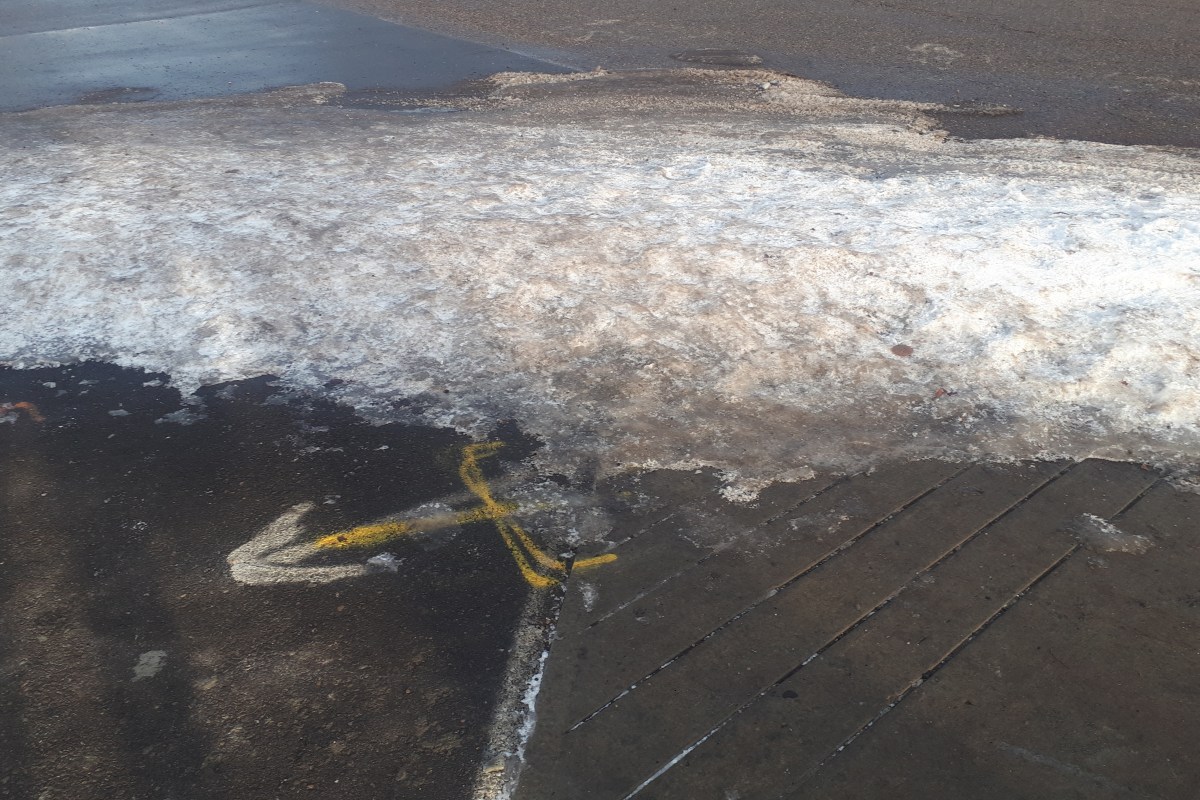
This is how the parking lot was like in terms of icyness, but at night!
You see, at the back of this giant mall, West Edmonton Mall, there’s an overflow parking lot along 90th Ave where people can park their cars if the multi level parking areas all around the mall are too full. Essentially I’d walk through a residential neighborhood , walk through that parking lot, cross to into the mall, walk through the mall, and then get out on the side of the mall where the transit station is.
The thing is in the winter, this parking lot is like a giant, giant ice rink. The reality is, if lots of snow falls into the ground and if left untouched by snowplows, trucks or snowblowers, that pile of snow – however many inches it is – it gets packed down. Then, if in a couple of occasions the weather gets warmer the surface layer of the snow melts a little bit and it becomes ice and that can happen over and over. Cars would not have a difficult time navigating the parking lot because they have tires. It might be a bit slippery driving around but that’s pretty much it. However for people on their feet it gets a bit more tricky.
That night, I decided to walk from my workplace to the mall because it was a night that is not too cold so I thought I can handle it. I’m still dressed for the weather though, I have my nice long winter coat that we bought not too long ago from Winners , and I have this really nice and warm knitted hat that I got from my cousin’s and aunt’s place in Ontario. It’s really thick, thicker than most hats. And it is really cozy with a nice little flower knitted on the brim.
As I left the residential area of Summerlea, passing through the playground and entered the parking lot I realize I’m in big trouble. There are hardly any cars around, there’s the very faint light from the street light switch was not helpful in helping me identify where is a section of the parking lot that is the least icy. You know, how you can usually differentiate between the really really slick shininess of an icy sidewalk and the pathway where it’s just snow that is a little bit bunched up but you might have more traction. That night was not my lucky night.
So I did the only thing I can do . I started walking baby steps, little tiny steps to get as close and to get across as quickly as possible. Here’s the tricky thing. I am very aware what time the bus I’m taking will be departing, 9:58 PM. If I do not catch the bus, since it’s already almost 10:00 PM, I need to wait one full hour for the other bus before I can get home. So I’m conflicted! I need to walk slowly because it’s so icy and scary but at the same time I have this bus I need to catch . I’m so happy that there’s no one else in that parking lot because every three steps I would slip a little bit and scream!
I was about halfway through when, I suppose, my balance was a little bit off, because I slipped and fell forwards. I was really afraid I’m gonna slam my face onto the icy pavement. However because my hat was a lot thicker than most hats I actually had a cushion. I did fall face first, but it was my forehead that hit on the ground. I was lying there in shock for a second or two . And I realized I was not bleeding, I wasn’t hurt, no scratches or bumps on my face and I was so shocked and relieved. Then slowly but surely I rolled over on to my back, tried to sit up and struggled because even my hands cannot grip anything because everything is so slippery. And I slowly stood up and continued walking . By the time I crossed the parking lot and reached the sidewalk along 90th Ave I was overjoyed. I moved on to enter the mall through Bourbon Street the restaurant area tried to run and walk and shuffle through the mall to catch my bus.
The next day I woke up in pain and was very scared. My neck hurts! I could not even pinpoint where that came from. Because I arrived home late in the evening I didn’t get a chance to tell anybody what happened the night before. Over breakfast I went into the main floor of our house and talk to my aunt and I told her what’s happening with my neck. She was very worried and for good reason. During the vehicle accident in my childhood where my parents and sister were killed, my brother and I were not left unscathed. My major injuries consisted of a lot of wounds causing a lot of blood loss, and a fractured skull. So my aunt was really worried that it might have something to do with my head again, even if it’s been a couple decades since my injury . Then, I told her about the slip and fall I had the night before. Now she was even more worried! She told me to go to a doctor ASAP, because my slip and fall might have affected my head and she said that it actually might be a concussion. Now here’s the thing, I haven’t heard of the word concussion before so I was even more scared and it sounded really serious.
While enduing my neck that was hurting, I took some painkillers and went to school. For this day my classes were at the University of Alberta. I discovered that there is a medical clinic there that students can go to, which is such a relief. So in between my classes, I went to the Student Union Building on the 2nd floor, and try to see a doctor. I’ve never been to this building before, I’ve never been to this clinic before, so I quite don’t know what to expect.
I didn’t have to wait very long and when I told the doctor what is happening how I’m feeling and what happened that might be related. He asked a few questions, touched my head a couple times, and said he doesn’t seem to see get it was anything really serious. And he introduced a brand new word to me. Whiplash! As it turns out, a whiplash can happen when you experience a strong incident like slipping and falling that can cause muscles or joints in other parts of your body to feel tension and be hurt. I was told to take painkillers, take it easy on myself, and wait it out. If I’m still feeling dizzy (if ever), if my neck or my head or other parts of my body are hurting, then I could go back for further help.
A couple days after, I was chatting with my boyfriend at the time. We’re hanging out in his apartment. He is born and raised in Canada so he has experience with a lot of winters both in Alberta and BC where he was from. I told him what happened, I told him what the doctor said , and he said that makes a lot of sense.
It wasn’t only until a few years after when I learned about the “Penguin walking technique”. I think I saw something about it on social media. I mentioned it to the new boyfriend I was dating then, the guy who ended up being my husband. He said that makes a lot of sense. I told him about the slip and fall incident and how that’s very scary for me. So now, every time we walk around and there is a potentially slippery and icy area he would remind me of the Penguin walking technique, hold my hand and we’ll walk through together.
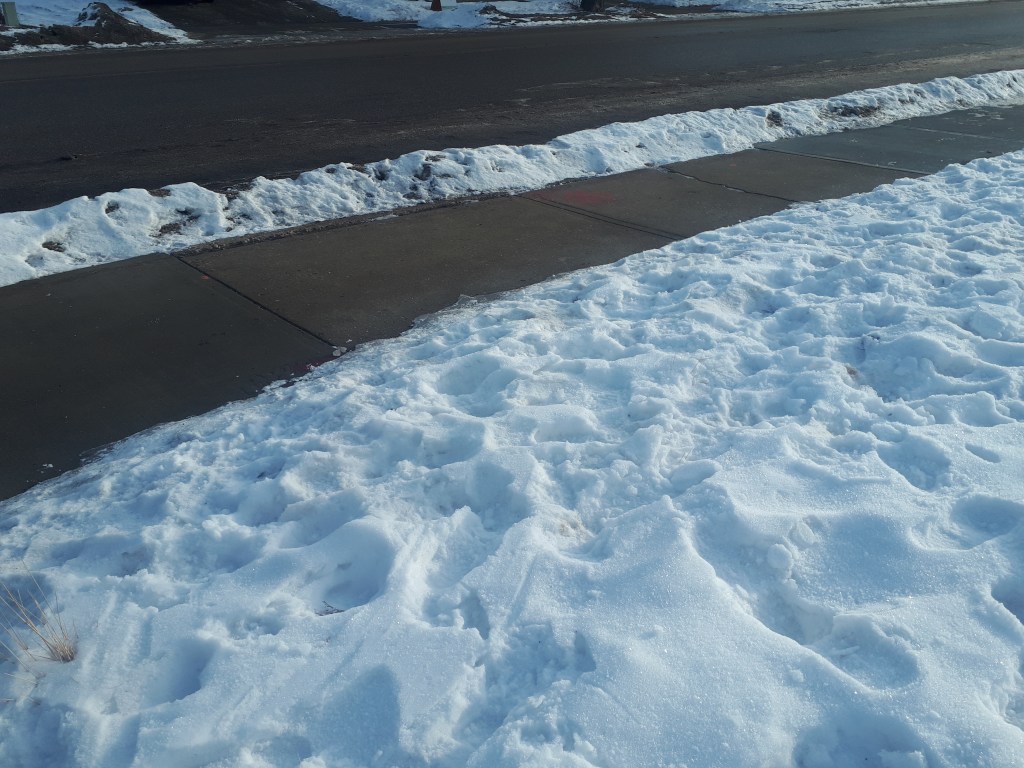
I think this is the reason why icy sidewalks and roads caused me a lot of stress and anxiety when walking around in the winter. This is particularly important for me as well, as a person who cannot drive. A couple of years ago, there is now an app launched by the City of Edmonton, where you can report icy sidewalks and piles of snow and windrows. Which in many ways is nice. But I really hope that everybody, from policy makers, to building owners, to parking lot owners, to home owners, to ensure that there is at least one straight path that is wide enough, safe enough, accessible enough for everybody to pass through all seasons long.
This is part of an ongoing series of posts discussion issues I personally encounter while taking public transit in Edmonton. Links to other posts will be added on an ongoing basis:
What is a Captive Transit User? I learned about the term for the first time from the City of Edmonton’s website. The easy definition is: someone who takes public transit because it’s the best (or only available) option for them to travel around. The part about feeling ‘captive’ comes from the restriction that sometimes comes up, perhaps because one is too poor to own and maintain a vehicle, one does not know how to drive, or for medical reasons, cannot operate a vehicle. In many ways, I relate to this a lot. Though I’m pretty fortunate to afford the occasional taxi ride, and with my husband having a car.
“A hundred and eleven street, a hundred and second Avenue…A hundred and twelve street, a hundred and second Avenue… A hundred and thirteen street, a hundred and second Avenue.”
These lady robot announcements weren’t always a part of one’s commute taking the bus here in Edmonton. The first time I started hearing them, I think it’s about 2012 or so, I can’t help but giggle while taking the bus because the voice just sounds monotonous and a bit silly. My brother (who was new to Edmonton at the time) and I would poke fun at the robot voice sometimes. But the more I hear these announcements, the more I appreciate its benefit when taking transit in Edmonton.
When I first came to Edmonton in 2008, I used a print map of ETS to get around. I have both the city-wide map to help me understand the different routes available, and the the route-specific maps as well. I needed to be familiar with the route number 4, 106, 150, 111, 112, 100, 119, 136 and the LRT so I can to go school, work, hang out with friends and do other activities. I still had a flip phone during those early years and Google Maps is not as good as it is now.
I tried very hard to make sure I get off the right bus stop, but in the winter, when it is dark and the windows are frosted it can be tough to look out by the window and keep track. If you end up missing your stop by a few blocks, walking a few extra minutes late at night and in the winter is not something I – or anyone – look forward to.
I also realized that the audio announcements help people with disabilities! I remember reading a quote from a news article from a person who is blind, who said that the automated announcements of the next bus stops are really useful. I bet that for people who are also new to Edmonton, it’s handy as well.
When I visited New York City last year, a city where sure, there are numbers in the street names, but the system is so different, hearing the audio announcements of the upcoming bus stops, while looking at the app on my phone, helped me navigate around really easily.
But then, we all know that technology is not perfect. When I lived on the further west side of the city, taking the 136 bus, one of the words that is in several street names kept on being mispronounced. For some reason, ‘Potter” became “Potters” and the word next to it loses the letter S at the end. So, Potter Greens Drive sounded like Potters Green Drive. The city’s app for reporting different city issues also wasn’t perfect – there wasn’t an option to report operating issues specific to buses at the time. But I did my best to report it anyways. I really hope it’s been fixed.
At least twice a week, there seems to be technical issues with the LRT announcements when it is supposed to indicate the next station. Either the next station announced is a few stations off, or the announcements were in reverse order. Luckily, now there is an option in the City’s app to report issues about transit vehicle operations.
LRT stations have additional types of announcements as well which is handy. Particularly right now during the pandemic, there are audio reminders that masks are mandatory. Back in early 2020, both the above-ground and underground LRT stations started to give passengers a heads up that bus transit fares are increasing in the near future.
Overall, audio announcements has been a handy feature for all users of our transit system. I hope that it continues to have the proper resources to maintain and update its functionality so that it works most – if not – all of the time.
On December 17, 2017, my partner (now husband) and I decided to take the one last opportunity to tour the Coliseum before it was officially closed down. This is a summary of the tour, including some observations of the area and new things I have learned.
My partner is a born-and-raised Edmontonian, while I moved here when I went to university. That being said, I had a chance to go to the Coliseum a few times. First, for an Oilers game with my partner, then for a few concerts, and also another time for an Oil Kings game, during one of the nights when there was a Teddy Bear Toss.
We went there by taking public transit, which was lovely because it gave my partner greater flexibility. Also from our memory, parking in Northlands is expensive. As the years went by, traveling around by transit is a part of our date that we enjoy, since the buses and LRT vehicles are almost empty and we cozy up in our seat.
When we went to the Farewell Weekend tour, it was pretty quiet. I wonder if it is because it was the last day, or because it was pretty chilly.
The map was a useful guide to particular points of interest, and upon visiting those places, there were signs that explained the function of the area and some interesting historical or sports-related facts. Many places that are not publicly available is available for viewing this time around, such as the locker rooms and bathrooms for the athletes, the media room, fancy suites on the top floor, with a lobby that looked like a hotel.
We both forgot about the open skating opportunity, so instead, we went to the frown row, Corey sat in the penalty box, and asked me to take a photo of him pretending to be upset for being sent to the box. We spent a some time watching people skate around, while enjoying the soda and nachos we bought from the only concession stall that was open.
Afterwards, we decided to take the LRT to go to downtown instead of going home right away. At Churchill station we saw a woman painting a mural on the concourse of the LRT station. It was incredible, with patterns of what seemed to be a woman, lots of red birds, and a village and various scenery of a community. I started from a distance when he nudged me to say hello to the artist and chat about the mural. I felt shy at first but my husband reassured me that the artist might actually appreciate the chat. And he was right. I told the artist that she outline seems really interesting, that the elements she’s painted so far look incredible, and inquired her on what the painting is about. She told me that it is part of an initiative called Paint The Rails, which now had resulted to several paintings across different city’s LRT stations.
As we were already in downtown, we decided to stop by the Farmer’s Market and we arrived just in time to see the different shops close down. It’s nice to see the different types of businesses that were there, and we took some photos in front of the nice decoration that were set up in the interior of the City Hall building.
Afterwards we decided to visit the funicular for the first time, which is just a few block away by the Hotel MacDonald. We thought it was really neat and the lookout point at the bottom was great! I remember that one of the benefits of the funicular is for people with mobility aids to have a chance to see our beautiful river valley more closely. Using it ourselves made us realize and appreciate that goal.
After that we decided to head on home. As the Coliseum was accessible by transit and our detour in downtown Edmonton was also accessible by transit, we continued to use transit to head home. It was a lovely weekend date in the winter that we continued to cherish.
When I first arrived in Canada, I had my first experience in having an actual process to sort out garbage. Different types of garbage are sorted according to type such as refundable like bottles and milk cartons and cans, landfill materials, recyclables like plastic sandboxes, and things you can refund for money such as wine bottles, beer containers, and soda containers. So before moving to Edmonton, I have integrated the habit of sorting my garbage. And I also have a vague idea or realization, that returning these refundable drink containers will give you money. Then, I first noticed in grocery receipts, that you get charged money for buying liquids to drink in particular containers. So if you make the effort of returning these bottles, it’s not like you earn extra money, but more like you get your own money back.
When I moved to Edmonton I have observed a similar process. The way organic material is handled is a little bit different, but the sorting process is still there. Making sure you have the appropriate bags to sort your garbage such as the transparent bags for leaves in the fall, the black garbage bags for landfill stuff, the blue almost transparent plastic bags for recyclables, is integrated in once grocery shopping routine.
However, the actual process of people or organizations collecting refundable drink containers is something I haven’t seen before. As it turns out, this can result to a lot of money! And it looks like it is a relatively popular method of fundraiser.
I personally have seen many bottle drives before, and participated in some of them as a donor of containers. This particular weekend however, I finally helped my neighbourhood community league by supervising the bottle collection drive portion of our September event, for Community League Day. It’s a pretty easygoing task, all I have to do is to physically be on standby beside the truck where people would pull over bring their containers of bottles and place it inside the truck. At the end of the day this truck, this company, will take away these bottles, process them, and give money.
Using bottle drives for fundraisers have been so popular that I received multiple requests as a homeowner different times a year. During spring and fall, like a predictable annual routine, I would get a flyer on my mailbox requesting for bottles to help the neighbourhood local children’s Scouts. A particular nonprofit organization has this as a regular part of their fundraising which is called Empties To Winn. The way this works is, they provide uniquely labelled large plastic bags where people can put in their drink containers for refund, every quarter the organization sends someone to pick up your bag with bottles and cans, and at the end of the year, you get a tax receipt.
There’s so much money to be made from collecting bottles and handing them over for a refund. Folks experiencing homelessness typically use this as a method to earn a little bit of money. I see people in parks and Transit stations looking a little bit worse for wear, reaching into the garbage bins to see if there are drink containers in them. We even have a small incident in our neighbourhood last year, for some residents were a little bit upset because they realized on garbage day their bags of recyclables is ripped into pieces causing guard pieces of garbage to be flowing and flying all throughout the sidewalks and streets. It was discovered that this is a result of a homeless person on garbage day going to each of the piles of garbage bags, ripping open the bags to see if there are any bottles. My neighbours made it clear that it’s not like they don’t want a homeless person going around the neighbourhood. The only problem is the littering it causes. Thankfully one of the residents had the chance to see this gentleman rummaging through the bags and kindly asked him to tie up the bags again after he sifted through them. Problem solved.
It’s fascinating to observe the people handing over bottles during the bottle drive. There’s the one gentleman in his red pickup truck where the back compartment is full to the brim of bags. He said he was planning to bring them to the Bottle Depot, and then COVID-19 happened, and then this opportunity came about to dump them all here. There’s the lady who had her containers in a water drum, so we had to work together to pour them all onto a plastic bag to put into the truck. There was the father of the kids who’ll be benefiting from the bottle drive. He told me that his son goes to the elementary school of the neighbourhood, and he appreciates that this bottle drive will raise funds toward’s be renovated playground for the elementary school.
For some people, they are diligent enough to collect the bottles bring it to the nearest Bottle Depot and enjoy the earnings of their diligent organizing. But for many, getting a few dollars every few months is not worthwhile, but the feeling of being able to contribute meaningfully for a charitable cause it’s definitely worth a lot more. For as long as there this system that helps collect organized and provide money for these recyclable drink containers, I think we are going to have bottle drives for the next little while and it is awesome.
This is part of an ongoing series of posts discussion issues I personally encounter while taking public transit in Edmonton. Links to other posts will be added on an ongoing basis:
What is a Captive Transit User? I learned about the term for the first time from the City of Edmonton’s website. The easy definition is: someone who takes public transit because it’s the best (or only available) option for them to travel around. The part about feeling ‘captive’ comes from the restriction that sometimes comes up, perhaps because one is too poor to own and maintain a vehicle, one does not know how to drive, or for medical reasons, cannot operate a vehicle. In many ways, I relate to this a lot. Though I’m pretty fortunate to afford the occasional taxi ride, and with my husband having a car.
My husband and I live in a nice neighbourhood here in Edmonton, with neighborhoods right beside ours with super fancy, multi-million-dollar houses. Whenever we walk through these sidewalks and streets and see these houses, he would ask me, “Do you want me to buy that house? It looks so pretty!” It’s just a fun conversation topic, more like a little game, we do when we walk around the neighborhoods.
Almost every single time, I would say, “No! Because, where’s the bus stop? There’s none!” The proximity of a reliable bus stop was a very important factor when we were house shopping back in 2015. So during these walks I would wield this response in a swift and sassy manner. For many of fancy houses that is definitely the case. Because people are likely to be driving a car or even multiple cars to get to these homes, there is no expectation of accessible public transit.
In 2015 when we impulsively decided to start shopping for a house, we talked about our most important priorities. Price is a factor of course, and having a space or structure of a home that is easy to convert a portion of into an income property. For my husband, the neighbourhood is also important, so he wanted a house that is on the slightly mature west side of the city close to where he grew up. For me, as I have struggled and learned the hard way that going home from downtown Edmonton in the evening is really difficult, I told him it is very important to have good public transit access to downtown all day and all night.
We were so particular about our requirement for good bus access. When we were talking to our real estate agent, I grabbed a printed city-wide transit map, analyzed the different public transit routes that showed up in the map, grab the highlighter and marked the different areas that we would consider for our new house, and gave it to our real estate agent as a reference.
And we managed to find it! We found a house that is along a major road but not as loud and busy as the Whitemud or 87th Avenue, with a reliable and frequent bus route, pretty close to the in-laws’ house, and is easy or possible to construct an income property in the basement. And for a good price!
So for the past almost five years traveling around the city has been a lot easier for me. Going to work, going to the mall, going to downtown or Whyte Ave, and just traveling around the city. It is only what it’s super late at night that I would take a cab to go home and go to my destination.
I know very well, that this is the reason why, my husband has been very angry on my behalf when he saw he proposed new bus routes by the City of Edmonton’s Bus Network Redesign. We are not losing the bus stop that is 20 steps in front of my house, but it drastically will change from a frequent 15-minute bus route into a 30-minute community bus route. The frequent bus routes are either a 7 minute walk, or a 15-minute walk. A major selling feature of the home was ripped out from us, at least that is his impression.
My husband was also worried for other people who might be more entrapped and limited with their housing options. How will the Bus Network Redesign affect them?
Think of someone who is low income, who chose a specific apartment in a busy intersection because of the bus route that is nearby, and they realize that their bus route will be gone after the redesign is implemented. And they are just in the middle of their one-year lease. How is this going to impact their ability to get around? What if, they have an employer, a boss at work, who is not very understanding that this worker might be running late or not be able to fulfill certain work shifts that are given to them because of the changes in the bus route?
I wonder how much collaboration did Edmonton Transit Service have with agencies such as the planning department of the city, or even external ones like End Poverty Edmonton or United Way to determine whether these bus routes are the best way to go moving forward. I remember a few city councilors saying that it is true, the new bus network will not be perfect for the first little bit, and this will provide real-time tangible information and feedback on how the bus routes are working and make changes accordingly. It sounds fancy from a political big picture perspective. How can you explain that to someone who is here in Edmonton as a minimum wage worker still navigating our city in our transportation system, and where external circumstances are a bit more unkind? How about the people whose housing options are limited and employment options are limited; can they put up with a year-and-a-half of waiting for feedback before bus routes can be tweaked and improved in a specific area?
In my volunteering for the transit advisory board, we worked on a report recommending marketing strategies to inform as many people as possible, as early as possible, about the changes in the bus routes. It’s an interesting and neat experience to do research, think of my personal experiences, work with staff of the city, and present right in front of the actual politicians during a city committee meeting. It’s a bit surreal. I really hope that our suggestions are well taken, and that the city staff can identify other ways of notifying Edmontonians from all walks of life. Because for some, they might actually have to move from their home if their transportation options no longer work for them.
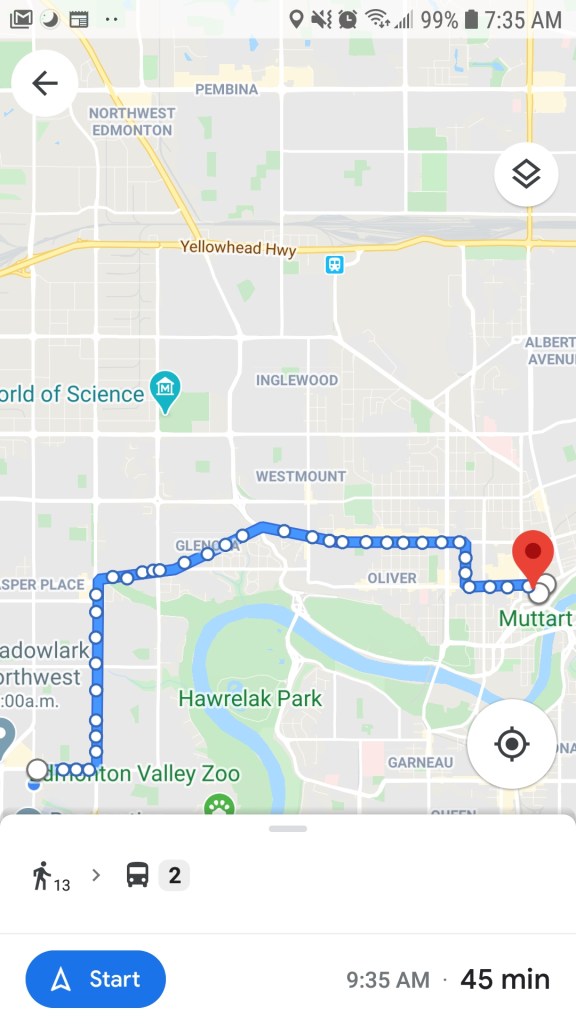
This is something my husband offered, to sell our house if being within a 2-minute walk from a frequent bus stop is important to me. I told him that moving is not necessary, at least not for now. I reassured him that a 13 minute walk or a seven minute walk is very manageable and I can handle doing that on a daily basis. These conversations took place before the pandemic, and now, the tediousness of a daily commute is hardly a concern, as I am fortunate enough to have an office job that I can do from home. But not for the “essential workers”.
The timeline of the implementation of the new bus routes has been delayed due to the pandemic, and I personally don’t know whether I should be relieved or worried. Is it a pain point that is just getting delayed? Or is the right thing to do because there is enough uncertainty in people’s lives? Once the next opportunity becomes available, it will never be perfect but I hope that it will be manageable to those who are most impacted, the captive transit users.












 FilipinaYEG