The Privilege of Work Benefits

By: Giselle General

As the end of the year is approaching, I double-checked my Health Spending Account (HSA) which is part of my benefits as an employee of a nonprofit organization. I’m pleased to see that for this year, I have used up about 75% of the total allocated funds for a wide range of services and products for my health and wellbeing. I bought hand braces for my hands to deal with my carpal tunnel and nerve issues, and for physiotherapy appointments early in the year.

Then when the pandemic happened, I tried to book a few online appointments with my psychologist which worked really well! At the earliest opportunity I booked massage therapy appointments again, almost once a month, because my furniture for my working at home arrangement is okay but not ideal, causing issues with my arms and shoulders from poor posture. Filing a claim to get reimbursed is a smooth and easy process thank goodness.

Living in two different parts of the worlds, for almost half my life in each country, has given me an opportunity to observe the vast differences when it comes for companies compensating and caring for employees.

I grew up in a remote village that was dominated by a single industry, mining precious metals. Workers of the company were given benefits such as a home, with utilities included, free schooling for the kids (elementary and high school) and a medical clinic. These incentives makes sense, because working for the company requires living in that location all the time. This is why when I was younger, thinking of these items as expenses didn’t occur to me. There are also trucks and buses that transport the employees to and from the mines and other facilities and then to waiting sheds that are a few steps away from their home. I knew that these were additional perks in addition to the salary that the workers picked up twice a month.

It wasn’t until my parents passed away (which included my father, the employee of the company) that I realized that there was a specific exchange taking place here. As my grandma and I settled into the store we owned and integrated our living quarters there, I became aware of other bills that people have to pay, such as electricity and water. I was permitted to continue to go to school that was meant for the children of the mining company’s employees. This is because we are still part of the community as an independent business owner, but there were some additional administrative school fees I have to pay.

person's hand catching a medicine pill being poured out of the bottle.

In my recent visits of the Philippines, I’m learning that more of my relatives are working for call centres. It’s a growing industry over there. Many of them were thrilled of what they will be given such as higher-than-average wages, and health benefits to cover hospital expenses and prescriptions. Having a fund to tap on to pay for medication is a huge deal because it’s not common. Regular medication or treatments for illnesses such as hypertension, diabetes, or kidney troubles is financially burdensome.

Another type of employee benefit I observed in the Philippines is recreational trips, and company-wide outings. It seems like the attitude of ‘work hard, play hard’ is commonplace for companies with demanding responsibilities. A cousin who is a year younger than me told me stories of very busy periods at their work, where they practically sleep in the office for a week straight in order to meet a deadline, as in with sleeping mats and dinners provided by the company! I thought to myself, once it hits 10 PM, how productive are their workers really, when having to work for the rest of the night? But it looks like that’s the way it works there. And then, after this grueling time period, a weekend is scheduled for the entire company to have a trip in a resort to have fun in the beach, with picnics, swimming and more. For companies that employ majority younger adults, who are motivated by adventure and have the stamina to pull all-nighters, it seems to be a workable arrangement.

Being an employee here in Canada was a learning curve for me. I admit I was reluctant to maximize my benefits as I don’t completely understand what that entailed. The first time I tried to sort out the details of using my work benefits to go to the dentist, and I realized that I don’t have to pay a single penny after the procedure, was shocking to me. For so long, growing up, I felt fearful to seek dental care, to the point that two of my adult teeth were damaged so badly they have to be extracted and I wear partial dentures ever since. This has motivated me to have a predictable and positive dental health moving forward.

After moving into our house where my husband connected me to the dental clinic he used since he was a child, my dental appointments are regular. One year I had to have a major procedure, taking all four of my wisdom teeth, with my work benefits and my husband’s benefits, I didn’t have to pay a cent for the procedure and the prescription painkillers. It’s incredible!

Retirement contributions was another learning curve for me too. I remember being told that after passing my probation period that my paycheque is going to have another rows of numbers in the document, explaining the amount that will be docked out of my pay for RRSP contributions and how much my employer is adding as well. I remember in the personal finance forums online that this is a common topic when it comes to employee benefits.

Closeup of a woman's face and shoulders, while lying on a massage bed getting a shoulder massage.

Finally, I gradually got into using benefits for paramedical procedures. The first time I went to therapy for my mental health, it was free of charge because I obtained services from an nonprofit specifically helping people like me – sexual assault survivors. At first, there was only insurance company we use to claim expenses for these procedures, until it was separated and we had a Health Spending Account, which covers expenses for a wide range of things such as physiotherapy, massage, psychologist, and a lot more.

Coordinating benefits packages and coverage between my husband’s and mine took a bit of initial work but now it’s very seamless. I felt really good about being able to partially pay for my husband’s eyeglasses, as he needed a prescription starting last year. As a couple we now tap into each other’s benefit packages when we officially became common-law a few years ago.

With all the current conversation due to the current pandemic, these conversations are at the forefront of many working people. One’s paycheck usually goes to major expenses and if there are any benefits it helps ease the financial burden on some of those purchases that meaningful but never prioritized.

It goes without saying that I feel fortunate to still be employed at this time, and even more blessed and priviledge to not only benefit from these work benefits, but to also acknowledge the wide range of options that are out there.

The Fight for Healthy Social Media Habits: A Filipina-Canadian Perspective on Covid19

Woman sitting on couch browsing her smartphone

Doomscrolling sounds like a terrible terminology, and maybe it is. If the past fifteen years or so were any indication, the usage of technological devices from computers, the Internet, email, web subscriptions, and recently social media has occupied a significant portion of our time emotional energy and attention.

And it is understandable that there is such a great desire to stay as informed and as connected as possible given the realities of the current situation we’re facing which is a pandemic. And also, it is not like many other challenges and issues we have in our day-to-day lives have been put on hold because of the pandemic. The pandemic is just in addition to everything else, like natural disasters, scheduled government activities like budget deliberations, and the seasons. Products and services continue to be launched and promoted, various forms of entertaining content still get published in dizzying speeds, in addition to what I would describe as people increasingly having social and political discourse online.

I’ve heard so many times that social media apps are specifically designed to continuously capture one’s attention, to make it really hard to pull away deliberately and take a break from consuming all the content. Either it can suck people in into reacting and arguing or contradicting the thing they read. It also prompts people, even without realizing it, to make comparisons between with their own lives and however other people’s lives are portrayed in their carefully crafted posts and announcements.

A lot of times, what we read in social media also pushes us to do things really impulsively without realizing how what we publish can be interpreted by others. The term ‘keyboard warriors’ is there for a reason, after all. Oftentimes, the volume of commentary on a particular topic and a particular position on a topic is enough to make you drown mentally.

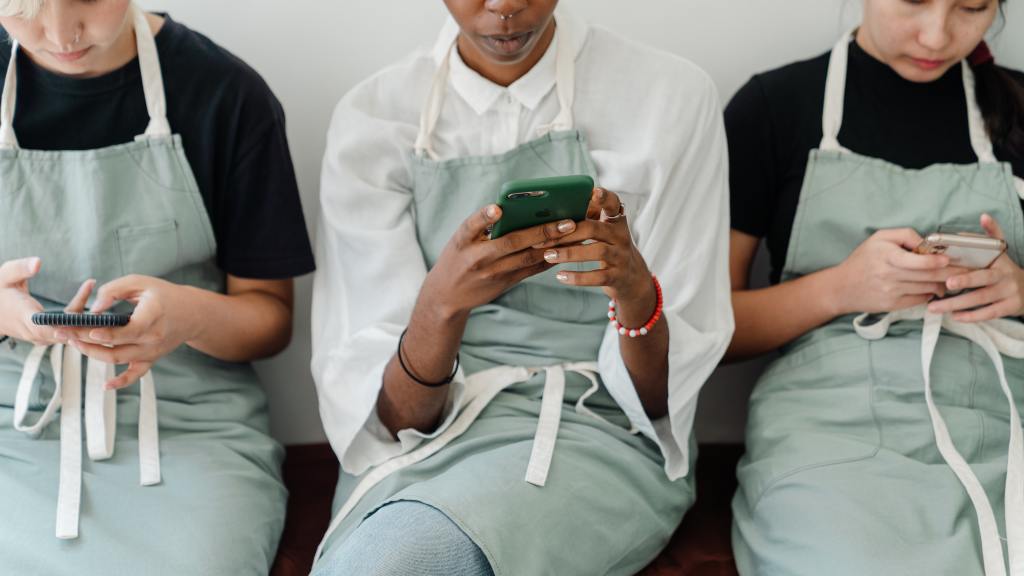
Three people wearing uniforms and aprons sitting beside each other browsing on their own smartphones

As someone who wants to be always informed and deeply involved in the community, this is a tricky fine line I have been trying to navigate. I am learning a little bit more about the concept of boundaries and I realized it is time to extend that with how I use technology.

So here is how I have been doing it in the past, which I realize it’s a decent foundation. On my desktop computer, I have an app called LeechBlock that sets timers so I only use certain websites for a specific period of time. This helps me prevent going through all content and scrolling mindlessly for minutes even hours without realizing it. When the timer for that web page says “oh you have been using this for 10 minutes straight!” it feels weird because you lose your grasp of time when you are just mindlessly doing something.

And now, I took it to the next level by doing the same thing for my own cell phone using an app called SocialFever. I’ve been doing it for just a few weeks, and I always get surprised when the timer says take a break from your phone because you have been looking at it for half an hour. I was like what? I have been on my phone for half an hour straight already? I just a bit shocking but also not completely. I still get surprised whenever the phone says time to take a break from this app for the day because I have already reached the limit you have set for myself. I have set a half-hour maximum for this particular app which is Twitter or YouTube and the internet browser app/

It is interesting seeing is the end of the day report I get from this app. For the past few days it seems like I have been using my phone for a an average of two to three and a half hours per day for doing different activities. Another eye-opening, if not a little bit humiliating, statistic that this app tracks now is how many times I unlock my phone. It’s weird to see that I unlock my phone in a several dozen times a day with the stats to prove it.

Screenshot of app alerting "app time has been exceeded".
This is the screen that pops up whenever I’m using an app for too long. It’s a jolting wake up call every time, but one that I appreciate.

I hope that by setting externalized limits, I don’t have to rely as much on my flawed self-control and instead, reserve my energy to when I pivot into doing productive things outside of browsing and interaction on social media apps. The pandemic is going to be here for a while so I know that cutting myself off completely from social media is not something I want to do. This, I hope, is the means to have a happy medium.

The Evolution of Audio Announcements- The Captive Transit User Series Part 7

By: Giselle General

This is part of an ongoing series of posts discussion issues I personally encounter while taking public transit in Edmonton. Links to other posts will be added on an ongoing basis:

What is a Captive Transit User? I learned about the term for the first time from the City of Edmonton’s website. The easy definition is: someone who takes public transit because it’s the best (or only available) option for them to travel around. The part about feeling ‘captive’ comes from the restriction that sometimes comes up, perhaps because one is too poor to own and maintain a vehicle, one does not know how to drive, or for medical reasons, cannot operate a vehicle. In many ways, I relate to this a lot. Though I’m pretty fortunate to afford the occasional taxi ride, and with my husband having a car.

“A hundred and eleven street, a hundred and second Avenue…A hundred and twelve street, a hundred and second Avenue… A hundred and thirteen street, a hundred and second Avenue.”

These lady robot announcements weren’t always a part of one’s commute taking the bus here in Edmonton. The first time I started hearing them, I think it’s about 2012 or so, I can’t help but giggle while taking the bus because the voice just sounds monotonous and a bit silly. My brother (who was new to Edmonton at the time) and I would poke fun at the robot voice sometimes. But the more I hear these announcements, the more I appreciate its benefit when taking transit in Edmonton.

When I first came to Edmonton in 2008, I used a print map of ETS to get around. I have both the city-wide map to help me understand the different routes available, and the the route-specific maps as well. I needed to be familiar with the route number 4, 106, 150, 111, 112, 100, 119, 136 and the LRT so I can to go school, work, hang out with friends and do other activities. I still had a flip phone during those early years and Google Maps is not as good as it is now.

A public transit bus rapidly passing through.

I tried very hard to make sure I get off the right bus stop, but in the winter, when it is dark and the windows are frosted it can be tough to look out by the window and keep track. If you end up missing your stop by a few blocks, walking a few extra minutes late at night and in the winter is not something I – or anyone – look forward to.

I also realized that the audio announcements help people with disabilities! I remember reading a quote from a news article from a person who is blind, who said that the automated announcements of the next bus stops are really useful. I bet that for people who are also new to Edmonton, it’s handy as well.

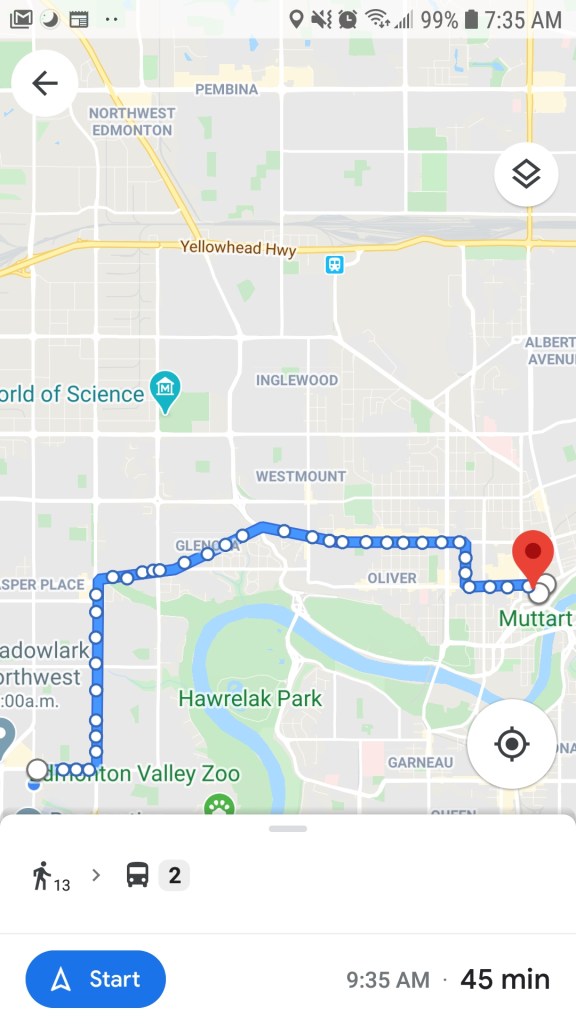
Screenshot of Google Maps showing walking and bus directions in Edmonton.

When I visited New York City last year, a city where sure, there are numbers in the street names, but the system is so different, hearing the audio announcements of the upcoming bus stops, while looking at the app on my phone, helped me navigate around really easily.

But then, we all know that technology is not perfect. When I lived on the further west side of the city, taking the 136 bus, one of the words that is in several street names kept on being mispronounced. For some reason, ‘Potter” became “Potters” and the word next to it loses the letter S at the end. So, Potter Greens Drive sounded like Potters Green Drive. The city’s app for reporting different city issues also wasn’t perfect – there wasn’t an option to report operating issues specific to buses at the time. But I did my best to report it anyways. I really hope it’s been fixed.

At least twice a week, there seems to be technical issues with the LRT announcements when it is supposed to indicate the next station. Either the next station announced is a few stations off, or the announcements were in reverse order. Luckily, now there is an option in the City’s app to report issues about transit vehicle operations.

Selfie of woman outside in winter, wearing a knitted winter hat and most of her face covered in a light blue scarf

LRT stations have additional types of announcements as well which is handy. Particularly right now during the pandemic, there are audio reminders that masks are mandatory. Back in early 2020, both the above-ground and underground LRT stations started to give passengers a heads up that bus transit fares are increasing in the near future.

Overall, audio announcements has been a handy feature for all users of our transit system. I hope that it continues to have the proper resources to maintain and update its functionality so that it works most – if not – all of the time.

Mastering Mask-Making: a Filipina-Canadian’s Perspective on Covid-19

A pile of fabric face masks with plastic window that is in the process of being completed

At this point of the pandemic, wearing masks has been a regular part of people’s routines when going out their homes. This is not to debate the merits of wearing one or the politics surrounding mask wearing during this pandemic, but more on my experiences making them and using them.

In the spring, there are so many instructions online on how to make masks, that even as someone who sews on a regular basis, I was a bit overwhelmed. There seemed to be two major pattern types, the folding accordion type, and the front folding two pattern type. Since I have no shortage of fabric I decided to use what we have to make the masks for my husband and myself.

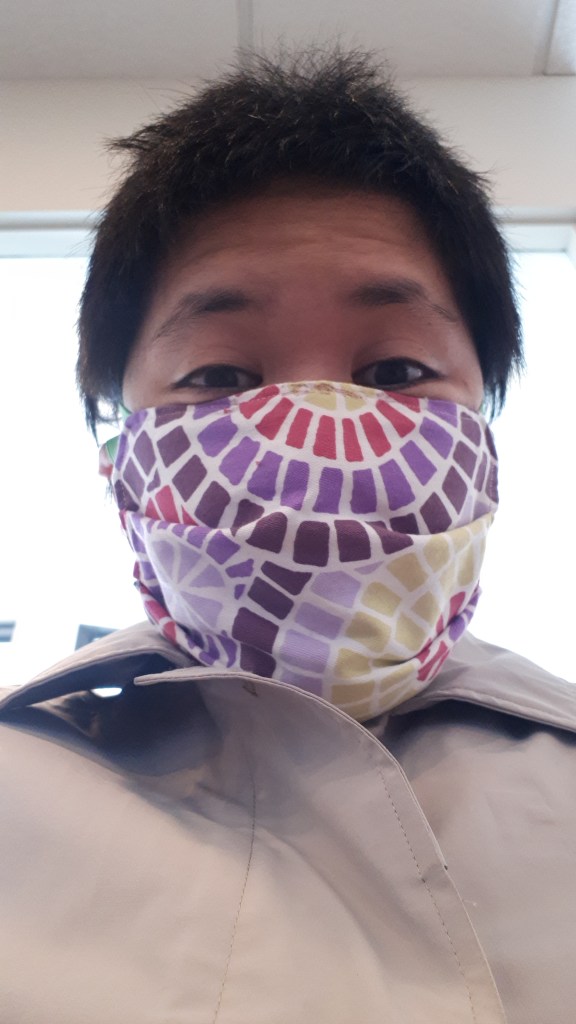
Selfie of woman wearing a fabric face mask, the horizontal accordion style.

It took several attempts. Some are too small, and many were too tight! I don’t have a lot of experience working with elastics, and as a result I end up putting insufficient elastic for the string that is supposed to hold up the masks. I also don’t have a lot of experience with additional components that are not necessarily a fabric such as metal wires for the nose bridge. At first, I don’t even have materials that can function as a nose wire. It wasn’t until after I got some garden wire and also some pipecleaners, that I had the chance to learn how to incorporate a nose wire into making a mask.

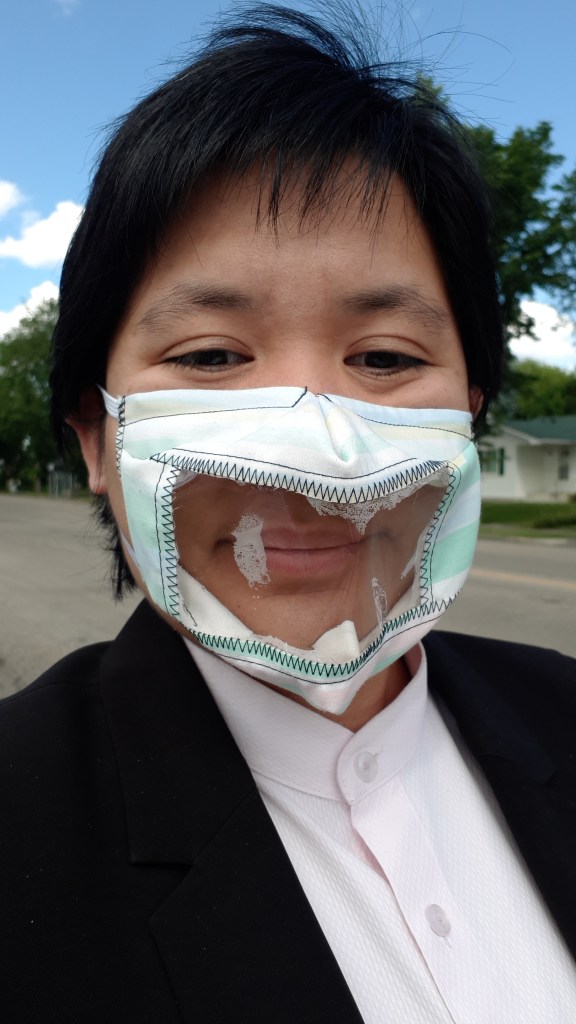
A few months into the pandemic, when mask wearing started becoming more commonplace, I heard an article talking about the difficulties that people who are deaf or hard of hearing are facing because of people wearing masks. The challenge that they face is, it is even harder to hear people speak, and for those who rely on lip reading, they are unable to do so. I eventually stumbled upon a mask with a clear plastic transparent window and I thought that was awesome. I made a few attempts making this mask and they are a part of my own inventory of masks that I wear on a regular basis.

Selfie of woman wearing a fabric face mask with a plastic transparent window.

I really like these special masks that I made. When I have gone to retail stores wearing these masks I get a lot of nice compliments! People say that it is actually nice to see a persons smile again which obviously was covered thanks to masks. I remember attending an outdoor community event around early October and I wore one of these masks with a plastic window, and I got a lot of compliments from people who attended. One inevitable challenge is that when you talk, some fogging or moisture buildup occurs. I learned a trick to mitigate this, which is applying a very thin layer of dishwasher soap and letting it dry. Letting it dry is particularly important because it is awkward sniffing and smelling the dishwasher soap scent while wearing the mask with the window. I’m sure you can tell I learned that from experience.

During this time, I was also helping with fellow Albertans making free stuff for those in need specifically, I was helping to make free laundry fabric scrub bags for health care workers. There was another initiative running alongside this one, which is making free fabric masks for people in need. I admit, I felt conflicted for a while. I wasn’t sure which initiative I should keep on helping with. Eventually, I reminded myself that it is OK to help on one initiative only and hope that others, are willing to step up to help with the other one. It seems like that is the case! Many other people who have skills in sewing and quilting, helped to make free masks for those in need. Others turned it into a creative fundraising method. I heard that one lady made masks as a fundraiser and raised $10,000 for the Edmonton food bank and I thought that’s impressive.

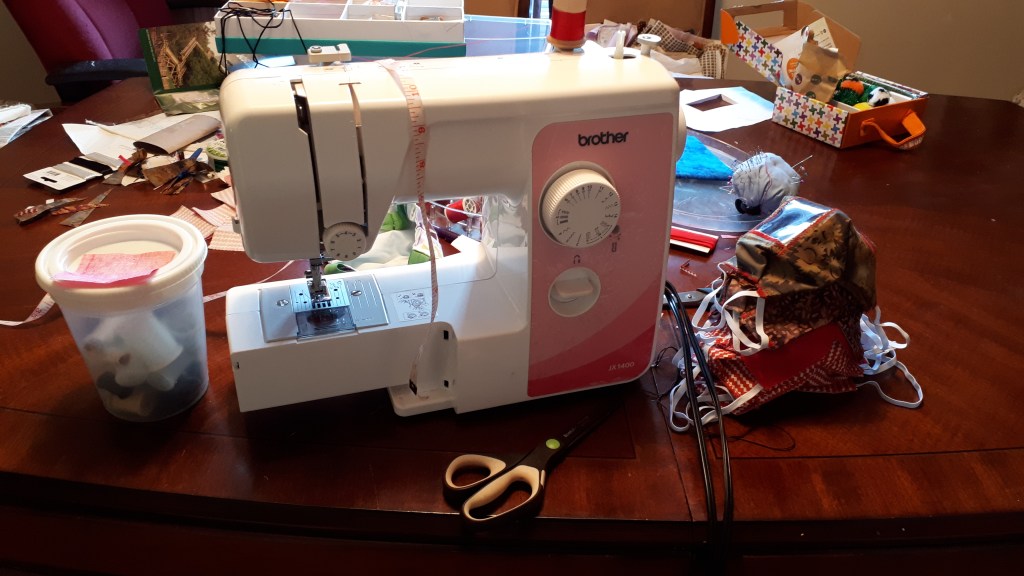
Sewing machine on a wood table with sewing supplies around it, and a pile of completed fabric face masks beside the machine.

I made an attempt to make free masks for those who need it, and it was good but it did not last long. I was happy to make roughly 30 masks in total. The challenge I had was, because I am not a car owner, delivering these masks was more difficult than I anticipated. I also got frustrated when people don’t respond to Facebook messages after a couple days.

I decided that chasing people and following up with them on social media after making a request for a free mask is not worth my energy. When I stopped making these masks and getting stressed out with all the logistics of delivering them I decided to focus on the fabric bags that I am making for healthcare workers and I’m able to reach making 300 of them. And that felt pretty awesome!

When my husband had to go back to the office on a more regular basis he asked me to make several more masks for him. He already has a few that he uses whenever we have to go out for things such as going for groceries. But this time he actually wanted something more special and customized for him. We went against my inclination to use fabric I already have, and we went to the fabric store to buy a brand new fabric with a design that he likes for me to make masks. He has about two dozen of these masks. He seems pretty pleased with himself and I’m more than happy to make those for him.

Just in the fall, as I started to go back to work at my office on almost a daily basis, I decided to make additional masks also. At this point, after some trial and error, I found a mask style that I’m happy with overall. So I made five more of these and I learned my lesson from last time, and I put in an additional inch of elastic.

Woman wearing a face mask while donating blood at a blood donation clinic.

Now that it’s getting even colder, I learned another technique that I started to do when taking public transit and having my face covered. In the past, to keep myself warm and comfortable I actually wrap my winter scarf around my face. A few times, I have actually taken public transit and covered my face using only this scarf , not wearing a mask at all. And the way I wrap my face it is pretty comprehensive, practically my entire face is covered except for my eyes. So I’m pretty confident that I have fulfilled the bylaw regulation about face coverings. But now that it’s getting even colder I even doubled up. I would wear my fabric mask 1st and then, wrap my face you seeing that fluffy winter scarf that I use everyday during winter. When I go to our office, I make sure that I have at least one fabric mask which is what I use when community or when I don’t need to talk to people, and I make sure that I have at least one of my special masks with a plastic transparent window if I need to talk to people.

The routines related to masks in my daily living has been more settled now. From handwashing them on the weekends, ensuring the stitches and seams are still intact, and providing solidarity on social media to people who had to deal with people who refuse to wear masks feel second nature now. There is a part of me that wishes that people continue to wear masks to limit the spread of the flu during flu season. But for now, I’ll continue to find small motivations and silver linings to make the pandemic more manageable.

Edmonton Experience Story: Coliseum Open House Before Closing

By: Giselle General

On December 17, 2017, my partner (now husband) and I decided to take the one last opportunity to tour the Coliseum before it was officially closed down. This is a summary of the tour, including some observations of the area and new things I have learned.

My partner is a born-and-raised Edmontonian, while I moved here when I went to university. That being said, I had a chance to go to the Coliseum a few times. First, for an Oilers game with my partner, then for a few concerts, and also another time for an Oil Kings game, during one of the nights when there was a Teddy Bear Toss.

We went there by taking public transit, which was lovely because it gave my partner greater flexibility. Also from our memory, parking in Northlands is expensive. As the years went by, traveling around by transit is a part of our date that we enjoy, since the buses and LRT vehicles are almost empty and we cozy up in our seat.

A "Points of Interest" map of the Edmonton Coliseum.

When we went to the Farewell Weekend tour, it was pretty quiet. I wonder if it is because it was the last day, or because it was pretty chilly.

The map was a useful guide to particular points of interest, and upon visiting those places, there were signs that explained the function of the area and some interesting historical or sports-related facts. Many places that are not publicly available is available for viewing this time around, such as the locker rooms and bathrooms for the athletes, the media room, fancy suites on the top floor, with a lobby that looked like a hotel.

We both forgot about the open skating opportunity, so instead, we went to the frown row, Corey sat in the penalty box, and asked me to take a photo of him pretending to be upset for being sent to the box. We spent a some time watching people skate around, while enjoying the soda and nachos we bought from the only concession stall that was open.

The skating rink of the Edmonton Coliseum, veiwpoint from the bleachers.

Afterwards, we decided to take the LRT to go to downtown instead of going home right away. At Churchill station we saw a woman painting a mural on the concourse of the LRT station. It was incredible, with patterns of what seemed to be a woman, lots of red birds, and a village and various scenery of a community. I started from a distance when he nudged me to say hello to the artist and chat about the mural. I felt shy at first but my husband reassured me that the artist might actually appreciate the chat. And he was right. I told the artist that she outline seems really interesting, that the elements she’s painted so far look incredible, and inquired her on what the painting is about. She told me that it is part of an initiative called Paint The Rails, which now had resulted to several paintings across different city’s LRT stations.

As we were already in downtown, we decided to stop by the Farmer’s Market and we arrived just in time to see the different shops close down. It’s nice to see the different types of businesses that were there, and we took some photos in front of the nice decoration that were set up in the interior of the City Hall building.

Afterwards we decided to visit the funicular for the first time, which is just a few block away by the Hotel MacDonald. We thought it was really neat and the lookout point at the bottom was great! I remember that one of the benefits of the funicular is for people with mobility aids to have a chance to see our beautiful river valley more closely. Using it ourselves made us realize and appreciate that goal.

After that we decided to head on home. As the Coliseum was accessible by transit and our detour in downtown Edmonton was also accessible by transit, we continued to use transit to head home. It was a lovely weekend date in the winter that we continued to cherish.

Story Time: The Processed Food Products I had to Learn How To Make

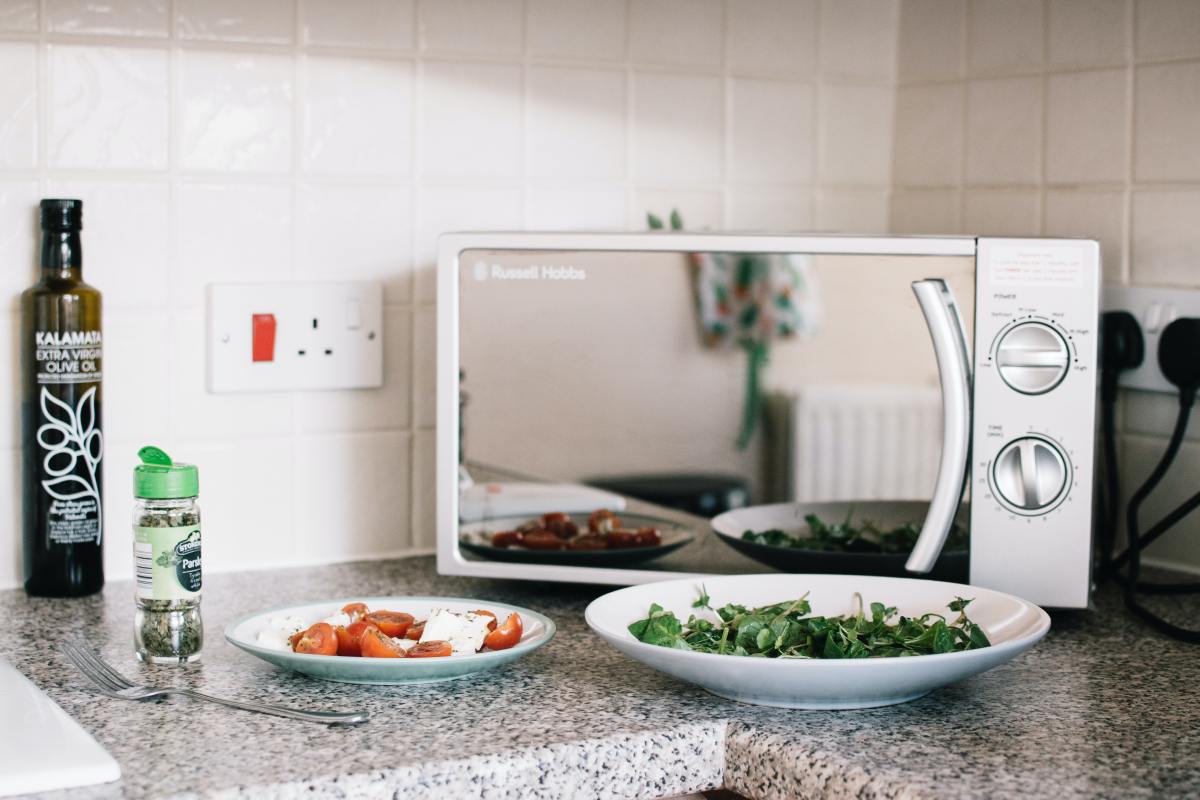
Kitchen counter with a microwave, sauce with tomatoes, a plate with greens and bottle of spices and olive oil

by: Giselle General

As someone born in relatively more modern times, even if I grew up in a rural place before coming to Canada, I’m not completely ignorant of processed food products. The fact that my family had a convenience store gave me greater access to them. So I already know how to prepare and cook frozen hotdogs and meats, and how to differentiate preparing instant noodles from a package using a pot water, and instant cup noodles by pouring water that is already boiling.

However, upon arriving to Canada, certain products are so new to me that I had to learn the hard way how to prepare them. I fondly look back at these cooking mishaps with humor now, but it was either mortifying or frustrating during that time. Here are some of these (now adorably funny) mishaps.

Microwavable Meals

“Did the package just say that this is frozen creamy linguini chicken pasta? So the pasta is not raw? How does this work”? Microwavable meals were a lifesaver for me and my cousin when I first arrived in Canada. My older cousin is really busy with going to college and working, that preparing meals is something that is not feasible all the time. Besides, these frozen meals are pretty cheap. I eventually learned that it is very important to follow the instructions to a T. When it says, lift only one corner of the container, you have to do so. When it says to let it stand for one minute after the timer goes off, you have to do that, otherwise your hands are not going to like feeling burnt.

Here are where the mishaps happened. When I was already living in Edmonton, a few times I decided to bring a microwavable meal to school, find a clean microwave on campus so that I have a slightly more decent meal for cheap. One time, I forgot to bring utensils so my plan went sideways. The other time, I forgot that this is a frozen meal, so on locations where the temperature is above zero, like my own backpack, it starts to melt and makes a wet sticky mess on your bag!

Close up of an oven's handle and buttons.

When I started dating my then boyfriend, now husband, I also discovered an even more unusual type of microwavable meal called “rice steamers”. There are extra steps such as layering the plastic bowl-like contraptions and lifting half of the plastic seal. Each plastic bowl is a different part of the meal, one is rice or noodles, then the other would have the vegetables or meat and the sauce. After taking it off the microwave, you combine all the different food items together and there’s the meal, ready to go!

Frozen Pizza

Frozen pizzas were a mystery for me the first few times too, haha! One time, I tried to help with making dinner at my then-boyfriend’s place. I though I understood all the instructions, set the timer, removed the plastic film and whatnot. But I forgot to remove the cardboard box to transfer it onto a pizza pan, so the bottom was weirdly soggy and damp. The other time, after I learned that keeping the box on isn’t what you are supposed to do, I placed the frozen pizza right on the oven rack. The pizza was cooked well this time, though I did struggle with taking it out of the oven to cut it into pieces. I felt really silly for sure!

There wasn’t an explicit instruction in the box that talks about that – I bet it’s because it’s assumed that people already know that frozen pizzas are to be placed in a metal baking pan. But now, I know better and I’m a pro at making frozen pizzas when in a pinch for a good meal!

Canned Tomato Soup

The only “instant soup” (not instant noodles) that I was familiar with at the time is the cream of mushroom soup. Empty the can, with this almost jelly-like blob that held the shape of the can, add another can of liquid, either milk or water, stir the blob so it combines with the other liquid, and warm it up. But the first time I dealt with tomato soup, it’s a bit of a mystery to me.

Tomato soup with green garnish on a white bowl.

My then-boyfriend and I were making a simple dinner at his condo and we wanted soup, and he wanted tomato soup. It was confusing because upon opening the can, it was a thick liquid, but not as solidified as the cream of mushroom soup. I added the water, combined it and heated it up. For some reason I thought it’s taking such a long time to simmer, but I waited and waited anyways. Once it looked reasonably warmed through, I put it in a bowl to serve. He ate it without a fuss.

It wasn’t until years later, that he admitted that I burned the soup very very badly! That’s why there was a tough brown layer of soup at the bottom of the pot. I can only imagine how horrible it tasted, oh no! But he didn’t say anything at the time. I guess that’s what happens when you are still in the honeymoon phase of your relationship. Now it’s been a running joke between me and my husband when we cook and prepare meals together!

Love language Reflections: Support in times of Crisis

Man hugging woman, woman's head burried on his shoulder

by: Giselle General

My husband and I had a particularly challenging weekend sometime in June this year. As if the pandemic is not enough. In times of crisis or particularly stressful situations, people react differently. People’s reactions can possibly be categorized into the following: fight flight or freeze mode.

Similar to how we face a threat that is directly affecting us, people might react in the same way if there is a crisis about their loved ones, especially if we are directly involved in their daily lives. Some people are in “hyper solution mode” or “fight mode” running around getting things done, getting everyone together to act, and then after this adrenaline panic-solution mode, they get exhausted and worn out. These helper types, dedicated to support their loved ones, end up not realizing they need to care for themselves too.

There are some people who have intense outbursts of emotion during times of crisis, getting stuck and unable to provide tangible practical solutions to resolve the crisis at the end. I personally describe this as the ‘flight mode’ especially emotionally. However, in my opinion, there is value with how these type of people respond even if it may be off-putting at the time. They demonstrate the emotional impact, the reality and seriousness of the situation at hand.

Woman sitting and crying, and person's hands supporting her shoulder's comforting her back.

And there are people that are in silent mode, I would say is the ‘freeze mode’. Those who are too quiet or maybe two numb or lost, unable to determine a course of action. It’s not necessarily that they’re useless in the time of crisis, however, it takes prompting or direct, specific instructions to get them to do anything. Whether it is direction from the hyper solution-focused loved one, or being prompted by the emotional outburst of the others. 

Particularly for long-term relationships, I think it is really important to understand how our loved ones respond during times of crisis.

This is because different reactions or solutions would be more appropriate depending on the situation. If someone is in medical distress, it probably would be important to be more solution-focused at least until the severity of the situation is minimized. However, it is important to acknowledge the intense feelings that have come up because of the situation. Imagine your loved one being taken away by ambulance – there’s the peak emotional state and then there’s the crash afterwards. In many crisis situations, solutions, support, and follow-up is more of a marathon not a race. There needs to be diligent planning and follow-up and ongoing communication so that the problem at hand can be fully resolved.

The valuable thing about knowing your loved ones’ mechanism when responding to crisis as you can pick them up and support them during times when they are struggling. Some people struggle with displaying their emotions even after the fact, even when it’s safe, more appropriate, or even healthy to do so. Some people get paralyzed and unable to do proactive helping in the heat off the crisis and that can be detrimental as well. I think it’s important for people to have faced crisis situations to feel vulnerable enough and unpack their emotions afterwards. Being self-aware of one’s own tendencies are just as helpful.

Lined notebook with handwritten words, "Today, 1, 2, 3".

This is speaking from recent experiences. I think, or I hope, that I’ve figured out my own and my husband’s mechanisms when it comes to crisis solving. There will be times when he’s not willing to talk about it just yet and that’s okay. Sometimes disconnecting from the situation for a bit by browsing the internet is an okay way to provide yourself some relief. And it’s important to acknowledge that. He gently suggested a couple times for me to meditate because he knew that it would be helpful for me, and I honestly would not even thought of it if he had not brought it up.

It’s important for loved ones to not be judged by their coping mechanisms. It is also important to gently and lovingly nudge your loved one to get supports that you are unable to provide. It took me a while to acknowledge that sometimes I just need a talk therapy session with a professional to help unpack my emotions so that I can be less filtered in my language and be more candid in a way that works at specifically for me.

To be heard, understood, supported, and pushed sometimes, is really important to maintain our sense of perspective, sense of health, and nurture our ability to help ourselves and our loved ones. 

Relationship “Green Flags”

Woman leaning her chin over a book on the table, smiling and giving a thumbs up.

By: Giselle General

During one of the rare days that I was working in the office this past summer, I dropped by the office of one of my coworkers. He’s a few years younger than me, just finished university a year ago, and is about to pursue another important life milestone: moving out of his parents’ home and moving in with his girlfriend. He started as a volunteer five years ago so we have known each other for a few years and has heard of the relationship milestones that I had myself, particularly reaching legal common-law status with my partner, and afterwards, getting married.

I was teasing him a little bit, and giving some friendly warnings about how moving in together with your significant other is both exciting and unnerving. I told him that getting annoyed with little things such as how toothpaste tubes are placed in the bathroom sink or how a toilet seat or lid is set up will be inevitable. During the chat, I used a phrase I saw somewhere over the internet in the context of a romantic relationship which is “green flags”. When he told me that they assembled a piece of furniture and it went smoothly, I enthusiastically told him that is a relationship “green flag”. He said, he will use that term also moving forward.

In conversations about romantic relationships, “red flag” is a common and appropriate term. It is indeed important to be attentive to subtle and obvious cues, both verbal and nonverbal that can indicate something that is potentially problematic. But spotting positive signs is not encouraged as much. So I was thrilled when I saw the term “green flag”, I think on an internet meme somewhere. Oh, the power of internet, this time for good!

So here is a very introductory list of “green flags” in a romantic relationship.

  • Both parties are able to be patient and collaborative at the same time. Building furniture, especially from IKEA, is the ultimate test for this. Another way to test this is when cooking a dish together that takes several steps, like cooking on a stove, baking, assembling.
  • Understanding and respect of differences and limitations such as allergies, food preferences, physic endurance doing an activity, clothing colors or textures of objects they like or don’t like, and more.
  • Ability to communicate well, outside of romantic expression and having sex
  • Feeling confident and secure in one’s appearance when around them, there’s no need to fake it to impress
  • Experiencing a messy bodily illness or function in front of them, and they didn’t freak out too much and judged you harshly. This includes skin irritation, digestive issues, the flu, blood, etc.
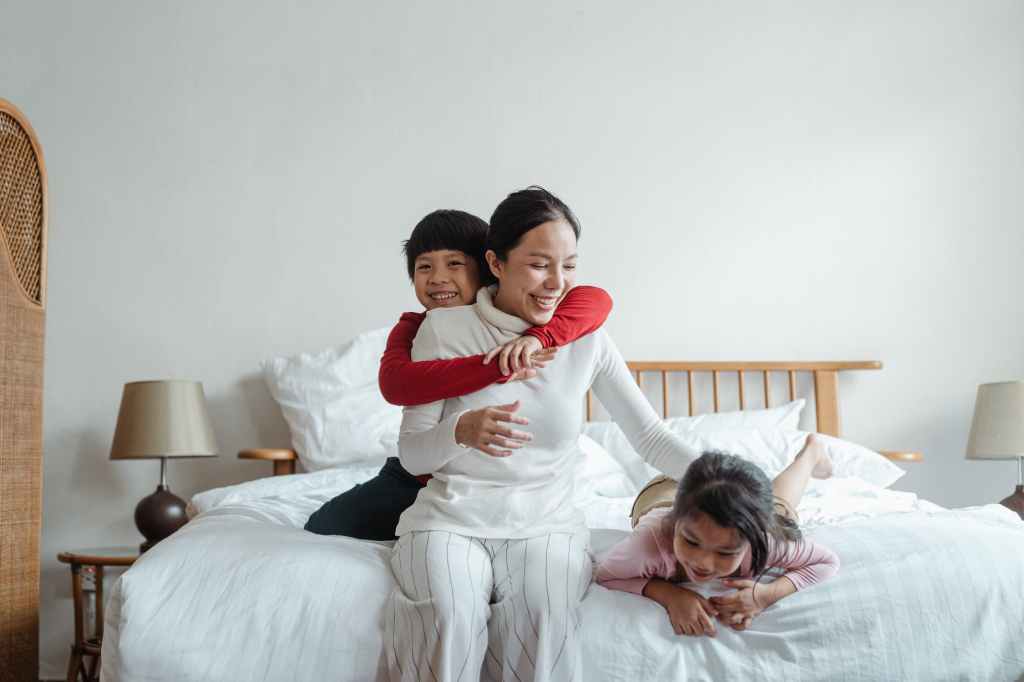
Mother and a young son and daughter, sitting on a bad teasing and laughing together.

And here is a very introductory list of “green flags” in a family relationship.

  • Feeling at ease in their presence, whether it is an older or younger family member
  • Comfortable with making small requests, from unloading the dishwasher, cleaning the hair off the shower drain, or a car ride
  • Positive gestures done in the past is never used as blackmail material or as a guilt-tripping tactic
  • Able to share casual stories about daily life even if it may sounds like shallow venting

And another short list of “green flags” at one’s place of employment.

  • On weeks or days that are difficult, there is a feeling that the next day can be a bit better, and it does
  • Feeling productive most of the time
  • Having one’s direct supervisor and a few colleagues (not necessarily all of them) be understanding and sympathetic towards the ups and downs of your duties
  • Not worrying one time about salary and payday
  • Having functional equipment and honest efforts to fix something when something is broken
  • Being comfortable with whatever arrangements you make during lunch break

I have two sets of relatives here in Edmonton, two happily married couples whom I observed one action they both do, they address their respective spouses as “mahal”, as in the word for love (and also for expensive, haha!) in Tagalog. I really liked it. So with my partner and now my husband, we address each other as ‘love’. And it’s awesome!

My husband and I chat about our respective workplaces and I share little stories of work activities for staff, social gatherings, and upcoming changes. My husband says with an amused look “wow, your managers actually know how to manage.” Based on stories from so many people we know, we both realized that managing employees is not a skill that everyone has.

I think it’s a good idea to proactively spot ‘green flags’ in our experiences and interactions. It provides an opportunity for appreciation and gratitude, as well as motivation to learn, master and emulate those positive things. This is something that I will try to do more moving forward.

When I was too Shy To get Involved

closeup of a female student carrying books while standing on a sidewalk with parked cars

by: Giselle General

When a child is labelled as an ‘honour student’, that comes with significant implications. There is a barrage of positive traits that are associated with it: intelligent, well-disciplined, capable, confident, admired, role model. The positive associations can also be a heavy-handed set of expectations.

In the Philippines, the English word “transferee” is used to describe students who were new to the school and didn’t start first grade or freshmen year in the school. Growing up in a small mining village with a single school where everyone knows everybody, being a transferee is a rarely-used label.

And then, I became one of those students. Halfway through high school, I moved from the small village to the nearby city.

silhouette of a person walking alone

The move was unnerving for many reasons, and one of them for me is navigating academic achievement and extracurricular involvement. My younger self knew that schools are the same everywhere, that well-performing students get awards and recognition and benefits such as scholarships. The schoolyear stared in June and it wasn’t until November (so about 5 months in and more than halfway through the school year) when I started getting involved again in school clubs.

There were so many things to get used to in this routine. I never had to travel through public transportation every single day, two trips, to go to school and back. It was three years since I lived with my younger brother, and I was living alone in my house-and-business-building dwelling, my sari-sari store, for about a year. It sounds strange to say but I had to get used to living with people again. My brother and I are back to having the mother/father/sister dynamic that we had, only he’s 10 years old and I’m in the midst of puberty.

During the first few months, my priority was knowing names in the school, and within a few weeks, I was successful in knowing the names of my classmates, both first names and last names. The school was previously an all-boys school, and part of the culture was for students to call each other by their last names, since there’s too many students with the names John, Alexander, Anthony, Mark, James, Carlo, etc. The tradition carried on with the female students. So yes, I had to get used to be called General by students during casual conversation. In the early morning before class starts, I hear often “hey yo, General! can I copy your homework?

Two clusters of board game pegs, one cluster with 6 light organge pegs and one brown peg by itself.

But I didn’t join any school clubs right away, because I was still afraid of going home late. I was fearful or unsure on whether the elders, the legal guardian, is aware of the challenges and realities of high school students living in the city. We don’t have a computer at home, so even something as simple as submitting a printed report requires going to an internet cafe in downtown Baguio and it requires a lot of organizing. These city kids seem fancy and wealthy and carefree, and I don’t know how to fit in.

Eventually I was able to articulate, although awkwardly, why I didn’t join clubs. “I feel too shy to go”. My uncle, Tito Roy, who was a teacher in the school, snapped me out of it in his own way. He said how ridiculous that is and told me to “just go and give it a try’.

That really paid off because it opened multiple opportunities for me to feel the same way as in my former school, get involved, achieve things, and have a mental escape from the horrors at home that were about to happen the following year. Managed to be the valedictorian for my graduating class even if I was there for just two of the four years of high school.

As an adult, I think there are times I still feel like this. I found a fancier, but perhaps more appropriate term of it. ‘Imposter Syndrome’. There is a daunting feeling of feeling like an outsider for a multitude of reasons: because of being new and in an unfamiliar space, and being uncertain of one’s ability to be a positive impact in that space. I think the last thing that people want is to be perceived as dead weight or an inconvenience.

Has this feeling gone away? Not completely. I’m participating in the community in ways that I haven’t heard my elders or friends do: help at an election campaign, offer to be a columnist for an ethnic newspawper, submit a writing proposal for a heritage-focused digital writing project, registering to join a board of directors of an organization. So many times I feel a bit lost and unsure navigating these situations. One advice I heard that helped is this: everyone is just trying to wing it. Another one I’m trying is to approach things with curiosity. Instead of thinking “oh man I don’t think I really get what is going on here”, to think “hmmm, what is going on here and what new things I can learn?”

The shy side of my is likely still there, and it’s not the worst thing. A key lesson I remembered from therapy is that “feelings are information”. The feeling of shyness and uncertainty is simply a sign of being new in a situation, experience, or dynamic. And it can be handy in embracing, learning and growing.

Love Language Reflections: Appreciating Each Other’s Yin and Yang

Black and white photo of a couple holding hands, photo focus on the torso, arms and hands.

By: Giselle General

Being “Therapist approved” is an inside joke that my husband and I have, which is a reference to the first time I went for mental health help in 2017. I shared to my counselor at the time the different gestures my husband does to support me, as well as his perspectives that are different from mine in a good way. And always, after each story, this counselor would say “he’s great, I like this guy!” After every therapy session I’d share this to him, and would say cheerfully “wow, I’m therapist approved!”

Recently, I booked another online therapy appointment with the psychologist I’ve been seeing for the past year. This time around, there isn’t a major issue that I needed regular appointment for, but more like an check-in and occasional help once in a while. It’s like going for a massage – but for my psychological wellbeing – going once every few months feels really nice!

As I described how my husband and I support each other, and how our personalities and priorities are complementary but different, this psychologist commented about how my husband and I seem to be a yin and yang of each other. A contrast that is drastic and obvious, but works so well together and creates a harmonious union.

It reminded me of a painting I made many years ago, back when we were still living in the condo. It is an abstract interpretation of how he and I were a yin and yang complement to each other. It looks like my younger self had observed that about our relationship already. My husband liked the painting to much that it moved with us when we bought our house. Now, not all paintings that I made are kept. Some end up getting donated to fundraising auctions for charities, or I paint over it with a different design. For a painting to stay here for more than five years, it has to feel really special to him.

Abstract painting of a yin and yang symbol that is altered, with handwritten scribbles in either blak or white pencil.

What does this yin and yang harmony as far as our relationship is concerned? Here are some examples:

  • I’m very achievement-oriented and strive for excellence, while he is content with being minimal and steady in achieving life goals
  • He has an amazing ability to be a long-time ‘couch potato’ sitting and watching TV or playing video games all day. I lose attention, and my bottom hurts after watching 1.5 episodes on Netflix, unless it is really interesting.
  • He emphasizes a lot on rest and relaxation, while I’m energetic and immerse myself in lots of volunteering and creative work
  • One example related to chores: I strongly dislike doing laundry, having to wait and time my day to move clothes from the washer to the dryer. But he is more than happy to do so. And then, he dislikes folding and putting away clothing neatly, which is something I am more than happy to do.
  • Our backgrounds and upbringings are drastically different. He is a born-and-raised Canadian white man, with a middle-class family, parents who raised him and stayed in the same home the entire childhood. I grew up in the Philippines, orphaned at a young age and had to function as a parent, immigrated to a new country and moved across cities and provinces.

I think it is not just personality, but encouraging one’s partner to look at things from a different perspective, so that each person has a sense of balance in life. It’s really great whenever he talks to me a few times a month to help me take inventory of all my volunteer activities, and making sure I don’t take up too much and overstretch myself.

Another important aspect is the acknowledging and accepting the differences, particularly if it doesn’t cause harmful disruptions in day to day living. For many years, our budgeting system is quite different, and as long as we are overall organized, it was okay if he used a specific software for budgeting while I used my bank’s online system. It’s totally okay if our office desks, which are next two each other, looks so different. His is really tidy, while mine has mini piles of stuff, from pens, my wide-open bullet journal, business card organizer, and our couple’s diaries. It’s totally okay if he has his clothes sorted in a pile of stackable bins, one of each type of clothing, while I have a closet where majority of the clothes are in hangers.

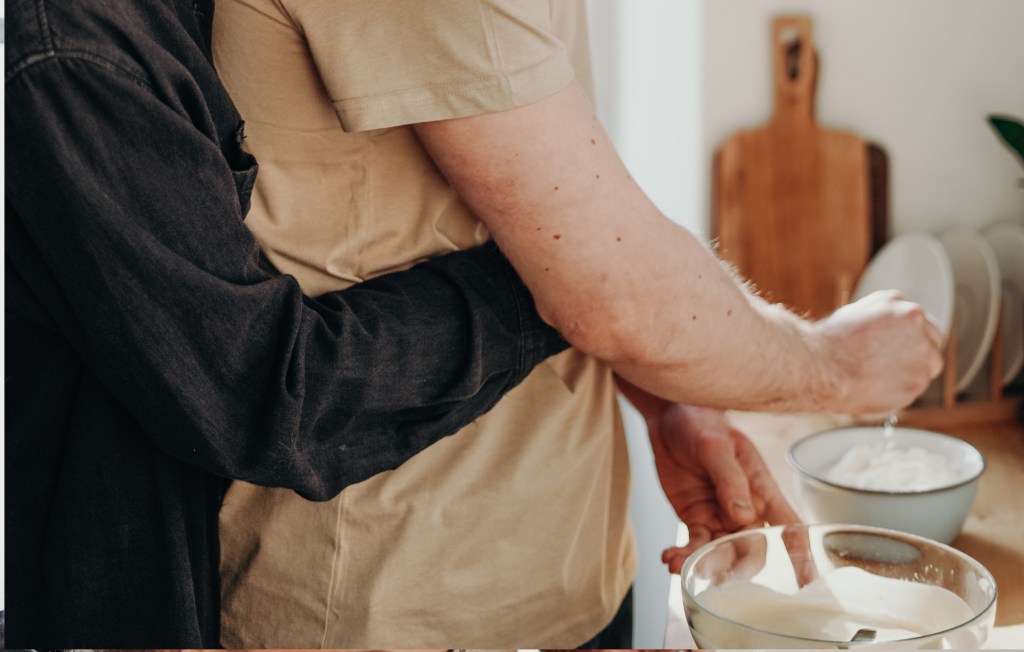
Close up of a couple mixing baking ingredients. One person hugging the other from the back.

It’s been six years since I looked at that yin and yang painting up close. I wrote words in black or white color pencil in the flowy parts of the yin and yang symbols. As I read the words, the passages are filled with eagerness and curiosity, affection and optimism. There were many phrases that are contrasting and complementary describing both him and me and our experiences: happy and sad, modest and proud, dark and light, straightforward and confusing, assertive and passive, generous and practical, gentle and blunt, he and she.