Book Review and Thank You Letter: Frostbike by Tom Babin

Giselle holding the book Frostbike. Her husband's bike is behind her.

By: Giselle General

A few weekends ago, I visited someone near my home to talk about different neighbourhood things and the upcoming election. That late morning visit was lovely and veered into a conversation about winter cycling, something my husband just started to do in 2024 when the snow hit. As a result, she enthusiastically offered to lend this book that I immensely enjoyed. So to this neighbour, who also gave me a sample pack of roibos tea from a local tea shop, this is a Thank You letter and review of the book Frostbike, the Joy, Pain and Numbness of Winter Cycling, by Tom Babin.


April 19, 2025

Hi neighbour,

That winter morning was frosty, but my hands felt better right away from how you welcomed me to your home, with a cup of tea. The great conversations about my post the day before about someone wanting to organize an English-learning initiative for newcomers in the neighbourhood was even lovelier. As we chatted about different matters, the inevitable half-complaints about winter came up. Then I shared that my husband tried biking to work once a week since the summer, with this season being his first time winter biking.

I was so delighted that you were delighted to hear about this, and shared all your experiences biking from your neighbourhood all the way to the core of downtown. I appreciated your observations on your experiences as a cyclist and how the service roads, sidewalks, shared-use paths and the dedicated bike lanes affect your ride. That you were looking forward to the warmer weather since you are quite faster on the bike then driving at times. So, when you enthusiastically offered to lend me the book Frostbike for my husband to read, I happily took in home.

The thing is, my husband is a digital book reader these days. He’s quite happy with the app from our local library and been reading books regularly. So I ended up being the one who read the book. The fact that the author in Canadian, and Albertan at that, was a particular draw to me. This is not someone who lives overseas – this is someone with relatable and relevant experience, who lives only a 4-hour drive away.

I liked the way the table of contents was outlined, and how the information and stories started growing in scope. Starting from his personal journey of biking, building and acquiring bikes to help him get cycling in winter. Then the second part is about his assessments of locations, both local and abroad and their winter cycling infrastructure. Then the final part went even broader, the collective thoughts, sentiments and culture not just about cycling, but about winter in general.

Perhaps because I haven’t had a lot of exposure to writing based in Calgary – whether it is fiction, non-fiction, or journalistic, the book gave me the very first deep explanation of the chinooks. It went in detail how that weather phenomenon affects people who live there – from huge migraines from temperature and air pressure changes, to the drastic change from ice and snowbanks to deep watery cold puddles on roads and sidewalks in just a matter of hours. I mean, I’m not a fan of being splashed by cars when I’m on the sidewalk, I can only imagine it being worse down there.

The author’s experiences with biking in the winter reflected what my husband shared to me these past few months. That compact snow is ideal. Ice is more manageable that some would assume. Studded tires make a huge difference. Soft snow and slush is the worst, even more when they are combined with bits of mud, sand and gravel. Putting salt can be described as “the devil you know”, very useful for traction, but damaging in many other ways. Biking at -20 or -30 weather is more doable than anticipated. That car drivers being impatient and hostile is one of the worst things about cycling. And yes, the way infrastructure is laid out plays a very big role in how pleasant or save the bike ride could be. I’m so grateful though that my husband got actual studded tires right away. I definitely would not let him get away with the author’s first attempt at using flat screws on a conventional bike wheel. I do a lot of DIY stuff, but that’s too far. As I always say to my husband – safety first!
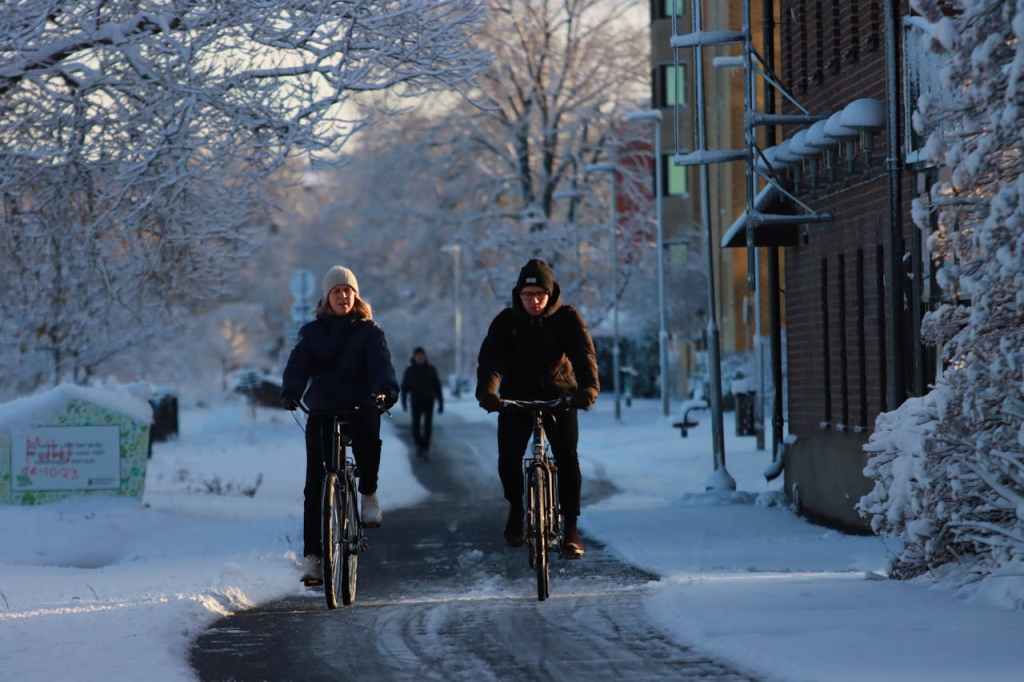
Two people biking on a bike path in winter. Everything, except for the actual bike path, is covered in snow.

The section that talked about the different cities in Europe that have enviable cycling infrastructure was fascinating to read. I empathize with the author’s struggle with not finding the perfect ‘silver bullet’ solution that can be easily copied over to North America, especially in cities that are much bigger compared to the smaller Scandinavian cities. A common pattern is those European cities is the practical normalization of biking all year long, which makes the seasonal switch to winter biking more manageable. The cities described made me realize the truth of the advocacy statement I’ve heard so many times here in Edmonton: build it and they will come.

As someone who doesn’t cycle, the chapters of the last section resonated with me the most. The author started to probe deeply on how pop culture and casual interpersonal interactions over the decades talk about winter so negatively. This I completely agree, and I find a bit frustrating. The pity that people cast towards me when I said “I walked less than half an hour to get here” is so intense. Music, media, TV, movies and songs definitely portray winter as harsh, relentless and something to escape from.

He argues that our negative impressions of winter are holding people back from something positive (or even practical) like winter cycling. I’d say that it is also holding people back from doing even just short walks in the winter! As an immigrant, I have had enough stories and warnings about how awful winter is, so this definitely tracks.

Edmonton had an initiative now for a few years called Winter City Edmonton, to encourage people to seek out interesting and exciting activities to do during winter, such as the winter festivals. And this year, the encouragement also had a different direction, to get people to do more of the typical fun activities but with a winter twist, such as going to a restaurant with a winter patio. I think that the next step should be encouraging doing everyday transportation while being prepared for winter, not wanting to escape it as quickly as possible. With heated cars (that even have heated seats and heated steering wheels), well-insulated buildings, and high-tech cozy winter wear might have contributed to people rejecting the notion of winter altogether, rather than having a practical mindset of it being a regular part of the day. This is what is needed to encourage people to have infrastructure to make walking and cycling manageable all year long. To quote the book when talking about cycling in those European countries “I found a similar practicality: winter didn’t seem to be the enemy, it just was.

I really enjoyed this opportunity to learn from a long-time winter cycling enthusiast what my husband went through, and what the passionate folks in the city are talking about. I know in a few years I would consider getting a bike again, but for now, I feel more informed in understanding where people are coming from, as far as the other transportation methods that don’t involve the car.

So thank you! I hope your biking this year, now that the snow is gone and I think we are past the second “false spring” is going well so far. Maybe my husband will see you on the trails or roads, and perhaps I also will in the future. I bet that if the Coffee Fridays YegBike community has a book club section, they would talk about this book. It’s safe to say, they probably already had.

Construction Zone Bus Stops: The Captive Transit User Series Part 11

A street in Edmonton with a temporary bus stop made with cement barricade, wooden platform, and 2 x 4 for the fencing.

By: Giselle General

This is part of an ongoing series of posts discussion issues I personally encounter while taking public transit in Edmonton. Links to other posts will be added on an ongoing basis:

What is a Captive Transit User? I learned about the term for the first time from the City of Edmontonโ€™s website. The easy definition is: someone who takes public transit because itโ€™s the best (or only available) option for them to travel around. The part about feeling โ€˜captiveโ€™ comes from the restriction that sometimes comes up, perhaps because one is too poor to own and maintain a vehicle, one does not know how to drive, or for medical reasons, cannot operate a vehicle. In many ways, I relate to this a lot. Though Iโ€™m pretty fortunate to afford the occasional taxi ride, and with my husband having a car.


I jokingly refer to my current place of residence as the “West End Construction Pandemonium Zone.” Although that is true, I cannot monopolize the title. All the different areas along the LRT construction route, whether the east one from Mill Woods to Downtown or the west one, really fall under this category. When I tell exactly where I live, though, people agree and do the small cringe that shows sympathy.

Funny enough, my commute taking the bus to and from our neighbourhood is overally pretty smooth. The issues I encounter are not any more different than my previous homes or workplaces. The new experience for me over the past year is the slight changes in the bus stops. Whether the east bound or west bound ones, every few months or so, the bus stop gets moved a block or two away. This is so the construction company has full access to the stretch of road where they are doing underground or above ground work. 

As a result, I had to pay attention to my surroundings and check the navigation apps. and I had to calculate extra walking time, and it’s best not to be surprised. The worst feeling is having to run to go to the nearest bus stop and see the bus zip past you. Learned that the hard way a few times. 

I learned that for drivers, there’s a bit of a learning curve as well. Sometimes, their digital screen doesn’t immediately update and so they will not be allowed to stop and let passengers disembark. 

The temporary bus stops would have the usual sign used in regular bus stops, but that’s where the similarities end. Since the stops sometimes have to be positioned in the middle of the road or right beside a sidewalk, there were these wood structures with platform and railings set up. There are no seats or roofs either. Depending on the location the ramp for wheelchair users are set up different ways. I suppose, portability is a factor in these structures so they can be moved wherever they are needed.

Snow clearing was something I worried about since construction zones are left untouched. This winter has been very, very good, perhaps even safer than the sidewalk near the houses. I suppose sparing a bucket of gravel to deal with an icy patch is barely noticeable given the amount of construction materials they have to use. I hope that this continues for however many more winters to come.

Being sneaky with jaywalking (oops) is something many of us bus riders do, because taking the very very longer way to cross the street and catch the bus is a pain in the butt. I am careful and know my basic safety principles when crossing the street so fingers crossed I don’t get hit by a car. Besides,  as a result of the construction there are fewer lanes on this major road, basically cut in half. So crossing the street the jaywalking way is like crossing a residential street that feels like an unmarked crosswalk. Let me be clear I’m not actively endorsing this – do at your own risk.

And there are times when the bus stop comes a lot closer to my house and it’s really nice. This is the case for the west bound bus stop where I disembark on my way home.

It takes diligence and responsibility of not only the city, but the construction company to ensure that residents and users of the road have a manageable experience, especially for a project that will take years – maybe even close to a decade, to be completed. 

My husband and I also walk by the construction area (of course just by the periphery and we stay outside the barricades), and observe the process. We can’t help but trade jokes about the pillars being constructed, given what happened in the summer of 2022. I’d take photos of the construction areas and sent them to my family group chat. My brother-in-law teases me that I’m overly generous and optimistic about when the construction will be completed. Well, I’d love to take his son, my nephew, on a cool train ride before he enters first grade so I can gain some ‘cool auntie’ points. 

The only other thing I hope that temporary bus stops have is better shelter from the heat and cold. Given that many of the regular bus shelters and stops don’t have it, perhaps it is a pipe dream. But, it never hurts to dream, right? It would also help in the summer construction months, to shield my eyes from the dust cloud right after a bus pulls over.

Transit Routes Made us Move! The Captive Transit User Series: Part 10

A snowy sidewalk with a sign saying "ETS Bus Stop" learning against a teelphone pole.

By: Giselle General

This is part of an ongoing series of posts discussion issues I personally encounter while taking public transit in Edmonton. Links to other posts will be added on an ongoing basis:

What is a Captive Transit User? I learned about the term for the first time from the City of Edmontonโ€™s website. The easy definition is: someone who takes public transit because itโ€™s the best (or only available) option for them to travel around. The part about feeling โ€˜captiveโ€™ comes from the restriction that sometimes comes up, perhaps because one is too poor to own and maintain a vehicle, one does not know how to drive, or for medical reasons, cannot operate a vehicle. In many ways, I relate to this a lot. Though Iโ€™m pretty fortunate to afford the occasional taxi ride, and with my husband having a car


It finally happened! Well, technically the decision was last December which is already half a hear ago. Putting up with the huge change in transit routes in my former neighbourhood, in addition to re-evaluating my life after losing in the the municipal elections, prompted me and my husband to sell our home.

This time around, I didn’t need to grab a paper map of all the city-wide bus routes. Google Maps is much more handy this time around. So it is much easier to assess the bus routes to and from downtown and other parts of the city, at various times of the day.

In addition to the very desirable financial aspect of being mortgage free, having access to bus routes similar to the former number 4 route, or better, is a key criteria. And that is absolutely what we achieved in the townhouse we bought near the Misericordia Hospital on the west end. We officially moved in Spring 2022.

I used to want roommates. Now I want affordable. And always, I need the bus…

https://www.cbc.ca/news/canada/edmonton/first-person-henday-project-giselle-general-1.6441221

This time around, the routes I have access to is many times better than my former neighbourhood. In my former home, I was already happy with that one bus route since it is so frequent and available from early morning and late night. Now, since I am along the major road which is 87 avenue, I have access to two of these frequent bus routes, in addition to several 3-digit community routes and 2-digit cross-city routes. And many times, when I have to do errands, walking is a very feasible option. Walking under 20 minutes, I have access to many five business plazas, including West Edmonton Mall!

Living in a place with convenient transit and walking routes meant I haven’t had a taxi or rideshare trip since May, and as of writing this it is already July! In the past, when I am running a bit late going home from work, I’d take a taxi or rideshare. My monthly budget for this is about $150 a month. Looks like I will be way in the green at the end of the year.

Even the construction happening right next to me isn’t a bother at all. The construction company seems to diligently make efforts to provide proper signage for detours for cars and pedestrians, and adequate notification if construction needed to be a bit noisy at night. Sure it might be about a decade or so, but it would be even more remarkable when we have an LRT station just a stone’s throw away.

This is the ultimate goal, what I hope everyone can have – to have “transit so boring you don’t even check the schedule”. This is my experience now, and in my opinion, that is what it takes for people to trust and choose transit as a serious mode of transportation living in this city.

“Sprinting While Connecting” The Captive Transit User Series Part 9

A stylish professonal woman by a sidewalk during the day waving for a bus.

By: Giselle General

This is part of an ongoing series of posts discussion issues I personally encounter while taking public transit in Edmonton. Links to other posts will be added on an ongoing basis:

What is a Captive Transit User? I learned about the term for the first time from the City of Edmontonโ€™s website. The easy definition is: someone who takes public transit because itโ€™s the best (or only available) option for them to travel around. The part about feeling โ€˜captiveโ€™ comes from the restriction that sometimes comes up, perhaps because one is too poor to own and maintain a vehicle, one does not know how to drive, or for medical reasons, cannot operate a vehicle. In many ways, I relate to this a lot. Though Iโ€™m pretty fortunate to afford the occasional taxi ride, and with my husband having a car.


This particular write-up combines two of the issues I am passionate about as a person who is unable to drive: public transit and snow clearing.

I think it is a right of passage for any Edmontonian to channel their inner cheetah, or kangaroo, or Usain Bolt, to get off the bus and train they are currently in, see the connecting bus or train for the next part of their journey, and run to catch it like your life depends on it. It may be an exaggeration to say that your life is over if you miss your connecting bus or train, but it can be quite inconvenient, a great cause of stress and a waste of money and time when you do.

During my early university years, for my morning classes I would hop off the #119 Bus at the West Edmonton Mall Transit Centre, and then sprint to catch the #4 or #106 to go to the University of Alberta to make it on time for my 8 AM class. Going home is the worst part though, particularly after 9 PM. if I missed the #136 bus, I’d have to wait another half hour (or during the years before 2010, it is an hour-long wait) to get home, and my tired self just feels that is too much. So I’d take a taxi, spend $25 to get to my home in the Hamptons neighbourhood on the west side of the Henday. At the time, it’s so far west, that when I say the street address, taxi drivers get confused and say “What? That’s a street number beyond the 200! Where is that?”

When transit facilities expanded and the Lewis Farms Transit Centre opened in 2011, I had more travel options and it was nice! I can take the express morning bus straight to South Campus LRT, and upon disembarking, I’d sprint to catch the train heading to the University of Alberta North Campus. Now that I think about it, even through the winter months, not a single time did I slip on ice or slush, fall and hurt myself while sprinting to catch the train. Sure, sometimes I miss the but or train I meant to catch, but the mantra I tell myself while still trying to sprint is “better late than injured”.

I know that many people find transit unreliable because of the issues with connections. It’s tricky because on one hand, I understand the expectations of promptness. If the app or the map says that the bus is arriving at a certain time, it better arrive that time, right?

A street intersection during winter with a transit bus passing by.

But at the same time, road conditions certainly affect the speed of the bus from one stop to the other, and from one transit station to the other. Many things can cause micro-delays that add up, from a passenger with a wheelchair boarding or disembarking, letting a mother duck and her ducklings cross the street, or a bus driver deciding to help an elderly person take their groceries home. Perhaps the LRT is delayed because of people trying really hard to squeeze in, or holding the door open for that poor fellow running to catch the LRT. There’s so many factors.

This last winter, when the roads were so dangerously icy due to the freeze-and-thaw conditions, Edmonton transit told all buses pull over and stop operating for an hour until it is less icy. I imagine that derailed many people’s commutes, but I also understand that driver safety is important. Better be late than the city spending hours of time and lots of money rescuing buses that crashed.

The mobile app of the the city 311, also has a new feature now where people can report whether a bus is late. I hope this is something that people use more often. The social media account for transit is not as responsive as the one in Calgary so venting about it on social media is not as effective.

Going back to the panicked moments when catching my connecting bus or train, I’m so relieved that I’ve never slipped and smashed my face onto the concrete. Particularly for the South Campus LRT station which I used almost daily for a while, whenever there’s a heavy snowfall I see the city staff using all tools and equipment to clear snow on the go, from manual shovels, a bobcat, to what I nicknamed as the “motrorized rolling snow brush thingies”. I’m grateful for the quality of their work and I hope they continue to be able to do this.

Now that I moved to a new neighbourhood where transit is much more frequent (on peak hours I have a bus that comes every 10 minutes or less, and in the evenings, every 15 minutes or less). So I will likely not need to sprint and chase the bus to go to my usual destinations. It’s about time, as my knees and my feet are not in the best shape. This is what I wish for people all over the city, to have transit coverage so boring you don’t worry about when the next one is coming.

Storytelling time: My First and Scariest Winter Slip-And-Fall Incident


By: Giselle General

So this happened during my first winter here in Edmonton, back in 2008. There’s a lot of things to learn and navigate and get used to. I learned that winter looks and feels different in different provinces. Things are starting to settle after moving here in July. I have a stable retail job, and I’m earning enough money at the time, I started dating someone who I fondly called my first Canadian boyfriend. And I am navigating all the different schedules and routines I need to do so I can go to the two schools I’m attending which is the University of Alberta and also McEwan University which was called at the time Grant McEwan College.

I worked the closing shift in the retail store where I was working, which is Future Shop at the Terra Losa business centre. It is located on 95th Ave and 172nd St and commuting in the evening was tricky at the time. You have two choices: be lucky and take the bus that is coming along less frequently from the area to the mall and then catch the bus from the mall to our house on the West End. Or if there are no longer buses that are passing through the business centre , take a 25 to 30 minute walk from the store to West Edmonton Mall, through the mall, to the transit station along 87th Ave. This walk is actually nice and refreshing most of the time, especially in the fall or spring or summer months. But winter is a whole different ball game.

Concrete parking lot covered in ice.
This is how the parking lot was like in terms of icyness, but at night!

You see, at the back of this giant mall, West Edmonton Mall, there’s an overflow parking lot along 90th Ave where people can park their cars if the multi level parking areas all around the mall are too full. Essentially I’d walk through a residential neighborhood , walk through that parking lot, cross to into the mall, walk through the mall, and then get out on the side of the mall where the transit station is.

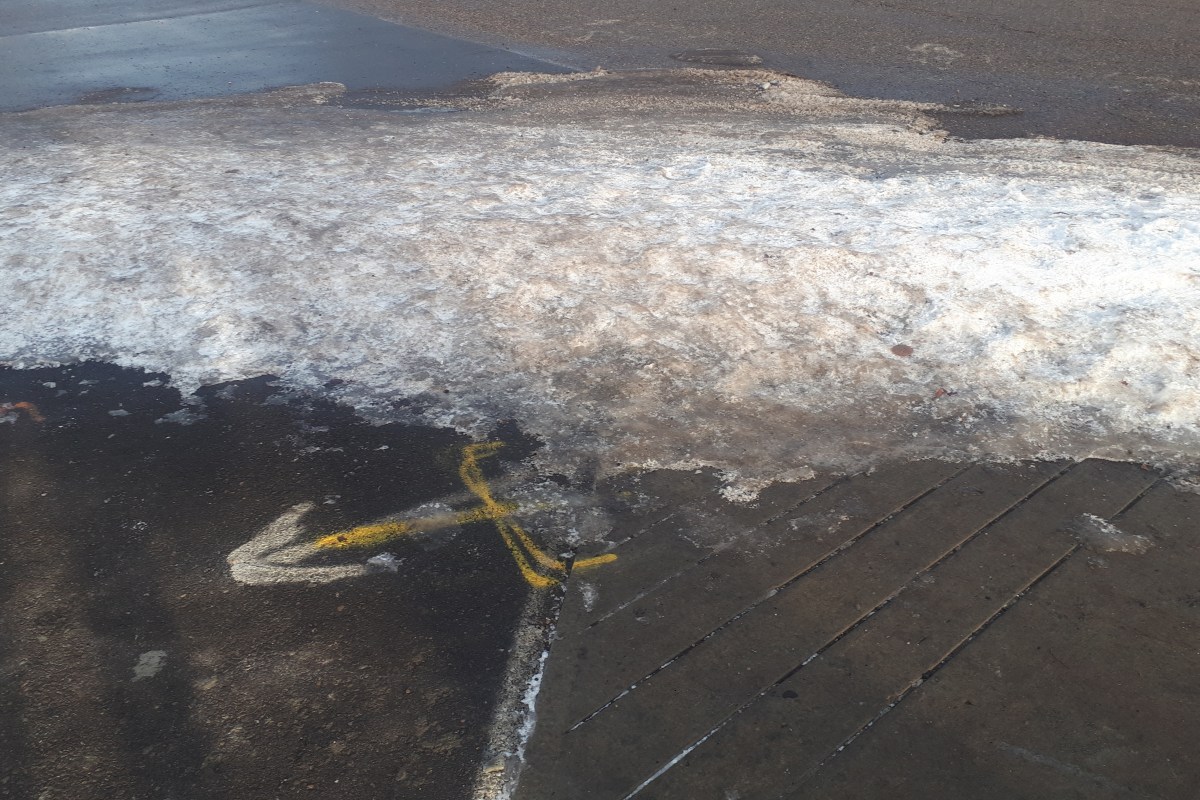
The thing is in the winter, this parking lot is like a giant, giant ice rink. The reality is, if lots of snow falls into the ground and if left untouched by snowplows, trucks or snowblowers, that pile of snow – however many inches it is – it gets packed down. Then, if in a couple of occasions the weather gets warmer the surface layer of the snow melts a little bit and it becomes ice and that can happen over and over. Cars would not have a difficult time navigating the parking lot because they have tires. It might be a bit slippery driving around but that’s pretty much it. However for people on their feet it gets a bit more tricky.

That night, I decided to walk from my workplace to the mall because it was a night that is not too cold so I thought I can handle it. I’m still dressed for the weather though, I have my nice long winter coat that we bought not too long ago from Winners , and I have this really nice and warm knitted hat that I got from my cousin’s and aunt’s place in Ontario. It’s really thick, thicker than most hats. And it is really cozy with a nice little flower knitted on the brim.

Woman wearing a black winter jacket, multi color scarf and white knitted hat with a yellow knitted flower.

As I left the residential area of Summerlea, passing through the playground and entered the parking lot I realize I’m in big trouble. There are hardly any cars around, there’s the very faint light from the street light switch was not helpful in helping me identify where is a section of the parking lot that is the least icy. You know, how you can usually differentiate between the really really slick shininess of an icy sidewalk and the pathway where it’s just snow that is a little bit bunched up but you might have more traction. That night was not my lucky night.

So I did the only thing I can do . I started walking baby steps, little tiny steps to get as close and to get across as quickly as possible. Here’s the tricky thing. I am very aware what time the bus I’m taking will be departing, 9:58 PM. If I do not catch the bus, since it’s already almost 10:00 PM, I need to wait one full hour for the other bus before I can get home. So I’m conflicted! I need to walk slowly because it’s so icy and scary but at the same time I have this bus I need to catch . I’m so happy that there’s no one else in that parking lot because every three steps I would slip a little bit and scream!

I was about halfway through when, I suppose, my balance was a little bit off, because I slipped and fell forwards. I was really afraid I’m gonna slam my face onto the icy pavement. However because my hat was a lot thicker than most hats I actually had a cushion. I did fall face first, but it was my forehead that hit on the ground. I was lying there in shock for a second or two . And I realized I was not bleeding, I wasn’t hurt, no scratches or bumps on my face and I was so shocked and relieved. Then slowly but surely I rolled over on to my back, tried to sit up and struggled because even my hands cannot grip anything because everything is so slippery. And I slowly stood up and continued walking . By the time I crossed the parking lot and reached the sidewalk along 90th Ave I was overjoyed. I moved on to enter the mall through Bourbon Street the restaurant area tried to run and walk and shuffle through the mall to catch my bus.

The next day I woke up in pain and was very scared. My neck hurts! I could not even pinpoint where that came from. Because I arrived home late in the evening I didn’t get a chance to tell anybody what happened the night before. Over breakfast I went into the main floor of our house and talk to my aunt and I told her what’s happening with my neck. She was very worried and for good reason. During the vehicle accident in my childhood where my parents and sister were killed, my brother and I were not left unscathed. My major injuries consisted of a lot of wounds causing a lot of blood loss, and a fractured skull. So my aunt was really worried that it might have something to do with my head again, even if it’s been a couple decades since my injury . Then, I told her about the slip and fall I had the night before. Now she was even more worried! She told me to go to a doctor ASAP, because my slip and fall might have affected my head and she said that it actually might be a concussion. Now here’s the thing, I haven’t heard of the word concussion before so I was even more scared and it sounded really serious.

While enduing my neck that was hurting, I took some painkillers and went to school. For this day my classes were at the University of Alberta. I discovered that there is a medical clinic there that students can go to, which is such a relief. So in between my classes, I went to the Student Union Building on the 2nd floor, and try to see a doctor. I’ve never been to this building before, I’ve never been to this clinic before, so I quite don’t know what to expect.

I didn’t have to wait very long and when I told the doctor what is happening how I’m feeling and what happened that might be related. He asked a few questions, touched my head a couple times, and said he doesn’t seem to see get it was anything really serious. And he introduced a brand new word to me. Whiplash! As it turns out, a whiplash can happen when you experience a strong incident like slipping and falling that can cause muscles or joints in other parts of your body to feel tension and be hurt. I was told to take painkillers, take it easy on myself, and wait it out. If I’m still feeling dizzy (if ever), if my neck or my head or other parts of my body are hurting, then I could go back for further help.

A couple days after, I was chatting with my boyfriend at the time. We’re hanging out in his apartment. He is born and raised in Canada so he has experience with a lot of winters both in Alberta and BC where he was from. I told him what happened, I told him what the doctor said , and he said that makes a lot of sense.

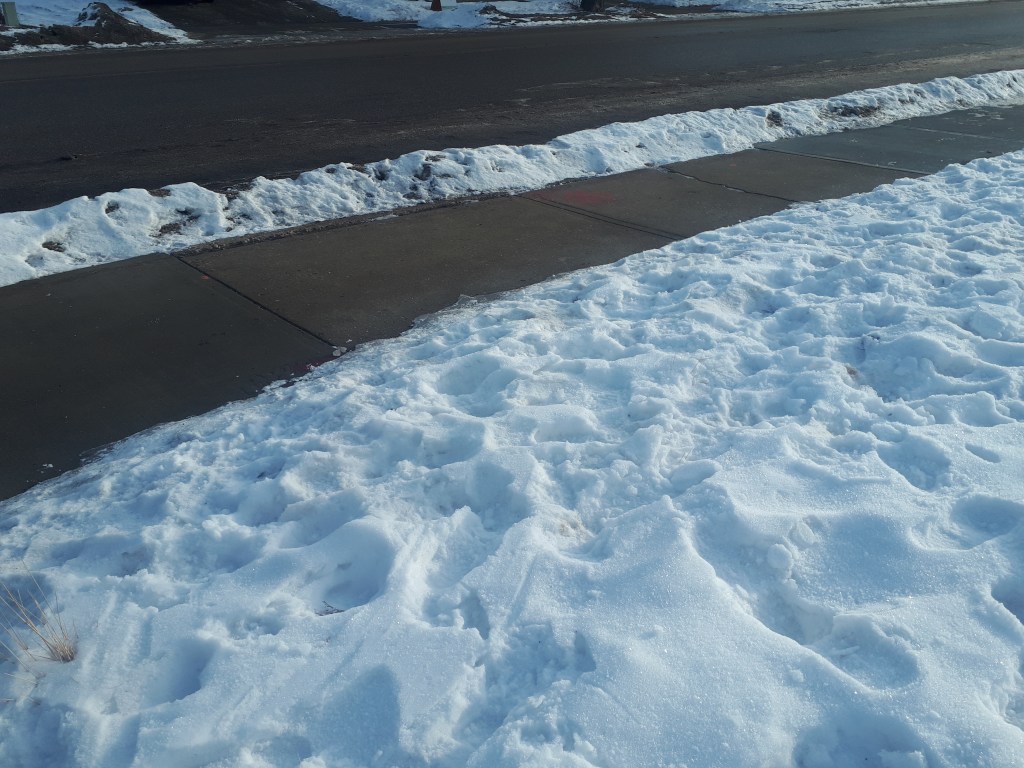
Outdoor sidewalk shovelled clearly of snow during winter.

It wasn’t only until a few years after when I learned about the “Penguin walking technique”. I think I saw something about it on social media. I mentioned it to the new boyfriend I was dating then, the guy who ended up being my husband. He said that makes a lot of sense. I told him about the slip and fall incident and how that’s very scary for me. So now, every time we walk around and there is a potentially slippery and icy area he would remind me of the Penguin walking technique, hold my hand and we’ll walk through together.

I think this is the reason why icy sidewalks and roads caused me a lot of stress and anxiety when walking around in the winter. This is particularly important for me as well, as a person who cannot drive. A couple of years ago, there is now an app launched by the City of Edmonton, where you can report icy sidewalks and piles of snow and windrows. Which in many ways is nice. But I really hope that everybody, from policy makers, to building owners, to parking lot owners, to home owners, to ensure that there is at least one straight path that is wide enough, safe enough, accessible enough for everybody to pass through all seasons long.

Transit Access Influence House Shopping: The Captive Transit User Series Part 6

single family house with a pure white cube style architecture

By: Giselle General

This is part of an ongoing series of posts discussion issues I personally encounter while taking public transit in Edmonton. Links to other posts will be added on an ongoing basis:

What is a Captive Transit User? I learned about the term for the first time from the City of Edmontonโ€™s website. The easy definition is: someone who takes public transit because itโ€™s the best (or only available) option for them to travel around. The part about feeling โ€˜captiveโ€™ comes from the restriction that sometimes comes up, perhaps because one is too poor to own and maintain a vehicle, one does not know how to drive, or for medical reasons, cannot operate a vehicle. In many ways, I relate to this a lot. Though Iโ€™m pretty fortunate to afford the occasional taxi ride, and with my husband having a car.

My husband and I live in a nice neighbourhood here in Edmonton, with neighborhoods right beside ours with super fancy, multi-million-dollar houses. Whenever we walk through these sidewalks and streets and see these houses, he would ask me, “Do you want me to buy that house? It looks so pretty!” It’s just a fun conversation topic, more like a little game, we do when we walk around the neighborhoods.

Almost every single time, I would say, “No! Because, where’s the bus stop? There’s none!” The proximity of a reliable bus stop was a very important factor when we were house shopping back in 2015. So during these walks I would wield this response in a swift and sassy manner. For many of fancy houses that is definitely the case. Because people are likely to be driving a car or even multiple cars to get to these homes, there is no expectation of accessible public transit.

In 2015 when we impulsively decided to start shopping for a house, we talked about our most important priorities. Price is a factor of course, and having a space or structure of a home that is easy to convert a portion of into an income property. For my husband, the neighbourhood is also important, so he wanted a house that is on the slightly mature west side of the city close to where he grew up. For me, as I have struggled and learned the hard way that going home from downtown Edmonton in the evening is really difficult, I told him it is very important to have good public transit access to downtown all day and all night.

We were so particular about our requirement for good bus access. When we were talking to our real estate agent, I grabbed a printed city-wide transit map, analyzed the different public transit routes that showed up in the map, grab the highlighter and marked the different areas that we would consider for our new house, and gave it to our real estate agent as a reference.

Paper map with a person's hand pointing on a part of the map

And we managed to find it! We found a house that is along a major road but not as loud and busy as the Whitemud or 87th Avenue, with a reliable and frequent bus route, pretty close to the in-laws’ house, and is easy or possible to construct an income property in the basement. And for a good price!

So for the past almost five years traveling around the city has been a lot easier for me. Going to work, going to the mall, going to downtown or Whyte Ave, and just traveling around the city. It is only what it’s super late at night that I would take a cab to go home and go to my destination.

I know very well, that this is the reason why, my husband has been very angry on my behalf when he saw he proposed new bus routes by the City of Edmonton’s Bus Network Redesign. We are not losing the bus stop that is 20 steps in front of my house, but it drastically will change from a frequent 15-minute bus route into a 30-minute community bus route. The frequent bus routes are either a 7 minute walk, or a 15-minute walk. A major selling feature of the home was ripped out from us, at least that is his impression.

My husband was also worried for other people who might be more entrapped and limited with their housing options. How will the Bus Network Redesign affect them?

Think of someone who is low income, who chose a specific apartment in a busy intersection because of the bus route that is nearby, and they realize that their bus route will be gone after the redesign is implemented. And they are just in the middle of their one-year lease. How is this going to impact their ability to get around? What if, they have an employer, a boss at work, who is not very understanding that this worker might be running late or not be able to fulfill certain work shifts that are given to them because of the changes in the bus route?

I wonder how much collaboration did Edmonton Transit Service have with agencies such as the planning department of the city, or even external ones like End Poverty Edmonton or United Way to determine whether these bus routes are the best way to go moving forward. I remember a few city councilors saying that it is true, the new bus network will not be perfect for the first little bit, and this will provide real-time tangible information and feedback on how the bus routes are working and make changes accordingly. It sounds fancy from a political big picture perspective. How can you explain that to someone who is here in Edmonton as a minimum wage worker still navigating our city in our transportation system, and where external circumstances are a bit more unkind? How about the people whose housing options are limited and employment options are limited; can they put up with a year-and-a-half of waiting for feedback before bus routes can be tweaked and improved in a specific area?

In my volunteering for the transit advisory board, we worked on a report recommending marketing strategies to inform as many people as possible, as early as possible, about the changes in the bus routes. It’s an interesting and neat experience to do research, think of my personal experiences, work with staff of the city, and present right in front of the actual politicians during a city committee meeting. It’s a bit surreal. I really hope that our suggestions are well taken, and that the city staff can identify other ways of notifying Edmontonians from all walks of life. Because for some, they might actually have to move from their home if their transportation options no longer work for them.

This is something my husband offered, to sell our house if being within a 2-minute walk from a frequent bus stop is important to me. I told him that moving is not necessary, at least not for now. I reassured him that a 13 minute walk or a seven minute walk is very manageable and I can handle doing that on a daily basis. These conversations took place before the pandemic, and now, the tediousness of a daily commute is hardly a concern, as I am fortunate enough to have an office job that I can do from home. But not for the “essential workers”.

Two 2-storey homes beside each other with the  grassy lawns frosted with snow

The timeline of the implementation of the new bus routes has been delayed due to the pandemic, and I personally don’t know whether I should be relieved or worried. Is it a pain point that is just getting delayed? Or is the right thing to do because there is enough uncertainty in people’s lives? Once the next opportunity becomes available, it will never be perfect but I hope that it will be manageable to those who are most impacted, the captive transit users.

“I’ll Make it on Time, I Think?” The Captive Transit User Series: Part 3

By: Giselle General

This is part of an ongoing series of posts discussion issues I personally encounter while taking public transit in Edmonton. Links to other posts will be added on an ongoing basis:

What is a Captive Transit User? I learned about the term for the first time from the City of Edmontonโ€™s website. The easy definition is: someone who takes public transit because itโ€™s the best (or only available) option for them to travel around. The part about feeling โ€˜captiveโ€™ comes from the restriction that sometimes comes up, perhaps because one is too poor to own and maintain a vehicle, one does not know how to drive, or for medical reasons, cannot operate a vehicle. In many ways, I relate to this a lot. Though Iโ€™m pretty fortunate to afford the occasional taxi ride, and with my husband having a car.

Volunteering and attending events take me to many parts of the city. Whenever people I chat with ask how I got there, and I say “public transit”, there’s a short flash of sympathy on their faces, followed by a slight grimace. One of the reasons is because they know and I know, how much time it takes to get around.

Taking transit, or at least using this method to get around, should never replace a car in terms of speed. I think that’s mindset flaw that many people have, particularly those who drive.

But I am not going to deny the fact that it does take a lot of time to get around places, while being optimistic that the connections that a transit user has to take actually work. Given the realities of travel, traffic, construction, and winter conditions cause a lot of delay. Missing connections cause stress and can discourage people from using public transit, or worse, grudgingly use it day in and day out, while making plans to get out of ‘feeling trapped’ as soon as possible, which is in the form of getting a car.

Frequency and convenience are two important factors that influence the appeal of taking transit.

Honestly, this is why I have mixed feelings with the Bus Network Redesign on a personal level.

First, the very micro-thinking, self-focused, part of me laments that I will lose the frequent bus stop that’s just a few steps away from my house. It’s so close, I shovel snow off the bus shelter during the winter, haha! I mean, the bus stop will not be removed altogether, it will be replaced by a less frequent, local bus route. The frequent major route is a 13 minute walk away.

Second, the solution-focused part of me is curious on how I would adjust to a 7 minute walk eastward, or a 13-minute walk northward to one of the several new, frequent bus routes. The 13- minute walk northward is a more familiar setup for me since I have done the same route on the weekends when taking certain buses. The idea of hopping on a bus that comes every 8 minutes is quite appealing. And since I’m an office worker who sits on my bottom most of the day, I suppose that a walk is actually a healthy thing to integrate in my daily routine.

Finally. the big-picture, community-oriented side of me is hopeful that once this new set of routes and schedules are implemented, there will be some hard evidence that will encourage the city to tweak things for the benefit of Edmontonians. Because I volunteer for our citizens -based government advisory board on public transit, I learned that revamping a city’s entire public transit network is something that many North American cities are going through right now.

The busy and fast paced way we are living our lives, pushes people to do things the quickest way. Traveling is one of those tasks that people don’t always have time or patience for. This is an important consideration when planning, changing, and implementing effective transit services.

“I Don’t Want To Be Raped Again” The Captive Transit User Series: Part 2

This is part of an ongoing series of posts discussion issues I personally encounter while taking public transit in Edmonton. Links to other posts will be added on an ongoing basis:

My frame of mind for the longest time was, the most dangerous place to be is my own bedroom. This however, didn’t prevent me from associating darkness and public places with being at risk.

What is a Captive Transit User? I learned about the term for the first time from the City of Edmontonโ€™s website. The easy definition is: someone who takes public transit because itโ€™s the best (or only available) option for them to travel around. The part about feeling โ€˜captiveโ€™ comes from the restriction that sometimes comes up, perhaps because one is too poor to own and maintain a vehicle, one does not know how to drive, or for medical reasons, cannot operate a vehicle. In many ways, I relate to this a lot. Though Iโ€™m pretty fortunate to afford the occasional taxi ride and with my husband having a car.

When it comes to big picture thinking on social and political topics, this is a short list of a trauma-informed approachย (the 4 Rโ€™s) that I compiled.

  1. Realizes the widespread impact of trauma and understands potential paths for recovery
  2. Recognizes the signs and symptoms of trauma in clients, families, staff, and others involved with the system
  3. Responds by fully integrating knowledge about trauma into policies, procedures, and practices
  4. Resists re-traumatization 

I sincerely hope that government officials and service providers, especially with transit, would integrate this perspective in very clear and tangible ways more often.

The way the human psyche works, all it takes is one horrific and traumatic event to discourage someone from doing something, or to have a very negative association towards something.

That makes a lot of sense. If a person gets attacked in a specific LRT station, that person will likely try to not use it ever again, or if they don’t have a choice, to be more wary, stressed and anxious every time the use it. Certain bus routes apparently have a prominent reputation for having lots of disruption, where the likelihood of being harassed is a lot higher. Imagine being in an ongoing state of high alert and anxiousness on a regular basis?

As a high school student in a city in the Philippines, I always got told to go home way before sunset, because taking public transportation after dark is dangerous. As a relatively new resident of Edmonton back in 2008, I was also told to be careful when commuting in downtown because of the “sketchy people” that are around.

This is tough, because when I was hearing these messages, many of these people don’t know of my history of sexual assault. My frame of mind for the longest time was, the most dangerous place to be is my own bedroom. This however, didn’t prevent me from associating darkness and public places with being at risk.

When I got home from my office in downtown, sometimes I say to myself with a huge sigh of relief “Today is a good day! I didn’t get raped…or stabbed, or groped. Thank goodness!” There are numerous stories of harassment that I hear from fellow residents of Edmonton about unwanted attention while waiting for a transit vehicle, or while onboard one. Many people crafted strategies to minimize the likelihood of this happening, such as wearing headphones and staring blankly when someone is trying to strike up a conversation.

Many share the feeling that they are forced to be nice to not “set him off” and to avoid being an ‘active hostile target’ of harassment. There was that story of a woman speaking out when a man on a bus started making racist remarks to an Asian-Canadian person. There is two types of hostility in this instance, the one inflicted towards the Asian-Canadian person, and then towards the woman who called out the harasser.

Commuting late at night poses a additional set of challenges. There’s that heightened sense of panic when the bus is missed or the last route has passed. There’s a recent announcement that the city’s telephone service line, 311, is unavailable in the evenings after 7PM, which is a disservice to those who are more vulnerable in the evenings.

One time, I was stuck at the U of A South Campus because when I got off the LRT, the connecting bus I was planning to take just departed, and it is another half hour for the next bus since it is after 10 PM. I realized that instead of waiting completely alone, it is better for me to take the train back to the University of Alberta station and take a taxi there to get home. This is a good back-up plan assuming there is indeed a taxi waiting in the stall by the University Transit Station every time. And based on personal experience, that is not always the case. Spending extra time to re-route one’s travel to get home because of safety reasons is a bit counterintutive since the best scenario would be just getting home quicker, but for a transit user with limited money, this is a reality. A trade off between money and time, with safety being potentially compromised along the way.

Being blamed for an attack while taking transit really riles me up. It reminds me of the blame cast at me and that I internalized, and that many others have experienced as well.

Perhaps it is a very high standard, but this is my take on achieving a safe transit system: When an Edmontonian who previously had a horrific experience taking transit, then decides to take a chance and felt comfortable, safe and satisfied in their journey from point A to point B. I have some level of hope from what seems to be the city’s effort to incorporate GBA+ Analysis framework, and the availability of ways to make an impact such as city committees like the one I volunteer for. This is the threshold that ought to be met, and I do hope we get closer to getting to this, in a way that an average person will instinctively notice it.

Embracing Snow Pants for Daily Wear in Winter

It’s a safe bet that for many of us, the last time we wore a jumper of any kind was when we’re little kids under the age of six. Unless you are a big fan of rompers, have a work-related protective equipment that involves a jumper-style outfit, or you are into denim jumpers, you probably haven’t worn any clothing of this style since. However, for myself, I have learned to embrace a specific kind of jumper for my day-to-day living particularly living in our great winter city of Edmonton. It’s the snow pants.

Winters can be pretty long in Edmonton, and having the optimal amount of clothing can be a bit of a challenge. Particularly for us transit users, having that balance between warm and layered enough, and not being too stuffy like the Pillsbury doughboy is a difficult balancing act. I used to scoff at people or articles that say “You just need to dress for the weather.” It felt a little bit elitist because in my mind, really good-quality outdoor outfits are only for fancy activities like skiing and snowboarding. However, I have paid the price too many times of being too vulnerable and exposed because of not wearing enough layers, or wearing something that will get wet and cold after going through a pile of slush.

At one point, I told myself, I got to be a big girl and make sure I don’t get sick or injured because I’m going out and about the city while not driving. I’m getting those darn snow pants. And at the same time, make sure I’ll be very cheap about it. Thanks to my husband, I learned to embrace the value of thrift store shopping without feeling ashamed about it anymore. So that is exactly where I got most of the components of my optimal winter warm outfit. Going to a thrift store, I found a winter coat that I have been wearing for about 3 years now. It is a fancy brand, but thanks to the thrift store pricing, it was about $30 or less, I can’t remember anymore, it’s too long ago. And then, going through the racks winter clothing in the children’s section, I saw exactly what I was looking for, a purple jumper style snowsuit that is bright purple, warm with shoulder straps and was able to fit over my chest and zip over my boobs just fine.

February 2019 is when I first had to put this outfit to the test. Edmonton had a really challenging week when it was around -40 Celsius for almost a week and a half. I was really concerned because of the reality of buses and cars being delayed, so I know I should try not to freeze while waiting patiently for the bus. I know very well myself about how I react when it gets too cold. I get really really upset, angry, and in pain. Like, “I’m so discouraged about life” kind of pain. Like, “put me out of my misery” right now kind of pain. I put on a fleece sweater, put my winter jacket on had my hat, wrapped my face with my thick fluffy blue scarf, like I always do. And then the fluffy bright purple jumper snow pants.

And it worked! I was able to handle standing stationary on an outdoor bus shelter for about 20 minutes before the bus came, and I was completely fine. My hands, on the other hand, were a little bit unhappy with me. My stubborn self refuses to wear gloves at the time, while browsing on my phone on the bus stop. Other than that though, I was able to get to work relatively comfortable and in good spirits! Also, I needed to get too used to the whole ritual of undressing and removing all the layers and then putting on office related clothing. I’ve procrastinated all these years, but finally last year. I did bring my separate work shoes in a bag and left it in the office. And then, I would take off my big clunky and cozy winter boots and put on my work shoes. I did at the end of the day, put on my winter boots again, the snow suit jumper, all the layers, covering my face, and then head home.

This early 2020 we had another one of those very cold weeks. I tried the same outfit again, and it worked just as well. I even had a bit of an upgrade. Last December, my husband and I decided to get myself a pair of winter boots that have anti slipping bikes that are retractable with a push of a button at the back of the boots. They look heavy, industrial, and really badass. I really like them. I have been joking around that my calves are probably super strong right now with all the extra weight that I have been carrying on my feet everyday. And thanks to getting used to the habit last year of switching out of my winter boots and then onto my dress shoes, that has not been a problem this year at all. I’m still thankful to my fluffy purple snow pants. 

One positive indicator this year that made me realize that the snow pants are actually a good thing, is how people react when they see me. During different community events, or even at the office elevator, people look at my pants and they say.

“Wow! You are on the right track.”

“That’s amazing! That’s what you call being prepared”

This is what I encourage everybody to do, in order to comfortably navigate winter. Not only for the sake of commuting to work or two different places, but to also enjoy all the outdoor festivals and activities available, or just be okay and in a good condition when going out for a walk or buying something quick from the convenience store. The snow pants are worth it. There’s ways to buy them in a very affordable manner, from thrift stores to clothing swaps. It’s totally okay that in your destination, you hang your snow pants and your winter coat on two hangers right beside each other. For newcomers, like myself, It is really worth it while trying to get acclimatized to winter. It’s valuable to not 100% hate winter during your first couple years, and spare yourself of any painful first memories of winter. We have the power in our hands to adjust ourselves, our physical selves, given that we cannot control the weather as much as we want to.

Learn and Explore the City: Fort Edmonton Park

This is a quick overview, from someone who moved to Edmonton and didn’t grow up here, about a really neat city attraction that is historical, interactive, and entertaining: Fort Edmonton Park.

If I were to choose a phrase to describe it, the place would be a “living museum”, with actual old buildings from a time long ago in the city, complete with decorations and accessories from that time. Where there are actors who wear attires from that time, which can make visitors feel like they have traveled back in time.

My then boyfriend (now husband) and I went there for our dating anniversary, our second one, back in 2012. An idea we copied from a TV show is what we call a “superdate” which is an all-day date where one person from the couple plans all the activities without telling the other. And then, on the day of, the activities are disclosed shortly before going there. After a lovely lunch in a restaurant located in a local neighbourhood business plaza, and him buying a large stuffed giraffe too big to fit in the back seat, I told him that our next destination was Fort Edmonton Park.

Visiting the Park

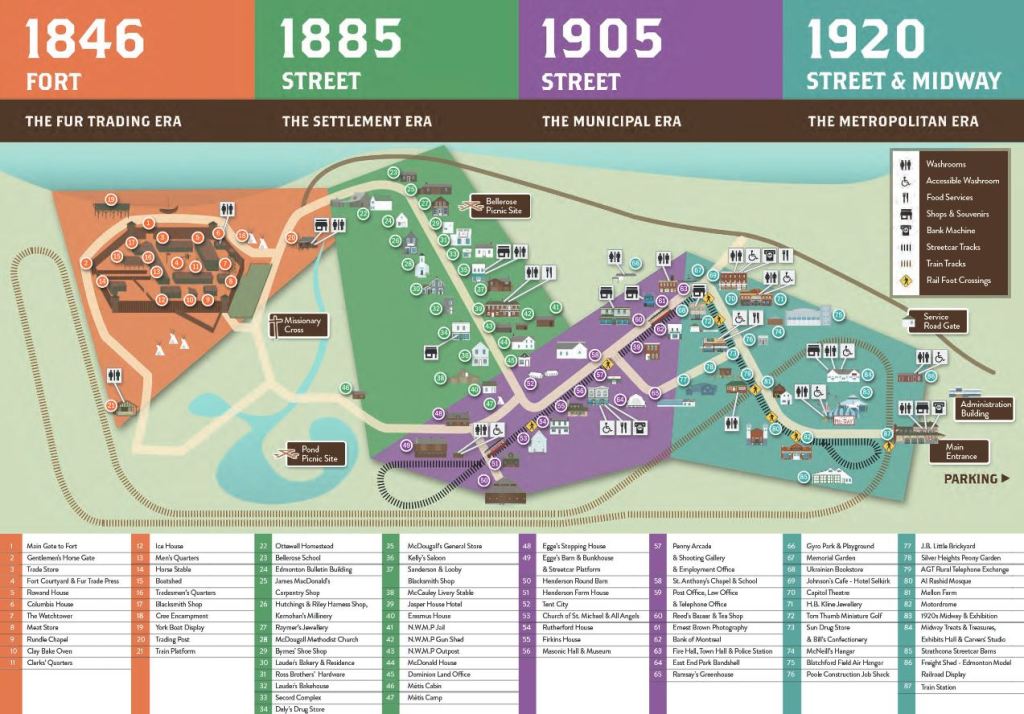
Fort Edmonton Park is an reconstruction of how Edmonton looked like in its early days. There are four time periods that are represented: 1846, 1885, 1905 and 1920, showcasing how the city of Edmonton has evolved from a fur trading area, to how the first few homes and structures were built that is the starting signs of a village, to a city that is starting to grow and expand.

I personally wasn’t able to wrap my mind around what a fur trading building looked like until I visited the park for the first time. Seeing and touching samples the different types of fur was super interesting. I had used Bank of Montreal for my personal banking needs and was really amused to see an old tiny building with the bank’s name, indicating that it is one of the earlier banks in the city. Seeing old clothing and the structures of these homes and thinking about how people back then had to deal with the cold winter months, filled me with wonder.

There are other entertaining activities as well. There is an old train that visitors can hop on and have a tour of the entire area. There is a small theater that shows historical films, and there was even a photography shop where people can wear costumes and have a portrait taken looking like it’s from a hundred years ago.

I keep seeing digital posters for advertisements regarding events that take place when the park was closed for touring. The bus I take when commuting to work passes by Fox Drive that leads to Fort Edmonton Park. I ought to check out the annual Halloween event at some point, it looks really interesting. There are opportunities to have brunch or dinners at the Hotel’s restaurant all year long, and the food is pretty good!

In my opinion, every newcomer to the City, both the born-and-raised Canadians who came from other provinces, and those who landed from other countries and had made Edmonton their home, should have the opportunity to visit this location, ideally within their first few years. Understanding the context of what the city has looked like many years ago can help those who are new here, appreciated how things are today.

Learning History

While I feel like a broken record when I say “welp, that was NOT included in my ‘Welcome to Canada’ booklet”, it’s very true. There isn’t a lot of information about this city when I moved here. Fort Edmonton Park was a helpful way for me to learn and witness this. We don’t have a City Museum in a conventional sense, but I would say this is the closest one.

I was fortunate enough to squeeze in one elective class during university which was Introduction to Native Studies, and in 2017 because it was Canada 150 I learned a little bit more about Canada as a whole. I also took another elective class during university which was an advances English Literature class that discussed Canadian authors that describe the experiences of Asian people from 1900 onwards.

Now that I am learning more about the history of Indigenous peoples in Edmonton and realizing that Fort Edmonton Park has gaps, I’m relieved that the renovation will include an additional exhibit specific to this.

Booking Venues for Special Events

I didn’t know until I was a bridesmaid for a friend’s wedding, that Fort Edmonton Park is a lovely venue for a wedding and it is a well-known one, particularly in the summer. We had one of the old small churches in the Park as the location for the wedding ceremony, and then we had on of the second-floor halls of an old store as the location for the reception. While the bridal party was walking around the area for our wedding photos, we learned that there were two other weddings happening on the same day. We ran into another bridal party having their group photos, and we walked by the other wedding reception’s venue, hearing the lively dance music through the air.

I also thought that Hotel Selkirk is just a historical building that visitors at the park can tour, but as it turned out, people can rent the rooms, like a regular hotel! I learned about this during the wedding as well, as my friend rented two rooms as a waiting area for the bride and the groom’s wedding entourage. That was a lovely way to experience the city and this location, integrating historical structures with modern-day activities.

The website for the park is www.fortedmontonpark.ca/ . I look forward to the park opening again for tours, and experiencing it again with a slightly different perspective now that I’ve lived in Edmonton for a little bit longer.