Story Time: The Processed Food Products I had to Learn How To Make

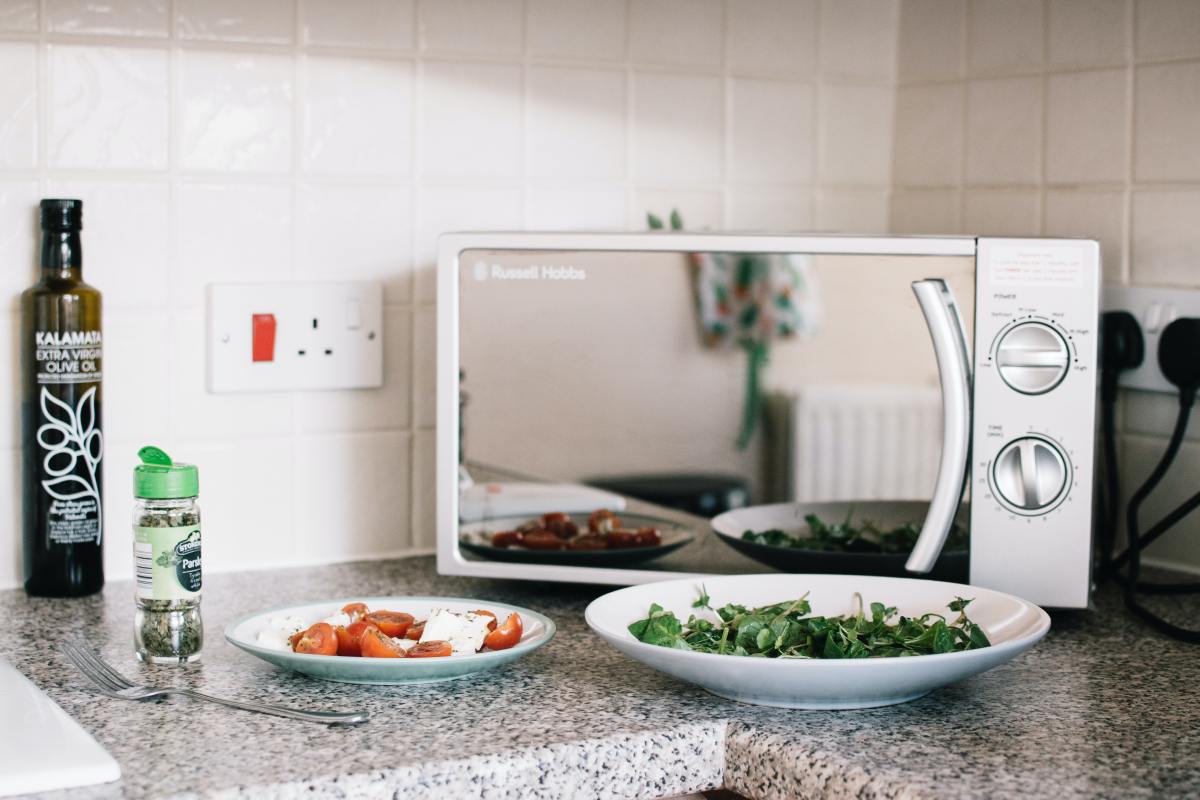
Kitchen counter with a microwave, sauce with tomatoes, a plate with greens and bottle of spices and olive oil

by: Giselle General

As someone born in relatively more modern times, even if I grew up in a rural place before coming to Canada, I’m not completely ignorant of processed food products. The fact that my family had a convenience store gave me greater access to them. So I already know how to prepare and cook frozen hotdogs and meats, and how to differentiate preparing instant noodles from a package using a pot water, and instant cup noodles by pouring water that is already boiling.

However, upon arriving to Canada, certain products are so new to me that I had to learn the hard way how to prepare them. I fondly look back at these cooking mishaps with humor now, but it was either mortifying or frustrating during that time. Here are some of these (now adorably funny) mishaps.

Microwavable Meals

“Did the package just say that this is frozen creamy linguini chicken pasta? So the pasta is not raw? How does this work”? Microwavable meals were a lifesaver for me and my cousin when I first arrived in Canada. My older cousin is really busy with going to college and working, that preparing meals is something that is not feasible all the time. Besides, these frozen meals are pretty cheap. I eventually learned that it is very important to follow the instructions to a T. When it says, lift only one corner of the container, you have to do so. When it says to let it stand for one minute after the timer goes off, you have to do that, otherwise your hands are not going to like feeling burnt.

Here are where the mishaps happened. When I was already living in Edmonton, a few times I decided to bring a microwavable meal to school, find a clean microwave on campus so that I have a slightly more decent meal for cheap. One time, I forgot to bring utensils so my plan went sideways. The other time, I forgot that this is a frozen meal, so on locations where the temperature is above zero, like my own backpack, it starts to melt and makes a wet sticky mess on your bag!

Close up of an oven's handle and buttons.

When I started dating my then boyfriend, now husband, I also discovered an even more unusual type of microwavable meal called “rice steamers”. There are extra steps such as layering the plastic bowl-like contraptions and lifting half of the plastic seal. Each plastic bowl is a different part of the meal, one is rice or noodles, then the other would have the vegetables or meat and the sauce. After taking it off the microwave, you combine all the different food items together and there’s the meal, ready to go!

Frozen Pizza

Frozen pizzas were a mystery for me the first few times too, haha! One time, I tried to help with making dinner at my then-boyfriend’s place. I though I understood all the instructions, set the timer, removed the plastic film and whatnot. But I forgot to remove the cardboard box to transfer it onto a pizza pan, so the bottom was weirdly soggy and damp. The other time, after I learned that keeping the box on isn’t what you are supposed to do, I placed the frozen pizza right on the oven rack. The pizza was cooked well this time, though I did struggle with taking it out of the oven to cut it into pieces. I felt really silly for sure!

There wasn’t an explicit instruction in the box that talks about that – I bet it’s because it’s assumed that people already know that frozen pizzas are to be placed in a metal baking pan. But now, I know better and I’m a pro at making frozen pizzas when in a pinch for a good meal!

Canned Tomato Soup

The only “instant soup” (not instant noodles) that I was familiar with at the time is the cream of mushroom soup. Empty the can, with this almost jelly-like blob that held the shape of the can, add another can of liquid, either milk or water, stir the blob so it combines with the other liquid, and warm it up. But the first time I dealt with tomato soup, it’s a bit of a mystery to me.

Tomato soup with green garnish on a white bowl.

My then-boyfriend and I were making a simple dinner at his condo and we wanted soup, and he wanted tomato soup. It was confusing because upon opening the can, it was a thick liquid, but not as solidified as the cream of mushroom soup. I added the water, combined it and heated it up. For some reason I thought it’s taking such a long time to simmer, but I waited and waited anyways. Once it looked reasonably warmed through, I put it in a bowl to serve. He ate it without a fuss.

It wasn’t until years later, that he admitted that I burned the soup very very badly! That’s why there was a tough brown layer of soup at the bottom of the pot. I can only imagine how horrible it tasted, oh no! But he didn’t say anything at the time. I guess that’s what happens when you are still in the honeymoon phase of your relationship. Now it’s been a running joke between me and my husband when we cook and prepare meals together!

Bottle Drives as Fundraiser: a Unique Edmonton Experience For Me

Box truck with label on the side that says "Get the Yuck Out, Skip the Depot"

By: Giselle General

When I first arrived in Canada, I had my first experience in having an actual process to sort out garbage. Different types of garbage are sorted according to type such as refundable like bottles and milk cartons and cans, landfill materials, recyclables like plastic sandboxes, and things you can refund for money such as wine bottles, beer containers, and soda containers. So before moving to Edmonton, I have integrated the habit of sorting my garbage. And I also have a vague idea or realization, that returning these refundable drink containers will give you money. Then, I first noticed in grocery receipts, that you get charged money for buying liquids to drink in particular containers. So if you make the effort of returning these bottles, it’s not like you earn extra money, but more like you get your own money back.

Lawn Sign that says "Help us Build a New Rio School Park. Rio Park Bottle Drive, Today 9 AM - 1 PM"

When I moved to Edmonton I have observed a similar process. The way organic material is handled is a little bit different, but the sorting process is still there. Making sure you have the appropriate bags to sort your garbage such as the transparent bags for leaves in the fall, the black garbage bags for landfill stuff, the blue almost transparent plastic bags for recyclables, is integrated in once grocery shopping routine.

However, the actual process of people or organizations collecting refundable drink containers is something I haven’t seen before. As it turns out, this can result to a lot of money! And it looks like it is a relatively popular method of fundraiser.

I personally have seen many bottle drives before, and participated in some of them as a donor of containers. This particular weekend however, I finally helped my neighbourhood community league by supervising the bottle collection drive portion of our September event, for Community League Day. It’s a pretty easygoing task, all I have to do is to physically be on standby beside the truck where people would pull over bring their containers of bottles and place it inside the truck. At the end of the day this truck, this company, will take away these bottles, process them, and give money.

Selfie of Author, wearing a knotted hat and wearing a name tag "Giselle, Board of Directors".

Using bottle drives for fundraisers have been so popular that I received multiple requests as a homeowner different times a year. During spring and fall, like a predictable annual routine, I would get a flyer on my mailbox requesting for bottles to help the neighbourhood local children’s Scouts. A particular nonprofit organization has this as a regular part of their fundraising which is called Empties To Winn. The way this works is, they provide uniquely labelled large plastic bags where people can put in their drink containers for refund, every quarter the organization sends someone to pick up your bag with bottles and cans, and at the end of the year, you get a tax receipt.

There’s so much money to be made from collecting bottles and handing them over for a refund. Folks experiencing homelessness typically use this as a method to earn a little bit of money. I see people in parks and Transit stations looking a little bit worse for wear, reaching into the garbage bins to see if there are drink containers in them. We even have a small incident in our neighbourhood last year, for some residents were a little bit upset because they realized on garbage day their bags of recyclables is ripped into pieces causing guard pieces of garbage to be flowing and flying all throughout the sidewalks and streets. It was discovered that this is a result of a homeless person on garbage day going to each of the piles of garbage bags, ripping open the bags to see if there are any bottles. My neighbours made it clear that it’s not like they don’t want a homeless person going around the neighbourhood. The only problem is the littering it causes. Thankfully one of the residents had the chance to see this gentleman rummaging through the bags and kindly asked him to tie up the bags again after he sifted through them. Problem solved.

Inside of a truck, with a dozen blue garbage bags with refundable bottles and drink containers.

It’s fascinating to observe the people handing over bottles during the bottle drive. There’s the one gentleman in his red pickup truck where the back compartment is full to the brim of bags. He said he was planning to bring them to the Bottle Depot, and then COVID-19 happened, and then this opportunity came about to dump them all here. There’s the lady who had her containers in a water drum, so we had to work together to pour them all onto a plastic bag to put into the truck. There was the father of the kids who’ll be benefiting from the bottle drive. He told me that his son goes to the elementary school of the neighbourhood, and he appreciates that this bottle drive will raise funds toward’s be renovated playground for the elementary school.

For some people, they are diligent enough to collect the bottles bring it to the nearest Bottle Depot and enjoy the earnings of their diligent organizing. But for many, getting a few dollars every few months is not worthwhile, but the feeling of being able to contribute meaningfully for a charitable cause it’s definitely worth a lot more. For as long as there this system that helps collect organized and provide money for these recyclable drink containers, I think we are going to have bottle drives for the next little while and it is awesome.

Transit Access Influence House Shopping: The Captive Transit User Series Part 6

single family house with a pure white cube style architecture

By: Giselle General

This is part of an ongoing series of posts discussion issues I personally encounter while taking public transit in Edmonton. Links to other posts will be added on an ongoing basis:

What is a Captive Transit User? I learned about the term for the first time from the City of Edmonton’s website. The easy definition is: someone who takes public transit because it’s the best (or only available) option for them to travel around. The part about feeling ‘captive’ comes from the restriction that sometimes comes up, perhaps because one is too poor to own and maintain a vehicle, one does not know how to drive, or for medical reasons, cannot operate a vehicle. In many ways, I relate to this a lot. Though I’m pretty fortunate to afford the occasional taxi ride, and with my husband having a car.

My husband and I live in a nice neighbourhood here in Edmonton, with neighborhoods right beside ours with super fancy, multi-million-dollar houses. Whenever we walk through these sidewalks and streets and see these houses, he would ask me, “Do you want me to buy that house? It looks so pretty!” It’s just a fun conversation topic, more like a little game, we do when we walk around the neighborhoods.

Almost every single time, I would say, “No! Because, where’s the bus stop? There’s none!” The proximity of a reliable bus stop was a very important factor when we were house shopping back in 2015. So during these walks I would wield this response in a swift and sassy manner. For many of fancy houses that is definitely the case. Because people are likely to be driving a car or even multiple cars to get to these homes, there is no expectation of accessible public transit.

In 2015 when we impulsively decided to start shopping for a house, we talked about our most important priorities. Price is a factor of course, and having a space or structure of a home that is easy to convert a portion of into an income property. For my husband, the neighbourhood is also important, so he wanted a house that is on the slightly mature west side of the city close to where he grew up. For me, as I have struggled and learned the hard way that going home from downtown Edmonton in the evening is really difficult, I told him it is very important to have good public transit access to downtown all day and all night.

We were so particular about our requirement for good bus access. When we were talking to our real estate agent, I grabbed a printed city-wide transit map, analyzed the different public transit routes that showed up in the map, grab the highlighter and marked the different areas that we would consider for our new house, and gave it to our real estate agent as a reference.

Paper map with a person's hand pointing on a part of the map

And we managed to find it! We found a house that is along a major road but not as loud and busy as the Whitemud or 87th Avenue, with a reliable and frequent bus route, pretty close to the in-laws’ house, and is easy or possible to construct an income property in the basement. And for a good price!

So for the past almost five years traveling around the city has been a lot easier for me. Going to work, going to the mall, going to downtown or Whyte Ave, and just traveling around the city. It is only what it’s super late at night that I would take a cab to go home and go to my destination.

I know very well, that this is the reason why, my husband has been very angry on my behalf when he saw he proposed new bus routes by the City of Edmonton’s Bus Network Redesign. We are not losing the bus stop that is 20 steps in front of my house, but it drastically will change from a frequent 15-minute bus route into a 30-minute community bus route. The frequent bus routes are either a 7 minute walk, or a 15-minute walk. A major selling feature of the home was ripped out from us, at least that is his impression.

My husband was also worried for other people who might be more entrapped and limited with their housing options. How will the Bus Network Redesign affect them?

Think of someone who is low income, who chose a specific apartment in a busy intersection because of the bus route that is nearby, and they realize that their bus route will be gone after the redesign is implemented. And they are just in the middle of their one-year lease. How is this going to impact their ability to get around? What if, they have an employer, a boss at work, who is not very understanding that this worker might be running late or not be able to fulfill certain work shifts that are given to them because of the changes in the bus route?

I wonder how much collaboration did Edmonton Transit Service have with agencies such as the planning department of the city, or even external ones like End Poverty Edmonton or United Way to determine whether these bus routes are the best way to go moving forward. I remember a few city councilors saying that it is true, the new bus network will not be perfect for the first little bit, and this will provide real-time tangible information and feedback on how the bus routes are working and make changes accordingly. It sounds fancy from a political big picture perspective. How can you explain that to someone who is here in Edmonton as a minimum wage worker still navigating our city in our transportation system, and where external circumstances are a bit more unkind? How about the people whose housing options are limited and employment options are limited; can they put up with a year-and-a-half of waiting for feedback before bus routes can be tweaked and improved in a specific area?

In my volunteering for the transit advisory board, we worked on a report recommending marketing strategies to inform as many people as possible, as early as possible, about the changes in the bus routes. It’s an interesting and neat experience to do research, think of my personal experiences, work with staff of the city, and present right in front of the actual politicians during a city committee meeting. It’s a bit surreal. I really hope that our suggestions are well taken, and that the city staff can identify other ways of notifying Edmontonians from all walks of life. Because for some, they might actually have to move from their home if their transportation options no longer work for them.

This is something my husband offered, to sell our house if being within a 2-minute walk from a frequent bus stop is important to me. I told him that moving is not necessary, at least not for now. I reassured him that a 13 minute walk or a seven minute walk is very manageable and I can handle doing that on a daily basis. These conversations took place before the pandemic, and now, the tediousness of a daily commute is hardly a concern, as I am fortunate enough to have an office job that I can do from home. But not for the “essential workers”.

Two 2-storey homes beside each other with the  grassy lawns frosted with snow

The timeline of the implementation of the new bus routes has been delayed due to the pandemic, and I personally don’t know whether I should be relieved or worried. Is it a pain point that is just getting delayed? Or is the right thing to do because there is enough uncertainty in people’s lives? Once the next opportunity becomes available, it will never be perfect but I hope that it will be manageable to those who are most impacted, the captive transit users.

Love language Reflections: Support in times of Crisis

Man hugging woman, woman's head burried on his shoulder

by: Giselle General

My husband and I had a particularly challenging weekend sometime in June this year. As if the pandemic is not enough. In times of crisis or particularly stressful situations, people react differently. People’s reactions can possibly be categorized into the following: fight flight or freeze mode.

Similar to how we face a threat that is directly affecting us, people might react in the same way if there is a crisis about their loved ones, especially if we are directly involved in their daily lives. Some people are in “hyper solution mode” or “fight mode” running around getting things done, getting everyone together to act, and then after this adrenaline panic-solution mode, they get exhausted and worn out. These helper types, dedicated to support their loved ones, end up not realizing they need to care for themselves too.

There are some people who have intense outbursts of emotion during times of crisis, getting stuck and unable to provide tangible practical solutions to resolve the crisis at the end. I personally describe this as the ‘flight mode’ especially emotionally. However, in my opinion, there is value with how these type of people respond even if it may be off-putting at the time. They demonstrate the emotional impact, the reality and seriousness of the situation at hand.

Woman sitting and crying, and person's hands supporting her shoulder's comforting her back.

And there are people that are in silent mode, I would say is the ‘freeze mode’. Those who are too quiet or maybe two numb or lost, unable to determine a course of action. It’s not necessarily that they’re useless in the time of crisis, however, it takes prompting or direct, specific instructions to get them to do anything. Whether it is direction from the hyper solution-focused loved one, or being prompted by the emotional outburst of the others. 

Particularly for long-term relationships, I think it is really important to understand how our loved ones respond during times of crisis.

This is because different reactions or solutions would be more appropriate depending on the situation. If someone is in medical distress, it probably would be important to be more solution-focused at least until the severity of the situation is minimized. However, it is important to acknowledge the intense feelings that have come up because of the situation. Imagine your loved one being taken away by ambulance – there’s the peak emotional state and then there’s the crash afterwards. In many crisis situations, solutions, support, and follow-up is more of a marathon not a race. There needs to be diligent planning and follow-up and ongoing communication so that the problem at hand can be fully resolved.

The valuable thing about knowing your loved ones’ mechanism when responding to crisis as you can pick them up and support them during times when they are struggling. Some people struggle with displaying their emotions even after the fact, even when it’s safe, more appropriate, or even healthy to do so. Some people get paralyzed and unable to do proactive helping in the heat off the crisis and that can be detrimental as well. I think it’s important for people to have faced crisis situations to feel vulnerable enough and unpack their emotions afterwards. Being self-aware of one’s own tendencies are just as helpful.

Lined notebook with handwritten words, "Today, 1, 2, 3".

This is speaking from recent experiences. I think, or I hope, that I’ve figured out my own and my husband’s mechanisms when it comes to crisis solving. There will be times when he’s not willing to talk about it just yet and that’s okay. Sometimes disconnecting from the situation for a bit by browsing the internet is an okay way to provide yourself some relief. And it’s important to acknowledge that. He gently suggested a couple times for me to meditate because he knew that it would be helpful for me, and I honestly would not even thought of it if he had not brought it up.

It’s important for loved ones to not be judged by their coping mechanisms. It is also important to gently and lovingly nudge your loved one to get supports that you are unable to provide. It took me a while to acknowledge that sometimes I just need a talk therapy session with a professional to help unpack my emotions so that I can be less filtered in my language and be more candid in a way that works at specifically for me.

To be heard, understood, supported, and pushed sometimes, is really important to maintain our sense of perspective, sense of health, and nurture our ability to help ourselves and our loved ones. 

Relationship “Green Flags”

Woman leaning her chin over a book on the table, smiling and giving a thumbs up.

By: Giselle General

During one of the rare days that I was working in the office this past summer, I dropped by the office of one of my coworkers. He’s a few years younger than me, just finished university a year ago, and is about to pursue another important life milestone: moving out of his parents’ home and moving in with his girlfriend. He started as a volunteer five years ago so we have known each other for a few years and has heard of the relationship milestones that I had myself, particularly reaching legal common-law status with my partner, and afterwards, getting married.

I was teasing him a little bit, and giving some friendly warnings about how moving in together with your significant other is both exciting and unnerving. I told him that getting annoyed with little things such as how toothpaste tubes are placed in the bathroom sink or how a toilet seat or lid is set up will be inevitable. During the chat, I used a phrase I saw somewhere over the internet in the context of a romantic relationship which is “green flags”. When he told me that they assembled a piece of furniture and it went smoothly, I enthusiastically told him that is a relationship “green flag”. He said, he will use that term also moving forward.

In conversations about romantic relationships, “red flag” is a common and appropriate term. It is indeed important to be attentive to subtle and obvious cues, both verbal and nonverbal that can indicate something that is potentially problematic. But spotting positive signs is not encouraged as much. So I was thrilled when I saw the term “green flag”, I think on an internet meme somewhere. Oh, the power of internet, this time for good!

So here is a very introductory list of “green flags” in a romantic relationship.

  • Both parties are able to be patient and collaborative at the same time. Building furniture, especially from IKEA, is the ultimate test for this. Another way to test this is when cooking a dish together that takes several steps, like cooking on a stove, baking, assembling.
  • Understanding and respect of differences and limitations such as allergies, food preferences, physic endurance doing an activity, clothing colors or textures of objects they like or don’t like, and more.
  • Ability to communicate well, outside of romantic expression and having sex
  • Feeling confident and secure in one’s appearance when around them, there’s no need to fake it to impress
  • Experiencing a messy bodily illness or function in front of them, and they didn’t freak out too much and judged you harshly. This includes skin irritation, digestive issues, the flu, blood, etc.
Mother and a young son and daughter, sitting on a bad teasing and laughing together.

And here is a very introductory list of “green flags” in a family relationship.

  • Feeling at ease in their presence, whether it is an older or younger family member
  • Comfortable with making small requests, from unloading the dishwasher, cleaning the hair off the shower drain, or a car ride
  • Positive gestures done in the past is never used as blackmail material or as a guilt-tripping tactic
  • Able to share casual stories about daily life even if it may sounds like shallow venting

And another short list of “green flags” at one’s place of employment.

  • On weeks or days that are difficult, there is a feeling that the next day can be a bit better, and it does
  • Feeling productive most of the time
  • Having one’s direct supervisor and a few colleagues (not necessarily all of them) be understanding and sympathetic towards the ups and downs of your duties
  • Not worrying one time about salary and payday
  • Having functional equipment and honest efforts to fix something when something is broken
  • Being comfortable with whatever arrangements you make during lunch break

I have two sets of relatives here in Edmonton, two happily married couples whom I observed one action they both do, they address their respective spouses as “mahal”, as in the word for love (and also for expensive, haha!) in Tagalog. I really liked it. So with my partner and now my husband, we address each other as ‘love’. And it’s awesome!

My husband and I chat about our respective workplaces and I share little stories of work activities for staff, social gatherings, and upcoming changes. My husband says with an amused look “wow, your managers actually know how to manage.” Based on stories from so many people we know, we both realized that managing employees is not a skill that everyone has.

I think it’s a good idea to proactively spot ‘green flags’ in our experiences and interactions. It provides an opportunity for appreciation and gratitude, as well as motivation to learn, master and emulate those positive things. This is something that I will try to do more moving forward.

When I was too Shy To get Involved

closeup of a female student carrying books while standing on a sidewalk with parked cars

by: Giselle General

When a child is labelled as an ‘honour student’, that comes with significant implications. There is a barrage of positive traits that are associated with it: intelligent, well-disciplined, capable, confident, admired, role model. The positive associations can also be a heavy-handed set of expectations.

In the Philippines, the English word “transferee” is used to describe students who were new to the school and didn’t start first grade or freshmen year in the school. Growing up in a small mining village with a single school where everyone knows everybody, being a transferee is a rarely-used label.

And then, I became one of those students. Halfway through high school, I moved from the small village to the nearby city.

silhouette of a person walking alone

The move was unnerving for many reasons, and one of them for me is navigating academic achievement and extracurricular involvement. My younger self knew that schools are the same everywhere, that well-performing students get awards and recognition and benefits such as scholarships. The schoolyear stared in June and it wasn’t until November (so about 5 months in and more than halfway through the school year) when I started getting involved again in school clubs.

There were so many things to get used to in this routine. I never had to travel through public transportation every single day, two trips, to go to school and back. It was three years since I lived with my younger brother, and I was living alone in my house-and-business-building dwelling, my sari-sari store, for about a year. It sounds strange to say but I had to get used to living with people again. My brother and I are back to having the mother/father/sister dynamic that we had, only he’s 10 years old and I’m in the midst of puberty.

During the first few months, my priority was knowing names in the school, and within a few weeks, I was successful in knowing the names of my classmates, both first names and last names. The school was previously an all-boys school, and part of the culture was for students to call each other by their last names, since there’s too many students with the names John, Alexander, Anthony, Mark, James, Carlo, etc. The tradition carried on with the female students. So yes, I had to get used to be called General by students during casual conversation. In the early morning before class starts, I hear often “hey yo, General! can I copy your homework?

Two clusters of board game pegs, one cluster with 6 light organge pegs and one brown peg by itself.

But I didn’t join any school clubs right away, because I was still afraid of going home late. I was fearful or unsure on whether the elders, the legal guardian, is aware of the challenges and realities of high school students living in the city. We don’t have a computer at home, so even something as simple as submitting a printed report requires going to an internet cafe in downtown Baguio and it requires a lot of organizing. These city kids seem fancy and wealthy and carefree, and I don’t know how to fit in.

Eventually I was able to articulate, although awkwardly, why I didn’t join clubs. “I feel too shy to go”. My uncle, Tito Roy, who was a teacher in the school, snapped me out of it in his own way. He said how ridiculous that is and told me to “just go and give it a try’.

That really paid off because it opened multiple opportunities for me to feel the same way as in my former school, get involved, achieve things, and have a mental escape from the horrors at home that were about to happen the following year. Managed to be the valedictorian for my graduating class even if I was there for just two of the four years of high school.

As an adult, I think there are times I still feel like this. I found a fancier, but perhaps more appropriate term of it. ‘Imposter Syndrome’. There is a daunting feeling of feeling like an outsider for a multitude of reasons: because of being new and in an unfamiliar space, and being uncertain of one’s ability to be a positive impact in that space. I think the last thing that people want is to be perceived as dead weight or an inconvenience.

Has this feeling gone away? Not completely. I’m participating in the community in ways that I haven’t heard my elders or friends do: help at an election campaign, offer to be a columnist for an ethnic newspawper, submit a writing proposal for a heritage-focused digital writing project, registering to join a board of directors of an organization. So many times I feel a bit lost and unsure navigating these situations. One advice I heard that helped is this: everyone is just trying to wing it. Another one I’m trying is to approach things with curiosity. Instead of thinking “oh man I don’t think I really get what is going on here”, to think “hmmm, what is going on here and what new things I can learn?”

The shy side of my is likely still there, and it’s not the worst thing. A key lesson I remembered from therapy is that “feelings are information”. The feeling of shyness and uncertainty is simply a sign of being new in a situation, experience, or dynamic. And it can be handy in embracing, learning and growing.

Love Language Reflections: Appreciating Each Other’s Yin and Yang

Black and white photo of a couple holding hands, photo focus on the torso, arms and hands.

By: Giselle General

Being “Therapist approved” is an inside joke that my husband and I have, which is a reference to the first time I went for mental health help in 2017. I shared to my counselor at the time the different gestures my husband does to support me, as well as his perspectives that are different from mine in a good way. And always, after each story, this counselor would say “he’s great, I like this guy!” After every therapy session I’d share this to him, and would say cheerfully “wow, I’m therapist approved!”

Recently, I booked another online therapy appointment with the psychologist I’ve been seeing for the past year. This time around, there isn’t a major issue that I needed regular appointment for, but more like an check-in and occasional help once in a while. It’s like going for a massage – but for my psychological wellbeing – going once every few months feels really nice!

As I described how my husband and I support each other, and how our personalities and priorities are complementary but different, this psychologist commented about how my husband and I seem to be a yin and yang of each other. A contrast that is drastic and obvious, but works so well together and creates a harmonious union.

It reminded me of a painting I made many years ago, back when we were still living in the condo. It is an abstract interpretation of how he and I were a yin and yang complement to each other. It looks like my younger self had observed that about our relationship already. My husband liked the painting to much that it moved with us when we bought our house. Now, not all paintings that I made are kept. Some end up getting donated to fundraising auctions for charities, or I paint over it with a different design. For a painting to stay here for more than five years, it has to feel really special to him.

Abstract painting of a yin and yang symbol that is altered, with handwritten scribbles in either blak or white pencil.

What does this yin and yang harmony as far as our relationship is concerned? Here are some examples:

  • I’m very achievement-oriented and strive for excellence, while he is content with being minimal and steady in achieving life goals
  • He has an amazing ability to be a long-time ‘couch potato’ sitting and watching TV or playing video games all day. I lose attention, and my bottom hurts after watching 1.5 episodes on Netflix, unless it is really interesting.
  • He emphasizes a lot on rest and relaxation, while I’m energetic and immerse myself in lots of volunteering and creative work
  • One example related to chores: I strongly dislike doing laundry, having to wait and time my day to move clothes from the washer to the dryer. But he is more than happy to do so. And then, he dislikes folding and putting away clothing neatly, which is something I am more than happy to do.
  • Our backgrounds and upbringings are drastically different. He is a born-and-raised Canadian white man, with a middle-class family, parents who raised him and stayed in the same home the entire childhood. I grew up in the Philippines, orphaned at a young age and had to function as a parent, immigrated to a new country and moved across cities and provinces.

I think it is not just personality, but encouraging one’s partner to look at things from a different perspective, so that each person has a sense of balance in life. It’s really great whenever he talks to me a few times a month to help me take inventory of all my volunteer activities, and making sure I don’t take up too much and overstretch myself.

Another important aspect is the acknowledging and accepting the differences, particularly if it doesn’t cause harmful disruptions in day to day living. For many years, our budgeting system is quite different, and as long as we are overall organized, it was okay if he used a specific software for budgeting while I used my bank’s online system. It’s totally okay if our office desks, which are next two each other, looks so different. His is really tidy, while mine has mini piles of stuff, from pens, my wide-open bullet journal, business card organizer, and our couple’s diaries. It’s totally okay if he has his clothes sorted in a pile of stackable bins, one of each type of clothing, while I have a closet where majority of the clothes are in hangers.

Close up of a couple mixing baking ingredients. One person hugging the other from the back.

It’s been six years since I looked at that yin and yang painting up close. I wrote words in black or white color pencil in the flowy parts of the yin and yang symbols. As I read the words, the passages are filled with eagerness and curiosity, affection and optimism. There were many phrases that are contrasting and complementary describing both him and me and our experiences: happy and sad, modest and proud, dark and light, straightforward and confusing, assertive and passive, generous and practical, gentle and blunt, he and she.

“I Think I’ll Walk Instead”: The Captive Transit User Series Part 5

Woman wearing an orange fabric mask with plastic windown showing her smile, and wearing a straw floppy hat.

By: Giselle General

This is part of an ongoing series of posts discussion issues I personally encounter while taking public transit in Edmonton. Links to other posts will be added on an ongoing basis:

What is a Captive Transit User? I learned about the term for the first time from the City of Edmonton’s website. The easy definition is: someone who takes public transit because it’s the best (or only available) option for them to travel around. The part about feeling ‘captive’ comes from the restriction that sometimes comes up, perhaps because one is too poor to own and maintain a vehicle, one does not know how to drive, or for medical reasons, cannot operate a vehicle. In many ways, I relate to this a lot. Though I’m pretty fortunate to afford the occasional taxi ride, and with my husband having a car.

Time is money, and time is finite. At the same time, health is wealth. These are the different ideas I wrestle with whenever I think about how to travel to a location, as someone who cannot drive.

My family doctor’s clinic is located in a place that is accessible by public transit. At the same time, I’m aware of how long it takes to go there by walking. I’m very apprehensive about taking the bus right now because at this point in time, wearing masks is not mandatory, it is simply ‘highly recommended‘. I think, it is part of human nature, that if we can get away with NOT doing something, even if it is a small inconvenience, many of us tend not to do it. So what I did is walk the 45 minutes to get there and back. As the posters say, travel only when it’s essential. Might as well follow the advice.

Edmonton Transit Service Poster: COVID19 Update: Travel only if it's essentaial.

I’ve gotten so far as evaluating whether I’ll be capable or brave enough to consider biking to downtown. As I’m short and have a mediocre health levels, I always add 20% to the travel time that Google Maps recommend. If riding a bike takes 35 minutes, then for me it will be close to an hour, which is not bad. Is it worth the switch? But I think about my coworker who cycled to work who got hit by a car last December and was really badly hurt. That scares the daylights out of me. I don’t think I want another permanent dent on my skull. Falling of a mountain cliff and fracturing my skull once in my life is enough, thank you very much.

I heard perspectives that there will be frequent transit users that the system will lose due to COVID19. Unless the policy changes, I am one of them. Through my volunteering with the citizen-based volunteer government advisory board, the Edmonton Transit Service Advisory Board, I expressed my thoughts as clearly as I can. The chair of our board sent an official message to the councilors about the matter. While the outcome is not what we hoped for, there is some comfort in knowing that we made deliberate effort working with the government system in place.

White LRT vehicle on an outdoor train station platform.

In addition to the health-related aspect of wearing a mask, there is a safety component that I need to be more conscious about. As a woman, an Asian woman who visibly looks like one, I am aware of the additional hostility that Asian people are subjected to due to the pandemic. Comments such as “you bring coronavirus in Canada!” or “you’re a dumb sheep for wearing that mask”, can be hurtful, and potentially dangerous if the person saying them is being physically aggressive. That is the reality of sexism, racism and just overall xenophobia. One can argue that it is internalized victim-blaming, but there is merit in doing some preventative measures to stay safe. If I get hurt or killed by a racist, sexist person, I won’t get to continue my goals of living a positive life for myself and the people around me.

So this is where I am. Until mask wearing is more normalized, I will likely steer away from taking transit as much as I can. I might even take an Uber more frequently, given their firm policy of ‘No Mask. No Ride’. It will be interesting to see how transit policy changes in preparation for the upcoming school year.

The Process of Checking my Privilege: A Filipina-Canadian’s Perspective On COVID-19

At this rate, it would be just over three months since drastic measures have been implemented here in Edmonton to mitigate the effects of the pandemic. Given my line of work, my tendency to get involved in the community, and how I stay connected on social media, I get to witness how different people react, respond, and adapt to the current situation.

Checking My Privilege

The first time I heard this phrase thrown around, it gave me mixed feelings. Since, in many ways, I am not part of privileged groups. I constantly heard about the many ways that women are mistreated (which is true), how migrants are disadvantaged (which is also true), and how my plight as an orphan is tragic and pitiful (which, let’s face it, is also true in many ways).

But after participating in a few activities that encouraged people to check their privileges in all aspects, I had a more complex perspective and better appreciation of the idea, including things that are most certainly beneficial and not everyone has access to for no other reason that location and circumstance. Here’s a short list:

Public Transit: The fact that there is still transit service in Edmonton is a huge deal, since in places like the Philippines, many people are unable to go around since all public transportation is banned due to the lockdown. On top of that, public transit vehicles here are buses, which a nice and large vehicles and there is ample space to spread out and stagger seats for passengers. The LRT is also still operational which is wonderful! And, the icing on the cake, is that for some time paying public transit fare is suspended during this time. That’s quite incredible!

Person wearing white shirt soaping hands with white bar of soap

Access to Information: The ability to read, write and hear, particularly information written in the English language, ought to not be taken for granted during this time. Most of the government announcements and health information is in English. This came to light after a fellow Edmontonian who is involved in the community, was asking for donations of printing paper so she can print information about COVID-19 in languages like Urdu, Hindi and Punjabi. Another spotlight came from advocates for those who are deaf and hard of hearing, pushing anyone who product digital media these days to ensure that accessibility tools are the default. A volunteer in my office posted on Twitter, saying that being blind, info-graphics are useless, and photos don’t work well if there are no alt-text descriptions.

Uninterrupted Access to Utilities: I’m talking about water, internet, electricity and heat. I’ll say this over and over because it cannot be underestimated. It’s definitely more comfortable to stay in one’s home if these critical elements are in place constantly. From someone who grew up in an environment where electricity interruptions are normal, and when water is scheduled only to be available certain times a day, living in Canada where these are hardly interrupted still blows my mind. Think about this simple question: how can you wash your hands regularly when you don’t have constant access to clean water? I reflected on this on an earlier post, after visiting the Philippines and the homes I used to live in.

Government Benefits: Another term I learned a while back, that is highlighted during this time is the Social Safety Net. Applications for programs like CERB and loans for businesses, legislation to delay evictions for tenants are being passed on a faster pace than before. This is something to not take for granted and it’s always valuable to think critically on who benefits and who gets left behind. It’s incredible to witness both the praise and the criticisms of these programs. I think it’s a sign that people are being both proactive and vocal about how policies and programs affect them and those around them.

Back view woman looking at a laptop on a dining table

Having a Job, and the Ability to Work or Study from Home

Many office jobs can be done from home, and there are so many occupations that need to be done in person. The ability to smoothly switch over to working from home also depends on one’s current circumstances. There are many articles talking about inequalities based on region, internet speed available, having computers and laptop, and a privacy to join online meetings or classes with limited interruptions.

Our basement roommate just spoke to us as she was recently laid off, and given that she won’t be able to have enough money to pay rent, she is moving out by the end of the month (which is technically less than one month, as stated in our agreement). My husband and I stated that it’s not a problem at all, and we are sorry to hear about the job loss. She is moving back to her parents’ home when she won’t have to pay rent, and it is a stressful time for her. Stability through employment is something not to be taken for granted.

This is just a short list. I can go on and on. I think I’m writing this as an opportunity to express gratitude, count my blessings, and remind myself that as an individual, when these programs have gaps, there are many ways to fill them temporarily to help those facing a current crisis.

“I’ll Make it on Time, I Think?” The Captive Transit User Series: Part 3

By: Giselle General

This is part of an ongoing series of posts discussion issues I personally encounter while taking public transit in Edmonton. Links to other posts will be added on an ongoing basis:

What is a Captive Transit User? I learned about the term for the first time from the City of Edmonton’s website. The easy definition is: someone who takes public transit because it’s the best (or only available) option for them to travel around. The part about feeling ‘captive’ comes from the restriction that sometimes comes up, perhaps because one is too poor to own and maintain a vehicle, one does not know how to drive, or for medical reasons, cannot operate a vehicle. In many ways, I relate to this a lot. Though I’m pretty fortunate to afford the occasional taxi ride, and with my husband having a car.

Volunteering and attending events take me to many parts of the city. Whenever people I chat with ask how I got there, and I say “public transit”, there’s a short flash of sympathy on their faces, followed by a slight grimace. One of the reasons is because they know and I know, how much time it takes to get around.

Taking transit, or at least using this method to get around, should never replace a car in terms of speed. I think that’s mindset flaw that many people have, particularly those who drive.

But I am not going to deny the fact that it does take a lot of time to get around places, while being optimistic that the connections that a transit user has to take actually work. Given the realities of travel, traffic, construction, and winter conditions cause a lot of delay. Missing connections cause stress and can discourage people from using public transit, or worse, grudgingly use it day in and day out, while making plans to get out of ‘feeling trapped’ as soon as possible, which is in the form of getting a car.

Frequency and convenience are two important factors that influence the appeal of taking transit.

Honestly, this is why I have mixed feelings with the Bus Network Redesign on a personal level.

First, the very micro-thinking, self-focused, part of me laments that I will lose the frequent bus stop that’s just a few steps away from my house. It’s so close, I shovel snow off the bus shelter during the winter, haha! I mean, the bus stop will not be removed altogether, it will be replaced by a less frequent, local bus route. The frequent major route is a 13 minute walk away.

Second, the solution-focused part of me is curious on how I would adjust to a 7 minute walk eastward, or a 13-minute walk northward to one of the several new, frequent bus routes. The 13- minute walk northward is a more familiar setup for me since I have done the same route on the weekends when taking certain buses. The idea of hopping on a bus that comes every 8 minutes is quite appealing. And since I’m an office worker who sits on my bottom most of the day, I suppose that a walk is actually a healthy thing to integrate in my daily routine.

Finally. the big-picture, community-oriented side of me is hopeful that once this new set of routes and schedules are implemented, there will be some hard evidence that will encourage the city to tweak things for the benefit of Edmontonians. Because I volunteer for our citizens -based government advisory board on public transit, I learned that revamping a city’s entire public transit network is something that many North American cities are going through right now.

The busy and fast paced way we are living our lives, pushes people to do things the quickest way. Traveling is one of those tasks that people don’t always have time or patience for. This is an important consideration when planning, changing, and implementing effective transit services.