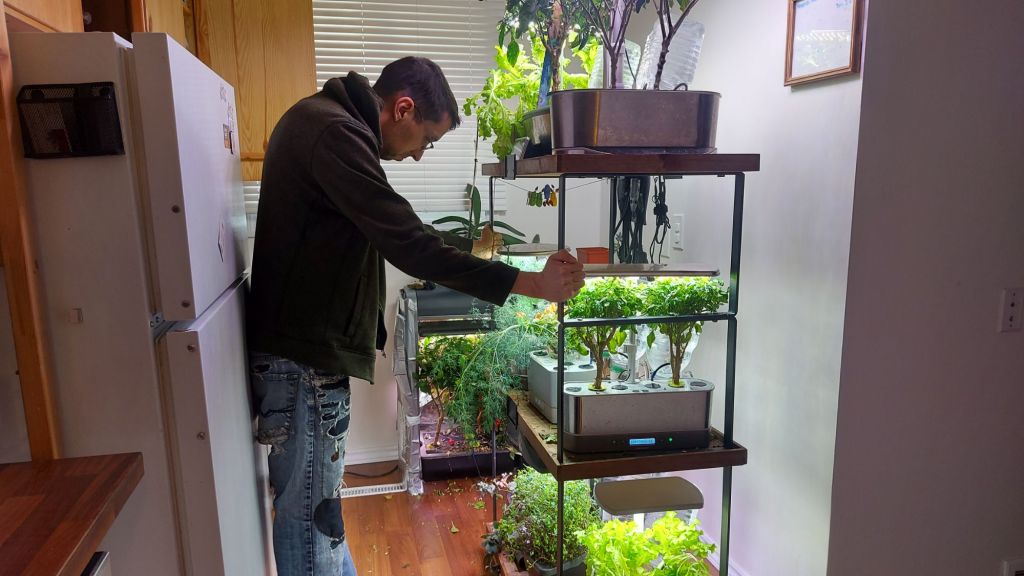
On a previous post, I mentioned about our monthly routine to take care of all our indoor hydroponics gardening that we named “Plant Maintenance Day”, which we just completed today. I thought it would be cool to show a glimpse of the process to make sure that the plants are as healthy as they can be and that the equipment lasts as long as possible.
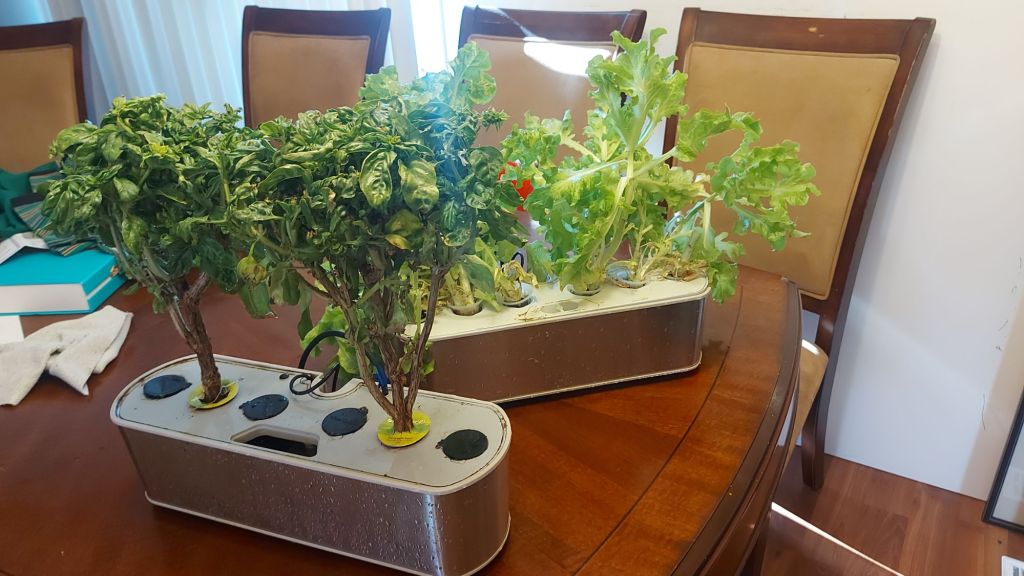
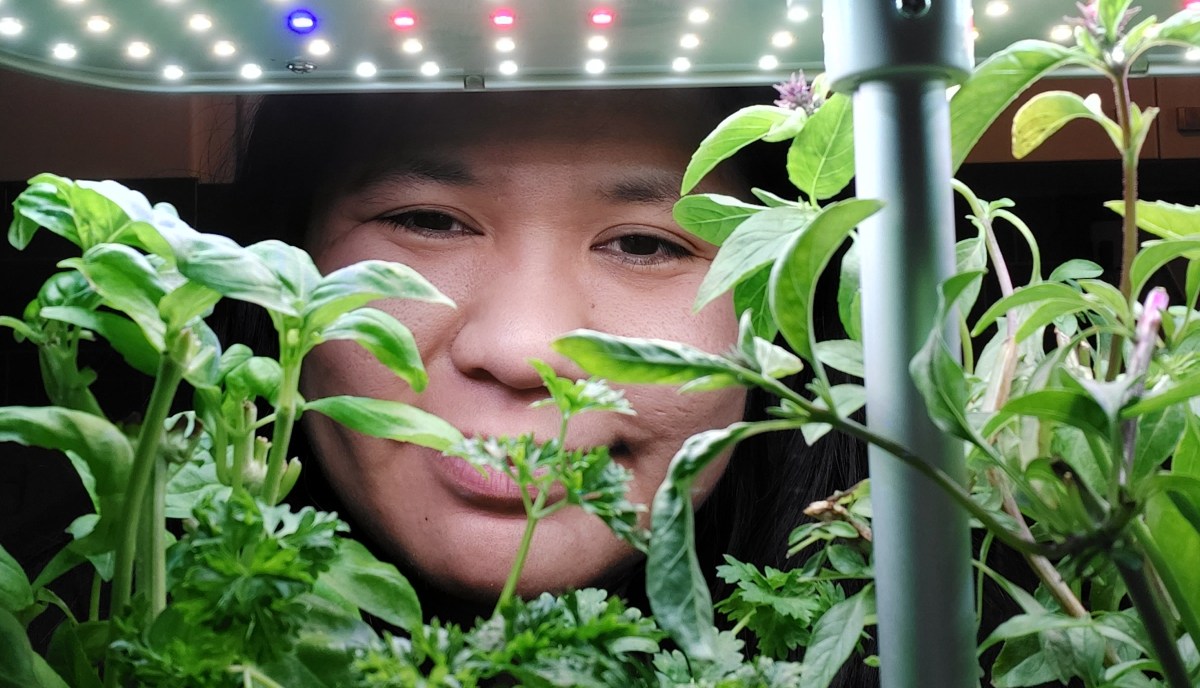
Newer models of the Aerogarden are much easier to clean, just like this oval shaped unit with no strangely shaped components inside the water basin. This basil plant looks overall healthy, although the slightly brown shade of the roots is a slight concern.
This Jalapeno plant is getting tall, and the clear roots is a sign that it’s healthy. We just harvested dozens of peppers a few weeks ago and there’s more that are developing. It is nice to see the roots while I washed the underside of the plant unit.
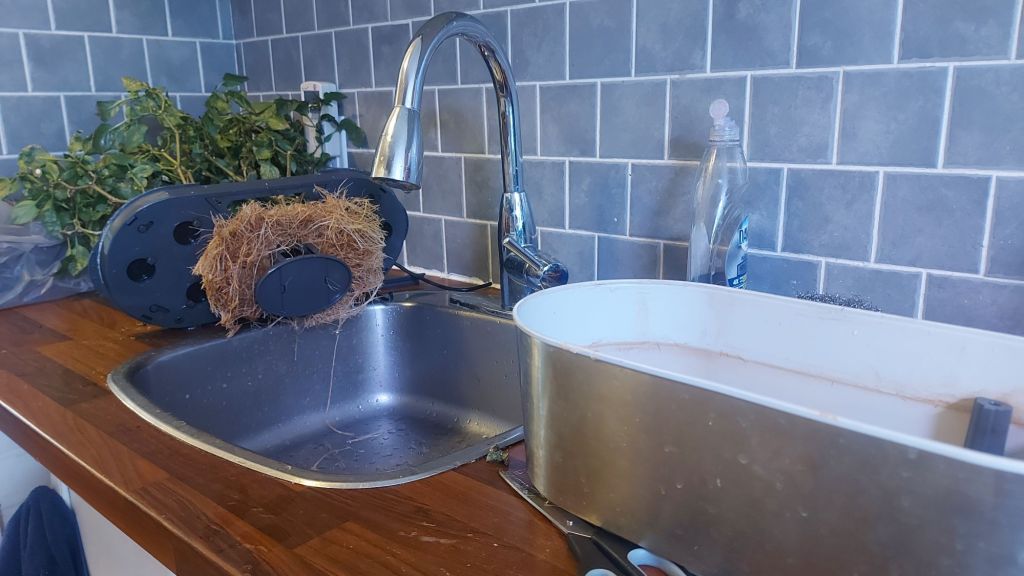
I’m so relieved that our sink has one of those faucets with a movable spout as it makes filling water in containers easier, including for the planters after washing them.
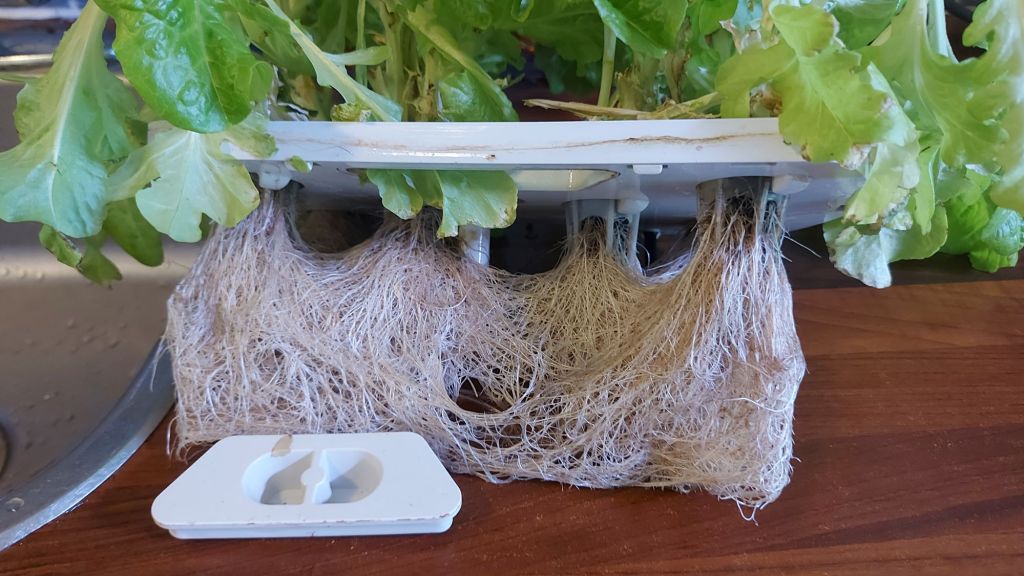
I guess there is strength in unity! This long Aerogarden unit where we planted all six pods with lettuce, had their roots intertwined with each other. I just needed to trim the bottom a little bit because if the roots fill in the container (which has happened before), the plant will start to get ill.
It’s a production line cleaning all the 12 Aerogarden units. After I finish cleaning them and re-filling with fresh water, I place them on the dining table, ready to be returned to our plant shelf.
These bright and white roots are a delight to see under the other Aerogarden unit we planted with lettuce. Two of the planters with lettuce is the perfect amount to make enough salads for the husband’s work lunches for the week.
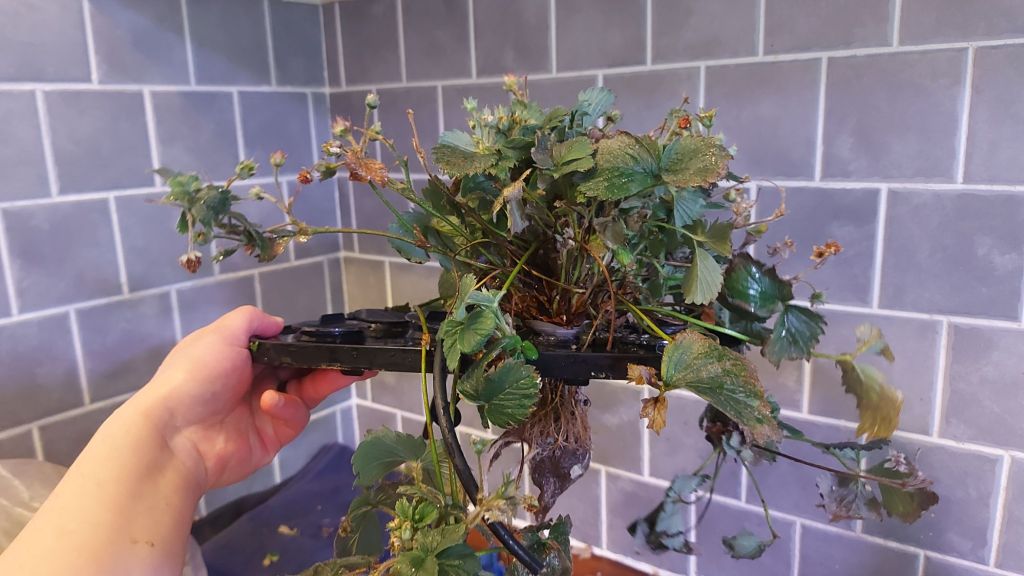
This strawberry plant is not looking well at all. It looks like strawberries are not a good fit for hydroponics gardening of this style. But we wanted to give this one more chance, so it goes the usual treatment of getting the roots washed as well as the whole planter.
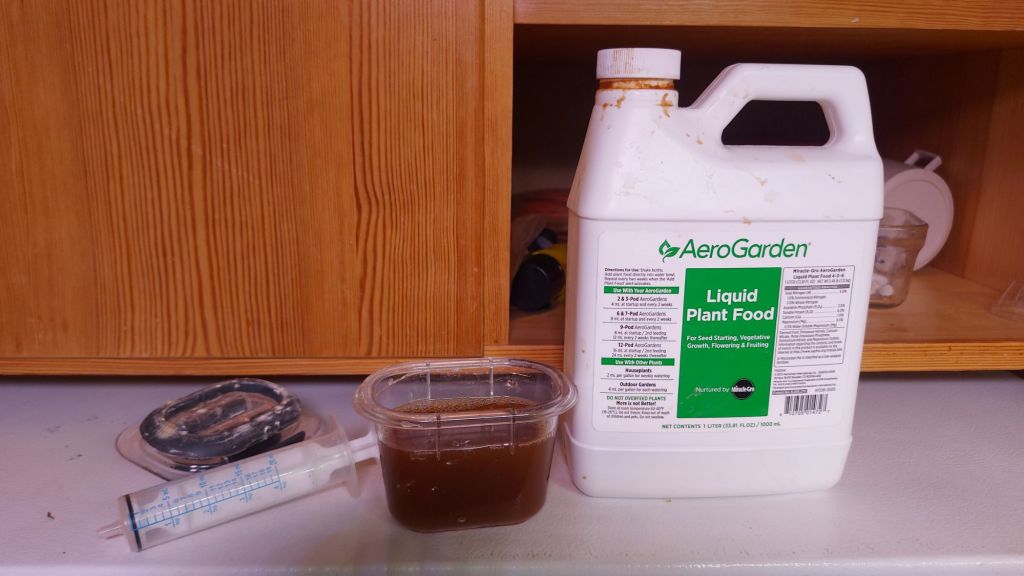
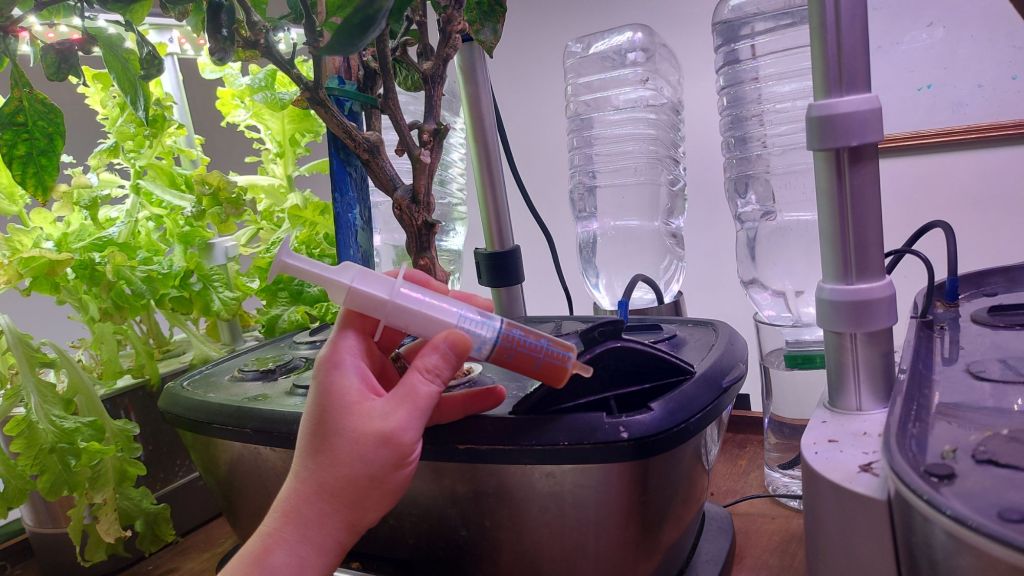
After each planter gets fresh water, they get a new dose of fertilizer as well. A syringe makes measuring and placing this liquid very easy.
This planter is the top shelf, so it’s about five and a half feet high and I had to reach with a step stool. While this is a good spot to put the fertilizer in, I just had to go with whatever hole I’m able to reach and see clearly.
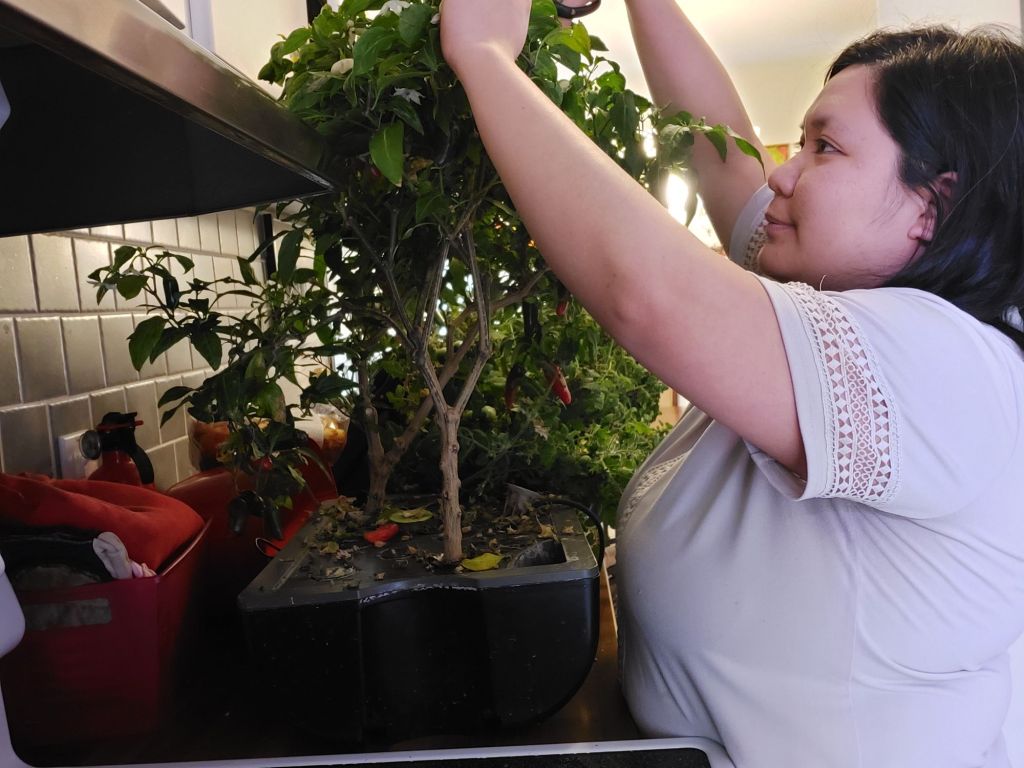
The height of all the plants need to be limited, otherwise they will hit the top panel with the lights and the bulbs get damaged. So this one got a very aggressive “haircut” from me today. Then I harvested all the peppers that were turning red.
And after cleaning off all the random plant leaves and dirt that have fallen off during the cleanup, the plants are happy for another month!
It’s remarkable how we have been doing this for almost three years now. While working side by side today, he asked me if I would consider outdoor gardening. I said not anytime soon, because I truly enjoy seeing the greenery all year long, as well as the delicious harvests that we get. As long as we have the energy to do the detailed cleanup once a month, adding water and fertilizer as needed, and harvest regularly before the fruits get overripe, we’ll keep this routine as is.
Most people plan elaborate parties, find a fun public event with fireworks and a festive way to count down to midnight, some even post a long heartfelt social media posts with photos taken throughout the year, others may claim that staying at home to have a restful night is the best way to spend the day. There’s a wide array of things people do to bring in the new year.
For my husband and I, we eagerly count down to our distinct personal occasion, that we tell people about it. Do we look forward to this day with the same enthusiasm as our anniversary? It’s possible!
It’s our annual Budget Deliberation Day! It’s when we wait until the last business day of the year for our online purchases to process, add all the information in our budgeting software, assess our expenses for the past 12 months and then set our budget for the upcoming year.
When a colleague asked my husband what activities we have planned for the holiday break, he mentioned about Budget Deliberation Day. His colleague claimed “if my spouse and I do that, we will get divorced!” I can see how that can be the case for many couples and families. It’s difficult to talk about money. Having what could look like a business meeting to talk about an integral part of our personal lives, can feel coldhearted and harsh. I suppose for my husband and I, that is the point of having a dedicated day and process for this, it eliminates stress and anxiousness because it is predictable, safe, calm and with a mindset of informing and supporting each other.
We did not do this right away after we moved in together. What I do know was when he bought his own home for the first time, he also got a budgeting software. Just as boyfriend-girlfriend at that time, whenever I come over to his place, he would eagerly show the charts and graphs of his income and expenses and the sub-categories for each. During this time I was living with my relatives still, who didn’t have a system about budgeting that they taught me. So I was winging it as a young adult in my 20’s, using spreadsheets and even the free version of the Mint budgeting app at the time.
When we moved in together I still used my own system, including the built-in budgeting interface that was part of my bank’s online banking. Year after year, the boyfriend – then turned common-law partner – continued to show me the software, gently encouraging me to finally give it a try. When my bank removed the budgeting section off their online banking, I figured it is time to do it. If we are going to build a life together long term, might as well have an easier way to discuss finances. After all, we are “team communicate!”
So what happens during budget deliberation day? Not a whole lot actually. Since throughout the year, we regularly add our budget information in the software, we already have a good sense of our income and expenses. It’s not like we have no clue what is happening and have sort through 12 months of information. We check the long term information such as net worth, investments, money we can easily access and withdraw. We check our income and expenses to see how much they match up with what we have anticipated at the beginning of the year.
One very important thing to note is this is not a time to shame each other, and ourselves, if we went over budget on certain categories. Since we are not in debt and have some money in our chequing account, we know that going over budget is not going to hurt us in the long run. It could be just a sign that for next year, we just need to increase the budget in that category.
Our categories are not identical either, and that is not the point for us anyways. For me, I wanted to clearly see how much I spend on groceries compared to eating out, so those are separate categories. For the husband, eating out is combined with the rest of his “fun personal” expenses category. For the longest time it was difficult for me to set boundaries about giving financial help to relatives overseas. Setting the budget for that category and assessing it every year helped me set boundaries so I can help wholeheartedly without being resentful, and without compromising my financial goals. Besides, if I get into financial trouble, no one from the motherland can help me.
We plug our computers onto the monitor and show each other the software page, the chats and the numbers. We might have to ask to raise a budget category. The whole thing takes about two hours tops. Today we finished right before lunch, and that’s with both of us sleeping in.
The software is not the fanciest one around but that never mattered to us. The colours are straightforward enough, and the charts in different formats (line, pie, bar, doughnut, custom) are fun to read. We have this in our computers, so not an app on our phone, which I think prevents us from obsessing about budgeting in a toxic way.
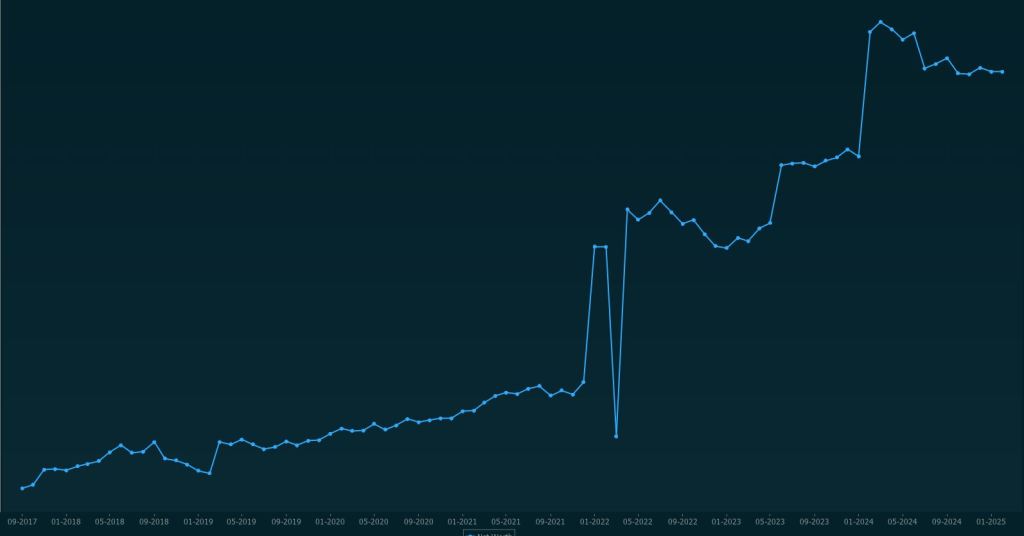
He’s used the budgeting software for 15 years now, and I have for seven. I think the most fascinating realization for me is how the numbers and charts tell a story. In his net worth chart, the largest dip in the line graph was when we traveled overseas for the first time. He had to spend a lot of money and also lost wages for three months. For me, the steepest decline in my line graph was when we downsized from a single family home to a town house and I used my savings to pay for a portion of the house. It’s so worth it though – because we were mortgage free afterwards!
Budget Deliberation Day is also an opportunity for us to talk about potential big expenses for the upcoming year. This helped us plan for a new roof, hot water tank and furnace. This helped us plan for our big adventures, whether it is travel, changing careers while ensuring we can pay our bills while finding a new job, running for politics, or aggressively increasing our retirement savings. I personally think that unexpected financial surprises, especially the type when the other person can claim “you could have talked to me about this sooner because you knew!” is what causes conflict between couples, not the actual numbers being shown in the budget.
It’s truly a solid way to start the year, secure and confident in my ability to be financially aware, appreciate my spouse for his diligence, and look forward to our future together.
In December 2023, so about a year ago, I decided to finally work on something that eluded me since I was a kid. The ability to actually finally stay afloat and tread on the deep end of the swimming pool. I figured that there’s no better place to do this than the place where I used a swimming facility for the first time over a decade ago, the YMCA on the west end.
I grew up in a mountain village in rural Philippines, where swimming pools are nonexistent. The hot spring resorts in the nearby mountains are not the optimal place to learn how to swim properly as they are designed for large groups that go there to socialize and splash around on waist (or chest) deep water. When I moved to the city, the school I attended didn’t have a pool despite it being a private school – only the more expensive ones had them.
When I moved to Canada at 16, I never heard any invitations to check the pool at my high school, so whether our school even had a swimming team or the related facilities will forever be a mystery to me.
Back in 2011 at age 20 out of my own initiative I finally went to the YMCA on the west end. I forked up the monthly fee despite being a part time student with seemingly endless expenses from my schooling, home expenses, my brother’s upcoming immigration to Canada and shopping for all the supplies he needed, and things that a young adult would like to get every now and then.
It was awkward at first. I observed other people who used the floating belt and how they swam on the pool within the confines of the plastic ropes. My hands, feet or shoulders kept hitting the plastic rope, I can hardly breathe, and I gasped loudly in relief once I reached the end of the lane. I tried to go twice a week in the summer before my shift at work started at 1 PM. But that summer flew by fast. As soon as my teen brother arrived in Canada that fall and I got admitted to to co-op placement program for my business degree in university, the swimming routine went adrift.
Fast forward to the next attempt at the pool in 2014, when I got an office job in downtown Edmonton. The downtown YMCA was only two blocks from my office and I managed to stick to my gym membership for about six months before I fell out of habit again. The workout rooms and the group exercise classes gave me a strange dilemma, and only after a few tries in the pool, I opted to do exercises that don’t require me to smell like chlorine even after taking a shower.
I haven’t thought of swimming again for many years until 2023. I noticed that my back and shoulders were hurting more often, and going for a massage once a month didn’t seem to be enough. I also found out that my new job then didn’t cover the cost of massage therapy. I needed a cheaper way to get the movement that my shoulders and back needed that stretching, dancing and pilates fail to help.
It occurred to me that my Saturday afternoons were free while the husband was away with the drinking and running group. I figured, might as well work on a fitness goal for myself too!
Since it’s been such a long time since I was last in a pool, I booked one private lesson to assess my skill level – or should I say, lack of skill. I just need to know whether I can be on the deep end while wearing a flotation belt without panicking or feeling ashamed. That was the best $45 and half-hour session I’ve spent for myself that year. The lifeguard instructor confirmed I can rotate my arms and flip my feet just fine and watched closely my awkward attempt to do the “egg-beater technique” to tread water on the deep end. “Now, all you need is practice”, he said. That I sure can do.
That became my routine. Saturday afternoons, as soon as the husband drives off, I got ready to take the bus to the YMCA. Two walls of the swimming room had clocks. I eyed on the clock’s hand rotating as I swam back and forth with the floater belt acting like an armour of courage. On my third visit, I waited until the open space with the deep end was free of the lane-swimmers, take off the floater belt and twirl my arms, legs and feet. When the water reached my chin, I’d grab onto the edge of the pool for a moment, and then let go for another try.
With more visits in the pool, I gained more seconds treading water on the deep end. 15 seconds, then 25, then 30, then 45, and then a full minute before needing to grab onto the pool’s edge. Then a minute, and then a minute an a half. The hands of the clock making a full rotation acted like my cheerleaders, beckoning me push just a little harder. The day came when I went onto the swimming lane with no floater belt, from the shallow to the deep end for a minute and swam back, and did that over and over for a half hour. By March, I finally reached the milestone of being a mildly-functional swimmer.
There was actually a swimming facility closer to my home. I eagerly watched the city’s webpage on recreational facilities for the pool’s re-opening. I got annoyed when the opening got delayed three times. I admit I was also losing motivation to take the 25 minute bus ride to the other pool and back. When the neighbourhood pool finally did open, it was exactly the next level of learning I needed. It’s only a fifteen-minute walk to my house and because of that I can shower at home afterwards. Literally no excuses this time.
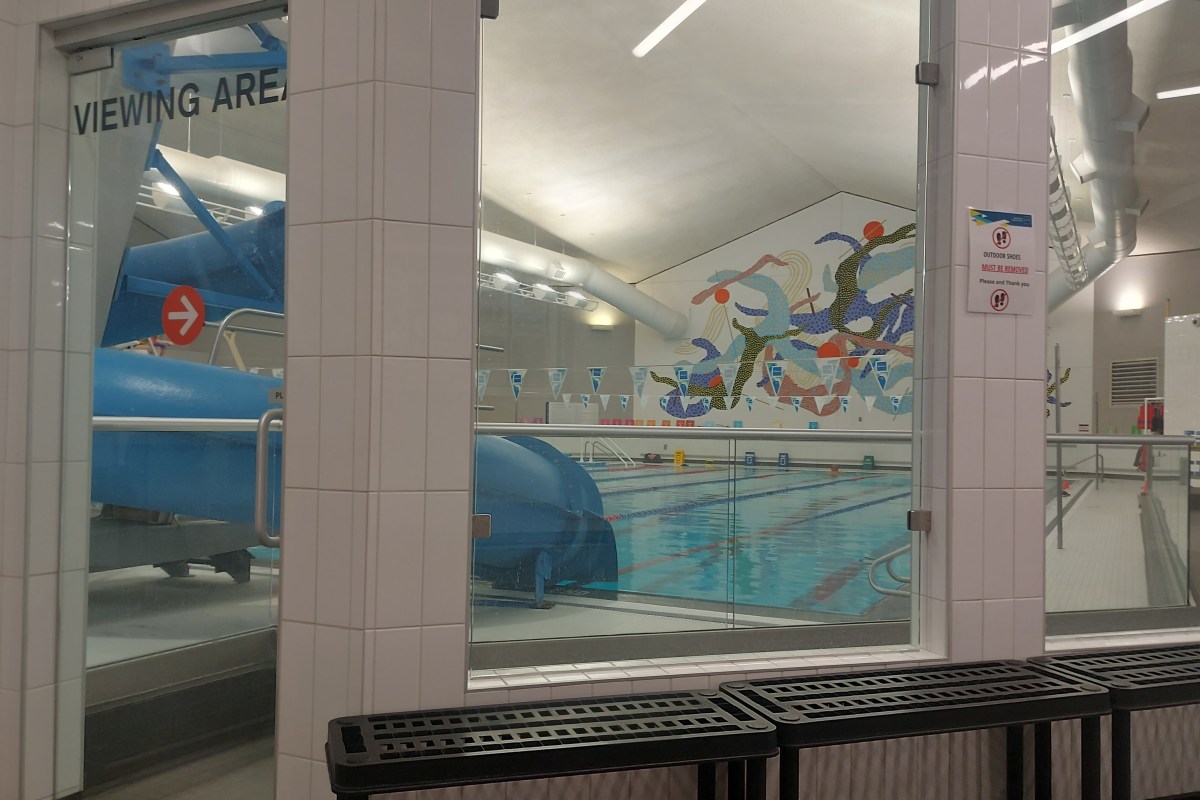
The smell and feel of the poolwater was somehow different. A bit gentler and I loved it. The change rooms and locker spaces were much bigger too. When the entire pool is configured for lane swimming only, there are six lanes that has room for one swimmer going in both directions so it is effectively 12 lanes. On the days when I go and it is open swim time, the pool is divided into the shallow, middle and deep sections. It was another great way for me to hang out in the deep end for as long as I need to, as long as I get out of the way of those using the water slide, diving board, and rope.
Whenever I go to the pool, I make sure that I stay in the lanes clearly labelled as “slow”, so I stay out of the way from those who were zipping through the lanes at what looks like to be five times my speed. I still bump the plastic floating dividers sometimes. But at least I don’t panic and need to be pulled out by the lifeguards. As I watch other swimmers with the floating belt swimming on the lane next to me, I try to subtly beam positive vibes and prayers to them, hoping that they too will reach the milestone of feeling more skilled in the water.
Just like any habit that is supposed to be healthy, around late summer I started to fall out of habit again. This time around, my body tells me when I really needed it – no excuses. After only a half-hour swim, my shoulders and back feel much more relaxed and nimble. And at $8 per trip to the pool, it’s definitely much cheaper than massage therapy. It’s not just exercise – it’s therapy, it’s pain management. For the drop-in rate, I got a discount because of the family membership fee I purchased for the neighbourhood’s community league, which is surely a bonus.
Also since the summer I joined my husband a bit more regularly when he goes to our very unique running-and-drinking group. A 45-minute brisk walk is a good addition to my fitness routine, if I choose to ignore the snacks and alcohol that we consume at the end of route. And as always, for doing errands that are close by, I walk for up to 30 minutes one way instead of taking the bus or waiting for a car ride. The true definition of a 15 minute neighborhood that makes certain fitness activities more achievable for me.
My goal is to one day to be a more public space to test how I deal with the deep waters then. I’m thinking the WaterPark that is pretty close. Or if I get invited to a social event in someone’s backyard pool or a lake that works for me too. I’m just thrilled that I won’t need to piggyback off my husband like when we were at the hot springs in Iceland in 2018 or at the local WaterPark in 2019. To be able to carry my own weight, or at least, my body afloat in the deep end, is an empowering feeling I didn’t realized I needed until I achieved it.
Lately, my corner of the internet is full of discussions about how couples share responsibilities in the home, how in many cases the division of tasks could get unequal, and passionate opinions on what to do when this is the case. I wanted to add my two bits into this discourse, not to side myself with a specific point of view, but to reflect and assess my situation as someone who is married for coming into five years (wow!) and sharing a home with my now-husband for coming into thirteen years.
In 2022 when my husband started to work for my father-in-law, he would go to work four days a week and then go to school remotely on Fridays. On these days he would be in the home office for most of the day, taking breaks only for lunch. Then he started to do one task which is doing laundry. It’s easy enough to do in between long study sessions since we only have two loads of laundry between us. Last year, around October 2023, he took a break from schooling on Fridays and it became what we now officially call as Househusband Friday.
How does it look like? It starts with us doing our own thing for breakfast and then once I’m ready to leave to the office for work, he would walk me to the bus stop. So we’ll have that small bit of quality time during the walk until the bus picks me up and I wave goodbye looking out the window. Maybe it looks like I’m a child being dropped off the yellow bus to school, but I don’t care. I love it. It’s sweet. It’s very kilig – Filipinos would get it!
Then when he gets home, from 8 AM to 1 PM he would nonstop work on the list of tasks. These included weekly chores like doing laundry and dishes, semi-monthly chores like vacuuming, dusting and grocery shopping, and the as-requested tasks like disposing items to the eco-station, changing the batteries of smoke detectors, deep cleaning the very top shelf of the kitchen cabinets, and more. He would then relax for a couple of hours, and then make dinner.
If there’s one thing we both love – I mean aside from each other – it’s our task lists. So it is not weird, unromantic, or offensive to have a list on our whiteboard of the things to do and even what I would like to have for our dinner. I’m pretty flexible with it actually. After a few months of this routine, it feels so nice to come home to a warm meal and a yummy drink (usually a smoothie) ready. And usually there’s leftovers enough for one or two meals on the weekend.
Then as the weekend comes, it’s my turn. I love to neatly put away our clothes, so I’m in charge of folding and hanging laundry. When the bathroom needs deep cleaning, that’s on me as well. I do prepare any other meals for the weekend, while he finds time to check his budget and pay the shared home bills. If there’s a home tasks we need to do together, we find time for them as well. If the chore is a bit creative, we like to consider it a mini date, like when we made this lawn ornament a few weeks ago.
The day before the start of the work week, usually Sunday or Monday of a holiday long weekend, is the busiest for me as I meal prep for the week. But it’s not all me. My husband cooks the meal we bring to his father’s place for our regular Sunday dinner, or as we call it, “Spaghetti Sunday” because we mostly make spaghetti and meatballs.
As a couple we also like having titles or official terminology on things we do. We describe ourselves as “team communicate”, we ask for a “feelings check” or start the “intensity check” process when we are stressed, so “househusband Friday” was a very welcome addition. Once a month, we also have a dedicated “plant maintenance day” for when we clean and re-organize our 12 Aerogarden units for our indoor farming set up.
During the week, we strive to cover for each other too. We load, run, and unload the dishwasher with minimal prompting. When I make one of the upcycled outfits and bits of thread and fabric are strewn over the dining table, I do a quick sweep with the walis, a plant-based soft broom imported from the Philippines. He is good at preventing messes from happening in the first place.
Truth to be told, I really appreciate that there’s more awareness and discussion about how couples divide household chores. I feel horrified at the stories I read about how apparently, husbands would deliberately and maliciously mess up a task to make their spouses upset to the point of not asking for help again. I remember being stunned at learning the term weaponized incompetence, but it fits in many cases.
The tricky and nuanced part is determining when to confront, when to educate, when to accommodate, and when to finally terminate the relationship. In online discourse where stories are condensed and context could be incomplete, it can feel excessive to see suggestions of “throw the whole man away.” But there are times when it’s valid. There can be times though when digging deeper through the root of the problem, whether it is trauma, illness, difference in cognitive abilities, lack of education but with willingness to learn, or something else, can help make a process that works for everyone involved.
I think it’s partly why I cringe when some people claim that a to-do list is too childish or offensive. And if a list is a no-go, I could imagine the haters when they find out how I write the grocery list for my husband since he started going alone during Househusband Fridays. Not only is it handwritten (gasp!), I make a new one every time instead of a standard list (gasp again!), the items are arranged based on type of item and also listed sequentially based on the layout of the store. Personally it is the ultimate example of setting someone up for success and making the tasks as quick and efficient as possible.
In my humble opinion, chores are most of the time not fun. Anything and everything that can be done to make it as quick, efficient, and enjoyable for the couple as they do them individually and together, is a win. I heard the argument that money is the main reason for divorce. I’d say a second close one is conflict with domestic duties as they are part of everyday life. It these issues are unresolved, it can affect someone multiple times a day, and can really wear people down over time.
Appreciation goes a long way too. Maybe it seems childish, but the occasional compliment for completing chores or admiring the outcome can help remind our spouses that the we see the effort they do. I think the most common phrase we say in my home is “thank you, baby!”
Chores and the domestics are an integral part of one’s health and keeping the relationship strong and sustainable. If there’s one thing I wish all couples have, is to reach a state of domestic delight. That the mundane aspects of maintaining their home is a source of joy, security, confidence and bonding.
During one of the househusband Fridays this summer, I had the day off. He still went through most of the tasks on the list, but I took over some of the seasonal tasks I added earlier this week. He did the weekly laundry and dishes and the vacuuming for the month. I mowed the grass, reorganized our little backyard patio, from the furniture, the barbeque and the pile of bags of refundable bottles. Afterwards he started to install a second-hand printer we got, until it got so frustrating that he smashed it just like in Office Space. He wanted that printer out of the house ASAP so we went to the eco-station to dump it off.
As we waited for our turn to enter the eco-station gate he asked, “Does this count as a date?”
Giggling I said, “Of course!”
We continued to hold hands, with his other hand on the wheel, while the car idled along a queue of cars with people doing the same mundane task of disposing their trash.
Last year on my birthday at the end of May, I did something that I considered an unusual, but valuable, gift to myself. I officially handed my letter of resignation to the job I had for eight years.
Materially, my life is overall comfortable. Also I find shopping for items like clothes, cosmetics, gadgets pretty dreadful. Having to think of gift items for people to get me is the opposite of fun. Thinking of what to buy myself as a treat that need to be bought at a specific time of year is also pretty restrictive.
As my wages grew over the years, both from my employment and the honourariums for some of my volunteering and writing work, I try to be very mindful of lifestyle inflation. I didn’t want to fall into the trap of buying something just because I could. In the occasions where I do splurge, those purchases were made intentionally and with no guilt.
A big theme I’ve seen in how I approach my birthday is about giving myself something special of great non-tangible value. The trip I took in New York City in 2019 is my first overseas solo trip, granting myself the new experience of independence and rare unrestricted indulgence. The boudoir photoshoot I also booked a day before my birthday is to grant myself a new way of reclaiming my body and sense of self, a valuable thing for sexual abuse survivors like me. In 2020, I hired a freelance artist to recreate a piece of artwork I drew in 2013, granting myself a way to preserve precious memories and the enjoyment of collaborating with an artist. The drawing in particular was the memento I made from my first trip to the Philippines after immigrating, taking my Canadian (white) boyfriend in tow. In 2021, my self-gift was as simple as granting myself rest and family time as I started to ramp up my election campaign running for city councillor. Something truly in short supply and so precious for that period of time.
For my birthday last year, the plans to celebrate were straightforward and already confirmed. My brother worked night shift so meeting him separately worked better since typically dinner times happen when he is already on his way to work. The husband’s family will be coming over for a separate dinner in the home we just moved in to a few months prior. They planned to bring black forest cake. Perfect.
The only thing missing is the precious thing for me.
I talked to my husband about the idea throughout the month of May. This was not something taken lightly. The job search process over the past few months were not going so well, and I knew it is because I was not giving it the right energy and focus. Also, in the past, I was unemployed when I applied for that job I truly enjoyed for eight years. It seemed like I can only do one of these two things at a time: work full time or job hunt full time.
On top of this, I realized that I never had a full two-month summer break since before my parents died, which was the summer of 1999. Since 2000, my summer breaks consisted of working for most of it, either working in the store in the mining village in the Philippines, working in retail or placements during my university years, and then as a full-time working professional. As a child, since my birthday was the end of May, just right before the schoolyear begins in the Philippines, my birthday always marks the end of a notable period of time and the beginning of another.
I looked at my bank account repeatedly. I inspected the information in the budgeting software I used since 2017. If I were not to do anything extravagant or ridiculous, I can afford to pay my bills and save for retirement with no interruption, for quite some time.
This is the perfect timing for this reset.
When I woke up on my actual birthday which was a Tuesday, I was a bundle of nerves and certainty. I was working from home that day, in my home office where to my left was a wall of frames, including the employee recognition certificate I received for my years of service. The draft email was already in my inbox. And then I clicked send.
Just a few minutes after, I got a message through our internal chat software. It looked like it came as a surprise. Then emails and video calls took took place, with strategies and decisions to make the most of the one-month resignation notice.
Since we had a hybrid work arrangement still, my office was not as decorated as it was. Packing up any remaining personal items was easy. The last month of work flew by, as I eagerly waited for my last day of work, just right before Canada Day long weekend.
After the long weekend, my relaxed summer break began. Nothing changed in my evenings as I kept all my volunteer commitments. I also wanted to spend the same amount of time with my husband so I kept my sleeping schedule the same. But the time period that is labelled as the typical weekday work hours from 8 AM – 5 PM, were all free and flexible. It felt eerie but not as slow as I expected. Boring and lazy and unstructured was exactly what I’m looking for and what I got. It was quite remarkable.
In the middle and end of the month, when I paid my bills, rent or the automated deduction for my retirement savings got taken out of my bank account, I relished in the feeling that I didn’t have to work during that current week to pay for it. My past self (and of course my husband) helped make this comfortable period of time happen.
When September long weekend arrived as well as back to school for students, I knew this free time was up. It is time to be a responsible adult again and actively work towards finding my next job. I knew it will take months from applications, to interviews, to the offer and a starting date. As fall came and went, the pressure crept up a bit more. Thankfully my husband consistently and patiently put my panicked thoughts into perspective.
In some career-oriented articles, I’ve heard of people talking about the benefit of taking a break, sometimes they call it a sabbatical. The type of break for a working professional where they won’t have to worry about financials, but are able to not work full time to rest or try something different. I didn’t name it that way back in May 2022, but it looks like a two-month sabbatical and life reset is what I have gifted myself. One can argue that it was quite expensive, if not the most expensive gift I have given to myself. My living expenses were $3,500 a month and I didn’t find employment until six months later.
It was wonderful and definitely worth it though. Something that is hard to give or get for someone like me with extreme workaholic tendencies. The gift of rest, of reset, of leisure, of personal flexibility. I hope that I can do it again just a few more times during my prime career working decades.
Word counts and number of pages heavily influence my approach in writing. From Grade 4 onwards, in multiple classes from Language (English) class and Filipino class, we were required to fill pages upon pages of lined paper with paragraphs on certain topics. Some of them were comically dull, such as “what I did last summer” since for me, 70% of the time I was watching the store. I can cover that in just one paragraph. Since these essay worksheets have a defined number of pages and we students have learned that being suspiciously short lowers your grade, we learned to stretch and beat around the bush. Adding flowery words, extra couple of sentences, and extending simple statements with independent and dependent clauses are skills I’ve mastered well.
The page limit means just that – that there will be a point when I won’t be able to write any further. In my earlier years before I had access to a computer on a regular basis, this can be an agonizing experience. When I feel that I’m gaining momentum with the middle paragraphs of backstory and supporting points and then all of a sudden, I have less than half a page left, needing to hastily switch and make a concluding paragraph. It feels like walking into a hallway and getting smacked in the face with a glass door. It’s painfully abrupt. So, I’ve learned to “budget” the paper space ahead of time. As a university student here in Canada over a decade ago, I’m immensely grateful for Google Docs and Microsoft Word for this very reason. If I went overboard, I could trim the excess before submitting the final version.
For this memoir project, dealing with word counts and spitting out words is a whole new challenge. These days I rarely have limits on how long my write-ups should be, unless I have to submit them externally. As a volunteer columnist for the Alberta Filipino Journal for the past six years my word limit is simple, 650 – 700 words. Pretty easy to follow. When I wrote the historical essays for Edmonton Heritage Council’s historical initiative called Edmonton City As Museum Project, they had a maximum word limit, but writers get paid by the word. I tried my best to ensure I don’t unnecessarily inflate the piece while giving myself the flexibility to expand if needed. In both articles I had about 50 – 100 words left. With the CBC articles, there was also a word limit but the payment is a flat rate. It helped the editor with expanding a little bit more because they want to keep a well-written statement. Only the second piece went over the 600 word count.
Now that I had 40+ chapters to write about. I did some research on the average word count of a chapter for full-length books such as novels. I agonized on how many words I need to pump out in a day. With personal blogs such as the ones over here, there were many moments when I finished a post in a single sitting – usually about 1000 words. For some time, I wondered whether that’s a fluke or normal. This process of writing a lot – a whole lot more than usual – is an experiment on how many sentences I can spit out that are somehow coherent.
One of my husband’s favourite creative celebrities is J. Michael Straczynski, a filmaker who released their memoir/how-to book, Becoming Superman. What a remarkable and heartbreaking story of hardship in his younger years! It was also amazing to see how his artistic career blossomed. His is the first book where I read practical tips on advancing one’s journey as a writer. “Write all the crap out and write all the time, and make sure that you submit before the deadline, because it’s amazing how many assholes don’t” is the essence of his friendly and utilitarian advice. I like it. It resonated with me and boosted my confidence. I’ve always completed my written work on time, sometimes early, so that the editor can have the time and breathing room to look it over before getting bombarded by everyone else’s on-time or almost late submissions.
This time around, I am the rule-maker. And the rules, the constraints, are actually helpful in getting focused. So with each chapter I gave myself a semi-flexible limit: minimum 1000 words that clearly narrate at least three scenes, threads of thought, ideally both. This resulted into chapters that are between two to five pages. When I see a chapter going beyond that, I find a natural spot to split the narrative, which prevented me from feeling guilty that one area looked too long. Instead, by giving myself permission to split the chapters, I managed to add a couple more paragraphs to help make that mini story feel complete.
My author mentor lent me a stack of books to help me learn various techniques about writing. She enthusiastically said over and over that numerous principles used in writing fiction are just as useful in writing creative nonfiction. This was especially useful and motivational for me since I am narrating a story – the story of my childhood as my younger self experienced it. One of the books is On Writing, by novelist Stephen King. Similar to Becoming Superman, it’s a memoir/how-to combination which I liked. Him sharing his schedule with numbers is the most striking piece of advice for me. He said he would write a thousand words a day in the morning, stay consistent, and complete a first draft of a novel in three months as a result. Well, guess who completed a memoir draft in three months – this lady! I was overjoyed when I read this. Will my works be as brilliant as his, who knows? It also didn’t matter too much – he had a lot of freedom and flexibility since he wrote fiction. I know I shouldn’t trap myself into stringent formulas, but a roadmap helps prevent the feeling of spiraling out of control. I also don’t write a thousand words every single day. But if a thousand words in 50 days in under three months is a workable formula for me, I’ll take it!
This year, on top of everything else my husband and I drastically changed, I added one more to the list. I finally started working of my first memoir, my first full-length written work. The initial plan was to publish something right around my 30th birthday last year. That got derailed by two major things: COVID and running for public office during a pandemic.
This is to account my initial reflections on this journey and observing my mind, both how it works when it comes to motivation and getting organized, and from a mental health standpoint as far as memories and triggers.
I had to check my email history and digital calendar to confirm the timeline. When you don’t have a full time job, the pace of time feels so strangely elastic and oddly compact, depending on the time of day. In early September, I took a chance and applied for the Horizon’s Writing Circle, a writer mentorship program. I recall being so nervous outlining my bio as an artist, feeling like a fraud. I suppose I had a few essays and got paid for it. I’ve been blogging for a decade and been an ethnic paper columnist for five years. But will it be enough to deserve undivided attention from someone who actually published multiple books?
I applied for the program in early September and in early October I got the confirmation that I got in the program. How exciting! I arranged a meeting with the author mentor in mid-October. Just like the other mentorship programs I participated in, I had a very clear goal in mind and I needed their advice to make it successful. When I outlined my goal, the summary of the memoir and the tangible deliverable, my mentor was excited. But it didn’t hit home for me until I hear her utter the words “Yes, I’m very positive that by the end of our mentorship period, you will have a first manuscript.” That felt so real, so tangible. It’s remarkable.
This is a precious time and opportunity, I have to everything I can to make the most of it.
This sparked a flurry of motivation in my mind and my heart. I made an outline of all the different chapters and themes of my life using blank MS Word documents. In a few minutes I had 40 blank chapters. Whenever inspiration strikes as the cliche goes, I would open a file and either type the entire story right there, or write short phrases of the smaller stories to write about. As of right now, I’ve been doing this for just two months, and I’m halfway through, over 20 chapters that looked decent enough to be scrutinized. Done is better than perfect, I tell myself over and over. It frankly didn’t feel like much, but when I say to people out loud, their reactions remind me that 20 chapters in less than 60 days is noteworthy.
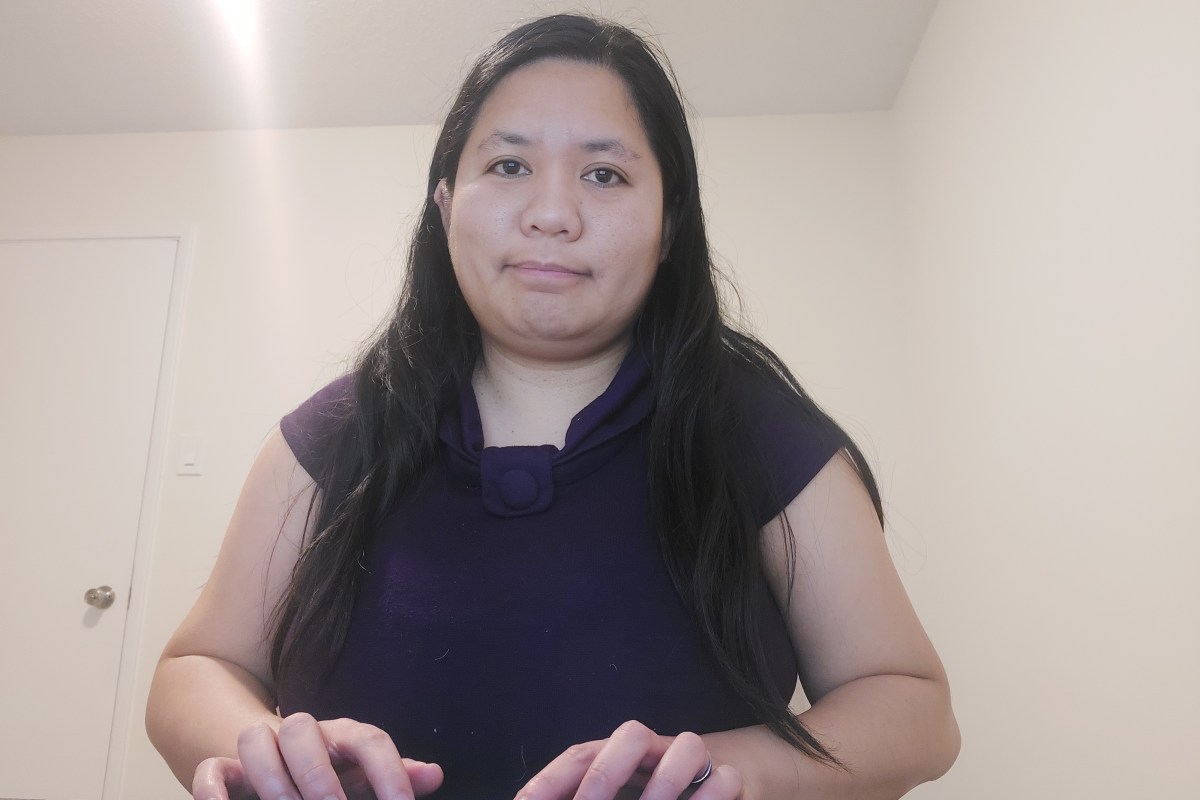
Some days when I write, my brain somehow forgets to tell my body to breathe. After the keyboard clatters for a few minutes as I tell a heartbreaking experience, I’d suddenly gasp for air. Only then do I clearly look at the words on the screen, and tears would roll down my face. I thought that being triggered would be more melodramatic and fiery than this. I guess I was wrong.
In early December I had a dream that I wasn’t happy about. In my dream, somehow my father became alive in my current life as an adult for just one day. I was frantically giving him a tour around my home and around Edmonton, filling him in on what he missed for the past 23 years. The day doesn’t end, I don’t know what rudely woke me up into reality. I laid in bed, my eyes angrily boring holes in the ceiling as the tears silently fell. I know that this is from my consciously digging up memories and putting them on paper, or in this case, the computer screen.
Damn it, brain! Why do you have to do this to me? This wore me out mentally more than the other times I got emotional while writing. I spent the next week not writing anything new, just updating the grammar of the earlier chapters I wrote.
While dedicating time and energy to write, I had to juggle other priorities as well. There’s truth to the saying looking for a job is a full-time job. Taking the time to diligently search for opportunities that fit my experience level and salary range and writing a thoughtful application, that takes effort and a mental toll. I try to switch it up during weekdays, a few hours on job searching, an hour or two on writing, then some time for chores and volunteering.
This is how I remind myself that being unemployed doesn’t mean I’m useless. That I’m still improving my skills, using the ones I have, and making a positive impact around me in different ways. Sometimes it looks like the homecooked meal I made and a clean kitchen sink. It can look like being present at a board meeting and being efficient in all the items we discussed. It can look like a piece of artwork I finished for the home and two memoir chapters done in a single day.
Activities not related to writing or career help me stay grounded and balanced. My husband actively finds video games that a very beginner-level person like me can handle, and he is very kind and diligent when we do levels together where he had to do about 70% of the work. It’s pretty sweet of him. Whenever he plays video games that he streams to his audience online, I hear him talk about me and share fun updates about ‘the wife’. I sometimes chime in on conversations and his audience seem to enjoy it. Our group of friends have organized a weekly movie night, just like what they did regularly a decade ago. My friend asked for my help with pet-sitting and it’s quite fun being a dog and cat auntie. It’s actually nice having a cat on your lap being cozy while reading one of the books my mentor author lent me about writing techniques.
My suicidal ideation has never left my mind, but I am able to keep it at bay for the most part. It’s not by feeling more optimistic about the world – there’s too much obvious evidence that people and systems are harmful and selfish and problematic. It’s by keeping a little bit of hope that what I do matters to a small extent and it affects people positively, whether it’s just myself, my immediate love ones, or those who gets affected by any of my community service work. And that’s enough for now.
As an attempt to convince his kids to take dental health seriously, I remembered my father, when I was a kid, basically telling us “don’t be like me!” He had metal dentures for the top of his teeth, and he during one of these conversations, he would take them out of his mouth and show them for us to have a closer look. I don’t recall any other details about what happened to his teeth that he ended up losing a few of his adult teeth and him needing to have dentures. He was too focused driving down his stern advice: don’t eat too much sweets and brush your teeth every night, or else you’ll lose your permanent teeth and that would be bad.
I knew he meant well, but back then there’s an issue as far as people’s perception of dental care in the Philippines. Since dental care is something you pay out of pocket, when you don’t have the means, so-called preventative care and checkups are out of the question. You would go only when there’s a toothache that is so unbearable pain or only to pull out rotting teeth.
In 1999, shortly before my family got into the fatal vehicle accident, I vaguely remember my sister telling me that she went to the community dentist on her own for the first time. That she was nervous and also proud that she went. At the time, both she and I are starting to see many of our adult teeth forming.
And when the accident happened, well, medical check-ups of any kind went out the window. Asking for permission, and for money, for medical and health related reasons was tough. My grandma would mock me and scornfully ask “did your father’s side relatives make you ask? If they want so badly to do things like dentist checkups form you, maybe you and your brother should move and live with them instead!”
2007 was a chaotic year for many reasons but January was pretty rough. After coming back from New Year’s vacation from the father’s side relatives, I asked the mother’s side relatives, who I live with, if some of the suvivor’s pension money can go towards a dental checkup. This infuriated my uncle and grandmother and my brother and I got punished severely. That’s all I have to say about that for now.
It was soon very obvious that two of my froth teeth were really rotting. Since dental care is cheaper in the Philippines, they were extracted and I got my new dentures less than a month before my flight to Canada on August 2007.
During university I managed to get a few check ups and fillings done for my teeth because I managed to stack my benefits. I learned that my benefits from working retail at Future Shop which covered 50% of basic procedures, plus the 50% covered from being a university student, completely took care of the cost. Perfect for a broke university student!
When I visited the Philippines in 2013 with my then-boyfriend, since I knew dental work is still cheaper and I was unemployed, I got a replacement for my dentures. I was sold to the fact that the one with a metal plating will be more sturdy than the plastic one. I was pretty irritable for a good chunk of the trip for other reasons so it was a stressful experience. The metal base had to be adjusted a few times so it stops cutting through my gums, but it was all good ever since.
After I got used to my metal plated dentures, that’s when I remembered that my father had a metal plated one as well! I whispered a little prayer then, apologizing that unfortunately I didn’t manage to keep all my adult teeth. From then on, my dental care routine has improved dramatically. I told myself, I’m the adult now and I can take the reins moving forward and take care of the teeth I have left.
When we moved to the neighbourhood my husband grew up in, he convinced me to go to his dental clinic so that we have the same dentist. Remarkably, my husband only had one dentist for his entire life, since he was a child! When Dr. Chin retires, I bet it will be quite an adjustment for him. Maybe my husband can reach 40 years old first before that happens?
The first major dental surgery I had was 2015, when I had ALL my four wisdow teeth pulled out at the same time. The bottom two are impacted, meaning they are not coming out properly and are kinda stuck, causing pain, risk of mis-aligning the rest of my teeth, and potential infection from hard to reach areas that I’m not able to clean properly. Again, huge thanks for work benefits covering the cost of all that.
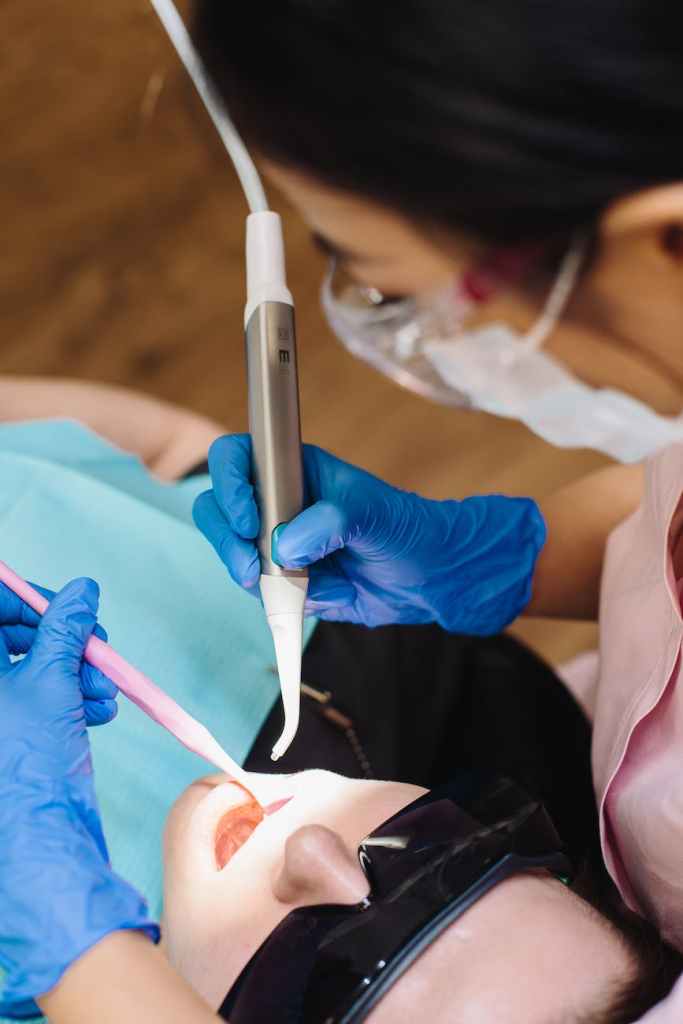
These days, I go to the dentist at least once a year for a full checkup and cleaning. Even after we moved from my husband’s neighbourhood to a different location, we continue to go to the clinic of his childhood dentist. It’s funny that I seem to be more diligent with booking my appointment that he was. When I sit on the patient’s chair and the dental hygenist gets started with their work, I have to remind myself to ask “oh! I have dentures, should I take them out now?”. Then they would put it away neatly wrapped in tissue and inside a paper cup.
Every appointment I would ask my dentist to check on my dentures. At this point, I would have this metal one for almost a decade now. Whenever I ask, how are they looking? Are they falling apart? Should I get them changed? So far, the dentist keeps saying that the dentures are still in good shape and for as long as they are comfortable I can keep using them.
Maybe in the future, when I am in a position to have a positive impression on a child, let’s say being an aunt or grandma, maybe I can do the same technique as my father did. Maybe I can pull out the dentures, grin widely to show the missing teeth, and say “this is what happens when you don’t take care of your teeth. Do you best to care for them and brush them always!” While I wasn’t able to fully follow my father’s advice, those were due to childhood circumstances outside of my control. Maybe when I give the strict cautionary tale, with the support of the adults in their lives, the kids these days will be able to follow through.
Content Warning: References to sexual assault, mental health treatment.
This story is from my experiences between February and September 2017, a transformative and healing time for me as far as my mental health and outlook in life.
February 2017 was when I had my first therapy appointment with the Sexual Assault Centre of Edmonton, a free therapy service for those who survived sexual abuse. My boss at the time suggested this resource in November 2016, right after she noticed I was reeling from the election of Donald Trump. Let’s just say it was not great as a sexual abuse survivor to have a prominent politician still elected after it was revealed he made statements like “grab the women by the pussy.”
After I did the online application and got the screening phone call in November 2016, I was told I’m waitlisted. Then I got notified that I am in and can book my first appointment. It was about mid-February in 2017, at 4 PM.
I chose 4 PM because the clinic is open only during office hours, but at the same time, I’d like to be at work for as long as I could before taking off for the day. Making up the work hours is not an issue at all. I’d leave work at 3 PM to take the bus to the office for the appointments.
For something as emotionally tough and draining such as therapy, especially for something traumatic like sexual assault, I didn’t realize how starved I was right after the appointments. Luckily, there is a business plaza right across the street, with this shop named Fifendekel. Due to the bus schedule, I actually arrive in the area 20 minutes before the appointment.
For the first few appointments, I’d stop by there, get a sandwich and a drink and eat it right away before the appointment. I’d rotate between the egg salad, tuna salad, or chicken salad, no tomatoes but extra sprouts. But I learned that it throws off my appetite for dinner. Also as it turns out, feeling stuffed while talking about heavy topics was not comfortable – I mean physically. Emotional discomfort is already there since, well, it’s therapy.
One time I decided to get food after the appointments, but I learned the hard way that they close at 4:30. So I learned that whether I’ll eat it right away or later, my window of opportunity is before my appointment. And that’s what I did.
While waiting for my sandwich to be assembled, I always look at the desserts glass display, eyeing the small paper plates with single slices of pie. I love blueberry pie, so whenever it’s there I’d order a slice to eat at the store. When I started ordering my food to-go, I was worried whether it will travel well in the take-out box, but it did, thank goodness!
So for many of the appointments I had afterwards, a routine was set. I’d leave work, take the bus, walk a few blocks to get a yummy sandwich and pie, put it in my briefcase vertically and head on to the appointment. Afterwards, I’d take a cab to take me home and have my sandwich and pie by myself in our breakfast bar by the kitchen. I literally felt like I’m being re-fueled, from the delicious food and moments of peace and quiet I have before my husband goes home after having dinner at his parent’s place.
Then at bedtime, we would do what we call the “therapy after the therapy”. While cozy in our bed, my husband would ask “how did therapy go?” and would diligently listen to any new insights or techniques I learned from the appointment.
Of course during the appointments, it is unavoidable that I share to my therapist a story or two about my husband. Oftentimes, those were positive stories of love, support and care towards me. The approval and glee from my therapist is quite evident. I’d tell this to my husband. He would then ask “so, I am therapist-approved?’ And I’d say “yes, absolutely you are!”
The appointments went from weekly for a few months, and then became bi-weekly by the summer, and then in early fall, for August and September, they became once a month. Until such time that my therapist felt it was a good time to wrap up.
Over the years, whenever I had blueberry pie, whether at a restaurant or a meal with love ones, I would always think fondly to myself “oh, there’s my therapy pie!”
Magtanim ay di biro, Maghapong nakayuko, Di naman makatayo, Di naman makaupo! (Planting is not a joke, as you need to bend over all afternoon, you cannot stand, you cannot sit!)
This is a folk song I remember learning as a child, about the hard work that is required to plant rice in farming fields. While I personally haven’t experienced that as a child since I grew up in a mountainous region in the Philippines before coming to Canada, it got instilled in my mind that care for plants is a serious and important thing.
Potted plants were a common thing in the homes where I lived in both countries. They came in different forms: an outdoor plant box, milk cans or clay pots for indoor plants, or just a raised garden bed right by the stairs leading up to the house. But plant care in Canada was a whole different ball game since the drastically changing seasons dictate what, when and how plants need to be care for.
I started paying more attention to indoor plants in the places I lived in, when I moved in with my then boyfriend, now husband. In his condo, he had one potted plant that he got from his mom as a housewarming gift. It’s one of those generic types of plants seen in many people’s homes. He had a nickname for it that stuck, Mr. Plant. We found the perfect spot for it, right beside the narrow living room window, perched by the edge of the TV stand. It was relatively low maintenance, watering it once a week and not putting any fertilizer was enough for it to survive long enough for us to take it to the house we moved in to in 2015.
That house came with one plant that was hanging by the stairwell ceiling, so we nicknamed it H. Plant, and yes H stands for “hanging”. We watered it regularly but didn’t put fertilizer as we never got into the habit of it. When there were a few leaves that were dying, I’d cut them off and put it in the pot, hoping to myself that it can be somehow a fertilizer substitute. I thought, it’s organic material, right? We also inherited an Aloe Vera plant from our friend, after their then newly-acquired cat kept on attacking it, which we aptly nicknamed A.V. Plant. It’s quite obvious that we name things in a practical, not creative way. We got a few other small pots of plants that didn’t survive as long, such as the one I got as a wedding gift, and one free pot I got from work for Earth Day.
Sometime later in the year 2021, when we were shopping at Costco, my husband decided to take an impulse purchase, which is very rare. He decided to get tabletop Aerogarden, which is a techy pot for plants that uses water, fertilizer, with buttons and a digital screen to remind you to add water, change water, put fertilizer, and more. This was set up for planting herbs. I was at first skeptical of it, but the husband seems eager to try it, and promised to be on top of the maintenance. And it worked! Some of the plants grew early and quickly, and I had to keep up with trimming and harvesting the herbs and integrate them in our meals. That has been pretty fun, and delicious! The best part for me is being able to make homemade pesto with the very healthy basis plants (both Genove Basil and Thai basil) that is tasty and nut free. The dill has died and we tried to put a root of a spring onion and it also worked!
As a couple, we’ve never really been the type to pick plants for our house because they are pretty. We were so low maintenance and unmotivated to put plants in our front lawn and backyard in the bigger house we had! But the Aerogarden sparked a new interest to plant things that are more of a win-win for us, healthy because of better air quality inside the house, and healthy because they are edible. In Edmonton, there’s also additional conversations about edible gardens in outdoor settings. More people are setting up fruit and vegetable garden beds and pots in their front yard, more neighbourhood groups are setting up community gardens (including my own), and the city is helping those who want to put edible food plants in trails and neighbourhood ponds.
In addition to increased conversations about planing for sustenance, there’s also more encouragement towards planting outdoors with a goal towards naturalization. As in, planting pants, shrubs, bushes that are native plant species in the area, and in a way where mowing won’t be necessary. I thought that there’s merit to the idea, and I’m eager to see more people take up on it. Now that we moved to a townhouse with a very small patch of dirt under our property lines, I don’t think we’ll be able to contribute much to this idea. Overall, it’s pretty neat to see what captures people’s interest in plant care in their homes and immediate surroundings!











 FilipinaYEG