Book Review and Thank You Letter: Frostbike by Tom Babin

Giselle holding the book Frostbike. Her husband's bike is behind her.

By: Giselle General

A few weekends ago, I visited someone near my home to talk about different neighbourhood things and the upcoming election. That late morning visit was lovely and veered into a conversation about winter cycling, something my husband just started to do in 2024 when the snow hit. As a result, she enthusiastically offered to lend this book that I immensely enjoyed. So to this neighbour, who also gave me a sample pack of roibos tea from a local tea shop, this is a Thank You letter and review of the book Frostbike, the Joy, Pain and Numbness of Winter Cycling, by Tom Babin.


April 19, 2025

Hi neighbour,

That winter morning was frosty, but my hands felt better right away from how you welcomed me to your home, with a cup of tea. The great conversations about my post the day before about someone wanting to organize an English-learning initiative for newcomers in the neighbourhood was even lovelier. As we chatted about different matters, the inevitable half-complaints about winter came up. Then I shared that my husband tried biking to work once a week since the summer, with this season being his first time winter biking.

I was so delighted that you were delighted to hear about this, and shared all your experiences biking from your neighbourhood all the way to the core of downtown. I appreciated your observations on your experiences as a cyclist and how the service roads, sidewalks, shared-use paths and the dedicated bike lanes affect your ride. That you were looking forward to the warmer weather since you are quite faster on the bike then driving at times. So, when you enthusiastically offered to lend me the book Frostbike for my husband to read, I happily took in home.

The thing is, my husband is a digital book reader these days. He’s quite happy with the app from our local library and been reading books regularly. So I ended up being the one who read the book. The fact that the author in Canadian, and Albertan at that, was a particular draw to me. This is not someone who lives overseas – this is someone with relatable and relevant experience, who lives only a 4-hour drive away.

I liked the way the table of contents was outlined, and how the information and stories started growing in scope. Starting from his personal journey of biking, building and acquiring bikes to help him get cycling in winter. Then the second part is about his assessments of locations, both local and abroad and their winter cycling infrastructure. Then the final part went even broader, the collective thoughts, sentiments and culture not just about cycling, but about winter in general.

Perhaps because I haven’t had a lot of exposure to writing based in Calgary – whether it is fiction, non-fiction, or journalistic, the book gave me the very first deep explanation of the chinooks. It went in detail how that weather phenomenon affects people who live there – from huge migraines from temperature and air pressure changes, to the drastic change from ice and snowbanks to deep watery cold puddles on roads and sidewalks in just a matter of hours. I mean, I’m not a fan of being splashed by cars when I’m on the sidewalk, I can only imagine it being worse down there.

The author’s experiences with biking in the winter reflected what my husband shared to me these past few months. That compact snow is ideal. Ice is more manageable that some would assume. Studded tires make a huge difference. Soft snow and slush is the worst, even more when they are combined with bits of mud, sand and gravel. Putting salt can be described as “the devil you know”, very useful for traction, but damaging in many other ways. Biking at -20 or -30 weather is more doable than anticipated. That car drivers being impatient and hostile is one of the worst things about cycling. And yes, the way infrastructure is laid out plays a very big role in how pleasant or save the bike ride could be. I’m so grateful though that my husband got actual studded tires right away. I definitely would not let him get away with the author’s first attempt at using flat screws on a conventional bike wheel. I do a lot of DIY stuff, but that’s too far. As I always say to my husband – safety first!
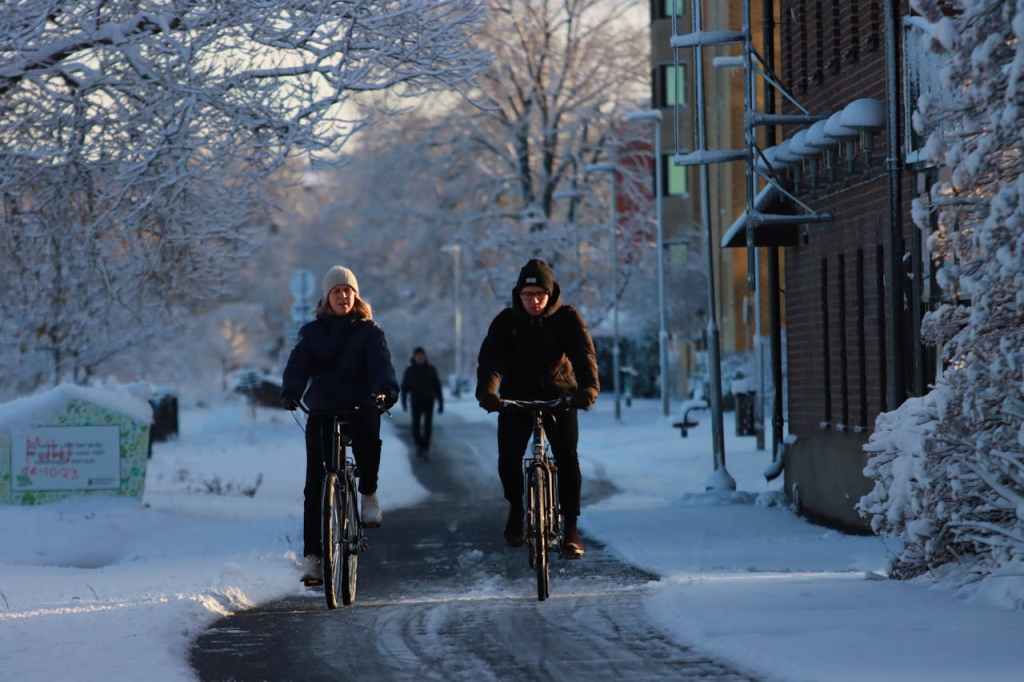
Two people biking on a bike path in winter. Everything, except for the actual bike path, is covered in snow.

The section that talked about the different cities in Europe that have enviable cycling infrastructure was fascinating to read. I empathize with the author’s struggle with not finding the perfect ‘silver bullet’ solution that can be easily copied over to North America, especially in cities that are much bigger compared to the smaller Scandinavian cities. A common pattern is those European cities is the practical normalization of biking all year long, which makes the seasonal switch to winter biking more manageable. The cities described made me realize the truth of the advocacy statement I’ve heard so many times here in Edmonton: build it and they will come.

As someone who doesn’t cycle, the chapters of the last section resonated with me the most. The author started to probe deeply on how pop culture and casual interpersonal interactions over the decades talk about winter so negatively. This I completely agree, and I find a bit frustrating. The pity that people cast towards me when I said “I walked less than half an hour to get here” is so intense. Music, media, TV, movies and songs definitely portray winter as harsh, relentless and something to escape from.

He argues that our negative impressions of winter are holding people back from something positive (or even practical) like winter cycling. I’d say that it is also holding people back from doing even just short walks in the winter! As an immigrant, I have had enough stories and warnings about how awful winter is, so this definitely tracks.

Edmonton had an initiative now for a few years called Winter City Edmonton, to encourage people to seek out interesting and exciting activities to do during winter, such as the winter festivals. And this year, the encouragement also had a different direction, to get people to do more of the typical fun activities but with a winter twist, such as going to a restaurant with a winter patio. I think that the next step should be encouraging doing everyday transportation while being prepared for winter, not wanting to escape it as quickly as possible. With heated cars (that even have heated seats and heated steering wheels), well-insulated buildings, and high-tech cozy winter wear might have contributed to people rejecting the notion of winter altogether, rather than having a practical mindset of it being a regular part of the day. This is what is needed to encourage people to have infrastructure to make walking and cycling manageable all year long. To quote the book when talking about cycling in those European countries “I found a similar practicality: winter didn’t seem to be the enemy, it just was.

I really enjoyed this opportunity to learn from a long-time winter cycling enthusiast what my husband went through, and what the passionate folks in the city are talking about. I know in a few years I would consider getting a bike again, but for now, I feel more informed in understanding where people are coming from, as far as the other transportation methods that don’t involve the car.

So thank you! I hope your biking this year, now that the snow is gone and I think we are past the second “false spring” is going well so far. Maybe my husband will see you on the trails or roads, and perhaps I also will in the future. I bet that if the Coffee Fridays YegBike community has a book club section, they would talk about this book. It’s safe to say, they probably already had.
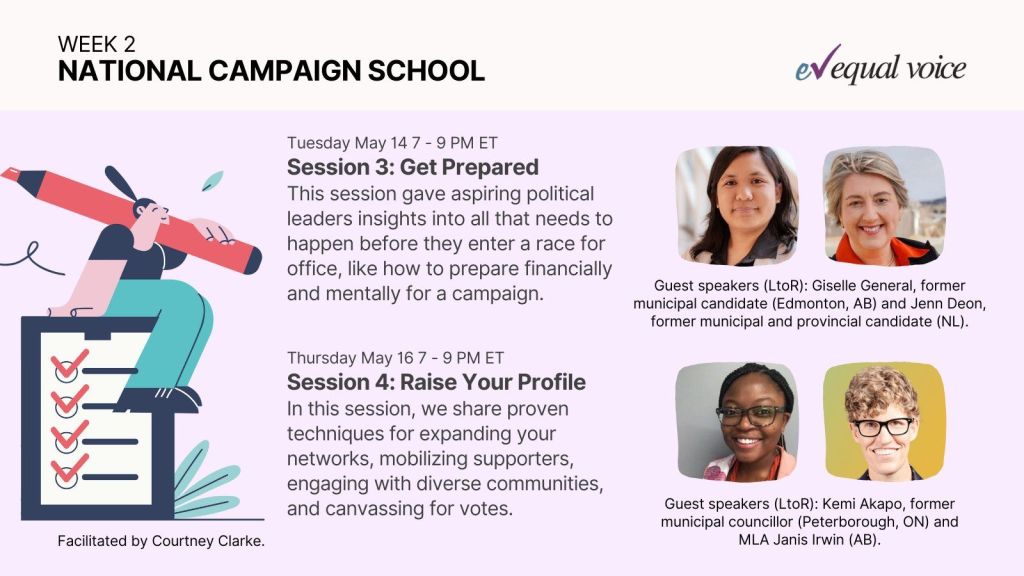
Recovering Political Candidate: I spoke at a Campaign School

By: Giselle General

I thought that being an election campaign failure – as in not winning the seat I was running for – would render my efforts meaningless. So it is to my surprise that I have been requested to speak to my experiences as an election candidate. I suppose there is truth to the saying that it is through mistakes and failures that people can gain the most growth.

I personally had benefitted from election campaign schools in the past, the first being the eight-month long program by the City of Edmonton back in 2017. The very local context of that program was really helpful for me as someone who was just somehow considering the idea of bring politically active at a candidate level. The experiences shared by the guest speakers then, many of which actually won, made the experience real and human.

Equal Voice is a Canada-wide organization helping women who want to run for politics or support those who wanted to do so. The first workshop I attended was hosted by the Alberta chapter of the organization. If I recall correctly, the Alberta chapter is no longer functioning, but the national organization continues to be active.

It looked like the other provincial chapters were super active as well. It was why I was so surprised when an organizer from the Newfoundland and Labrador chapter contacted me in October to speak to my experiences for their online election campaign school events. I was more than happy to share (maybe vent a little bit, haha) about what I did from 2018- 2021 to prepare for full-on election campaign mode leading to October 18, 2021.

Then in early April I heard from them again to speak on the same topic for their current campaign school. I guess I shared a few useful things last time, because the instructions I got were “just do the same things as last fall as you did great.” I’m really thrilled about the new options available now that online events are more frequent.

For those interested, here are my speaking notes, the longer version of what I shared .

  • INTRO: Even if you forget specific details, the main takeaways I’d like to share are:
    • Self awareness and using your strengths and skills as a foundation is very important.
    • Remembering there’s life after the election so consider your decisions accordingly.
    • All the things you do and life/ professional skills you have are all useful for the campaign.
    • Take inventory of your privileges and points of marginalization, being aware helps with planning and being compassionate to yourself.ย 
  • Conversations you had with your loved ones, your employer
    • Husband – Clearly defined role of my family members. For me, the campaign is NOT a family affair. There were some tradeoffs, but separating my campaign and family life from the get go was worth it for me. “I want to continue to be married after the election.”
    • Brother: I reassured my brother that it’s not as violent as the Philippines and (maybe) I won’t get murdered here. But if I do, my will, and life insurance, and organ donor card is up to date and they know what to do. 
    • Employer (Nonprofit Org): They knew I do a lot of community service and when I went to an election campaign school and all of my city volunteering, it’s just a matter of time. We discussed things such as what type of leave (banked vacation + some unpaid time off), how much (or little) should I publicize my employers name to protect their privacy (I didnโ€™t use their name), and duration of time off (2 months until end of the election month – I returned November 1). 
  • What kinds of things were you doing to prepare for your campaign, in advance?
    • 2021 was my first time running so it wasn’t like I had a strict guideline or a playbook. Also, COVID-related restrictions truly influenced my decisions. I wanted to behave as compassionately and ethically as I could, so I likely wasn’t going out in public right away compared to many people. 
    • Personally, with the things I did, I never had a political objective in mind. I never thought of “oh I will do this so that when I run they will think of me at the election” because frankly even now it feels sleazy to me. My focus at the time was to continue the things I already do that has some kind of public component and sharing about what I do and what I believe in regularly on social media. On social media I did the 70 – 30 rule. 70% re-posting and amplifying content I resonate and believe in, 30% posts about what I’m interested in or doing that aligns with my values. If there’s an overlap with municipal politics, that’s a bonus.
    • I also found community service that had the overlap of 1 – things I like, 2- things I am good at 3 – some level of public profile and 4 – some connection to the city or municipal matters. Transit board, neighbourhood board, multicultural journalism, city-focused nonprofit boards. 
    • The rest are tasks that helped me in my personal life that have a positive spill-over effect for running for office (as outlined below).
  • How did you save money and for how long?
    • Saved money for 3 years (up to $17,000) so I have savings to pay the full amount candidates can pitch for the campaign, and cover my entire salary when I’m was away for 2 months.  I did this from 2019 – 2021, $500/ month and the pandemic also helped cut my expenses. I’m doing this again. I’m a DINK household who is NOT passionate about travel. 
  • How did you grow your network in advance of putting your name on the ballot, and prepare your network for this political journey you were taking?
    • For me, given I’m an introvert, yes social media helped a lot. I know many candidates are community leaders that seem to be in every community fundraiser, picnic, gala and public event. And that likely increased their visibility. But that’s not who I am. Also in 2020, opportunities are more limited and I wanted to be – and still am – COVID-cautious. 
    • I learn about people who have different beliefs by curating my social media feed (particularly Twitter and LinkedIn) strategically. I don’t argue or shame them, but I **do** read the hot takes and the comments. 
    • Also, through paying attention to the local media here, including actually paying subscription fees for a local media startup, I have deeper understanding and awareness of local political issues.
  • Any appointments to be made, or tips for endurance, mental health, physical health on the campaign trail? 
    • I went to therapy (to address personal issues which in my case is sexual abuse trauma) and had therapy on an ongoing basis throughout the campaign. Fortunate enough to find free ongoing mental health resources. Need to search and apply and wait. 
    • Not commit to any political parties at a federal or provincial level. 
    • Not be ashamed of my lone wolf/ introvert tendencies. I worked with it, not against it. It saved me stress and angst. 
    • Share personal observations on the campaign trail – I talked about human but mundane things such as safety, bathroom access, accessibility in apartments, (lack of)  wheelchair ramps on most houses, taking the bus to carry campaign supplies around, etc. 
    • While it sounded like an exaggeration, I made a “extreme worst case scenario” list of what will make me cancel the campaign or prevent me from running (ex. me dying. my husband dying, our house going on fire and losing our home. either of us becoming bankrupt, amputated, drastically disabled, etc.) 
    • I also made a list of my campaign goals, with a realistic and dark side because of my reality as woman who is an immigrant, who looks Asian/ Indigenous, who is COVID-cautious, who cannot drive and has bladder and mobility issues. 1 – not die, 2 – not be in financial ruin, 3 – run a campaign based on my principles, with a combination of inspiring and education, 4 – win. 
  • Highlights, lessons learned on the campaign trail? Things you’d do differently the second time you run?
    • If I run again, I will do many of the prep I did from home and personally that helped me in 2021. I had very clear expectations and boundaries with my husband and with myself. (See tips above).
    • But I will be more careful of what I say on social media 2 years before the campaign period. I made a social media post about running for election and as a consequence, one of the boards where I volunteer asked me to step down from an executive (Vice President) position from that board. While I wasn’t actively campaigning yet, the risk of conflict of interest, real and perceived, is too risky for them. I was actually afraid I’ll be asked to step down, and that would have been bad for me as I’m the only Filipino member of the board and I want to stay and make an impact there. I continued to be a ‘regular’ board member and became an executive again after the election. But the timing of when you official share your interest in running, even if you are not officially on campaign mode yet, can impact your current community involvement. 
    • Employer conversations will be different this time around as I am a public servant now (work for provincial government). I’ll need to be a lot more quiet about it and know my work benefits and rights early next year. 
    • Maybe, using a language, timing and setting that resonates with my values of a “non politically smarmy politician”, perhaps I will share in in-person conversations more often that I will be running. It looks like there were some awareness gained in 2021 and there were offers for people to support more directly in the future. 
    • I will continue to have strict accessibility standards. So many people are still so ableist and don’t know how to produce accessible digital communication. I did it all and I’m proud of it. I’ll do it the same way again and not compromise on this. 
    • Remind myself again that THERE IS LIFE AFTER THE ELECTION, if I win, then that begins my journey as an elected official. if I lose, I gotta do the clean up, reporting and back to my former job and family routine at some point. Have a long term view of decisions you make. 
Between October 2023 and May 2024, some of my community positions have changed into former positions so I needed to make sure that my bio for the campaign school promotions was updated.

It seemed like the perspectives I shared were well-received based on the reactions in the smaller discussions and the follow-up email from the organizer. It was a great experience, especially for doing it the second time around, and if they invite me for a future talk or panel I certainly will do it again.

For those who wanted to run, it is a lot of work, and some of the things I did contradicted the other panelist’s experience. So take what works and make it your own.

The Unusual Birthday Gift I Gave Myself Last Year

By: Giselle General

Last year on my birthday at the end of May, I did something that I considered an unusual, but valuable, gift to myself. I officially handed my letter of resignation to the job I had for eight years.

Materially, my life is overall comfortable. Also I find shopping for items like clothes, cosmetics, gadgets pretty dreadful. Having to think of gift items for people to get me is the opposite of fun. Thinking of what to buy myself as a treat that need to be bought at a specific time of year is also pretty restrictive.

As my wages grew over the years, both from my employment and the honourariums for some of my volunteering and writing work, I try to be very mindful of lifestyle inflation. I didn’t want to fall into the trap of buying something just because I could. In the occasions where I do splurge, those purchases were made intentionally and with no guilt.

A big theme I’ve seen in how I approach my birthday is about giving myself something special of great non-tangible value. The trip I took in New York City in 2019 is my first overseas solo trip, granting myself the new experience of independence and rare unrestricted indulgence. The boudoir photoshoot I also booked a day before my birthday is to grant myself a new way of reclaiming my body and sense of self, a valuable thing for sexual abuse survivors like me. In 2020, I hired a freelance artist to recreate a piece of artwork I drew in 2013, granting myself a way to preserve precious memories and the enjoyment of collaborating with an artist. The drawing in particular was the memento I made from my first trip to the Philippines after immigrating, taking my Canadian (white) boyfriend in tow. In 2021, my self-gift was as simple as granting myself rest and family time as I started to ramp up my election campaign running for city councillor. Something truly in short supply and so precious for that period of time.

For my birthday last year, the plans to celebrate were straightforward and already confirmed. My brother worked night shift so meeting him separately worked better since typically dinner times happen when he is already on his way to work. The husband’s family will be coming over for a separate dinner in the home we just moved in to a few months prior. They planned to bring black forest cake. Perfect.

The only thing missing is the precious thing for me.

I talked to my husband about the idea throughout the month of May. This was not something taken lightly. The job search process over the past few months were not going so well, and I knew it is because I was not giving it the right energy and focus. Also, in the past, I was unemployed when I applied for that job I truly enjoyed for eight years. It seemed like I can only do one of these two things at a time: work full time or job hunt full time.

On top of this, I realized that I never had a full two-month summer break since before my parents died, which was the summer of 1999. Since 2000, my summer breaks consisted of working for most of it, either working in the store in the mining village in the Philippines, working in retail or placements during my university years, and then as a full-time working professional. As a child, since my birthday was the end of May, just right before the schoolyear begins in the Philippines, my birthday always marks the end of a notable period of time and the beginning of another.

I looked at my bank account repeatedly. I inspected the information in the budgeting software I used since 2017. If I were not to do anything extravagant or ridiculous, I can afford to pay my bills and save for retirement with no interruption, for quite some time.

This is the perfect timing for this reset.

When I woke up on my actual birthday which was a Tuesday, I was a bundle of nerves and certainty. I was working from home that day, in my home office where to my left was a wall of frames, including the employee recognition certificate I received for my years of service. The draft email was already in my inbox. And then I clicked send.

Just a few minutes after, I got a message through our internal chat software. It looked like it came as a surprise. Then emails and video calls took took place, with strategies and decisions to make the most of the one-month resignation notice.

Since we had a hybrid work arrangement still, my office was not as decorated as it was. Packing up any remaining personal items was easy. The last month of work flew by, as I eagerly waited for my last day of work, just right before Canada Day long weekend.

After the long weekend, my relaxed summer break began. Nothing changed in my evenings as I kept all my volunteer commitments. I also wanted to spend the same amount of time with my husband so I kept my sleeping schedule the same. But the time period that is labelled as the typical weekday work hours from 8 AM – 5 PM, were all free and flexible. It felt eerie but not as slow as I expected. Boring and lazy and unstructured was exactly what I’m looking for and what I got. It was quite remarkable.

In the middle and end of the month, when I paid my bills, rent or the automated deduction for my retirement savings got taken out of my bank account, I relished in the feeling that I didn’t have to work during that current week to pay for it. My past self (and of course my husband) helped make this comfortable period of time happen.

When September long weekend arrived as well as back to school for students, I knew this free time was up. It is time to be a responsible adult again and actively work towards finding my next job. I knew it will take months from applications, to interviews, to the offer and a starting date. As fall came and went, the pressure crept up a bit more. Thankfully my husband consistently and patiently put my panicked thoughts into perspective.

In some career-oriented articles, I’ve heard of people talking about the benefit of taking a break, sometimes they call it a sabbatical. The type of break for a working professional where they won’t have to worry about financials, but are able to not work full time to rest or try something different. I didn’t name it that way back in May 2022, but it looks like a two-month sabbatical and life reset is what I have gifted myself. One can argue that it was quite expensive, if not the most expensive gift I have given to myself. My living expenses were $3,500 a month and I didn’t find employment until six months later.

It was wonderful and definitely worth it though. Something that is hard to give or get for someone like me with extreme workaholic tendencies. The gift of rest, of reset, of leisure, of personal flexibility. I hope that I can do it again just a few more times during my prime career working decades.

Community Resource Article – When Debt Issues Arise

By: Giselle General

This article was also submitted by the author as a contribution to the Alberta Filipino Journal (a cultural/ community newspaper in the province of Alberta, Canada) in June 2022.

Managing oneโ€™s finances is an important responsibility in order for us to have a comfortable life. But sometimes, unexpected things happen, and we find ourselves in a difficult financial situation. Perhaps the bills, mortgage, rent or credit card payments were left unpaid too many times and things have escalated a bit. Perhaps you are about to lose your home, or received a court document, or been subjected to aggressive phone calls or messages from those who want payment.

Here are some resources that can help when financial problems turn for the worse.

When Financial Debt Requires Legal Help

  1. Consumer Debt Negotiation Project Program โ€“ Edmonton Community Legal Centre: Many of us have consumer debt, such as credit card payments, car loans, personal loans, even a mortgage. You might be falling behind on payments, and you discovered that there is a legal action that happened, letโ€™s say, you received a court document from the bank or the company you owe money to. You can contact this free program so you can get an opportunity to speak to a lawyer to get help.To contact this service, to go the website https://www.eclc.ca/need-legal-support/ and then click on the box that says โ€œFor Consumer Debt Negotiation Projectโ€

Emergency Financial Supports

  1. Community Bridge Program: Funds To Prevent Getting Kicked Out by Landlord: If you are renting the place where you live right now, and you fell behind on rent payments, it is likely that your landlord would want to evict you. Getting kicked out of the place where you live can be very stressful and disruptive. This program is a financial โ€˜rapid responseโ€™ as a last resort so you can stay in your place and make payments you missed. The link to access this program is https://bissellcentre.org/programs/individual/community-bridge/
  2. Emergency Needs Allowance โ€“ Government of Alberta: This is a program direct from the Alberta Government for when you face an unexpected emergency that can present a health risk and caused by unexpected circumstances that you cannot pay for. It can cover a wide range of needs such as food, clothing, childcare, temporary shelter, utility payments, eviction payments and more. The link to get more information and how to apply is:    https://www.alberta.ca/emergency-financial-assistance.aspx

Financial Literacy โ€“ Learning about Money Management

  1. Credit Counselling Society โ€“ Online Courses: This is a self-paced online course that focus on financial management skills such as learning the realities of credit, budgeting, spending on food, and more. In addition to the online courses, they also have other ways to support when you are currently facing financial difficulty. https://nomoredebts.org/financial-education/online-courses  
  2. Each One, Teach One: This program is designed for bankers to deliver basic financial literacy workshops to newcomers, refugees, individuals who face barriers to financial services, and people living in low-income communities, in a โ€œteach the teacherโ€ type of format. It is comprehensive, as it covers topics beyond just budgeting and debt, such as investments, contracts, and fraud prevention.  https://www.myunitedway.ca/each-one-teach-one/
  3. Money Mentors Financial Education: Money Mentors also provides services to help people in financial difficulties, and they have also educational content on their website. The catalogue is even more comprehensive than the other two, addressing other complex but common issues like preparing financially for a baby, having unpredictable income sources, home ownership, money discussions in inter-generational households, and many more.   https://moneymentors.ca/financial-education/  

This is not an exhaustive list, but I hope that this is a useful starting point. After you contact these resources, it is possible also that they might recommend other programs and services to help with your situation. Having financial issues can be stressful and embarrassing, but a lot of the time, the staff and volunteers that are part of these programs are understanding and compassionate. When contacting them, I highly recommend sharing all the necessary details and not leave out information even if it feels shameful. Complete transparency is important for them to understand your compete situation in order for you to get the best help you need.

Community Resource Article โ€“ Opportunities to Volunteer

By: Giselle General

This article was also submitted by the author as a contribution to the Alberta Filipino Journal (a cultural/ community newspaper in the province of Alberta, Canada) in April 2022

In hounour of National Volunteer Week which is on April 24, I would like to share some opportunities and resources when it comes to volunteering. A short definition of volunteering is doing a task where you are unpaid, or paid a very small amount that it wouldnโ€™t fit the minimum wage requirements, that supports a charitable or community-oriented objective.

This is a very small list of the thousands of opportunities available, but the ones Iโ€™d like for our readers to consider.

Right In The Neighbourhood and the City of Edmonton

  1. Community League of your Neighbourhood: โ€œBayanihan para sa kapitbahayโ€ is my simplified description of community leagues. Being helpful toward our neighbours, is the spirit of the neighbourhood Community League. Much like a people-run barangay association, your community league is a volunteer-based organization in the neighbourhood that helps plan social events, help advocate for issues in your neighbourhood, and at times they might have a hall where they maintain some local amenities. To know where you community league is, go to the website of the Edmonton Federation of Community Leagues: www.efcl.org
  2. City of Edmonton Volunteer Catalogue: The City of Edmonton, as in the actual municipal government, offers many services to everyday Edmontonians. For some of these event or programs, there are ways to volunteer and help! I personally have been a greeter for the cityโ€™s Free Admission Day in a local tourist attraction, and I have helped plant trees in a large park one summer. The link to set up your account and apply is: https://app.betterimpact.com/PublicEnterprise/9e275823-c9e5-46df-a092-b2c5b18d2526

Volunteer in the Filipino Community

  1. Edmonton Philippine International Centre: The goal of this organization is for the Filipino community to have our own building as a gathering place, event space and place we can go for support and connection. This is a remarkable and ambitious goal and help is needed from as many people as possible. The website to learn about them is https://www.epicalberta.com/
  2. Migrante Alberta: This is an organization that does advocacy work to help better the lives of migrants in our province. Helping hands and attendance is always appreciated in many of their activities, whether it is to lobby the government to address certain policies, events to help educate the community, or providing direct assistance to our fellow migrants in crisis. https://www.migrantealberta.ca/
  3. Organizations under COPA and CEFA: Congress of the Philippine Associations of Alberta (COPA) and CEFA (Council of Edmonton Filipino Associations) can be an opportunity to be more connected to the Filipino community, whether it is by helping these organizational bodies, or finding an affiliate association in the group. Both organizations are searchable on Facebook. 

Interest-Oriented Opportunities

  1. Next Gen Men: Their mission is to have โ€œa future were boys and men feel less pain and cause less harmโ€. If you are a parent, a community member or someone keen on ensuring men and boys are supported in their development as physically and emotionally healthy individuals, getting involved with them might be a good idea. https://www.nextgenmen.ca/
  2. Political Parties and the Provincial Elections: The provincial election is next year, and volunteer opportunities are available to those who want to either a candidate running under a political party name, or a political party overall. If you do an online search for your location and for a political party you are interested in, there will be opportunities to be hands on in making the change you want to see and thatโ€™s on the ground level of election season.
  3. Big Brother Big Sisters: For those who enjoy working with kids on helping them, this organization can be a great way to volunteer. There are different programs, from one-on-one mentorship, after school programs, and even virtual mentoring. https://bgcbigs.ca/ pexels

There are numerous ways to volunteer and the benefits are mutual, not just for the people or organizations being helped, but also for the person volunteering. Volunteering helps someone gain new skills, maintain positive mental health through socialization and positively impacting another personโ€™s life, and can also lead to other career and learning opportunities.

Community Resource Article โ€“ Supports for Women

By: Giselle General

This article was also submitted by the author as a contribution to the Alberta Filipino Journal (a cultural/ community newspaper in Alberta, Canada) in March 2022.

These are some community resources that can help provide programs, inspiration, physical and emotional support and more for the women and girls in your life and community.  

Supports for Young Girls and Teens

  1. YWCA Girls Counselling Group: The counselling group is for girls aged 14 โ€“ 16, a crucial time in oneโ€™s teenager years, and is a weekly drop-in program. It provides a safe, and structured space for teens to discuss the challenges they are facing, get guidance, support, and a listening ear from the facilitator who is a Registered Psychologist. In addition, YWCA also offers other services for women of all ages.https://www.ywcaofedmonton.org/programs-and-services/girls-counselling/
  2. Terra Centre for Teen Parents: An unexpected teen pregnancy can be daunting and stressful, but there are supports for the teen parents, the babies and their families. The agency provides programs and practical items to help young families reach their full potential.  https://terracentre.ca/what-is-terra/
  3. Girls Who Code: The goal of this organization is to inspire and support girls and teens into considering a career in technology, where women are still very under-represented. This can be a worthwhile resource if you work with children or youth in educational settings, or if you want to support girls in your family who loves computers, programming, engineering, robotics and more. https://girlswhocode.com/en-ca

Resources on Womenโ€™s Health, Including Reproductive Health

  1. Re:Pro, Podcast on Sexual and Reproductive Health: This podcast series launched by University of Alberta medical students are meant for those reproductive and sexual health questions โ€œthat you are too embarrassed to talk to your doctor aboutโ€. Listen online at https://reprohealthpodcast.libsyn.com
  2. O School, Online Resource on Sex and More: This online resource was founded by Filipina-American Andrea Barrica. She believed that no one else should have to struggle to unlearn sexual shame resulting from incomplete education growing up. Sexuality is a natural part of human lives and relationships. The comprehensive online resource covers the medical, practical, relational, and pleasure-focused aspects of reproductive and sexual health. https://www.o.school/

Resources for Leadership, Community and Career

  1. Alberta Women Entrepreneurs: They provide programs, events, and practical supports such as loans for women who want to launch their businesses and make it as successful as possible. To sign up, visit https://www.awebusiness.com/
  2. GROW Women Leaders: GROW Women Leaders launched in 2017, in celebration of Canada 150 out of the desire to spotlight incredible accomplishments of immigrant women in Canada. Now they provide programs and events to help immigrant women advance in the workforce. To get involved, visit https://www.growwomenleaders.com/
  3. Changing Together, A Centre for Immigrant Women: This charitable organization provides programs and supports for immigrant women, both citizens and newcomers to Canada. They also conduct research and publish content that highlights the challenges that immigrant women face, in order to spread awareness and bring change in the community. To join in their programs or volunteer, visit https://www.changingtogether.com/  

This is not a comprehensive list but can be a good starting point to let you know that there are resources that are available in time of need and to help you improve your life. It can be helpful to access services that have more comprehensive directories like 211 to learn about all the services available.

“Matanim ay ‘di Biro!” On Indoor Plant Care

By: Giselle General

Magtanim ay di biro, Maghapong nakayuko, Di naman makatayo, Di naman makaupo! (Planting is not a joke, as you need to bend over all afternoon, you cannot stand, you cannot sit!)

This is a folk song I remember learning as a child, about the hard work that is required to plant rice in farming fields. While I personally haven’t experienced that as a child since I grew up in a mountainous region in the Philippines before coming to Canada, it got instilled in my mind that care for plants is a serious and important thing.

Potted plants were a common thing in the homes where I lived in both countries. They came in different forms: an outdoor plant box, milk cans or clay pots for indoor plants, or just a raised garden bed right by the stairs leading up to the house. But plant care in Canada was a whole different ball game since the drastically changing seasons dictate what, when and how plants need to be care for.

I started paying more attention to indoor plants in the places I lived in, when I moved in with my then boyfriend, now husband. In his condo, he had one potted plant that he got from his mom as a housewarming gift. It’s one of those generic types of plants seen in many people’s homes. He had a nickname for it that stuck, Mr. Plant. We found the perfect spot for it, right beside the narrow living room window, perched by the edge of the TV stand. It was relatively low maintenance, watering it once a week and not putting any fertilizer was enough for it to survive long enough for us to take it to the house we moved in to in 2015.

That house came with one plant that was hanging by the stairwell ceiling, so we nicknamed it H. Plant, and yes H stands for “hanging”. We watered it regularly but didn’t put fertilizer as we never got into the habit of it. When there were a few leaves that were dying, I’d cut them off and put it in the pot, hoping to myself that it can be somehow a fertilizer substitute. I thought, it’s organic material, right? We also inherited an Aloe Vera plant from our friend, after their then newly-acquired cat kept on attacking it, which we aptly nicknamed A.V. Plant. It’s quite obvious that we name things in a practical, not creative way. We got a few other small pots of plants that didn’t survive as long, such as the one I got as a wedding gift, and one free pot I got from work for Earth Day.

A plate of spaghetti with homemade pesto sauce.

Sometime later in the year 2021, when we were shopping at Costco, my husband decided to take an impulse purchase, which is very rare. He decided to get tabletop Aerogarden, which is a techy pot for plants that uses water, fertilizer, with buttons and a digital screen to remind you to add water, change water, put fertilizer, and more. This was set up for planting herbs. I was at first skeptical of it, but the husband seems eager to try it, and promised to be on top of the maintenance. And it worked! Some of the plants grew early and quickly, and I had to keep up with trimming and harvesting the herbs and integrate them in our meals. That has been pretty fun, and delicious! The best part for me is being able to make homemade pesto with the very healthy basis plants (both Genove Basil and Thai basil) that is tasty and nut free. The dill has died and we tried to put a root of a spring onion and it also worked!

As a couple, we’ve never really been the type to pick plants for our house because they are pretty. We were so low maintenance and unmotivated to put plants in our front lawn and backyard in the bigger house we had! But the Aerogarden sparked a new interest to plant things that are more of a win-win for us, healthy because of better air quality inside the house, and healthy because they are edible. In Edmonton, there’s also additional conversations about edible gardens in outdoor settings. More people are setting up fruit and vegetable garden beds and pots in their front yard, more neighbourhood groups are setting up community gardens (including my own), and the city is helping those who want to put edible food plants in trails and neighbourhood ponds.

In addition to increased conversations about planing for sustenance, there’s also more encouragement towards planting outdoors with a goal towards naturalization. As in, planting pants, shrubs, bushes that are native plant species in the area, and in a way where mowing won’t be necessary. I thought that there’s merit to the idea, and I’m eager to see more people take up on it. Now that we moved to a townhouse with a very small patch of dirt under our property lines, I don’t think we’ll be able to contribute much to this idea. Overall, it’s pretty neat to see what captures people’s interest in plant care in their homes and immediate surroundings!

The Latest Sexual Assault Nightmare

Close up of a person's eyes looking afraid

By: Giselle General

Trigger warning: Trauma flashbacks, nightmares, violent sexual assault

I’m sharing this in time for Sexual Violence Awareness Month, which is in May. If you have experienced sexual violence, there is help. This is just one of the many amazing organizations that can provide support and healing. https://www.sace.ca/

On Easter Sunday, my husband and I decided to go to bed like it’s a regular Sunday. He is working the next day while I have the day off.

Sometime in the middle of the night, I had a horrific nightmare. Having nightmares related to sexual assault is not new to me, I’ve had them on and off for a few years. But this was such an expected curveball.

I was captured, together with other people, in what looked like a room in a building located in the mining village where I grew up. There were no other clues or signs that indicated where I was, just the people I was with. I was with N (a childhood classmate), his mother C and a few people whose faces I can’t figure out.

Our captors look like soldiers, and they were rounding up the people they have captured. I don’t hear any sounds from the others, because I was paralyzed in horror as I realized what they were doing to the younger women like me. The soldiers were taking turns raping them.

And then, came my turn. My vantage point shifted from what was happening around me to just seeing how my face, my eyes looked like. I can’t tell who or how many men were violating my body. I can’t tell where it hurts, what body parts or tools were they using. Did they have a gun pointed at my head? Were they yanking my hair so they can access my mouth? Am I getting struck by sticks, ropes, or knives? Was the pounding in my vagina or anus so rough my body shook uncontrollably? I don’t know, I couldn’t tell.

From my vantage point, I see just my head, sometimes bouncing and shifting in direction, likely because someone or something was ramming inside me. Am I lying down, am I tied up, am I sitting up, am I being straddled, carried or thrown around? I can’t tell.

Everything around her face – my face – was fading away. And my eyes – her eyes – came to focus. And I know that look. The flash of horror from knowing what is about to happen, then the silent scream of taking in all the pain happening all around my body inside and out, and how much being violated is ripping my soul. And then, the resignation and escape, when the brown of my eyes lost sparkle and life, still wide open but fading into dullness and numbness. My head bounces more roughly, the invasion getting frantic. My mind trying to tell me “he’s almost done, it’ll be over soon”.

The next thing I know, I’m thrown into the ground, my body naked, grime and mud on my arms, legs and knees, my belly feeling hollow and raw. I lay them stunned for a few minutes, and then I tried to crawl on my hands and knees, forcing myself to sit up. As I painfully manage to do so, I look down between my legs. There’s a pool of blood on the dirty floor, slowly growing in size.

I frantically crawled to the end of the room, where my fellow captives were. I locked eyes with N, who was sitting beside his mother. As I get closer to them, C had a good look at my battered, broken body and my lifeless eyes. She then pulled my in her lap, the way a mother would for her child. I scrambled to touch the blood still coming out from between my legs and weakly asked “I’m not that broken, am I?” She said “no you’re not!” and pulled me closer, as if giving me permission to seek refuge in her arms. I crawled closer to her lap, and wept.

Silhouette of three Soldiers Walking

And that’s when I woke up, shaking, crying and breathing hysterically. It shook the bed so much that it woke my husband, who swiftly took me in his arms. This is nothing new to him, although I can tell for sure, the first time in at least a few years.

What’s even more messed up is that it’s not the sexual assault that distressed me so much to wake me up. It was when a motherly figure, one that I don’t have anymore, tried to give support and comfort. The reminder of what I don’t know, of what I will never have again, is what hurt more, enough to shake me awake.

It wasn’t until the morning when I was about to prepare for lunch, alone in the house, that I realized that it has been fifteen years since the sexual assault incidences that happened to me took place. It felt like so long ago, but at the same time, it doesn’t.

Another realization that made me pause is the gruesome scene that came in my dream. The sexual abuse I experienced was with a known person, and involved more blackmail and quiet threats. No tools, weapons, or violent physical injuries occurred. I think that subconsciously, the knowledge that rape and sexual abuse are common tactics in war came up on the surface that night.

During that week I had a surprise. Turns out, my next therapy appointment is for that upcoming Sunday. It was a relief knowing that I’ll have my phone call in just six days instead of thirteen. Telephone therapy went well overall, and this was the last thing I brought up. He confirmed something he had said in the past, the reality of how trauma works. Triggers can be unexpected and can pop up anytime, and it will affect me in varying degrees for the rest of my life. Hearing this a few times in the past, it feels more reassuring every time. Because it means I’m not flawed or weak or bad for having reactions to these again.

But with all that said, I’ll be glad if it is five years or more before I get a horrific nightmare of this sort!

Telephone Therapy Appointments: 3 Tips

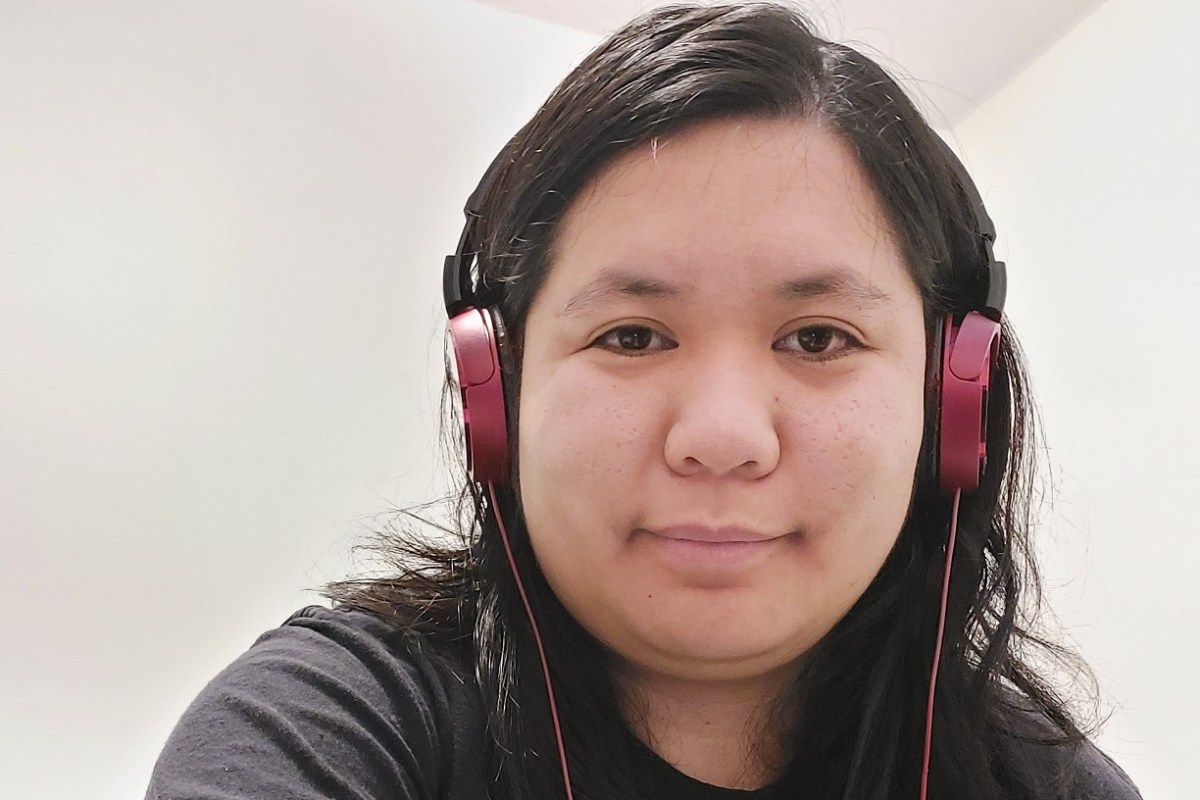
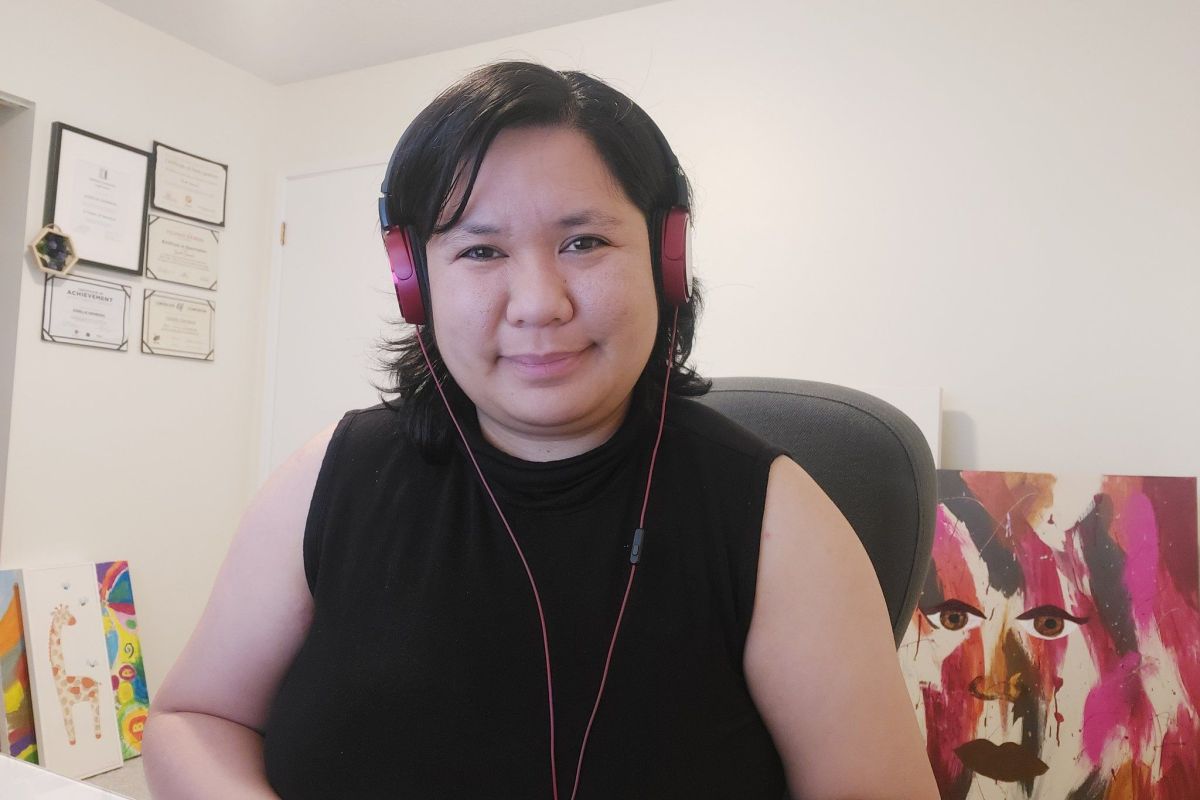
Giselle wearing a black T shirt and red headphones

By: Giselle General

Therapy, the mental health kind, is something that I have been doing on and off since 2017. It’s remarkable how much time has passed since I first experienced going to a centre with a business-and-clinic vibe waiting room, and sitting in a cozy office with a couch-like chair and chatting with a professional with a clipboard.

Due to the pandemic, I had my first opportunity to do a few virtual therapy sessions with someone I’ve met in person a few times. It worked out well because I’ve met her in-person many times before, so there is a rapport and a baseline of trust.

Now, I’ve been having appointments on a regular basis with my latest therapist for the past two and a half years now. This doctor, I’ve never met in person at all! The primary format of their mental health service is telephone appointments, so video meetings were not even an option. When I asked my family doctor’s clinic to be referred to this service though, I know I needed regular and ongoing mental health support without worrying about whether I’ll ran out of appointments.

Here’s an overview of my top three tips on how to make telephone therapy appointments as successful as possible.

First: Mindset and Expectations

Telephone therapy appointments, in terms of actual logistics, is different in many ways compared to virtual or in-person therapy.

The lack of opportunity to see facial expressions or nonverbal cues is a disadvantage. They will have a difficult or impossible time telling whether you are lying or withholding information. So in my opinion, this is most suitable for someone willing and able to be more forthcoming with their struggles. I think that telephone therapy can help a lot with issues that are not an escalated crisis.

For those that might have trouble being too vulnerable in a closed off space like an office, or might even have trouble with being honest when someone is watching their face, then telephone appointments can be advantageous. It can help someone be more up front because they don’t have to be afraid of seeing their doctor’s facial reactions immediately upon hearing their comments or stories.

Second: Preparation

It’s best to establish a physical space where you would speak to the therapist in private. Tidying or re-organizing the space, whether it is the desk and chair, a bed, living room, dining room can help you focus on the important and vulnerable conversations that is coming up.

Charge your phone and ensure it is 100% and ensure your headphones, if you’re using one, are nearby. I personally prefer having headphones because it keeps my hands free to do other tasks.

Now here’s where telephone appointments have advantages. If you think you would need to fidget, you can do so – just have your fidget items right next to you. I tend to write notes and the doctor’s advice during the appointment, something I haven’t done in in-person appointments since it just feels so awkward to me. You can have a drink of choice instead of just water if you want, like tea of coffee or smoothie. Although for myself, water has always worked.

I highly suggest preparing the topics you would like to talk about. During the initial appointment, when the therapist asks the awkward and important question “what brings you in today?” be prepared to say the difficulty you are having and a short summary of the backstory. So for me, for one of the things I need help with I said “I am running for elected office next year and will be starting a lot of work in a few months, so I am asking for help on an ongoing basis to deal with stress during this period of time and managing my real fears from being an immigrant, minority woman who might be attacked and hurt”.

If it is a follow-up appointment, the first two will likely be follow-ups or updates on previously discussed issues, and if there are any, one to two new things you’d like to talk about. I usually write this on a notepad, with space in between the points I wanted to talk about, to write any insights, advice or next steps most relevant to the topic.

Third: Appointment Day

It’s appointment day! Your supplies are ready, phone is charged and you are on your way to the private quiet space you picked for the phone call. I treat it as seriously as going out to an actual appointment, so I feed myself a good meal, wear ‘going out’ clothes but more comfortable versions (like a nice swater and slacks) but I skip the shoes.

I also give myself a small window of time to be the commute or the waiting room time, just about five minutes. My husband has been understanding about this, so he leaves our bedroom, I lock the door and he goes way to the other end of the house, like the living room, to be out of earshot.

Another benefit of telephone appointments is because no one will see you, you can be as visually expressive as you need to be. You can flail your hands while explaining something that’s upsetting. You can roll your eyes when the doctor says something that makes you react “duh, why didn’t I think of it that ways before?!” You can switch what your hands are doing between fidgeting, typing notes, or wiping tears and snot off your face. I typically write down a few bullet points for each of my concern that I can categorize as follows: insights, counter-points, action items.

One thing I strongly advice against is multi-tasking. No social media or emails or chores during the appointment. Since it is likely that the impact of a telephone appointment is slightly diminished from not interacting face to face, multi-tasking and getting distracted makes it worse.

Finally, after the appointment, give yourself at least five minutes to take a breath and process. Those few minutes right after an in-person appointment, when you walk out of the lobby out of the office to start traveling home, are helpful for a reason. Especially if it is an emotionally heavy conversation, it helps your mind settle a bit before you resume with the rest of your day.

A woman with a short haircut and brown and white sweater, on a phone call with her cellphone and writing on a notepad on her desk.

After each appointment, same principles apply to in-person or virtual appointments. If there is homework or readings or activities that were asked of you to do before your next appointment, do them as diligently as if they told you in person.

Just like any other way of getting support for one’s struggles, therapy will likely not be enough to help solve one’s trauma and past hurts, so I suggest thinking of the methods of therapy the same way. It’s okay to patiently put up with the realities of telephone therapy and then switch to your preferred methods at the first opportunity. But who knows, maybe the conveniences of telephone therapy can help you access it on a more frequent basis so that it can help with your self-improvement goals.

My “Turning Red” Story: When I Got My First Period

Scene from Disney Pixar Movie "Turning Red". Mei, as a red panda, looks at her reflection in her home's bathroom mirror.

In honour of the soon-to-end International Women’s Month, and in appreciation of the recent Disney Pixar movie Turning Red, I’d like to share the memorable and also a bit scary experience I had when I got my first period.

By the way, I got mine when I was in Grade 5, at 10 years old. So for those who argue that getting periods is not a topic for children, this is something that kids experience all the time!

As a storekeeper of a sari-sari store, I’m familiar with menstrual projects, which we nickname “napkins” in the Philippines. I noticed though that when kids come to our store to buy them, they always asked that it be wrapped in newspaper, or in an opaque plastic bag that conceals what is inside. When I ran out of newspaper, I’d use the cardboard from a 10-pack of cigarettes, or a bag from a wholesale pack of candy or bubble gum – those things are thick and brightly colored. During the movie, when Mei’s mother was putting different types of pads on the bathroom counter while describing them “regular, overnight, scented, wings…” it make me chuckle.

Just like most of my weekends, I was left alone watching over our little store in the mining village where I used to live at the time. Grandma (Lola Aleg) left for the day, to go to the city to get products for the store. Or is it for a while weekend or week? She’s gone so often I can’t keep track.

It was early in the weekend, when my mischievous self was tempted to sneak a chip bag from the store inventory as a snack for myself. It was 10 AM so the electricity for the whole village was shut off for a few hours already, an austerity measure that the mining company introduced a year ago. If I needed to go to the bathroom which is in the basement of our little store, I have to very carefully head down the ladder and do my business in a tiny room that is almost pitch black.

I went to the bathroom and in the faint light coming from the window, I saw something very wrong in my panties. I thought to myself, OMG! I can’t believed I pooped my pants without even knowing! This is what I get from sneaking too many snacks from the store display. It was sticky and brown, but surprisingly not as smelly as poop normally would. I hurriedly changed into clean underwear, fumbling in the dark where my underwear bag would be, worried that a customer would be calling from the storefront upstairs.

Then 4 PM comes around and electricity is back in the village. I went to the bathroom again to checked if there’s anything unusual in my underwear. This time around, there’s no mistaking it. It’s liquid, it’s sticky, it’s red – it’s a period! I hurried to try to wash both panties with water and bath soap, as I didn’t know how to clean blood off of fabric then. We learned that later in the school year.

I honestly can’t remember whether I told my grandma that weekend or sometime later. It wasn’t until six months later that I had my second menstrual cycle. This I wasn’t surprised about, as we learned about this in health class earlier in the school year. We also had a school assembly shortly before my first period, from one of the multinational companies that sell household items, including menstrual products.

What I do remember thought is that once I started having acne, lola told me many times on how I missed out on one of the most effective ways to combat acne. She said, I could have used the underwear when I had my first period, lightly wash off the blood but not completely clean if off with laundry soap, and with the part of the panty that had some light menstruation blood residue, to dab it off my face where pimples are popping up. The things was, she said, is that it needed to be from my first menstrual cycle. Looking back now, it sounds kinda nasty, but I understand that she grew up in a rural area in the 1930’s – 50’s. My brother and I weren’t spared from other old-fashioned methods to address various illnesses growing up.

Thinking back now, there were so many things that I wish I learned about how menstruation works. Dealing with cramps every month was a common experience, but I learned later on about how it can be debilitating for other people – as in blacking out or being nauseated in pain. I wished I learned earlier on how having sexual intercourse works during someone’s menstrual cycle. Turns out, it is messy, but doable and pretty satisfying – as long as you and your partner have prepared to clean up afterwards. I wished I got adequate information when I was exploring birth control methods, so I can better differentiate what is “expected spotting”, “usual menstrual cycle discharge” or “excessive bleeding” when I adjusted to having an IUD implanted in my uterus. It took one year for my frequent bleeding to stop and I’ve had an IUD in me for 11 years, that I might have a learning curve on how to put on pads again. Maybe I’ll just skip those altogether and go with a Diva Cup or those fancy new period panties.

Compared to years past, I think that available information about puberty life and other life milestones is getting better now, thanks to access to online information, being referenced in mainstream media, and professional content creators. I hope that for kids, teens and their families, that such experiences are something that is anticipated and informed about ahead of time.