Story Time: When I Chased Around My High School Principal

Four high school students in uniforms, standing in front of the classroom by the blackboard,making silly hand gestures.

Halfway through high school, I had to move to Baguio City, Philippines from the mining village I grew up in that was an hour away. The adjustment was a bit rocky, from having an actual travel commute from my home to the school, being hands-on again with caring for my little brother, and living with my grandmother and my cousin. It was a drastic switch from living alone to living with people.

I was motivated to do well in my new school, the prestigious “Boy’s High” in the city. We were the first batch of co-ed students for the school and it feels like being observed with a microscope all the time. It was an awkward adjustment for everyone, from teachers, the upperclassmen, and students. Seeing students with long blouses, vests and skirts as uniforms was a new sight, as well as female students taking leadership positions in various extracurricular activities.

When I found out that there was a school newspaper, I was thrilled! I joined right away, the new student who is a bit older than some of those who have been part of the club for a few years since their freshman hear. My first task, interview the high school principal for an article. Sounds intimidating, but sure, let’s do it! For context for non-Filipinos, students have a heavy sense of respect and fear of school teachers and administrators.

Our school’s layout was unique, with a road cutting between two areas: the main campus, and the annex campus. When the school switched into a co-ed format, enrollment numbers increased and as a result, a new building was built. The principal’s office is closer to the entrance of the school, on the main floor of the first building of the Main Campus area. My homeroom classroom is also on the main floor but on a separate building, one of the only two classrooms across the open basketball space that housed the chemistry lab, the library, the medical clinic, and the nurse’s office.

I prepared my questions and walked right into the principal’s office, tried to ask politely and in English, on whether I can interview the principal for the school newspaper.

The office secretary told me to come back a few days after during the lunch hour, about 12:30 PM, so that there is some time when I’m not in my class for us to speak. I came to the office and her secretary said that Mrs. Robles is not available, she might have forgotten our meeting, and for me to just try to stop by the same time the next day.

And then, the third time around, I managed to see the principal in her office but she was not available for the interview. She looked at me and said, “you are a determined student, Miss General”. I wondered then if she ever had a student relentlessly ‘chase after her’ before. So we found another mutually agreeable time to have an interview, and I managed to complete my article for the school paper.

This was my primary way to adapting to the new school, immersing myself in academics and extracurricular activities, an attempt to replicate what I used to do. It paid off in many ways, from graduating as valedictorian, getting asked to compete on behalf of the school for competitions which meant a day off from school, free fancy food, and a default 100% score on any quizzes I miss while competing, and a sense of value in myself.


The Process of Checking my Privilege: A Filipina-Canadian’s Perspective On COVID-19

At this rate, it would be just over three months since drastic measures have been implemented here in Edmonton to mitigate the effects of the pandemic. Given my line of work, my tendency to get involved in the community, and how I stay connected on social media, I get to witness how different people react, respond, and adapt to the current situation.

Checking My Privilege

The first time I heard this phrase thrown around, it gave me mixed feelings. Since, in many ways, I am not part of privileged groups. I constantly heard about the many ways that women are mistreated (which is true), how migrants are disadvantaged (which is also true), and how my plight as an orphan is tragic and pitiful (which, let’s face it, is also true in many ways).

But after participating in a few activities that encouraged people to check their privileges in all aspects, I had a more complex perspective and better appreciation of the idea, including things that are most certainly beneficial and not everyone has access to for no other reason that location and circumstance. Here’s a short list:

Public Transit: The fact that there is still transit service in Edmonton is a huge deal, since in places like the Philippines, many people are unable to go around since all public transportation is banned due to the lockdown. On top of that, public transit vehicles here are buses, which a nice and large vehicles and there is ample space to spread out and stagger seats for passengers. The LRT is also still operational which is wonderful! And, the icing on the cake, is that for some time paying public transit fare is suspended during this time. That’s quite incredible!

Person wearing white shirt soaping hands with white bar of soap

Access to Information: The ability to read, write and hear, particularly information written in the English language, ought to not be taken for granted during this time. Most of the government announcements and health information is in English. This came to light after a fellow Edmontonian who is involved in the community, was asking for donations of printing paper so she can print information about COVID-19 in languages like Urdu, Hindi and Punjabi. Another spotlight came from advocates for those who are deaf and hard of hearing, pushing anyone who product digital media these days to ensure that accessibility tools are the default. A volunteer in my office posted on Twitter, saying that being blind, info-graphics are useless, and photos don’t work well if there are no alt-text descriptions.

Uninterrupted Access to Utilities: I’m talking about water, internet, electricity and heat. I’ll say this over and over because it cannot be underestimated. It’s definitely more comfortable to stay in one’s home if these critical elements are in place constantly. From someone who grew up in an environment where electricity interruptions are normal, and when water is scheduled only to be available certain times a day, living in Canada where these are hardly interrupted still blows my mind. Think about this simple question: how can you wash your hands regularly when you don’t have constant access to clean water? I reflected on this on an earlier post, after visiting the Philippines and the homes I used to live in.

Government Benefits: Another term I learned a while back, that is highlighted during this time is the Social Safety Net. Applications for programs like CERB and loans for businesses, legislation to delay evictions for tenants are being passed on a faster pace than before. This is something to not take for granted and it’s always valuable to think critically on who benefits and who gets left behind. It’s incredible to witness both the praise and the criticisms of these programs. I think it’s a sign that people are being both proactive and vocal about how policies and programs affect them and those around them.

Back view woman looking at a laptop on a dining table

Having a Job, and the Ability to Work or Study from Home

Many office jobs can be done from home, and there are so many occupations that need to be done in person. The ability to smoothly switch over to working from home also depends on one’s current circumstances. There are many articles talking about inequalities based on region, internet speed available, having computers and laptop, and a privacy to join online meetings or classes with limited interruptions.

Our basement roommate just spoke to us as she was recently laid off, and given that she won’t be able to have enough money to pay rent, she is moving out by the end of the month (which is technically less than one month, as stated in our agreement). My husband and I stated that it’s not a problem at all, and we are sorry to hear about the job loss. She is moving back to her parents’ home when she won’t have to pay rent, and it is a stressful time for her. Stability through employment is something not to be taken for granted.

This is just a short list. I can go on and on. I think I’m writing this as an opportunity to express gratitude, count my blessings, and remind myself that as an individual, when these programs have gaps, there are many ways to fill them temporarily to help those facing a current crisis.

Metal Music and Reality Check Playlist: A Filipina-Canadian’s Perspective on COVID-19

Just like many people, I’m trying to find ways to spend time during the COVID19 lockdown in a way that is productive, or at least caring for my wellbeing. Turns out, that involves listening to some of the bands that I really loved during my late teen and young adult years.

One thing I didn’t quite realize fully is that metal and rock songs are quite insightful, that they can be quite deep in their meanings, after one stops to listen to the lyrics and pay attention to the music videos and the images portrayed.

I’d like to share some of the songs I listened to from some of the bands I love, and how they feel even more relatable during this time. Many of them criticize the social, economic, political, and environmental issues we have been facing for a while, that are highlighted even more during this time. Some of them, either the songs themselves or the music videos, highlight the feelings of despair, hopelessness and suffering, and that there just might be a source of hope, recovery and redemption.

Within Temptation: Mother Earth

Disturbed: Land of Confusion

Seether: Fake It

Within Temptation: (Paradise) What About Us

Disturbed: Another Way To Die

Seether: Rise Above This

For anyone who check these out, I hope that you enjoy it!

Love Language Reflections: On Not Buying Gifts

This is a fitting topic for my birth month! Gift giving is such as well-known gesture to showcase thoughtfulness, affection and meaning, but it can get complicated at times. Then the act of gift-giving is muddied with feelings or anxiousness, resentment, burnout or the pressure of expectations. That is when, in my opinion, the positivity stops.

May is also the month of Mother’s Day, so for the the first two weeks of the month, there’s a wave of relentless advertising about products and services that people ought to purchase to make mother feel special.

Man wrapping a gift box, tying the ribbon.

For couples, I suppose there are three occasions where it is usually expected, or anticipated, by people that they will receive a gift. Birthdays, wedding anniversaries (or equivalent) or Christmas (or equivalent). For quite some time know, my husband and I don’t buy each other gifts for every single holiday and birthday.

I didn’t always feel good about it, especially in the beginning. It’s something I gradually got used to, and eventually appreciated as I got older. The more I get attuned to the constant, and frequent ways of showing care, concern, commitment, and affection to each other, the material goods mattered less and less. Any day, I’ll take my husband saying “I love you” a dozen times a day, than a shiny piece of jewellery every anniversary that will surely collect dust.

We are not super materialistic to begin with and we are both independent in nature as well.. So when there is a product or service that we need, we don’t wait for the next gift-giving occasion, or make someone use their money to buy it. We research, check our budget if necessary, and make the purchase in a way that works best for us.

I needed a desktop computer, since I have only been using a tablet (that I can connect to a monitor) for the past five years. But I don’t need or want it to be completely brand-new. For this year, I got a “half brand new” computer, meaning, I inherited some of his computer parts that he needed to upgrade, got a new case and new components, and got my own machine for half the price! That was actually an experience we treasure, because going out to stores during the restrictions due to COVID19 is quite an experience.

The peace of mind and financial freedom is actually quite incredible. The holiday season every December is so relaxed, because there’s is no need to scramble to buy or make a gift.

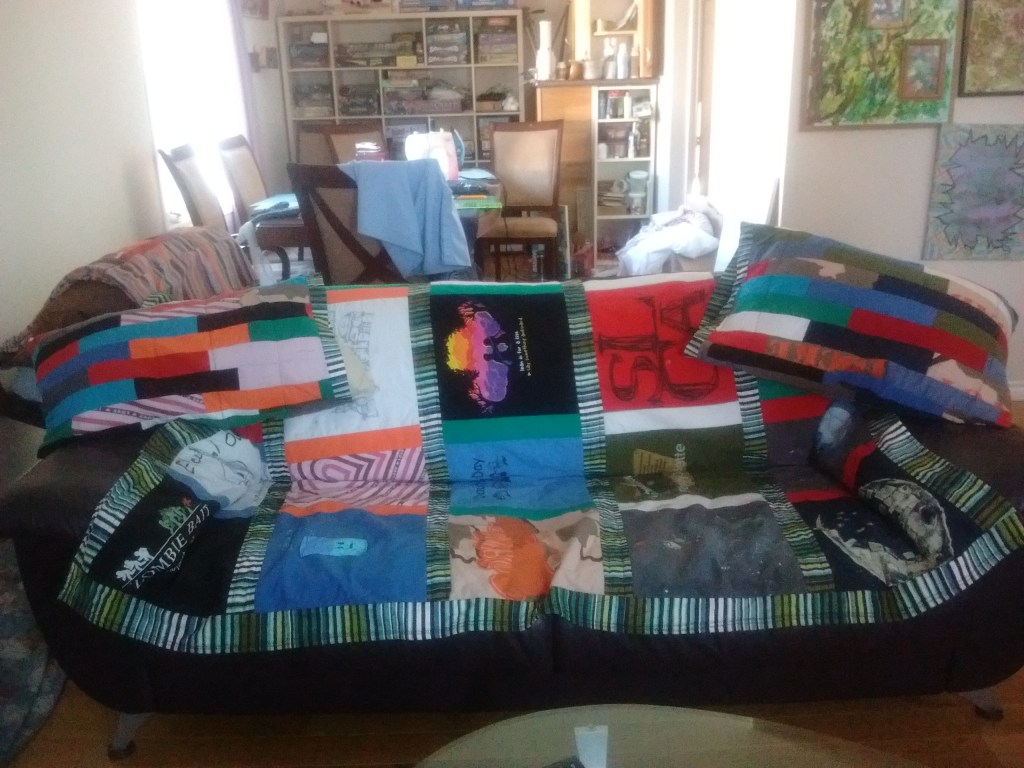
One way I have given him gifts is through my arts and crafts skills.I’m fortunate enough to be a crafter, so many of my gifts for him are artistic, one of a kind and also practical items. I first made a quilt, using our old Tshirts as material. As the years go by and we cohabited longer, it became apparent that it’s easy to run out of ideas for meaningful and utilitarian gifts. The quilts and pillow cases seem to be doing well in terms of longevity. And now, while using these items on a typical day, he would exclaim how much he appreciates these gifts “made with love”. I would exclaim how long ago these items were made, and they unexpectedly became mementos in their own right.

Living room couch covered with a quilt and pillow cases that were DIY.

For my brother, over several years, I have been giving him cash, and that seems to work well. It would be in an envelope with a heartfelt message and the dollar bills. Due to COVID-19, I know that many businesses don’t accept cash as payments anymore, so I sent it as an e-transfer, and included my heartfelt message in the message box. He is the only exemption to the rule, and I think in some ways it still counts, since I managed to escape the agony of choosing and buying an item he may not like or use, but instead, give something that would really of benefit as a young man. Maybe, the love language in that one, is that I trust him enough to know the best way to manage his finances.

“I Don’t Want To Be Raped Again” The Captive Transit User Series: Part 2

This is part of an ongoing series of posts discussion issues I personally encounter while taking public transit in Edmonton. Links to other posts will be added on an ongoing basis:

My frame of mind for the longest time was, the most dangerous place to be is my own bedroom. This however, didn’t prevent me from associating darkness and public places with being at risk.

What is a Captive Transit User? I learned about the term for the first time from the City of Edmontonโ€™s website. The easy definition is: someone who takes public transit because itโ€™s the best (or only available) option for them to travel around. The part about feeling โ€˜captiveโ€™ comes from the restriction that sometimes comes up, perhaps because one is too poor to own and maintain a vehicle, one does not know how to drive, or for medical reasons, cannot operate a vehicle. In many ways, I relate to this a lot. Though Iโ€™m pretty fortunate to afford the occasional taxi ride and with my husband having a car.

When it comes to big picture thinking on social and political topics, this is a short list of a trauma-informed approachย (the 4 Rโ€™s) that I compiled.

  1. Realizes the widespread impact of trauma and understands potential paths for recovery
  2. Recognizes the signs and symptoms of trauma in clients, families, staff, and others involved with the system
  3. Responds by fully integrating knowledge about trauma into policies, procedures, and practices
  4. Resists re-traumatization 

I sincerely hope that government officials and service providers, especially with transit, would integrate this perspective in very clear and tangible ways more often.

The way the human psyche works, all it takes is one horrific and traumatic event to discourage someone from doing something, or to have a very negative association towards something.

That makes a lot of sense. If a person gets attacked in a specific LRT station, that person will likely try to not use it ever again, or if they don’t have a choice, to be more wary, stressed and anxious every time the use it. Certain bus routes apparently have a prominent reputation for having lots of disruption, where the likelihood of being harassed is a lot higher. Imagine being in an ongoing state of high alert and anxiousness on a regular basis?

As a high school student in a city in the Philippines, I always got told to go home way before sunset, because taking public transportation after dark is dangerous. As a relatively new resident of Edmonton back in 2008, I was also told to be careful when commuting in downtown because of the “sketchy people” that are around.

This is tough, because when I was hearing these messages, many of these people don’t know of my history of sexual assault. My frame of mind for the longest time was, the most dangerous place to be is my own bedroom. This however, didn’t prevent me from associating darkness and public places with being at risk.

When I got home from my office in downtown, sometimes I say to myself with a huge sigh of relief “Today is a good day! I didn’t get raped…or stabbed, or groped. Thank goodness!” There are numerous stories of harassment that I hear from fellow residents of Edmonton about unwanted attention while waiting for a transit vehicle, or while onboard one. Many people crafted strategies to minimize the likelihood of this happening, such as wearing headphones and staring blankly when someone is trying to strike up a conversation.

Many share the feeling that they are forced to be nice to not “set him off” and to avoid being an ‘active hostile target’ of harassment. There was that story of a woman speaking out when a man on a bus started making racist remarks to an Asian-Canadian person. There is two types of hostility in this instance, the one inflicted towards the Asian-Canadian person, and then towards the woman who called out the harasser.

Commuting late at night poses a additional set of challenges. There’s that heightened sense of panic when the bus is missed or the last route has passed. There’s a recent announcement that the city’s telephone service line, 311, is unavailable in the evenings after 7PM, which is a disservice to those who are more vulnerable in the evenings.

One time, I was stuck at the U of A South Campus because when I got off the LRT, the connecting bus I was planning to take just departed, and it is another half hour for the next bus since it is after 10 PM. I realized that instead of waiting completely alone, it is better for me to take the train back to the University of Alberta station and take a taxi there to get home. This is a good back-up plan assuming there is indeed a taxi waiting in the stall by the University Transit Station every time. And based on personal experience, that is not always the case. Spending extra time to re-route one’s travel to get home because of safety reasons is a bit counterintutive since the best scenario would be just getting home quicker, but for a transit user with limited money, this is a reality. A trade off between money and time, with safety being potentially compromised along the way.

Being blamed for an attack while taking transit really riles me up. It reminds me of the blame cast at me and that I internalized, and that many others have experienced as well.

Perhaps it is a very high standard, but this is my take on achieving a safe transit system: When an Edmontonian who previously had a horrific experience taking transit, then decides to take a chance and felt comfortable, safe and satisfied in their journey from point A to point B. I have some level of hope from what seems to be the city’s effort to incorporate GBA+ Analysis framework, and the availability of ways to make an impact such as city committees like the one I volunteer for. This is the threshold that ought to be met, and I do hope we get closer to getting to this, in a way that an average person will instinctively notice it.

Book Review: Becoming Superman

This is a book review of Becoming Superman written by J. Michael Strazynski, the person behind the Babylon 5 Television series as well as SENSE8. The book is an autobiography, covering the author’s family history before he was born, chronicling his own experiences growing up in a precarious, violent home, his coping mechanisms in the form of comic books, pursuing a career in the creative and writing field, and ongoing commentary about his relationships throughout the years.

For some context, my husband is a huge fan of Babylon 5, and by huge, I mean it’s the “mega-nerd” level, which I say affectionately. He has the DVDs, book of the scripts of the episodes, including a separate book talking about what happened to another show that was launched by the author but was not so successful. Watching Babylon 5 was a memorable part of our early years of dating, back when sleepovers were not even a consideration and we are sorting through our mutual awkwardness. The moment that there was news about a book where the writer talked about his past, I was not surprised that my husband pre-ordered an autographed copy!

Now, to the actual review of the book.

It is detailed, gut-wrenching and compelling in its narration, a reflection of his ability to captivate audiences creatively no matter what creative medium. He is a well-recognized and well-respected writer in Hollywood, particularly in the science fiction genre, so this is just another testimony to his talents.

On a personal level, many chapters and stories are very relatable, particularly the parts that talk about fictional characters and forms of literature as a source of escape from the harshness of real life. The anguish of the young child, of the young man, in every fight that happened in the home, every time his father announced that they are moving again, every time he pours in hours and days writing to the point that he gets sick, all of these are palpable in every page and every chapter.

It’s fascinating to me though, to witness how a real person has embodied in many ways, the characteristics they saw in a particular fictional superhero, in this case, was Superman. Which made me wail in agony, just like him, when his father maliciously destroyed Michael’s comic book collection.

This is not just a book that aims to narrate and inspire. As I was reading through the chapters, there’s an undertone of wanting to use the book as a tool or a weapon, to vindicate and for vengeance. And in the last chapters of the book, my inclination was confirmed. The writer did intend to use the book in many ways to get back at his father, for the abusive treatment he inflicted towards the family, and to expose the background he felt his father was trying to hide and deny. It is evident that the writer wanted to broadcast as loudly as possible, his father as a Nazi sympathizer. An arrogant, violent and abusive man.

One thing I didn’t anticipate is how in certain chapters, it felt more like a personal development book, rather than an autobiography. During his several positions in journalism and scriptwriting, he shared a few pieces of advice that stood out to me (in paraphrased form):

  • Write as much as you can to “get the crap out”, so you can start making good content
  • Be reliable and always hand in your work on time, since about half the people who are expected to hand in work, flake out and miss deadlines. This builds reliability and a good reputation.

As someone who is still a young professional, who does creative work on the side, I think that these are really good pieces of advice, even for those who are not necessarily working in creative fields.

Overall, I am pleased with the book, and I know it will be part of a treasured collection of items that we will have in our home for a long time.

A Cog in the Community Service Machine: A Filipina-Canadian’s Perspective on COVID-19

It is to be expected, that in a crisis like this, many people will be put in a difficult position (or a more difficult position) and are in need of help. One incredible thing about this pandemic is that there were lots of opportunities to help, and there are different roles to fill.

It’s pretty neat to take a break from being on the organizer role (I’m talking specifically about my job), since all our programs are cancelled. My job is the main way I do something that helps people in need in a direct way. My volunteer work as a member of a board of directors is also important, and I appreciate it, but a bit more removed, a bit more big-picture.

I was not surprised that social media pages and groups were set up to help people in an efficient way. Facebook groups specific to COVID-19 that enabled the average person to have a direct way to help with advice, positive commentary on social media, and buying items online to help those with emergent need. For a Facebook page that is just barely a month old, to have 20,000 members, is pretty darn impressive. I wanna buy a case of wine for each of the founders and moderators of the page. What an incredible labour of love.

Another way I have been helping is by being in “super seamstress mode”. Since last year I’ve been making fabric bags for Boomerang Bags Edmonton, and that has proven useful during this time. Hundreds of people throughout the province started making fabric laundry bags for healthcare workers, so they can separate their dirty (and most likely contaminated) work uniforms and toss them right away into the washing machine.

In my neighbourhood, with relief, I discovered ways to do a little something cheerful right by my front yard. Sidewalk chalk art. Staying connected with community leaders. Volunteering from home.

For my workplace, I realized that disseminating information, especially online, is really important. It’s part of my duties anyways. Handling marketing and communications for work and the clients we serve who need help is a part of my daily duties as I work from home.

These are the “doer” type of roles. The soldiers in the field. The cog in the machine. I know there are hundreds of volunteers doing seamstress work right now. I know (and it’s incredible) that there are thousands of people on the Facebook group, that almost every single time someone make a post asking for help, an offer is made within an hour or less. I am seeing dozens of photos drawing positive messages of pavement or fences, even if there’s a risk of snowfall or watery puddles the next day that would wash it away.

I’d like to take a moment to give a shoutout to all the administrators, organizers, facilitators of these on-the-ground initiatives to help others. Because it’s more stressful to do it at this time, but the relieve that these gestures of support is also of a greater impact.

Love Language Reflections: Embracing the Mundane

I think there’s something that is always underestimated and undervalued in many kinds of relationships, not even just romantic ones but also when it comes to members of our family. It just the ability to embrace, be satisfied, or even be happy with the mundane day-to-day activities we deal with in our day-to-day lives and that we have to do with each other.

It is claimed that in many romantic relationships, or most of romantic relationships, there is the well-known so-called Honeymoon Phase when everything about the relationship and the other person is shiny, bright, enticing, and exciting. However since a romantic relationship will eventually become a family relationship, as in a household, as in people would be managing a household unit with all its chores, and expenses, and bills. Being comfortable with doing the tedious boring things while not killing each other is actually just as meaningful.

With my household situation when I was younger, particularly when I started living with my grandmother, I think there were a few of these mundane household moments that were really nice and I still treasure her to this day. The first time I learned how to cook rice, the first time and the future times that I am in charge of ironing clothes every weekend, when we were counting money every now and then so that we have enough to pay suppliers when we purchase the next batch of products for our store, and many other little things.

With my husband, in recent months and years including this weekend, these activities would include paying bills together, looking through this comprehensive chart of seasonal household chores to make sure that little things are not forgotten such as changing the batteries of our smoke detectors, cleaning grime off the stove, or emptying the fridge annually.

I remember within the first year of our relationship, the first time my husband and I assembled furniture together. I was told by a few couples in a joking way that Ikea furniture is the bane of many relationships. My brother-in-law just bought his townhouse and his dining room furniture just arrived but it wasn’t assembled on time before everybody else arrives for the housewarming party. We were asked to assemble it and would some communication and coordination, and the instruction manual and having the same tools that you need to assemble something like this, we’re able to assemble the dining table. This gave us a sense of pride! The fact that we somehow are able to tackle something as homely, and boring, as assembling new furniture is something we always remember as a ‘strength of the team.’

Most of the items that we bought for our new home are also second hand. So a lot of the items that we buy usually from Kijiji, involves driving to the other person’s house, trying to fit the awkward piece of furniture in the car or the trailer, taking it home and taking it out of the vehicle. And it’s really strange, but I consider these memories really simple but pretty fun.

I think that being able to deal with mundane day-to-day activities it’s a sign of a loving relationship. The ability to tackle little things is an indicator of how you will react and work together when big things cause a lot more trouble.

On the same token I think about my brother. He is my roommate now, he lives in the same house as me. Has his own household set up with responsibilities in arrangements with his girlfriend who also lives with us. And ever since we moved out of my relatives I think my brother and I are over all have a reasonably peaceful relationship living in the same home.

Honestly, I don’t have any specific tips or advice on what needs to be done in order to nurture such a positive relationship with the people you live with at home. I think that for people in romantic relationships, it’s something I definitely need to be worked on because it takes some time. And with any aspect of one’s relationship if a couple finds it important will be able to find a way to make it work. For family members however, that is a bit more challenging. I just hope it is something that people can look into and pursue.

Weathering the Pandemicโ€™s Stormy Atmosphere: A Filipina-Canadian’s Perspective on COVID-19

This will be one of the several posts I will likely write about my personal reflections regarding the pandemic. My thoughts are pulled in different directions and Iโ€™m hoping to write about different parts of them, one at a time.

At this rate, it would be almost a month since drastic measures have been implemented here in Edmonton to mitigate the effects of the pandemic. Given my line of work, my tendency to get involved in the community, and how I stay connected on social media, I get to witness how different people react, respond, and adapt to the current situation.

This is one emerging theme in my mind since the beginning, and as of this time, which is early April. It is my unavoidable tendency to compare this time to the typhoon season in the Philippines.

The Philippines gets at least a dozen typhoons every year. Since I was 16 years old when I moved to Canada, I have lasting memories of the disruption that this season causes every single year. The last few days of warm summer around the end of May, getting ready to go back to school in June, with the anticipation that in about six weeks, at least a few days of school will be cancelled because Mother Nature’s wrath is too much for safely walk or drive to school, work or do a lot of activities.

When school is cancelled, you stay at home and try to stay occupied. When school is cancelled because of a typhoon, it’s also very likely that access to utilities will be interrupted. In my very young memories (and I mean, really young, when my parents and sister were still alive), I recall memories of playing with my sister with a deck of cards, under candlelight on the dining table. Or we can convince our parents or nanny to very briefly knock on the apartment, right across the all, to see if my sister’s best friend, Ailea, wants to play. We’d then invite her to play house in the bedroom that we share.

Even dressing up to stay protected was a norm: from ensuring you have an umbrella that is less likely to flip and break into pieces, to letting it go altogether by making yourself waterproof with a raincoat and boots. Well, at least dressing up for the weather is also something that needs to be done in Canada, particularly during the fall and winter.

My mother, running a convenience store, is an essential business because people do need to buy food, and candles, diapers and medicine. After they passed away, my grandmother and I ended up being the storekeeper that has to keep their doors open, while making sure that the strong winds don’t knock over our display shelves of products, and our roof stays intact.

In short, having life disruptions, being home-bound, and experiencing numerous cancellations of regular activities is something to be expected, like the seasons.

In comparison, there is not a lot of reasons that massive disruptions happen particularly where I live. I’d say in Canada, there can be disruptions (that cause cancellations of events and evacuations) due to wildfires and floods, but most people don’t prepare for that every single year. I imagine that for many, this is part of the reason why the current changes can be quite stressful.

My feelings can be summed up as concern, uncertainty, but not crippling fear. I guess there is something to be said about getting used to something. Being home-bound because of a pandemic might not be 100% the same, but the tangible impact has enough parallels.

The experiences in the Philippines helped build an emotional foundation to help manage this. In fact, by comparison, this is significantly more comfortable! From making sure that one’s home is in order as much as possible, paying attention to the media and any directions from goverment officials, waiting out the worst part of the storm, and eagerly looking foward to when things go ‘back to normal’, being able to do this in a healthy way is key to riding out this particular storm.

Life is an 8/10

By: Giselle General

This is a post I’ve been meaning to write for a while. Honestly, the current circumstance that we as a society are facing right now hasn’t changed it by much.

Two years ago I started adapting a concept called Bullet Journalling, a DIY hybrid of a personal planner, calendar, journal, scrapbook and habit tracker. I’d like to give credit to the first Youtube Video where I discovered the idea.

My personal version is a system I made and modified over the past months and years. There are daily, weekly and monthly to-do lists, a 2-page overview of how the upcoming six months looks like, something called ‘collections’ where you write your ideas/ reflections/ notes on certain topics in a single place, and a mechanism to track habits you want to incorporate in your life. Here are some examples for me:

  • With my habit-tracker, I managed to integrate the daily habit of flossing my teeth, and I don’t need to track it anymore. Now, it’s replaced by a new habit I’m incorporating which is ‘not snooze the alarm clock.’
  • I have space in my weekly two-page layout for the week, to write something I’m grateful for
  • I have a ‘collection’ page for a few topics, such as my charitable contributions to the community. This gives me a page to look at when I’m feeling unproductive and that I’m not making a difference in the world
  • I also have a ‘collection’ page for women leaders I admire. It’s meant to inspire me for when I run for public office, a big dream I want to pursue in the future

For this post, the topic I’d like to discuss is mental health. A lot of other people who use the Bullet Journal system do different things about this. Some people make their journals creative like a scrapbook, and the artistic expression is helpful for their mental health. Some, like me, integrate a place to write what they are grateful about, for the day or the week. And some have ‘mood trackers’ where they use a coding system to indicate how they are feeling for the day. Many use colors of symbols. I heard that for those with ongoing medical conditions, either chronic illness or psychological illness, this is a useful record.

My version of this, is that on my weekly/daily to-do list, I rank what I feel about the day on a 10-point scale. So, a not-so-great day might be a 5/ 10 or something. I ranked my wedding day as a 9.5/ 10. I’ve been doing this for a few years now and realized that most days are a 7/10 or an 8/ 10. When I get grumpy or really sick then it might fall into a 6/10.

8/10 is a decent number! Thinking about the challenges I had in my earlier life, it feels uplifting to be honest. I can’t help but critically think of it though, and then, doubt creeps in at times. Is it a sign of resilience and healing? Or comfort and luxurious privilege? Or optimism or a healthier outlook in life? I hope that it’s a combination of all three. One thing I’m trying to remind myself, is that it is completely okay to feel my feelings. While this was meant to face head-on certain difficult emotions such as shame, discomfort, anger, or passion, I think it is just as useful to face head-on positive feelings such as relief, warmth, belonging, comfort, and sense of accomplishment.

Telling myself “I got this” or “this is not so bad, because I survived worse” had, in part, helped my put a higher rating even on days that may be challenging. There are some days where it was exhausting, draining, or uncertain, but the possibility that the next day would be better encourages me to think of the current day not as a waste, not a disaster, but just a natural low part of life.

It’s okay to feel good. It’s okay to be comfortable. It’s okay to not worry sometimes. This is likely something I’ll have to remind myself over and over for a very long time. Perhaps it’s a good thing, so as not to take the good fortune for granted, and in order to be proactive to prepare for difficult times.