The Life-Changing Impact of School Choirs in My Life

By: Giselle General

Humans of New York is a Facebook page I have been following for the past decade, with is compelling and artful way of capturing people’s portraits and their stories of the subjects, usually narrated from their perspective. A series of posts not too long ago talks about a subject that was dear to me, children’s and youth choirs. It was a story of the founder of the Young People’s Chorus of New York City.

Music, particularly singing in groups, was a regular part of my own life starting in elementary school. I would say it is my first ongoing experience as a child learning how it’s like to contribute something to a collective whole. Usually the settings are religious, where students from every grade level take turns being the main choir for the monthly Catholic mass at school. I learned then the phrase “singing is twice praying” which I find compelling to this day, even if I don’t regularly go to church. There is something deeper, spiritual, and elemental about music, and even more so for me, when the sounds come from my own body, my own breath, my own vocal chords.

I continued this musical journey through the Catholic Youth Ministry student group in my first two years of high school, still in the village where I grew up. By then, it has been three years since my parents and sister died, and I’m very well set in my ‘parental’ and provider roles for my brother and myself. Home life was not a place of ease and acceptance. Being part of the Youth Ministry choir was great way for me to maintain some sense of age-appropriate exposure and belonging, one of the few ways I felt like an actual teenager.

When I moved to a high school in the nearby city, I was too intimidated to join the Performing Arts Club of my new school in the city, but I did join the Liturgy Club. That involved a lot of singing in the daily church service from 7 PM – 7:30 AM before the morning bell.

“Hear me Jesus, hide me in thy wounds that I may never leave thy side. From all the evil that surrounds me, defend me! And when the call of death arrives, bud me come to thee. That I may praise thee with thy saints, forever!

When I came to Canada at 16 years old, I joined the school choir for Holy Cross high school in St. Catharines Ontario, during my only year in high school here, Grade 12. It seemed like an easy, seamless way to be part of a club. I can already sing in English and despite not being able to read music, I can follow along once the instructor plays the piano and demos the notes. The first song I learned is O Canada which was really cool. It meant I was years ahead in preparing for my citizenship ceremony, haha! On top of religious songs, I also learned how to sing pop songs in a choral setting. I learned how to be the backup melody while our vocalist Danica would sing the main lines. This one I remember well, which is Apologize by Timbaland.

Danica our lead vocalist: “I’m holding on your rope, Got me ten feet off the ground. And I’m hearing what you say, But I just can’t make a sound. You tell me that you need me, Then you go and cut me down, but wait. You tell me that you’re sorry, Didn’t think I’d turn around and say.”

The other students, including me throughout this entire verse: “Ooooh, na na na. Oooh na na na.

Staying after school on Thursday afternoons, sometimes also Tuesdays, was something I really looked forward to then, because I was not used to the way things were in Canada with school being done at 3 PM. It felt way too early and I’m usually at home alone after school. It opened remarkable experiences and opportunities for me, such as performing in front on a baseball stadium in Toronto and me taking the yellow school bus for the first time. And also, getting a loyalty award at the end of the school year for being involved in the choir. This has significantly helped in my adapting to life in Canada, followed by discovering the Filipino-Canadian Association of Niagara and its cultural youth dance group.

When I moved to Edmonton and stared university, I considered auditioning for the choir, but got intimidated by the fact that the members are likely music majors, so those with superior vocal skills who are planning to make this their career. As I went through the motions of completing my university degree, the show Glee came about. I thought the show was entertaining and fun and cool. While in this case, the choir is more of a show choir and is flashier, I’ve seen glimpses of what reminded me about what high school choirs, and high school clubs in general, can provide to young folks going through one of the most transformative stage of their lives.

I got teary-eyed when I watched one of the performances of this youth choir featured in Humans of New York, the Young People’s Chorus of New York City. The combination of the vocals of the performers and picking up the distinctive sound of youth, especially for the male students who seem to have just started puberty. Seeing how many of the kids are way shorter than their instructor/ conductor, and seeing how animated they are singing their parts.

My youth choir experience was something I personally cherish in my younger years. It kept me out of trouble and at the same time, helped me reconnect to my actual age and stage in life, that I was an actual kid who is still growing up, not saddled with adult responsibilities such as earning income and being the parent for me and my brother. When they are run well, youth choirs can serve as a bridge between kids of different backgrounds, provide structure, motivation and fun in a balance way for growing minds, and open opportunities for those who lack access in their own homes.

Thank you to all the adults that help manage youth choirs and other music-related programs and make them a success!

The Mindset of ‘Understanding, not Agreement’

A couple sitting on a yellow couch while arguing.

By: Giselle General

There’s no need for a rocket scientist to tell me, or anyone else, that people seem to be more divided than ever. There’s enough commentary around lamenting the increasing ‘us versus them’ mindset, amplified by social media, people speaking out against injustices they have suffered from for so long, and people feeling anxious about all social, economic, and political changes happening around them.

“This is a hill I’m willing to die on” is one of those euphemisms that I, as a English as Second Language speaker, try to wrap my mind around.

In a government advisory board I volunteer for, a long-time board member suggested the concept of ‘understanding, not agreement’.

I think this means, making an attempt to follow the thought process of someone’s argument or reasoning, without necessarily agreeing with this person’s position. It is something I haven’t heard before and it stuck with me ever since. I think that there is value to what he said, something I am discovering more and I expand the ways I volunteer in the community.

It gets tricky of course when the person’s perspective is inherently harmful or invalidating the suffering of others. I don’t have an answer right now on how to navigate this. I think that would be the necessary next stage as I try to get more involved in the community.

In one of my recent appointments with my therapist, we talked about getting backlash and criticisms and how to react to them. One piece of advice she gave was ‘find the nugget of truth’. I think there is something to that. Even if a racist person keeps on spewing out problematic commentary, if you dig just a little bit, there is something else beneath the hostility. It can be ignorance, it can be fear, it can be lack of belonging, or a little bit of each.

Someone who keeps on mentioning economic impact when it comes to policy decisions might not necessarily be a callous jerk who cares only about jobs. Perhaps their train of thought is that financial stability is a valuable foundation of a person’s wellbeing, and if that is not considered, it can be tough to convince people to do certain actions.

Someone who keeps on mentioning the number of people dying when it comes to policy decisions might not necessarily be a delusional person who thinks the government has unlimited money. Perhaps their train of thought is that every single life has value, and believes that if a person is dead because of government policy failing them, that is completely unacceptable.

Back in university, I remember reading an article about how conservative and liberal minded people can convince the other camp of their perspectives. The essence of the advice was to use the logic and mindset of the other party to frame the arguments towards the topic of discussion. For instance, it can be valuable to say that increased environmental protections through policy can help preserve and maintain the God-given nature, a precious resource and blessing that deserves care.

Given that COVID19 is still an issue, after almost two years, in an attempt to protect my mental health, to protect people around me from being subjected to my anger, and to keep my faith in humanity, I’m trying a bit harder to tell myself these days “understand what led a person to believe that way, even if in my own mind, it is completely nonsensical”. A book I read during a trip, Predictably Irrational: The Hidden Forces That Shape Our Decisions by Dan Ariely, also reminded me of the natural and human flaws of decision-making and belief.

As I browse through the different definitions of the word understand, I’m trying to learn how people behave and communicate, even if I am not convinced of their mentality.

to perceive the meaning of; grasp the idea of; comprehend

to perceive what is meant; grasp the information conveyed

to be thoroughly familiar with; apprehend clearly the character, nature, or subtleties of

to accept tolerantly or sympathetically

to assign a meaning to; interpret

to grasp the significance, implications, or importance of

And in the process, I can see more clearly why some people have views that are discriminatory or ignorant. Many beliefs and behaviours are harmful even towards oneself, but from the perspective of trauma or being in survival more, a clear path emerges.

How about confronting and addressing these mindsets that are problematic? That is a whole different conversation altogether.

End of the Journey of a First-Time Councillor Candidate: Repost from the Alberta Filipino Journal

Giselle outdoors in a neighbourhood holding her election flyer

By: Giselle General

Introduction: This is a re-posting of the articles I have written about my journey as an candidate for the 2021 Edmonton Municipal Elections. Politics and political participation in Edmonton will be a topic I would like to discuss on an ongoing basis, now that I had this experience. But since at this point, it has only been a month Election Day where I only got second place, I am still processing my emotions, compiling documents, and reflecting on everything I have observed and learned.

This was the third article, submitted on November 2021, but was written just two weeks after the election day. You can get a free copy of the paper, published monthly, from many Filipino-owned businesses in Edmonton. You can also everything digitally at: https://www.albertafilipinojournal.com/


The election is over for the municipal elections and I wasnโ€™t successful in my campaign to be city councillor for the city. I came second place. Here is my preliminary reflection of the end of this journey.

Relief in safety and campaign principles

I was determined to run the campaign by following very important principles. These are: positivity, transparency, inclusiveness, collaboration, and care for community. As a result, some of the tasks in the campaign took extra time, such as properly preparing maps for volunteers, calculating fundraising numbers for the weekly social media posts, or adding subtitles to all videos for the benefit of people who are deaf. With that said, both during and after the elections, people have messaged me expressing their appreciation for my thoughtfulness. My actions made the election informative for the average person, and people from the disabled community appreciated that I went above and beyond to ensure they can access the digital content that I published.

Another key component in my campaign is safety, given the reality of COVID19 and additional risk due to Anti-Asian Racism. Many times, I played it safe by avoiding entering  homes with tall gates, not door-knocking alone, and being careful when walking through uneven landscaping and front steps. While other campaigns were door-knocking as early as March, but I waited and observed closely the COVID numbers and the impact of changes in the rules. Sure, it meant I didnโ€™t go to as many homes, but Iโ€™m glad that throughout the campaign, I didnโ€™t get seriously ill or injured.

Anguish at missing the goal and systemic hurdles

Just like most people in the world who are ambitious and competitive, not winning definitely hurts for me. On top of that, I felt the weight and pressure of my endeavour, as the only Filipino candidate in the entire city for any municipal seat, after the other candidate withdrew. I definitely would have been great if I achieved this important milestone for the community. My heartbreak at not winning is not just for me, itโ€™s for the entire community.

The optimistic side of me dismissed the idea that money plays a huge role in campaigns, but seeing it firsthand gave me a wake-up call. While Iโ€™m confident that I did everything I could to have a well-run campaign, it came to a point where certain gaps can only be filled by additional funds or additional people helping. With this realization in mind, I know what I will advocate for moving forward to help those like me with passion and drive to make positive changes in government, and need just a bit more resources to be successful.

Marvel at the support, outcome, and generosity

Since I donโ€™t have in-depth experience that seasoned politically-engaged people have, I donโ€™t have context of the election outcome. All I know is I didnโ€™t get enough votes and I lost. The cool thing is that many days after the election I received messages of kind words and

As it turns out, getting 5000+ votes is a remarkable accomplishment for a first time candidate, and for a budget that I have it is impressive. I am very grateful to those who have supported the campaign, from the donations, those who made time to volunteer consistently, those who gave advice.

Drive moving forward

One thing I want to make clear is that this is the end of the journey of being a first-time candidate, and not the end of the community involvement journey, and likely not the end of the political journey. If you think about it, if I run for public office, I will be a second-time candidate, with a better understanding of processes, and the unspoken rules of the political world. In the meantime, my focus is to resume all my community service activities that I am already doing to make our city better for everyone.

Update on the Journey of a First-Time Councillor Candidate – Repost from the Alberta Filipino Journal

Giselle wearing a blue top and white blazer outside in a park in Edmonton

By: Giselle General

Introduction: This is a re-posting of the articles I have written about my journey as an candidate for the 2021 Edmonton Municipal Elections. Politics and political participation in Edmonton will be a topic I would like to discuss on an ongoing basis, now that I had this experience. But since at this point, it has only been a month Election Day where I only got second place, I am still processing my emotions, compiling documents, and reflecting on everything I have observed and learned.

This was the second article, submitted on September 2021. You can get a free copy of the paper, published monthly, from many Filipino-owned businesses in Edmonton. You can also everything digitally at: https://www.albertafilipinojournal.com/


My journey of being a first-time candidate for Edmonton City Council is coming to an end on October 18, Election Day! Here my reflection of the journey of being right in the front lines of a campaign.

It is much harder than anticipated. When I first told my brother that I am running, he was scared for my safety! It made sense, given how dangerous it is to run for public office in the Philippines. I reassured him that I likely wonโ€™t get murdered here, win or lose. But that doesnโ€™t mean that there are no dangers. As a visibly Asian woman, the risk of racists attacking me is a possibility, given the rise of Anti-Asian Hate due to COVID. There are even practical dangers, as well; many peopleโ€™s stairs, entryways and landscaping are not always stable, so a slip and fall is a risk when going to thousands of homes.

The harsh reality that it takes money and connections to run for public office became evident. Expenses line up really quickly. I am running against the current councillor, who spent $84,000 in her campaign in 2017. I wondered, how can I even match that? Advertising in bus shelters are at least $1,000, billboards start at $1,500. I spent $2,500 earlier this year for flyers and $3,500 on lawn signs, as name recognition is paramount to being successful.

I see many candidates who get a lot of help, in terms of time, money, and connections, from their parents, and my heart breaks into a thousand pieces every time. Itโ€™s a painful reminder of losing my parents too soon. I tearfully wondered every time, in what way would they have helped if they are still alive? Would my parents be proud? Think their daughter is crazy for being this ambitious?

COVID is a mixed blessing when it comes to attending events and activities. Typically, in an election campaign, there is a lot of traveling involved for meetings and gatherings, and it would have taken so much time while taking public transit, or I would need to spend a lot of money taking taxis, or a lot of stress arranging rides from other people. The switch to digital for many meetings and tasks proved to be helpful.

This campaign journey is also quite incredible in many ways that continue to uplift me. As of writing this, I got $17,000 worth of donations, money sent through e-transfers and online payments as well as in-kind donations, itโ€™s just remarkable. For many weekends in the spring and summer, people joined me in delivering flyers to neighbourhoods so I donโ€™t have to spend money on postage. Professionals shared their skills voluntarily, from websites design, graphic design, translating my flyers, mapping routes, strategy, and more!

Another remarkable thing is connecting with people who are not within my immediate network, those who, after researching all the candidates, discovered that I have what it takes to be their next Edmonton City Councillor.

This experience opened my eyes to the simple and complex reasons why our political system is the way it is right now. I really wish that for immigrants, women, and working-class people, that running for politics is not this cumbersome. After the election this is something that I want to address, by finding a way to share all the lessons learned from this campaign journey.

This election candidacy is a journey five years in the making. I hope that by October 18, that history can be made for the sake of the Filipino community in Edmonton and in Alberta, that I can be the first Filipina-Canadian councillor that Edmonton would have.

Mastering Mask-Making: a Filipina-Canadian’s Perspective on Covid-19

A pile of fabric face masks with plastic window that is in the process of being completed

At this point of the pandemic, wearing masks has been a regular part of people’s routines when going out their homes. This is not to debate the merits of wearing one or the politics surrounding mask wearing during this pandemic, but more on my experiences making them and using them.

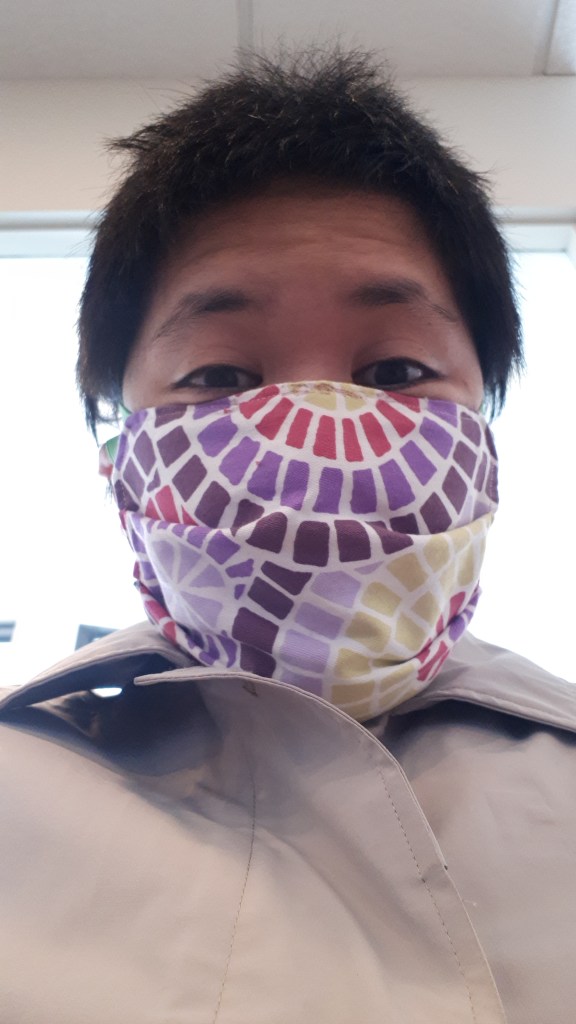
In the spring, there are so many instructions online on how to make masks, that even as someone who sews on a regular basis, I was a bit overwhelmed. There seemed to be two major pattern types, the folding accordion type, and the front folding two pattern type. Since I have no shortage of fabric I decided to use what we have to make the masks for my husband and myself.

Selfie of woman wearing a fabric face mask, the horizontal accordion style.

It took several attempts. Some are too small, and many were too tight! I don’t have a lot of experience working with elastics, and as a result I end up putting insufficient elastic for the string that is supposed to hold up the masks. I also don’t have a lot of experience with additional components that are not necessarily a fabric such as metal wires for the nose bridge. At first, I don’t even have materials that can function as a nose wire. It wasn’t until after I got some garden wire and also some pipecleaners, that I had the chance to learn how to incorporate a nose wire into making a mask.

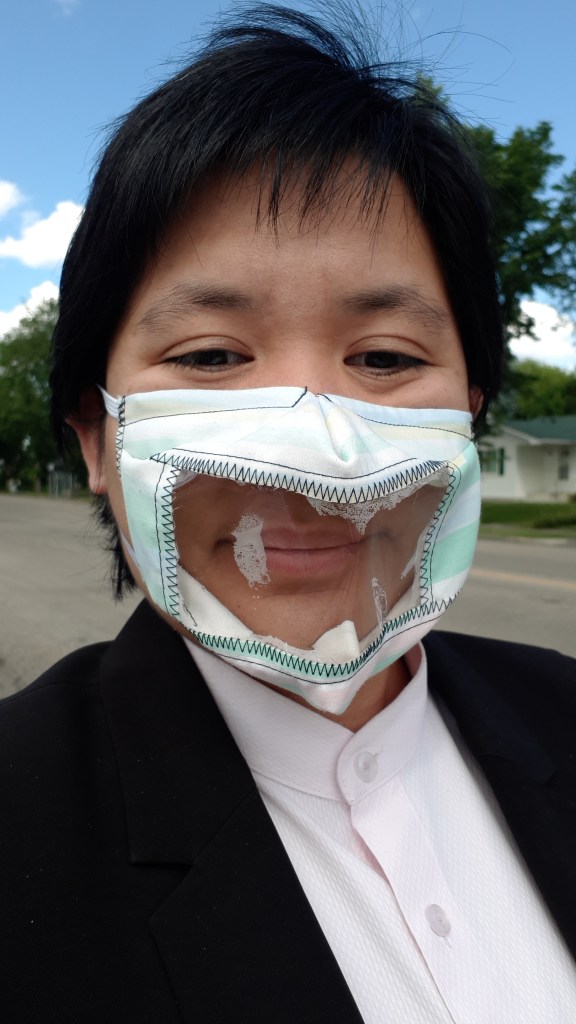
A few months into the pandemic, when mask wearing started becoming more commonplace, I heard an article talking about the difficulties that people who are deaf or hard of hearing are facing because of people wearing masks. The challenge that they face is, it is even harder to hear people speak, and for those who rely on lip reading, they are unable to do so. I eventually stumbled upon a mask with a clear plastic transparent window and I thought that was awesome. I made a few attempts making this mask and they are a part of my own inventory of masks that I wear on a regular basis.

Selfie of woman wearing a fabric face mask with a plastic transparent window.

I really like these special masks that I made. When I have gone to retail stores wearing these masks I get a lot of nice compliments! People say that it is actually nice to see a persons smile again which obviously was covered thanks to masks. I remember attending an outdoor community event around early October and I wore one of these masks with a plastic window, and I got a lot of compliments from people who attended. One inevitable challenge is that when you talk, some fogging or moisture buildup occurs. I learned a trick to mitigate this, which is applying a very thin layer of dishwasher soap and letting it dry. Letting it dry is particularly important because it is awkward sniffing and smelling the dishwasher soap scent while wearing the mask with the window. I’m sure you can tell I learned that from experience.

During this time, I was also helping with fellow Albertans making free stuff for those in need specifically, I was helping to make free laundry fabric scrub bags for health care workers. There was another initiative running alongside this one, which is making free fabric masks for people in need. I admit, I felt conflicted for a while. I wasn’t sure which initiative I should keep on helping with. Eventually, I reminded myself that it is OK to help on one initiative only and hope that others, are willing to step up to help with the other one. It seems like that is the case! Many other people who have skills in sewing and quilting, helped to make free masks for those in need. Others turned it into a creative fundraising method. I heard that one lady made masks as a fundraiser and raised $10,000 for the Edmonton food bank and I thought that’s impressive.

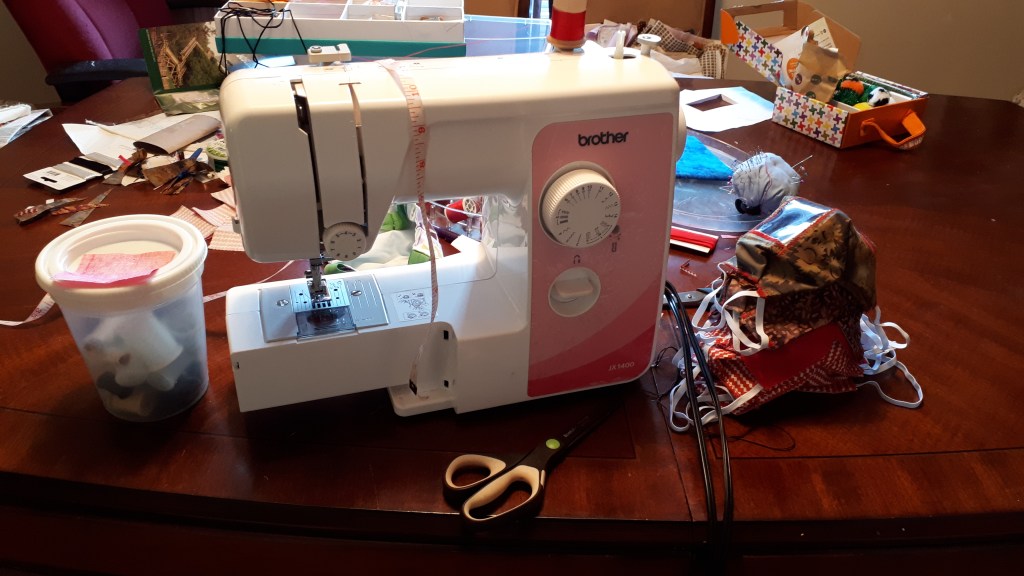
Sewing machine on a wood table with sewing supplies around it, and a pile of completed fabric face masks beside the machine.

I made an attempt to make free masks for those who need it, and it was good but it did not last long. I was happy to make roughly 30 masks in total. The challenge I had was, because I am not a car owner, delivering these masks was more difficult than I anticipated. I also got frustrated when people don’t respond to Facebook messages after a couple days.

I decided that chasing people and following up with them on social media after making a request for a free mask is not worth my energy. When I stopped making these masks and getting stressed out with all the logistics of delivering them I decided to focus on the fabric bags that I am making for healthcare workers and I’m able to reach making 300 of them. And that felt pretty awesome!

When my husband had to go back to the office on a more regular basis he asked me to make several more masks for him. He already has a few that he uses whenever we have to go out for things such as going for groceries. But this time he actually wanted something more special and customized for him. We went against my inclination to use fabric I already have, and we went to the fabric store to buy a brand new fabric with a design that he likes for me to make masks. He has about two dozen of these masks. He seems pretty pleased with himself and I’m more than happy to make those for him.

Just in the fall, as I started to go back to work at my office on almost a daily basis, I decided to make additional masks also. At this point, after some trial and error, I found a mask style that I’m happy with overall. So I made five more of these and I learned my lesson from last time, and I put in an additional inch of elastic.

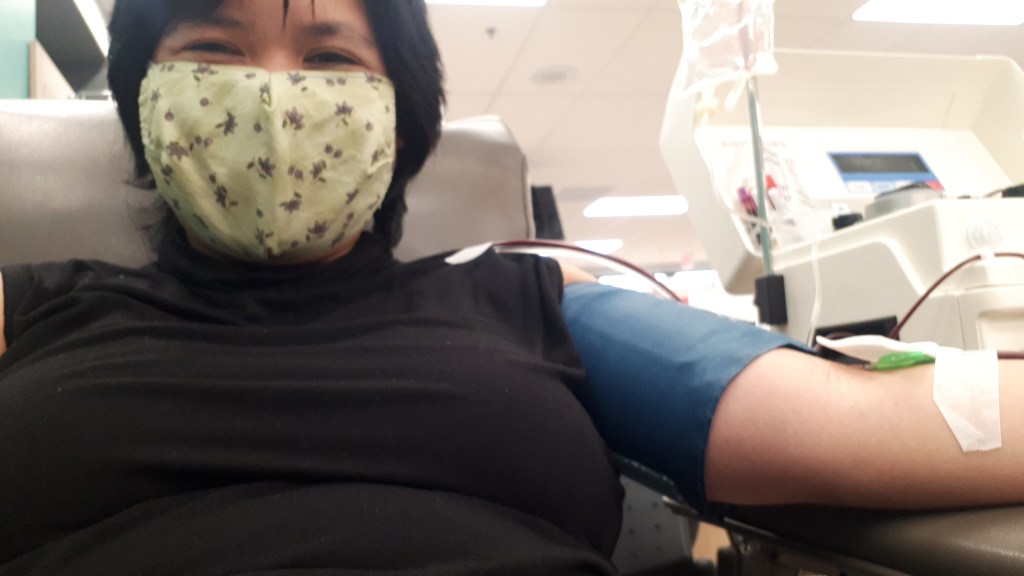
Woman wearing a face mask while donating blood at a blood donation clinic.

Now that it’s getting even colder, I learned another technique that I started to do when taking public transit and having my face covered. In the past, to keep myself warm and comfortable I actually wrap my winter scarf around my face. A few times, I have actually taken public transit and covered my face using only this scarf , not wearing a mask at all. And the way I wrap my face it is pretty comprehensive, practically my entire face is covered except for my eyes. So I’m pretty confident that I have fulfilled the bylaw regulation about face coverings. But now that it’s getting even colder I even doubled up. I would wear my fabric mask 1st and then, wrap my face you seeing that fluffy winter scarf that I use everyday during winter. When I go to our office, I make sure that I have at least one fabric mask which is what I use when community or when I don’t need to talk to people, and I make sure that I have at least one of my special masks with a plastic transparent window if I need to talk to people.

The routines related to masks in my daily living has been more settled now. From handwashing them on the weekends, ensuring the stitches and seams are still intact, and providing solidarity on social media to people who had to deal with people who refuse to wear masks feel second nature now. There is a part of me that wishes that people continue to wear masks to limit the spread of the flu during flu season. But for now, I’ll continue to find small motivations and silver linings to make the pandemic more manageable.

Bottle Drives as Fundraiser: a Unique Edmonton Experience For Me

Box truck with label on the side that says "Get the Yuck Out, Skip the Depot"

By: Giselle General

When I first arrived in Canada, I had my first experience in having an actual process to sort out garbage. Different types of garbage are sorted according to type such as refundable like bottles and milk cartons and cans, landfill materials, recyclables like plastic sandboxes, and things you can refund for money such as wine bottles, beer containers, and soda containers. So before moving to Edmonton, I have integrated the habit of sorting my garbage. And I also have a vague idea or realization, that returning these refundable drink containers will give you money. Then, I first noticed in grocery receipts, that you get charged money for buying liquids to drink in particular containers. So if you make the effort of returning these bottles, it’s not like you earn extra money, but more like you get your own money back.

Lawn Sign that says "Help us Build a New Rio School Park. Rio Park Bottle Drive, Today 9 AM - 1 PM"

When I moved to Edmonton I have observed a similar process. The way organic material is handled is a little bit different, but the sorting process is still there. Making sure you have the appropriate bags to sort your garbage such as the transparent bags for leaves in the fall, the black garbage bags for landfill stuff, the blue almost transparent plastic bags for recyclables, is integrated in once grocery shopping routine.

However, the actual process of people or organizations collecting refundable drink containers is something I haven’t seen before. As it turns out, this can result to a lot of money! And it looks like it is a relatively popular method of fundraiser.

I personally have seen many bottle drives before, and participated in some of them as a donor of containers. This particular weekend however, I finally helped my neighbourhood community league by supervising the bottle collection drive portion of our September event, for Community League Day. It’s a pretty easygoing task, all I have to do is to physically be on standby beside the truck where people would pull over bring their containers of bottles and place it inside the truck. At the end of the day this truck, this company, will take away these bottles, process them, and give money.

Selfie of Author, wearing a knotted hat and wearing a name tag "Giselle, Board of Directors".

Using bottle drives for fundraisers have been so popular that I received multiple requests as a homeowner different times a year. During spring and fall, like a predictable annual routine, I would get a flyer on my mailbox requesting for bottles to help the neighbourhood local children’s Scouts. A particular nonprofit organization has this as a regular part of their fundraising which is called Empties To Winn. The way this works is, they provide uniquely labelled large plastic bags where people can put in their drink containers for refund, every quarter the organization sends someone to pick up your bag with bottles and cans, and at the end of the year, you get a tax receipt.

There’s so much money to be made from collecting bottles and handing them over for a refund. Folks experiencing homelessness typically use this as a method to earn a little bit of money. I see people in parks and Transit stations looking a little bit worse for wear, reaching into the garbage bins to see if there are drink containers in them. We even have a small incident in our neighbourhood last year, for some residents were a little bit upset because they realized on garbage day their bags of recyclables is ripped into pieces causing guard pieces of garbage to be flowing and flying all throughout the sidewalks and streets. It was discovered that this is a result of a homeless person on garbage day going to each of the piles of garbage bags, ripping open the bags to see if there are any bottles. My neighbours made it clear that it’s not like they don’t want a homeless person going around the neighbourhood. The only problem is the littering it causes. Thankfully one of the residents had the chance to see this gentleman rummaging through the bags and kindly asked him to tie up the bags again after he sifted through them. Problem solved.

Inside of a truck, with a dozen blue garbage bags with refundable bottles and drink containers.

It’s fascinating to observe the people handing over bottles during the bottle drive. There’s the one gentleman in his red pickup truck where the back compartment is full to the brim of bags. He said he was planning to bring them to the Bottle Depot, and then COVID-19 happened, and then this opportunity came about to dump them all here. There’s the lady who had her containers in a water drum, so we had to work together to pour them all onto a plastic bag to put into the truck. There was the father of the kids who’ll be benefiting from the bottle drive. He told me that his son goes to the elementary school of the neighbourhood, and he appreciates that this bottle drive will raise funds toward’s be renovated playground for the elementary school.

For some people, they are diligent enough to collect the bottles bring it to the nearest Bottle Depot and enjoy the earnings of their diligent organizing. But for many, getting a few dollars every few months is not worthwhile, but the feeling of being able to contribute meaningfully for a charitable cause it’s definitely worth a lot more. For as long as there this system that helps collect organized and provide money for these recyclable drink containers, I think we are going to have bottle drives for the next little while and it is awesome.

The Process of Checking my Privilege: A Filipina-Canadian’s Perspective On COVID-19

At this rate, it would be just over three months since drastic measures have been implemented here in Edmonton to mitigate the effects of the pandemic. Given my line of work, my tendency to get involved in the community, and how I stay connected on social media, I get to witness how different people react, respond, and adapt to the current situation.

Checking My Privilege

The first time I heard this phrase thrown around, it gave me mixed feelings. Since, in many ways, I am not part of privileged groups. I constantly heard about the many ways that women are mistreated (which is true), how migrants are disadvantaged (which is also true), and how my plight as an orphan is tragic and pitiful (which, let’s face it, is also true in many ways).

But after participating in a few activities that encouraged people to check their privileges in all aspects, I had a more complex perspective and better appreciation of the idea, including things that are most certainly beneficial and not everyone has access to for no other reason that location and circumstance. Here’s a short list:

Public Transit: The fact that there is still transit service in Edmonton is a huge deal, since in places like the Philippines, many people are unable to go around since all public transportation is banned due to the lockdown. On top of that, public transit vehicles here are buses, which a nice and large vehicles and there is ample space to spread out and stagger seats for passengers. The LRT is also still operational which is wonderful! And, the icing on the cake, is that for some time paying public transit fare is suspended during this time. That’s quite incredible!

Person wearing white shirt soaping hands with white bar of soap

Access to Information: The ability to read, write and hear, particularly information written in the English language, ought to not be taken for granted during this time. Most of the government announcements and health information is in English. This came to light after a fellow Edmontonian who is involved in the community, was asking for donations of printing paper so she can print information about COVID-19 in languages like Urdu, Hindi and Punjabi. Another spotlight came from advocates for those who are deaf and hard of hearing, pushing anyone who product digital media these days to ensure that accessibility tools are the default. A volunteer in my office posted on Twitter, saying that being blind, info-graphics are useless, and photos don’t work well if there are no alt-text descriptions.

Uninterrupted Access to Utilities: I’m talking about water, internet, electricity and heat. I’ll say this over and over because it cannot be underestimated. It’s definitely more comfortable to stay in one’s home if these critical elements are in place constantly. From someone who grew up in an environment where electricity interruptions are normal, and when water is scheduled only to be available certain times a day, living in Canada where these are hardly interrupted still blows my mind. Think about this simple question: how can you wash your hands regularly when you don’t have constant access to clean water? I reflected on this on an earlier post, after visiting the Philippines and the homes I used to live in.

Government Benefits: Another term I learned a while back, that is highlighted during this time is the Social Safety Net. Applications for programs like CERB and loans for businesses, legislation to delay evictions for tenants are being passed on a faster pace than before. This is something to not take for granted and it’s always valuable to think critically on who benefits and who gets left behind. It’s incredible to witness both the praise and the criticisms of these programs. I think it’s a sign that people are being both proactive and vocal about how policies and programs affect them and those around them.

Back view woman looking at a laptop on a dining table

Having a Job, and the Ability to Work or Study from Home

Many office jobs can be done from home, and there are so many occupations that need to be done in person. The ability to smoothly switch over to working from home also depends on one’s current circumstances. There are many articles talking about inequalities based on region, internet speed available, having computers and laptop, and a privacy to join online meetings or classes with limited interruptions.

Our basement roommate just spoke to us as she was recently laid off, and given that she won’t be able to have enough money to pay rent, she is moving out by the end of the month (which is technically less than one month, as stated in our agreement). My husband and I stated that it’s not a problem at all, and we are sorry to hear about the job loss. She is moving back to her parents’ home when she won’t have to pay rent, and it is a stressful time for her. Stability through employment is something not to be taken for granted.

This is just a short list. I can go on and on. I think I’m writing this as an opportunity to express gratitude, count my blessings, and remind myself that as an individual, when these programs have gaps, there are many ways to fill them temporarily to help those facing a current crisis.

A Cog in the Community Service Machine: A Filipina-Canadian’s Perspective on COVID-19

It is to be expected, that in a crisis like this, many people will be put in a difficult position (or a more difficult position) and are in need of help. One incredible thing about this pandemic is that there were lots of opportunities to help, and there are different roles to fill.

It’s pretty neat to take a break from being on the organizer role (I’m talking specifically about my job), since all our programs are cancelled. My job is the main way I do something that helps people in need in a direct way. My volunteer work as a member of a board of directors is also important, and I appreciate it, but a bit more removed, a bit more big-picture.

I was not surprised that social media pages and groups were set up to help people in an efficient way. Facebook groups specific to COVID-19 that enabled the average person to have a direct way to help with advice, positive commentary on social media, and buying items online to help those with emergent need. For a Facebook page that is just barely a month old, to have 20,000 members, is pretty darn impressive. I wanna buy a case of wine for each of the founders and moderators of the page. What an incredible labour of love.

Another way I have been helping is by being in “super seamstress mode”. Since last year I’ve been making fabric bags for Boomerang Bags Edmonton, and that has proven useful during this time. Hundreds of people throughout the province started making fabric laundry bags for healthcare workers, so they can separate their dirty (and most likely contaminated) work uniforms and toss them right away into the washing machine.

In my neighbourhood, with relief, I discovered ways to do a little something cheerful right by my front yard. Sidewalk chalk art. Staying connected with community leaders. Volunteering from home.

For my workplace, I realized that disseminating information, especially online, is really important. It’s part of my duties anyways. Handling marketing and communications for work and the clients we serve who need help is a part of my daily duties as I work from home.

These are the “doer” type of roles. The soldiers in the field. The cog in the machine. I know there are hundreds of volunteers doing seamstress work right now. I know (and it’s incredible) that there are thousands of people on the Facebook group, that almost every single time someone make a post asking for help, an offer is made within an hour or less. I am seeing dozens of photos drawing positive messages of pavement or fences, even if there’s a risk of snowfall or watery puddles the next day that would wash it away.

I’d like to take a moment to give a shoutout to all the administrators, organizers, facilitators of these on-the-ground initiatives to help others. Because it’s more stressful to do it at this time, but the relieve that these gestures of support is also of a greater impact.

Book Review: Edmonton’s Urban Villages

Through my volunteering at the Edmonton Federation of Community Leagues, I obtained a copy of a book that talks about the concept of community leagues and its impact in Edmonton, named Edmonton’s Urban Villages, written by Ron Kuban. This is a review of the book.

A Comprehensive and Digestible Overview of this City’s History

A city that existed for over a hundred years has a fairly lengthy history, one that would have pretty decent documentation as well. It is safe to say that the volume of information can be overwhelming, particularly for someone like myself who doesn’t describe themselves as a ‘history buff’. What I appreciate about this book is in its pages, combined with narrations, photos obtained from archives of the organization and from the city, the book is a neatly organized overview of the city’s history that is easy to read.

I have heard about how the city evolved, how it expanded and merged with neighbouring towns, how roadways are planned and utilities are managed, how recessions and wars impacted the economy and day-to-day living. Though other events or forms of media, I learned about the different social, political and economic eras that our city had, and I appreciated how it was presented in the book.

Community Leagues and EFCL had been an incubator of many initiatives that flourished into independent organizations. When I encounter city-wide organizations that focus on a particular activity, like soccer or hockey, I am now more likely to probe on whether this is something that the community league movement had initiated on a neighbourhood level.

Familiar Names and Places Given Deeper Context and Appreciation

People whose names I see in street signs, news articles, historical videos and hall of fame galleries popped up numerous times in all the book’s pages, which for me is quite delightful. As I personally never had a formal class about Edmonton’s history, opportunities like this book, which is a light read, is a chance to understand who, when and what happened at certain times. Some of the names in the book were individuals I have met in person recently, and it’s incredible to witness what they have accomplished in decades past, that is impactful enough to be documented in such a fashion.

From war veterans to business owners, from politicians to women to broke the glass ceiling in their own right, witnessing how they did their part to make an impact at a local level (the neighbourhood level) is valuable in knowing why our city works the way it is now. The events were not always pleasant, and even the people were far from perfect. The chapters talked about differing views, burnout, conflict, and missed opportunities to work together, but there seems to always be a positive turn of events afterwards.

Motivation for Greater Involvement in the Community

My community involvement has a slightly selfish goal, to address my level of disconnectedness from not being born-and-raised here. At the same time, I feel deep meaning in making a contribution of my time and energy to the community at large. My personal involvement with community leagues is fairly recent, just when we moved to our house about five years ago. Learning about the concept of community leagues, an idea that originated in the US that had a Canadian and Edmonton-based modifications to it is quite remarkable.

I understand and appreciate better the idea that there are different levels of involvement: from the volunteer who comes at events to help set up and take down the furniture at the hall, the volunteer who tracks the mail for the organization and pays the utilities, the one who helps with fundraising and financial grant applications, the big-picture people who helps with decisions and bylaws, and more. The book repeatedly talked about the “unnamed volunteers”, thousands of them, that are the real heroes of this movement. I hope to do the same in my own way.

100th Anniversary of the Featured Organization

2021 is a significant year, as it is the 100th anniversary of the organization featured in the book, the Edmonton Federation of Community Leagues. There has been some projects that are in progress to memorialize this milestone. Discovering this book could not have come at a better time. An update of this book as it written in 2005, is a great idea for sure, since the past 15 years had made a lot of changes in Edmonton and how people and communities function.

If Money is not an Issue

Many years ago, while searching for jobs not too long after finishing university, I stumbled upon a few articles online that encouraged the reader to ask this question:

“If money is not an issue, what job would you like to have?”

At that time, I answered “volunteer”. And it seems like that indeed had led me to a role that suited my skills and interests, and is quite rewarding. As a Volunteer Coordinator of a nonprofit, I have learned to appreciate the value of having the structure that enables the volunteers to focus on what they do best at their designated role, and not to worry about small details that can delay or distract them.

Lately, I have been thinking of what the future holds given that I am still considered a young professional. After all, I’m a few years away before turning 30. Retirement feels like a long time away, despite the fact that my husband diligently prepares for it through our regular savings and keeping our accounts organized.

We have a lottery pool at work, where each staff member who wants to participate can pitch in $2, a staff person goes to buy a ticket, and hope that we are the next group of employees who win a few million dollars, like the ones we hear about in the news.

I remember a comment from a former colleague Sofia about lottery winnings that stuck with me. She said “imagine how much affordable housing you can build out of all that money.” I appreciate her viewpoint since it was the first time I hear from anybody about a way to spread the winnings to those in need. Another colleague had said, with a hint of worry “I wouldn’t know what to do with all the much money.” This is also a fair point, as I heard numerous stories of people’s lives turning for the worst after winning the lottery. The troubles that the winners have come in two ways, from being reckless about spending, and from being bombarded with inappropriate request for money from distant relatives to random strangers. I guess, with great wealth comes a great burden.

Right now, if money is not an issue because somehow I have large sums of it or an unlimited supply, I imagine that I will split the money into a few different categories:

  • Personal financial stability
  • Assisting relatives in need, both in this country and overseas
  • Local charitable donations
  • Large-scale impact on certain social causes

For example, I’ll pay off our home’s mortgage and set aside enough money for an investment fund where the interest is enough to cover current expenses and occasional luxuries. And then, I’d like to find a way to provide financial assistance to my relatives in need in a way that is sustainable and has a long-term benefit: whether it is funds to start a business, house and lot, or covering tuition payment for younger kids.

Outside of the family unit, here’s how I envision huge sums of money can make an impact. There are many charitable organizations that struggle to stay afloat, and as a result, searching for funding eats up precious time that could have been spent making a difference through their programs and services. Providing stability such as through an endowment fund or a financial boost for a few years would be a good thing, I think. And then, similar to those lottery winners who would donate millions of dollars towards a cause, I’d like to do the same thing as well. Instead of just dropping a cheque though, I’d like to help build something from the ground up. Maybe a new building to expand an organization’s service and operations, or even a brand new facility to fill an unmet need.

One can dream, right? But, since the chances of winning the lottery or having a massive multi-million dollar business empire is pretty small, the realistic, real-time version of myself had scaled back these lofty dreams into manageable, small things that can be done in present time. With the income from my paycheque, helping charities and relatives and building a sense of personal financial stability is achievable in small chunks. As far as making a large-scale impact, I’m hoping that running for public office one day can fulfill that.

Either on my own, or through in-person and online workshops, I have participated in exercises to help envision the future. It’s a good opportunity to evaluate one’s preferences and aspirations, and indulge in thinking about how outlandish scenarios might just come true. The plan is to ask again this question when I officially turn 30 and periodically in the future.

There was a catchy Filipino pop song that I remember in my teens, titled “Ambisyoso” which is the translation for ‘ambitious’. Some of the writer’s outlandish dreams are pretty funny, like a kissing scene with his favourite actress, but I really like the line that talked about “a wallet that never runs out of money”. That’s what prompted this thought exercise, and I’ll likely revisit it again.