Love Language Reflections: On Not Buying Gifts

This is a fitting topic for my birth month! Gift giving is such as well-known gesture to showcase thoughtfulness, affection and meaning, but it can get complicated at times. Then the act of gift-giving is muddied with feelings or anxiousness, resentment, burnout or the pressure of expectations. That is when, in my opinion, the positivity stops.

May is also the month of Mother’s Day, so for the the first two weeks of the month, there’s a wave of relentless advertising about products and services that people ought to purchase to make mother feel special.

Man wrapping a gift box, tying the ribbon.

For couples, I suppose there are three occasions where it is usually expected, or anticipated, by people that they will receive a gift. Birthdays, wedding anniversaries (or equivalent) or Christmas (or equivalent). For quite some time know, my husband and I don’t buy each other gifts for every single holiday and birthday.

I didn’t always feel good about it, especially in the beginning. It’s something I gradually got used to, and eventually appreciated as I got older. The more I get attuned to the constant, and frequent ways of showing care, concern, commitment, and affection to each other, the material goods mattered less and less. Any day, I’ll take my husband saying “I love you” a dozen times a day, than a shiny piece of jewellery every anniversary that will surely collect dust.

We are not super materialistic to begin with and we are both independent in nature as well.. So when there is a product or service that we need, we don’t wait for the next gift-giving occasion, or make someone use their money to buy it. We research, check our budget if necessary, and make the purchase in a way that works best for us.

I needed a desktop computer, since I have only been using a tablet (that I can connect to a monitor) for the past five years. But I don’t need or want it to be completely brand-new. For this year, I got a “half brand new” computer, meaning, I inherited some of his computer parts that he needed to upgrade, got a new case and new components, and got my own machine for half the price! That was actually an experience we treasure, because going out to stores during the restrictions due to COVID19 is quite an experience.

The peace of mind and financial freedom is actually quite incredible. The holiday season every December is so relaxed, because there’s is no need to scramble to buy or make a gift.

One way I have given him gifts is through my arts and crafts skills.I’m fortunate enough to be a crafter, so many of my gifts for him are artistic, one of a kind and also practical items. I first made a quilt, using our old Tshirts as material. As the years go by and we cohabited longer, it became apparent that it’s easy to run out of ideas for meaningful and utilitarian gifts. The quilts and pillow cases seem to be doing well in terms of longevity. And now, while using these items on a typical day, he would exclaim how much he appreciates these gifts “made with love”. I would exclaim how long ago these items were made, and they unexpectedly became mementos in their own right.
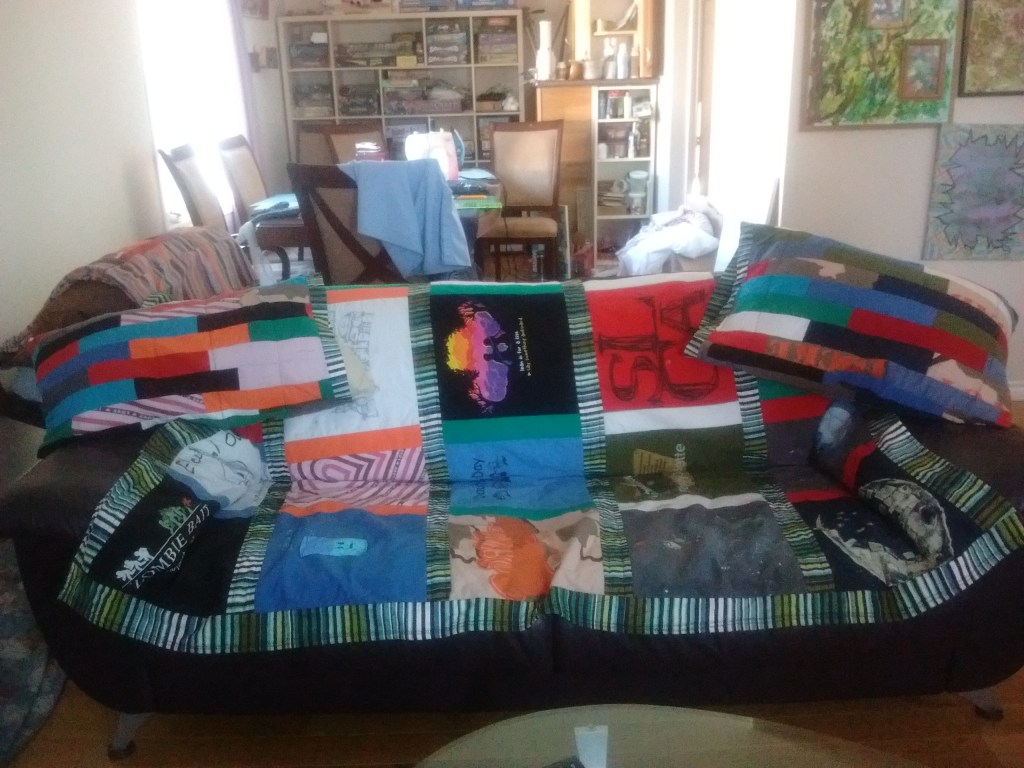
Living room couch covered with a quilt and pillow cases that were DIY.

For my brother, over several years, I have been giving him cash, and that seems to work well. It would be in an envelope with a heartfelt message and the dollar bills. Due to COVID-19, I know that many businesses don’t accept cash as payments anymore, so I sent it as an e-transfer, and included my heartfelt message in the message box. He is the only exemption to the rule, and I think in some ways it still counts, since I managed to escape the agony of choosing and buying an item he may not like or use, but instead, give something that would really of benefit as a young man. Maybe, the love language in that one, is that I trust him enough to know the best way to manage his finances.

“I Don’t Want To Be Raped Again” The Captive Transit User Series: Part 2

This is part of an ongoing series of posts discussion issues I personally encounter while taking public transit in Edmonton. Links to other posts will be added on an ongoing basis:

My frame of mind for the longest time was, the most dangerous place to be is my own bedroom. This however, didn’t prevent me from associating darkness and public places with being at risk.

What is a Captive Transit User? I learned about the term for the first time from the City of Edmonton’s website. The easy definition is: someone who takes public transit because it’s the best (or only available) option for them to travel around. The part about feeling ‘captive’ comes from the restriction that sometimes comes up, perhaps because one is too poor to own and maintain a vehicle, one does not know how to drive, or for medical reasons, cannot operate a vehicle. In many ways, I relate to this a lot. Though I’m pretty fortunate to afford the occasional taxi ride and with my husband having a car.

When it comes to big picture thinking on social and political topics, this is a short list of a trauma-informed approach (the 4 R’s) that I compiled.

  1. Realizes the widespread impact of trauma and understands potential paths for recovery
  2. Recognizes the signs and symptoms of trauma in clients, families, staff, and others involved with the system
  3. Responds by fully integrating knowledge about trauma into policies, procedures, and practices
  4. Resists re-traumatization 

I sincerely hope that government officials and service providers, especially with transit, would integrate this perspective in very clear and tangible ways more often.

The way the human psyche works, all it takes is one horrific and traumatic event to discourage someone from doing something, or to have a very negative association towards something.

That makes a lot of sense. If a person gets attacked in a specific LRT station, that person will likely try to not use it ever again, or if they don’t have a choice, to be more wary, stressed and anxious every time the use it. Certain bus routes apparently have a prominent reputation for having lots of disruption, where the likelihood of being harassed is a lot higher. Imagine being in an ongoing state of high alert and anxiousness on a regular basis?

As a high school student in a city in the Philippines, I always got told to go home way before sunset, because taking public transportation after dark is dangerous. As a relatively new resident of Edmonton back in 2008, I was also told to be careful when commuting in downtown because of the “sketchy people” that are around.

This is tough, because when I was hearing these messages, many of these people don’t know of my history of sexual assault. My frame of mind for the longest time was, the most dangerous place to be is my own bedroom. This however, didn’t prevent me from associating darkness and public places with being at risk.

When I got home from my office in downtown, sometimes I say to myself with a huge sigh of relief “Today is a good day! I didn’t get raped…or stabbed, or groped. Thank goodness!” There are numerous stories of harassment that I hear from fellow residents of Edmonton about unwanted attention while waiting for a transit vehicle, or while onboard one. Many people crafted strategies to minimize the likelihood of this happening, such as wearing headphones and staring blankly when someone is trying to strike up a conversation.

Many share the feeling that they are forced to be nice to not “set him off” and to avoid being an ‘active hostile target’ of harassment. There was that story of a woman speaking out when a man on a bus started making racist remarks to an Asian-Canadian person. There is two types of hostility in this instance, the one inflicted towards the Asian-Canadian person, and then towards the woman who called out the harasser.

Commuting late at night poses a additional set of challenges. There’s that heightened sense of panic when the bus is missed or the last route has passed. There’s a recent announcement that the city’s telephone service line, 311, is unavailable in the evenings after 7PM, which is a disservice to those who are more vulnerable in the evenings.

One time, I was stuck at the U of A South Campus because when I got off the LRT, the connecting bus I was planning to take just departed, and it is another half hour for the next bus since it is after 10 PM. I realized that instead of waiting completely alone, it is better for me to take the train back to the University of Alberta station and take a taxi there to get home. This is a good back-up plan assuming there is indeed a taxi waiting in the stall by the University Transit Station every time. And based on personal experience, that is not always the case. Spending extra time to re-route one’s travel to get home because of safety reasons is a bit counterintutive since the best scenario would be just getting home quicker, but for a transit user with limited money, this is a reality. A trade off between money and time, with safety being potentially compromised along the way.

Being blamed for an attack while taking transit really riles me up. It reminds me of the blame cast at me and that I internalized, and that many others have experienced as well.

Perhaps it is a very high standard, but this is my take on achieving a safe transit system: When an Edmontonian who previously had a horrific experience taking transit, then decides to take a chance and felt comfortable, safe and satisfied in their journey from point A to point B. I have some level of hope from what seems to be the city’s effort to incorporate GBA+ Analysis framework, and the availability of ways to make an impact such as city committees like the one I volunteer for. This is the threshold that ought to be met, and I do hope we get closer to getting to this, in a way that an average person will instinctively notice it.

Book Review: Becoming Superman

This is a book review of Becoming Superman written by J. Michael Strazynski, the person behind the Babylon 5 Television series as well as SENSE8. The book is an autobiography, covering the author’s family history before he was born, chronicling his own experiences growing up in a precarious, violent home, his coping mechanisms in the form of comic books, pursuing a career in the creative and writing field, and ongoing commentary about his relationships throughout the years.

For some context, my husband is a huge fan of Babylon 5, and by huge, I mean it’s the “mega-nerd” level, which I say affectionately. He has the DVDs, book of the scripts of the episodes, including a separate book talking about what happened to another show that was launched by the author but was not so successful. Watching Babylon 5 was a memorable part of our early years of dating, back when sleepovers were not even a consideration and we are sorting through our mutual awkwardness. The moment that there was news about a book where the writer talked about his past, I was not surprised that my husband pre-ordered an autographed copy!

Now, to the actual review of the book.

It is detailed, gut-wrenching and compelling in its narration, a reflection of his ability to captivate audiences creatively no matter what creative medium. He is a well-recognized and well-respected writer in Hollywood, particularly in the science fiction genre, so this is just another testimony to his talents.

On a personal level, many chapters and stories are very relatable, particularly the parts that talk about fictional characters and forms of literature as a source of escape from the harshness of real life. The anguish of the young child, of the young man, in every fight that happened in the home, every time his father announced that they are moving again, every time he pours in hours and days writing to the point that he gets sick, all of these are palpable in every page and every chapter.

It’s fascinating to me though, to witness how a real person has embodied in many ways, the characteristics they saw in a particular fictional superhero, in this case, was Superman. Which made me wail in agony, just like him, when his father maliciously destroyed Michael’s comic book collection.

This is not just a book that aims to narrate and inspire. As I was reading through the chapters, there’s an undertone of wanting to use the book as a tool or a weapon, to vindicate and for vengeance. And in the last chapters of the book, my inclination was confirmed. The writer did intend to use the book in many ways to get back at his father, for the abusive treatment he inflicted towards the family, and to expose the background he felt his father was trying to hide and deny. It is evident that the writer wanted to broadcast as loudly as possible, his father as a Nazi sympathizer. An arrogant, violent and abusive man.

One thing I didn’t anticipate is how in certain chapters, it felt more like a personal development book, rather than an autobiography. During his several positions in journalism and scriptwriting, he shared a few pieces of advice that stood out to me (in paraphrased form):

  • Write as much as you can to “get the crap out”, so you can start making good content
  • Be reliable and always hand in your work on time, since about half the people who are expected to hand in work, flake out and miss deadlines. This builds reliability and a good reputation.

As someone who is still a young professional, who does creative work on the side, I think that these are really good pieces of advice, even for those who are not necessarily working in creative fields.

Overall, I am pleased with the book, and I know it will be part of a treasured collection of items that we will have in our home for a long time.