Memoir Writing Reflections #10: I Got a Contract

By: Giselle General

Most of this year has been preoccupied by my second attempt running for city council, where I lost again.

Now that it’s over, I can re-focus again on my other endeavours that have been in the works for several years now. I made a social media post when I signed the dotted line last June, but I can embrace and fully recognize and celebrate it again – I got an author contract!

Earlier this spring I received an offer from NeWest Press, a nonprofit local publisher based here in my hometown of Edmonton. I really love the fact that it is local. I also really love that I am not the first Filipina-Canadian author they worked with. I highly recommend buying or borrowing The Cine Star Salon by Leah Ranada. I figured, if NeWest helped make her book into its final form, then I’ll be in great hands.

I’m equal parts baffled, humbled and excited that I got a contract quickly by comparison, only a year after I have completed the all the professional editing and beta reader services for the manuscript. I’ve heard so many stories of past and present struggles from writers about taking a very long time, as in years, to get a publisher. From feeling frustrated waiting for a long time, many decide to self-publish or make changes to the manuscript over and over to submit again.

It’s such a fascinating and intimidating experience reading the author contract that I searched for lawyers and contract reviewers to help me understand all it entails. There are some straightforward stipulations such as being on time with giving feedback on the manuscript, the advance payment, how many will be produced and what happens when copies are sold. And there are some long-term items should the book gain traction, such as movie rights, international distribution and translation.

Part of what makes this book writing process likely a bit unusual compared to many writers, is that I technically already got compensation. Thanks to the grants I applied for during the writing and editing process, I feel like I already earned some income from my writing efforts. And I will be the first to recognize how fortunate that is. I still remember the e-newsletter from the Edmonton Arts Council emphasizing that roughly 20% of applicants get approved. I bet that percentage is even smaller with the Canada Council for the Arts with the applicants all across the country. Both organizations gave funding for this book. I will never take that for granted.

As a result, I don’t feel pressured to sell a certain number of books to earn back my time and effort to break even or make a profit. Everything else is gravy. But of course, I’d like to have as many book sales as possible. The fact that contracts now have standard clauses for movie rights and international distribution can make anyone dream big!

The most remarkable part of this, is that it truly feels like a full-circle moment. The assigned editor for this final stage is the one who helped me get started in the first place. Wendy McGrath, my author mentor with the Writers Guild of Alberta program called the Horizon Writers Circle back in 2022. The one who said to me with fierce determination when I first talked about the idea of the memoir, “yes, in six month we will finish a first manuscript together!” The one who insisted that I start applying for grants so I can get professional editing services and pay them properly. The one who also edited a separate written work for a local anthology. The one who already have read and edited several chapters of the first draft. Most definitely, the perfect person to help take it to the finish line.

I like my rules and timelines so pretty soon, I will be fully working on the final round of editing for the manuscript before it officially goes on print. I had two additional manuscript review services I used a while back, but I didn’t incorporate their recommendations when I submitted the manuscript to a few publishers. This final review will be the perfect time to read the feedback to see if the delivery of the story can be more effective in some way.

Some major changes that need to be done are changing the names of the characters to protect people’s identity and decisions on how to deal with copyrighted content such as songs and poems. It felt right in my heart to add actual sections and quote them in the chapters when I was first writing. But in its final form, I feel more open to removing it altogether. It can be quite expensive to request for authorization and rights.

I’ve casually talked to people in the city the past few weeks about the book, as a way to deflect the conversation after I receive the standard sympathetic comments for losing at the election again. I met a person from another local bookstore I haven’t heard of, who said their shop is willing to host an event and a local reading session. My massage therapist told me that I should inform them when the book is out as they have a shelf by the reception area to sell locally made products. I’ve already been to a few book launch and author reading events and plan to attend more in the next while.

Even before all the book-related activities, I do have another launch coming up soon, the premiere of the documentary project Building Pinoy. Any lessons about promoting a creative project, dealing with reactions, will definitely be something that I’m sure I can apply for the book.

There’s an actual finish line that I can foresee. A year and a half will fly by quick.
Memoir Writing Reflections #9: The Paid Services are Done!

By: Giselle General

During the Writers Guild of Alberta 2024 conference where I spoke in a panel about memoir writing, I mentioned that a big driving force in my decisions is fairness in compensation. The moderator of the panel seemed to appreciate how much I emphasized paying people properly for their efforts. In an area where people are typically underpaid, if they are paid at all, I vehemently refuse to add to the exploitation of artists.

That was why I really appreciated the advice from my writing mentor Wendy, that I can – and should – apply for grants. It didn’t even occur to me that I can get money to cover expenses I needed, let alone have money to pay myself for the efforts beyond writing the book.

Based on my online search, I concluded that I needed a developmental editor, a line editor, and a copy editor. What they do are related to each other, but are also distinct. This resource (written for a Canadian audience from a Canadian webpage) can help provide clarity on the differences of each. I contacted several editors using both the directory I found online and also contacting a facilitator of a writing workshop that I enjoyed. After getting quotes and plugging in the numbers on the grant applications, I clicked submit. I had earlier success with a smaller grant, but these ones are different, with a complete budget breakdown for each expense. I agonized on how much to add in the subsistence category until I decided to allocate a partial subsistence since I won’t be doing this book project full time. I hoped that my explanation that I contacted three sources for a quote for each editor service was both believable and accurate. I told myself to wait patiently, doing as many self-edits as I can until the professionals take over – if I can can hire them, that is.

A woman browsing their laptop, with books and a coffee on their desk.

To my surprise, my grant applications got approved. The money I asked for is also a pretty decent size, about tens of thousands of dollars. I would have been content to be approved the money I needed to pay myself a partial subsistence (some kind of living allowance for doing this work). But I got exactly what I requested, to the penny. Right after the agreements were signed and the money got deposited, I contacted the first editor right away, worried that after three months that they have other projects and won’t have time to mine anymore.

Thankfully the developmental editor was available, a fellow Filipina-Canadian who is deeply involved in social justice, arts, and literary community in Ontario through an initiative called Living Hyphen, supporting the creative expression of hyphenated Canadians like her and me. When she gave her quote earlier she even offered to give a discounted rate in case finances are an issue, but I placed the full amount in the grant application and now that I got it, I’m ready to pay that full amount. We had to sort out timezone differences for the video calls and sent several emails back and forth to ensure the contract details worked for both of us. We agreed for her to have three months to do the review since she needed to read the whole manuscript to give the big-picture and structural advice that the developmental editor is supposed to do, while tolerating my countless grammatical mistakes.

When I received her very detailed report on what to consider before the next round of edits, I asked her a very vulnerable question: “You know how in our culture, we are supposed to obey the elders and authorities without question? I feel unsure about your report. Am I supposed to obey and follow them all? Am I supposed to do them and send back to you for approval?” I’ll always treasure her kind response to this. “Whatever you decide is up to you. You have the final choice to accept, reject any or all of the recommendations. It’s your story.” Definitely worth every dollar I was able to pay – thank you funding grants!

After a few more discussions where I realized she didn’t understand something major in the story, I knew I had a lot of work to do. While doing all these edits, I contacted the line editor next – the one who would take up the challenging tasks of editing the grammar, line by line. This person is not a Filipino – which I did on purpose because it is important for a native-English-speaker to understand the story and to flag Filipino references that are unclear to her. With how the scheduled ended up falling in place, she had to edit from mid-December until early January. I felt a bit guilty and emphasized that there’s no need to work through this over Christmas break. But she seemed okay with doing it. After all the hundreds of verbal tense edits she did on the almost 90,000-word manuscript, I gleefully e-transferred the payments.

A month after the line edits were completed, I contacted the person I chose as a copy editor, a fellow Filipino-Canadian in the local literary community in early 2024. This is my third professional editor so I kind of know the motions: preliminary meeting and discussion, contracts, payment details, sending a copy of the manuscript, and then waiting patiently. Through him, I saw the clear signs of a professional who cares about outcomes and not just getting paid. He booked a meeting with me to flag his concerns, believing that my manuscript is not ready for copy-editing just yet since there are certain parts of the story that he had trouble understanding. I told him my short-term goals which is to have a manuscript and templates of documents to contact agents and publishers.

So we had to change our scope to help achieve that – to do some line editing and copy editing of the sample chapters I will send, to do another set of line editing on the chapters with sensitive content, and to help me draft the content I will send for applications to get the book published. Think of it as a resume-writing service, but the applicant is me as a writer and the story of the memoir. All these cost a bit more, but with the grant funding I got, I was able to make some adjustments.

Once his edits were completed, the literary conference took place. The organizers did a fantastic job with the panel, as the first panelist had at least two memoirs published and bunch of other books, the second panelist had one memoir published, and there’s me who just finished the professional edits of the manuscript. Maybe I’ll reach the same achievement as the other two, but for the audience it was helpful to listen to writers at different stages.

A wall in Giselle's office with a sticky note with writing notes, a sheet with brand new jeweled stickers, and a sheet used as a tracker for editing book chapters.

Given the extra funding I got, the first consultant-based reading service I used was the Manuscript Reading Service of my province’s writing guild here Alberta. As I paid the fees and waited for the manuscript to be reviewed, I took my mind off anxiously waiting by doing other visual artistic projects, mostly upcycling. I particularly liked the pay structure, how reviewer gets most of the payment. The review I received was insightful.

After I went through another round of self-edits, it’s time to do the other professional service I never thought I’ll have the funds for – beta readers. Their role is to read the the manuscript and assess it as a “regular reader”. I did this for a Canadian author a few months ago and it was a pretty cool experience. I admit, I had an “imposter syndrome” moment and wondered if my time and effort reviewing the document, and my insights condensed in a four-page report, were worth the fees given to me. It was a process to re-frame my mindset. Consultants of all sorts are paid for a reason, so I deserved that fee as well.

For my manuscript I ended up having three beta readers, a writer based in the US, then two people from my city, a non-Filipino person I know through my other community service work, and a Filipino person with a education in writing. I sent them the same set of questions about their experienced reading the book and their responses were quite different than I realized. It’s exactly the feedback I needed because my story has very Philippines-based context, that would be published in a country outside of my motherland (if I get lucky), with a diverse audience. Until now, I actually have a lot of decisions to make on whether their opinions will sway me enough to edit certain book chapters. Or perhaps I should wait until an agent or publisher reads the sample chapters and we can work through the rest of the edits together.

I joked a few times that dealing with grants is the worse combination of applying for jobs and doing your taxes, including the need to report what you did with the money at the end of the time period. For the first art funder I submitted my report and it was accepted, which meant that my recordkeeping was organized and they clearly understood where and how I spent their funding for this project. As this year comes to a close, I am preparing my final report to the second funder as well.

It’s still so humbling to think about the financial access I was able to tap into, and because of that, I was able to pay all these professional writing services the amount they asked for. No haggling, not undercutting. This whole experience for the past year and half drives my motivation even more to get this story to the finish line, to its final published form.

Back view of Giselle in her office desk using her computer.

Memoir Writing Reflections #8: Retreats and Panels

By: Giselle General

Frankly, I’ve always felt a bit reluctant to “connect more with the writing community”. Perhaps it’s the introvert in me. Perhaps it stems from my younger self who didn’t really learn the proper life skills to build and maintain a lot of friendships. But over the past few months, I had a chance to make some effort on this goal in incremental ways.

I applied to attend the Pandemic University Nonfiction Writing Retreat which happened in May. I must say, the idea of a writing retreat felt foreign and out of reach for the longest time, as they typically involve going into some faraway touristy area or an isolated cabin in the woods, hours or even days of uninterrupted writing in solitude or small groups, and being completely disconnected from my home base and everyday life. That’s a bit much for me, I didn’t think I’ll have the time or even money for such as retreat.

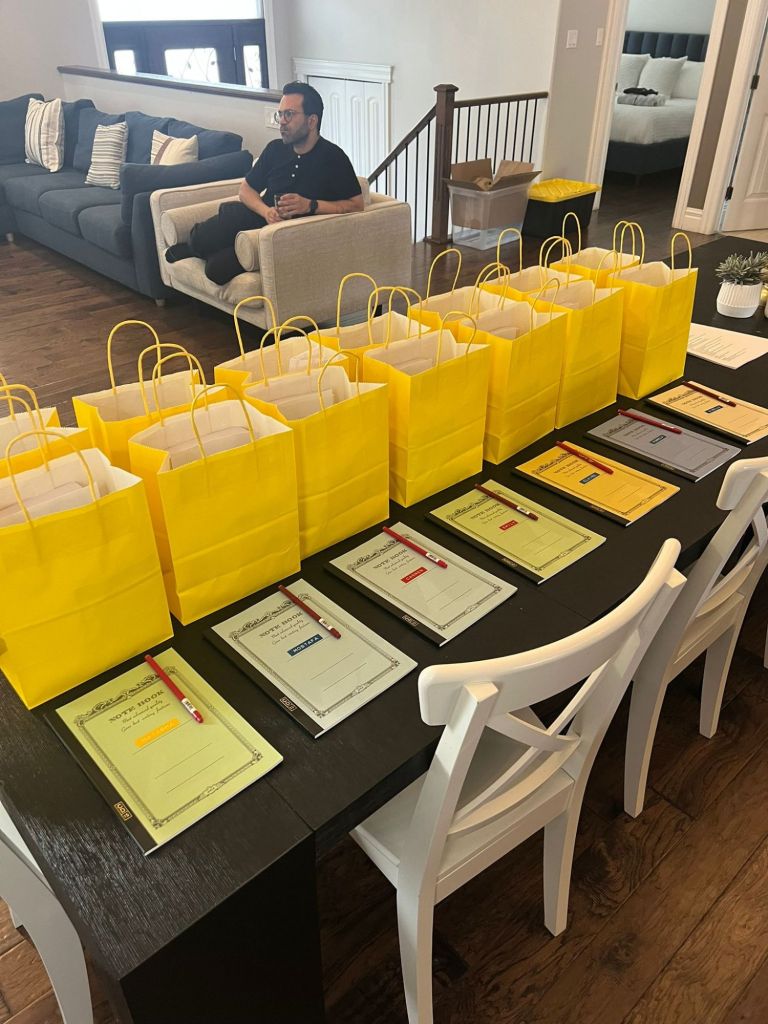
A table of gift bags and notebooks set up during the first night of the Nonfiction Writing Retreat.

So when this opportunity came up that gives me the choice to stay in my home city, be taken care of for majority of the day, and come to my home and husband in the evenings to recharge in familiar surroundings, I thought it was perfect. I’ve been wanting to attend Pandemic University courses for a long time but wasn’t able to find the opportunity to register. Also, the retreat being in Edmonton meant that it was more affordable for me.

When I went on the first night straight from work on the Friday evening, I was relieved that wasn’t too crowded, a total of 20 people if adding all the organizers and attendees. It is so much smaller and intimate which is exactly what I needed for my first-ever retreat ever. There were three presentations on various topics related to creative nonfiction that I recall were being offered as standalone courses, and then a Q and A with the organizers. Turns out, listening while sitting on a couch or dining chair with over a dozen creative people is so invigorating and cozy.

I remember feeling super self-conscious during the part where attendees like me were placed in smaller groups to do activities, review each others’ written drafts, and even during the one-on-one meeting to talk about my specific projects. It was very helpful though! I managed to ask questions and get advice on the two artistic projects I’m working on, the memoir and the documentary.

The wide range of backgrounds and topics that the attendees wrote about is just remarkable to see. Many of us have written, or are currently writing about really heavy topics and there’s something just so profound about being in the presence of people who managed to express their stories and insights through carefully crafted words. Whether it is the death of loved ones, torturous hardship, sparks of insight from unique experiences, or wanting to talk about someone they knew who is doing incredible things, everyone seemed to have the belief that this is worth sharing to the world.

The two delightfully surprising things about the retreat for me is how much I appreciated having my basic needs (my meals) prepared for me for two and half days, and how much I enjoyed talking about writing experiences in a homey setting. Turns out, it’s actually wonderful to have a block of time in between workshops for some independent working, which I used to start applying the advice I received earlier that day.

If time, resources and opportunity allows it, I definitely would do this again. We now have a group chat as well where people continue to share updates, advice from each other. Not bad for an ongoing community moving forward.

The back wall of the restaurant Otto, where the participants and organizers of the Nonfiction Writing Retreat and a few guests are assembled for a group photo.
Digital poster of the Writers Guild of Alberta conference  "No Place Like Home". The panel is "Memoir: Telling the Truth is Hard".

Then in June, I had the honour of being a panelist for the Writers Guild of Alberta conference which took place this year in Edmonton. Last year it was in Calgary and I joined the panels and events remotely, of which the organizers did a fantastic job. So when I was asked to participate in an online panel, I knew the logistics would go smoothly.

When I got the invitation though, I just to double check with them if they truly wanted me in it when I don’t have a published memoir. It looks like that is THE reason they asked me to be a panelist. It was fun, and I hope that it was helpful for those who listened to my rambles.

I was trying hard to not squeal and fangirl too much when I found out who our moderator was, and I think I managed to keep it together during the panel. People seemed to be equal parts amused and confused that I had a spreadsheet to keep track of the different chapters I wrote and the different live events I wanted to be mentioned in the story. I knew that being organized helped me with getting the draft done, and I shared many times how much the Writers Guild of Alberta’s programs and services, most especially the Horizon Writers Circle program where I was matched with Wendy McGrath, helped with making the first draft of the manuscript into reality.

We the panelists answered some of the questions in drastically different ways, which I hope can serve as a reassurance to the audience that they are multiple approaches to doing things – from the writing, the drafting, choosing which stories to tell and how much, and finishing the work.

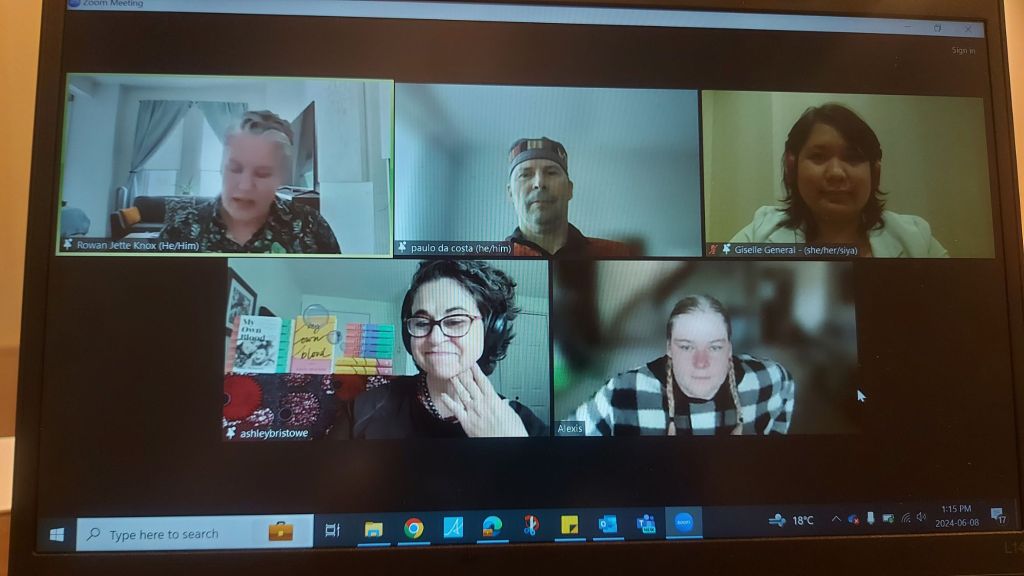
Screen of the Zoom meeting during the panel "Memoir: Writing the Truth is Hard where Alexis, Giselle, Ashley, paulo and Rowan are joining the meeting.

I do admit it feels really nice to hear people say “I look forward to seeing your book published”…”I look forward to reading it.”

I also appreciate that the conference is not as large and overwhelming compared to, let’s say, the transit conference I attended last November. At the larger gatherings, during the meals and the keynotes, there is about 150 people or less, enough to see everyone across the end of the banquet hall. The panels and keynotes I attended were very informative and insightful, and I loved witnessing for the first time how a literary awards ceremony looks like.

I managed to meet a few of my fellow Filipino creative people in the conference and hung out with some of them during the breaks. I ran into my editor, which I also mentioned during my panel.

Chances are that next year the WGA conference will be outside Edmonton, but I’m positive that I can join again either virtually or a short drive away. Maybe it will be in Red Deer! That would actually give me a reason to finally see the city.

The Filipinos I met at the conference were truly motivated to continue building our own community to support each other as well. Just a few weeks after the conference and after other artistic events for Filipinos in Edmonton took place, I got looped into a Facebook group chat for Filipino-Edmontonian artists.

The timing of these weekend multi-day activities worked perfectly in the whole project management of the memoir, as I was then working on the final set of professional edits. I’m hoping that I can find time and energy to nurture my growing community, support them in their ongoing work, and for them to celebrate my own accomplishments when it’s time.

And the journey to making this book a reality continues….

Memoir Writing Reflections 7: The Boss of My Book

By: Giselle General

I can hardly believe it but the time has come. It is manuscript feedback and editing time – first round, that is. Just around the last week of September I finally received the Editorial Letter from the Developmental Editor. I received a 19-page document and I couldn’t help but chuckle. It was more like a report than a letter, maybe even a little book.

My goodness is it a lot! In a good way. The letter organized the feedback in categories, and under each, there were several examples from the manuscript where these problems have come up repeatedly. In addition, in the actual copy of the manuscript she added some recommended edits (through the Tracked Changes feature) as well as comments on actual paragraphs. There were many of these throughout the 150-page, 85,000-word document.

With this, I learned that the timeline I submitted for the editing process might not be as realistic as I would have liked. Perhaps, if all I’m doing is creative work full time with volunteering at nights and weekends, maybe it would be achievable. But it’s different now. I have a separate full time day job that involved writing, coordinating and some creative work. Then all the volunteer commitments involve communicating, coordinating and some creative work. As much as I wish I have unlimited energy, alas I am only human. Working on the manuscript is set aside for the weekends.

When I first read the document and the email, I was anxious on what I was supposed to do with the feedback. There was one question in my mind that worried me the most. And I wanted to share that part of the email exchange here:

Hi Justine,

I have a follow-up question regarding the potential next steps after a writer receives the feedback on a developmental edit. I guess I’m struggling a bit with the Filipino tendency to be “always obedient” and “follow everything that is told by a person of authority and expertise”, combined a tendency to be a people-pleaser. 

If feels kind of silly to ask but I’d appreciate some clarity. I know that in your email and letter it says that your comments are “recommendations”. But as far as me as a writer, what happens next? Is this kind of a like a thesis document where I send you additional versions and that you look at it again until you approve the version and are satisfied with the edits? Or do I basically have free reign as far as which suggestions to apply or reject? If for instance I make significant edits to the manuscript and would like another comprehensive review, that is a separate and independent agreement for another developmental edits, is that correct? 

Hi Giselle,

I just opened up editor access on that line edit of your manuscript. Let me know if you’re still having issues opening it up and I’ll try and turn it into a Word doc.

Now for your question – not silly at all!  You have free reign at this point to apply or reject any/all my recommendations. It’s completely up to you as a writer! I don’t need to “approve” your manuscript for you to move on – that’s for you to decide 🙂 

Email exchange between Giselle and Justine from Living Hyphen, October 2023

Reading the email response was a huge sigh of relief.

When I mentioned this to my husband, he told me with such conviction, “You are boss of your own book.” The words on your book will be written the way that works best for you.”

This way of thinking is so new to me. I’ve always have the mindset that experts or authority figures have greater knowledge and expertise than me, so I must follow all their advice. But as I go through the recommended edits of not just the memoir, but for the other creative projects I’m doing, there had been times when I read the comments and think “that suggestion doesn’t make complete sense, but I can see why they suggested it. I don’t think I’ll do it 100% but will do something else that will resolve the issue that was flagged.”

For the Developmental Editor feedback, I actually had to review my draft manuscript backwards, from the last chapter to the first.

Writing and then editing a book is such a long process. From the various writing groups I joined, some people take weeks, months, or even multiple years to write and edit their draft. The last thing I wanted is for this project to get lost in the fast pace shuffle of life. Since I’m the type of person who needs a target end goal to stay motivated, I’ve set mid-December as my deadline to work on the developmental edits. That’s three months of incrementally working over the weekends, a few chapters at a time.

If all goes well, my Christmas gift to myself is the peace of mind from sending off the updated draft to the next person who will review it, the Line Editor. A line editor works line-by-line, tightening up sentence structure so the language is sharp and clear. I’m excited and nervous about this. I hope that I caught all the comma splice statements that seem to be a bad habit of mine. But if there are a few more, that the Line Editor can make them better.