Memoir Writing Reflections #5: Marinating Time is Over

By: Giselle General

After I finished the first round of drafting, I made the deliberate choice to not do revisions on my memoir manuscript since mid-January. Aside from reading the chapters for the reading event in March and organizing sample chapters for funding applications, I haven’t seen all of the other ones.

I don’t know why I chose a food-related analogy, but I thought letting the documents “marinate” for a few months is a good idea. My mentor author agreed. It seems like many other writers have done the same.

In those months I read two memoirs that have drastically different formats, which is equal parts refreshing and confusing. I suppose there is no truly one-size-fits-all approach.

I did my best to ensure my creative mind is not stagnant. I continue to write for the Alberta Filipino Journal, and some of my recent assignments were actually more challenging as they are more like articles or event summaries. Now that the weather is nicer I’ve also done some artwork again. And I try to write for this blog once a month. Heck, I even made a couple of submissions for a literary magazine. I got rejections both times.

Since I like scheduling and organizing, I’ve blocked a few hours on Sundays to start doing this again and actually booked it in my calendar like an event or appointment. I hope that the time I allocated is well-paced enough for the next two months, until I hear back from the different arts foundations where I submitted funding applications. I’m so very much looking forward to those. I’m excited to have professional editors look at the manuscript so they can chip away at all the awkward and ineffective bits and forge the final piece.

I organized my folders somehow like a factory production, where I have different containers (digital folders) to store various versions until it reaches the final version.

A computer screen showing several folders for a draft book. Each folder is for a different version of the draft.

What happened over the first four Sundays the self-revision time is scheduled in my calendar? I ignored them.

For the first two times, I don’t have any good excuse other than procrastination. Given I volunteer a lot in the city and I’m getting a lot of social media inspiration to deep clean my house, I have lots of alternative activities to do instead of reading through my files.

The third Sunday I have an actual legitimate excuse. My grandmother died and I had to focus on making sure I can communicate with everyone in the Philippines given that their time zone is 14 hours ahead. I have a lot of thoughts and feelings I’m still trying to unpack. On top of that, this particular grandmother, my mother’s mother, is an integral part of my childhood years covered in the memoir.

Now it’s the fourth Sunday of my so-called new Sunday routine to self-revise. I have so many volunteer tasks that I’m falling behind and I’m likely going to prioritize that.

In terms of the actual content I will likely not change anything since it is from the perspective of my childhood self. But my present-day self though, I’m just getting hit with more realizations and recently discovered family history that puts people’s behaviors into context. More nuance, less answers.

I even have other stories I wanted to incorporate somehow. Thankfully through the resources and advice I received I know I have a lot of options. I can write a whole chapter focusing on a experience. But it can also be as powerful as a paragraph, a sentence, or a phrase. It can be outlined as a story as it unfolds and experienced in real time, as an internal monologue, or a recent fleeting memory that can still be from the perspective of the child. This particular story I believe is very important and would enrich the reader’s experience of witnessing this orphaned girl trying to navigate a new reality.

This week I also submitted my report to the arts foundation that gave me the money, the grant, late last year. I’m supposed to report and show how I achieved my goals that I set out in that particular funding application. That was easy for me since the proof is very clear.

Now that grandma is buried and it’s my birthday month I really have to push forward with the self-revisions. That is, if my own existential crisis or health issues don’t get in the way.
Love Language Reflections: On Continuing Your Elders’ Hobbies

Both my grandmother and my mother were pretty skilled with sewing. Perhaps part of it is because sewing is taught in schools, during the class called Home Economics and Livelihood Education. I know of countless people who claimed that the lessons from these classes, which are taught from Grade 4 to High School, didn’t quite stick. But then, it is something lola and mama continued on in their adult lives.

Lola (grandma) learned advanced levels of sewing and dressmaking from a vocational school she went to right after high school. It proved really handy as she ended up having eight children, and she spent a lot of time making clothes for them. I guess you can describe these clothing as ‘bespoke’. She was also an entrepreneur, setting up several shops that sold various household items. So, her kids get to pick the fabric they want from the store inventory, and she would make these one-of-a-kind pieces of clothing. I heard she these days, she continues to do this making simple clothes such as shorts and skirts for great-grandkids.

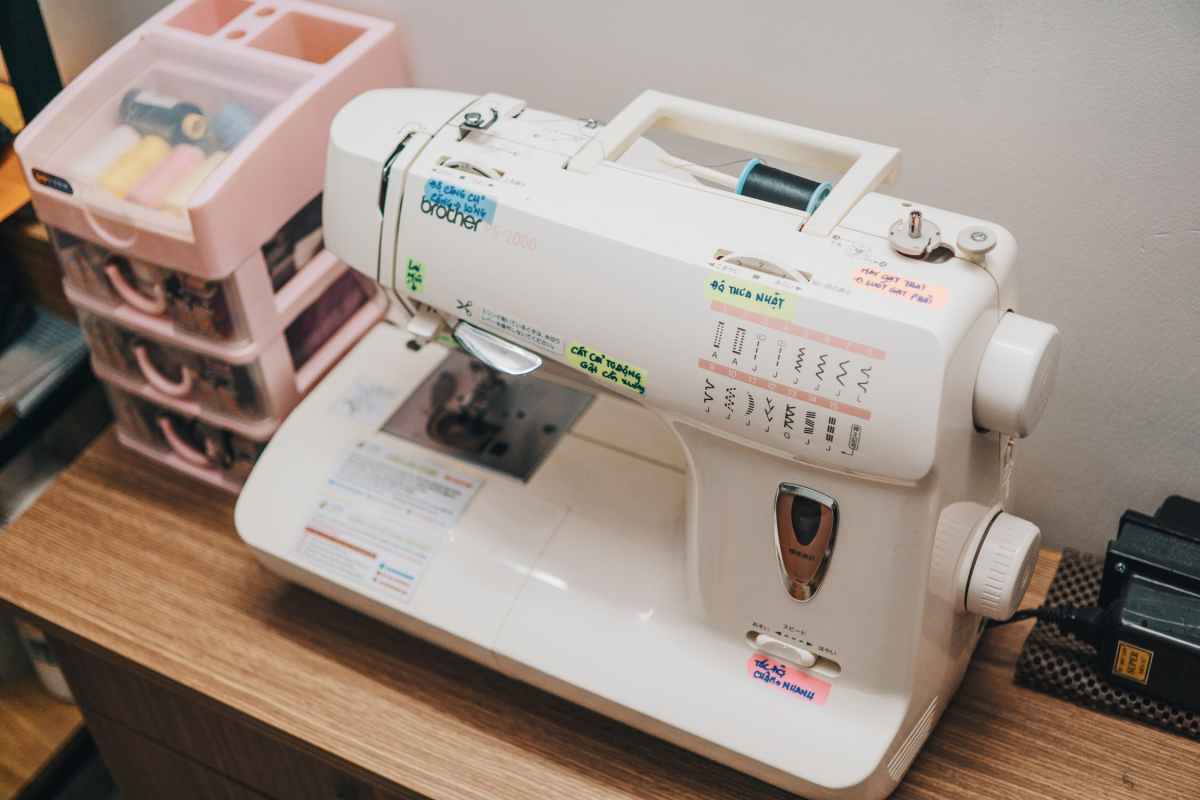
My mother, at least when we were much younger, would also make us clothes. I have a particular memory of her making this beautiful dress for my sister’s dance performance. In our village, schoolchildren perform regularly in school and community events, large group dances that are colorful and festive. After my brother was born, life got a bit more busy, and the sewing machine was stored away and was used more as a decorative coffee table, covered by a nice tablecloth and displayed in the house.

The sewing machine now fulfills many roles in my life. There’s the practical and utilitarian side, since knowing how to sew can help fix clothing and make them last longer. Hand-me-downs and thirfted items, worn by other people who have a different body size become an almost perfect fit for me. There’s the creative side, where a beautiful dress that doesn’t fit my chest anymore can become a beautiful sleeveless blouse, or the collection of old t-shirts can become a quilt for the living room, and the bedroom.

And then, there’s something else that I didn’t quite realize until now. It’s the “positive feeling” of continuing an inter-generational legacy. Perhaps it’s the same feeling that people get when they end up loving the same type of music as their elders, or mastering the same recipe that has been passed down onto the generations.

It’s strange because neither one of them actually taught me how to use the sewing machine. In my mother’s case, I was too young, and then she passed away so soon. During all those years I lived with my grandmother, it was she who was at the sewing machine, not me. And when I would bring home the sewing projects I have made from school, she would even scold me for how I badly did them. But I have been on the receiving end of her sewing handiwork. She would go to the old family home and take several bags of clothes that my aunts use to wear, and then she would tailor them to fit me. I have enough dresses go to to church and to go for Wednesday non-uniform days for an entire year without repeating a single outfit. Grandma would tell me which daughter wore each hand-me-down item that she was tailoring to fit me, and she would also complain about how some of the dresses are just too small for my larger frame.

Now I’m doing similar things. From making rags, to hemming pants, to making a personalized apron for my spouse and lots of quilts and pillow cases. He seems pretty thrilled about the opportunity to have uniquely designed items in the house. These DIY-made linens and clothing, he describes them as “made with love”. He is thrilled that between the two of us, we can prolong the usability of pants and shirts, as it fits right along with his tendency to save money.

This method that provided an intriguing combination of partiality, usefulness, resourcefulness and creativity, these women in my life have passed down to me. I guess that is in my way a way of homage, of acknowledging some kind of legacy.