Love Language Reflections: The Annual New Year Budget Deliberation Day

By: Giselle General

Most people plan elaborate parties, find a fun public event with fireworks and a festive way to count down to midnight, some even post a long heartfelt social media posts with photos taken throughout the year, others may claim that staying at home to have a restful night is the best way to spend the day. There’s a wide array of things people do to bring in the new year.

For my husband and I, we eagerly count down to our distinct personal occasion, that we tell people about it. Do we look forward to this day with the same enthusiasm as our anniversary? It’s possible!

It’s our annual Budget Deliberation Day! It’s when we wait until the last business day of the year for our online purchases to process, add all the information in our budgeting software, assess our expenses for the past 12 months and then set our budget for the upcoming year.

When a colleague asked my husband what activities we have planned for the holiday break, he mentioned about Budget Deliberation Day. His colleague claimed “if my spouse and I do that, we will get divorced!” I can see how that can be the case for many couples and families. It’s difficult to talk about money. Having what could look like a business meeting to talk about an integral part of our personal lives, can feel coldhearted and harsh. I suppose for my husband and I, that is the point of having a dedicated day and process for this, it eliminates stress and anxiousness because it is predictable, safe, calm and with a mindset of informing and supporting each other.

We did not do this right away after we moved in together. What I do know was when he bought his own home for the first time, he also got a budgeting software. Just as boyfriend-girlfriend at that time, whenever I come over to his place, he would eagerly show the charts and graphs of his income and expenses and the sub-categories for each. During this time I was living with my relatives still, who didn’t have a system about budgeting that they taught me. So I was winging it as a young adult in my 20’s, using spreadsheets and even the free version of the Mint budgeting app at the time.

When we moved in together I still used my own system, including the built-in budgeting interface that was part of my bank’s online banking. Year after year, the boyfriend – then turned common-law partner – continued to show me the software, gently encouraging me to finally give it a try. When my bank removed the budgeting section off their online banking, I figured it is time to do it. If we are going to build a life together long term, might as well have an easier way to discuss finances. After all, we are “team communicate!”

So what happens during budget deliberation day? Not a whole lot actually. Since throughout the year, we regularly add our budget information in the software, we already have a good sense of our income and expenses. It’s not like we have no clue what is happening and have sort through 12 months of information. We check the long term information such as net worth, investments, money we can easily access and withdraw. We check our income and expenses to see how much they match up with what we have anticipated at the beginning of the year.

One very important thing to note is this is not a time to shame each other, and ourselves, if we went over budget on certain categories. Since we are not in debt and have some money in our chequing account, we know that going over budget is not going to hurt us in the long run. It could be just a sign that for next year, we just need to increase the budget in that category.

Our categories are not identical either, and that is not the point for us anyways. For me, I wanted to clearly see how much I spend on groceries compared to eating out, so those are separate categories. For the husband, eating out is combined with the rest of his “fun personal” expenses category. For the longest time it was difficult for me to set boundaries about giving financial help to relatives overseas. Setting the budget for that category and assessing it every year helped me set boundaries so I can help wholeheartedly without being resentful, and without compromising my financial goals. Besides, if I get into financial trouble, no one from the motherland can help me.

We plug our computers onto the monitor and show each other the software page, the chats and the numbers. We might have to ask to raise a budget category. The whole thing takes about two hours tops. Today we finished right before lunch, and that’s with both of us sleeping in.

The software is not the fanciest one around but that never mattered to us. The colours are straightforward enough, and the charts in different formats (line, pie, bar, doughnut, custom) are fun to read. We have this in our computers, so not an app on our phone, which I think prevents us from obsessing about budgeting in a toxic way.

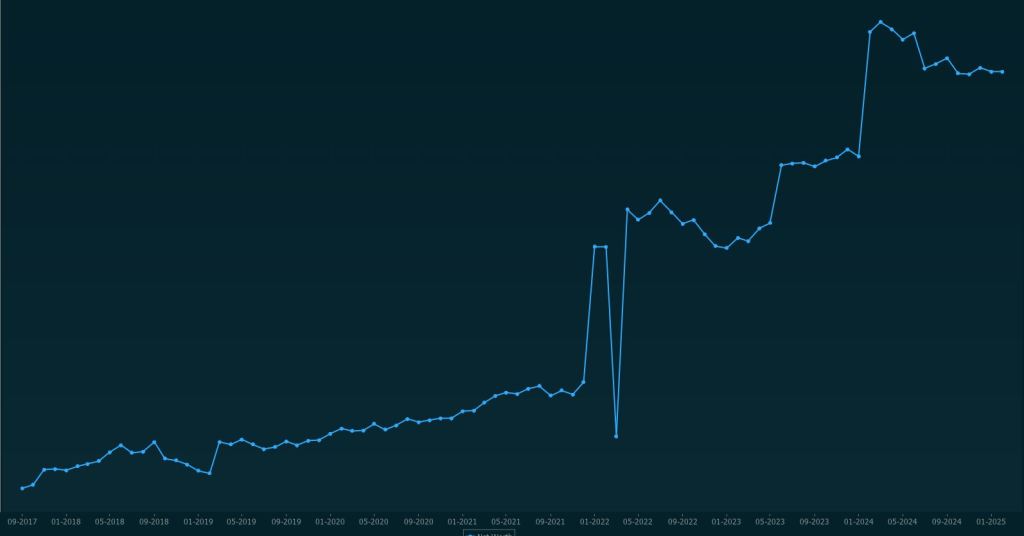
He’s used the budgeting software for 15 years now, and I have for seven. I think the most fascinating realization for me is how the numbers and charts tell a story. In his net worth chart, the largest dip in the line graph was when we traveled overseas for the first time. He had to spend a lot of money and also lost wages for three months. For me, the steepest decline in my line graph was when we downsized from a single family home to a town house and I used my savings to pay for a portion of the house. It’s so worth it though – because we were mortgage free afterwards!
Budget Deliberation Day is also an opportunity for us to talk about potential big expenses for the upcoming year. This helped us plan for a new roof, hot water tank and furnace. This helped us plan for our big adventures, whether it is travel, changing careers while ensuring we can pay our bills while finding a new job, running for politics, or aggressively increasing our retirement savings. I personally think that unexpected financial surprises, especially the type when the other person can claim “you could have talked to me about this sooner because you knew!” is what causes conflict between couples, not the actual numbers being shown in the budget.

It’s truly a solid way to start the year, secure and confident in my ability to be financially aware, appreciate my spouse for his diligence, and look forward to our future together.

My Financial Costs to Volunteering

The time and energy that it takes to volunteer in a meaningful way is something I anticipated and embraced. I mean, that’s the whole point. To receive little or no financial compensation for doing something that is interesting and helpful to the community at large. It gives opportunities to meet different types of people, learn information and perspectives that are not always available within one’s home or work environment, and have a fun time making a project or goal a reality.

However, there are two items that I didn’t quite expect, which turned into actual additional expenses. These are travel and food costs.

Overall, I’d say I have a decent grasp of my finances, where the dollars go, how much, and under which category. As I grow older and have reached a level of stability in my life, I’ve managed to aim a certain quality of life that I’m satisfied with, hit savings targets and enjoyed the process, and find ways to be savvy with expenses. That being said, as my list of volunteer activities grew, there are times that spending a bit more to travel around places or to have a quick bite is inevitable.

As a non-driver, public transit user, who attends meetings and activities outside of “regular” transit hours, the cost of ride hailing services do add up. I’d say 90% of my taxi, Tappcar and Uber trips are related to a volunteer or community service activity. Whenever possible, when heading to the location I try to take transit, and then only take a cab going back. However, traveling from downtown Edmonton where I work, to the very far edge of Edmonton farther west from Anthony Henday, it’s just not feasible. It’s a hefty car ride as well. Such trips would likely be $40 one way. I’ve done this a few times, and given my duties in this particular volunteer board, it’s not going to stop anytime soon.

Since I started using his budgeting software and system a while back, I do have the tools to answer this questions with actual numbers.

For another board I volunteer for, the main office is on the south side across the river, around the Scona area. When the weather is good and I can leave the office from downtown 45 minutes ahead of time, taking a bus and walking for 20 minutes (if the weather is good and the sidewalks are not slippery) is feasible. Otherwise, it’s a $20 cab ride to get to the meeting. And then, since the meeting ends pretty late, no way can I take transit going home. Fellow board members had kindly offered a ride sometimes, for which I’m grateful for. However, when that is not an option, that’s another $20 minimum for another trip. One volunteer meeting, $40 expense, but I get a nice dinner, so there’s upsides and downsides for sure.

For one board I am a member of, our sub-committee meetings usually take place in restaurants. Typically it would be a bar in downtown Edmonton. Sometimes there would be two of these meetings in a month, and that’s where the expense can add up.

I was worried about this when my husband helped me put things in perspective by asking a simple question. “Is it within the budget?” Regardless of what prompted the expense, there is comfort in knowing that the expense is anticipated and that I do have the resources to allocate money for it. Since I started using his budgeting software and system a while back, I do have the tools to answer this questions with actual numbers.

I’ve managed to find a workaround to make sure this doesn’t break the bank too much. As far as eating out is concerned, I have given up on my “solo restaurant dates” that I’d have once a month. So, that’s one less restaurant meal I spend on. Whenever there is a meeting in a bar, depending on how hungry I am, I started ordering appetizers half of the time, instead of choosing an entree right away. A board member started teasing me and say “looks like you have a thing for poutine!” when he noticed that for several meetings in a row, I’d get the same thing: iced tea and a poutine.

Regarding travel costs, it looks like I spent $1,500 on cab rides last year and $1,100 in 2018. That jump is definitely directly correlated to the additional activities I’ve been attending. But I have zero car expenses because I don’t drive. This expense is the additional one I have on top of my bus pass. Thinking about how much people spend on their cars, helped me put this in perspective.

I realize that having to spend a few dollars in addition to sharing one’s time and energy while unpaid is too much for some. But I hope that for some who have a bit of financial flexibility, that it would manageable to give just a little bit more. And seriously, the conversations I have outside the actual meetings, when at the restaurant chatting while waiting for everyone else, or during the carpools after a long board meeting, they are just as meaningful as the actual volunteer activity we just had.

Reasonably Content from being Reasonably Frugal

“You’re a monster! exclaimed a co-worker”, my husband told me, upon revealing to them at the lunch table that he is not buying me any gifts for Christmas. I imagine their jaw would drop even more if we tell them that it has been many years since I received anything from him covered in gift wrap or a card of any kind. Whether it is birthdays, anniversaries, or Christmas, we don’t buy items to celebrate that occasion whatsoever.

I had the same chat with a colleague in the kitchen not too long ago, when we were talking about a downtown Christmas Market right in our office building. I told her I haven’t explored the market yet, because the ‘anti-consumerist in me’ has no motivation to browse around different shops while fully aware that there is likely nothing that will catch my fancy and buy. She seemed pleased though, instead of the strong reaction my husband’s co-worker’s have.

My husband and I would share stories like this at night, during our scheduled bedtime that we try to stick to. We go to bed together at the same time, a great opportunity to share to each other how our day went, have some cozy cuddles, and also to have a regular sleep schedule. In addition to random stories of how the day went, we talk a bit about errands we need to do, what volunteer activity will I be working on, and the financial state of our home. He’d tell me which of our roommates had already paid rent, or how far long we are in paying off our mortgage.

Sometimes, he would mention about things that we need such as an apron for when he cooks spaghetti every Sunday, or a couple pairs of jeans or work shirts. He’d tell me about a hole in his shirt or a pair of pants that are too long, and I’d say ‘no problem, I’ll take care of it’. By taking care of it, it would either mean bringing out my sewing kit to repair the clothes or make the clothing item, or going to the thrift store to buy a few items. When a clothing item is too frayed to be worn anymore, they are the first candidates to be turned into a rag, oven mitt, and quilt.

“I broke my budget!” he told me just a few weeks ago, when he decided to buy a VR (Virtual Reality) gaming system, which is fairly expensive. He does have the money for it, but it’s just something he didn’t budget for this year. So according to the budgeting software he uses, for the ‘personal expenses’ category, he is over budget. Over budget from what I would say is a fairly low personal spending allocation. Instead of getting upset, I was quite amused. He now alternates between playing video games with a controller and the VR set, and he is pretty content.

Frugal is defined as economical and not wasteful about money and I think, with great relief, that we are able to incorporate that in our lives. Other positive words that come to mind are “budget-conscious” or “mindful about money”.

I wonder if our drastically different upbringings made it necessary to have upfront discussions about important topics that are taken for granted. There’s no expectations or assumptions that are to be made, the only way to know is discussing it. The fact that he is not Filipino gave me the confidence to frankly talk about women’s health issues and procedures that I experience. I was hopeful, and I was right, that he won’t be too grossed out. In the same token, he we talk about expenses, retirement plans, insurance and inheritances.

It’s fortunate that for many things that are important, we see eye to eye, both in principle and in process. We both like to stick to habits and automating things, which is evident in how we save money, pay bills, and track our spending. We found our happy medium between flexible, easygoing, forgiving and disciplined. This makes us feel okay with eating out with friends, and also meal prepping every week. This makes us consider thrift stores or DIY items as opposed to buying the latest model gadgets and equipment. This resulted to him using a nine-year-old flip phone with a $15 a month with a Pay As You Go set up, while I have a smartphone with 2 GB of data. This helped us feel okay with certain luxuries that were considered deliberately. He bought a TV and the VR gaming system, and the TV is the first one he actually purchased after moving out 9 years ago since his TVs then were both hand-me-downs. I had a professional photoshoot at a studio just for myself which was pretty expensive, but it is something that was carefully considered for a few years. It was both a fancy gift and a therapeutic exercise for myself.

The reasonableness in our approach takes the pressure off, which I think is what makes many people struggle with managing money. In our culture where immediate feedback, gratification, or results are sought after, the subtle peace of mind that comes with a long-term plan is not as appealing. Even the quietness of not having a major current problem can be unsettling for some. Thinking in bigger numbers in terms of dollars and time horizons is a significant thing I learned from my spouse. Now, I look at them with excitement, instead of dread. Given my age, having ‘only about twenty years’ left in our mortgage can be viewed as an optimistic thing.

Realizing that our savings rate does not compromise our way of life is reassuring. His biggest hobby is gaming (both video games and board games). He definitely maximizes the money he does buying these, and through friends and gaming leagues, has access to gaming opportunities where he doesn’t need to buy much. With my hobbies of arts and crafts and volunteering, there were multiple ways I discovered to save money also. Using second-hand and upcycled materials for the items I make, and then as far as volunteering is concerned, I usually get ‘paid’ by having food at the meetings.

This is something I hope that other couples and other households are able to achieve at some point.